
When I was going through my quarter-life crisis, the simple act of devoting myself to mastering a hard craft brought much-needed depth, direction, and fulfillment to my life.
For that reason, I’ve been wanting to write this piece for years.
An in-depth ultimate guide on self-directed skill acquisition.
Everything I wish somebody told me when I was pulling my hair out trying to teach myself the craft of writing.
It’s a biggie, over 20,000 words.
Below, I’ll teach you the learning methods used by masters across a variety of disciplines—art, business, writing, sports. (It’s way more than just deliberate practice!)
I’ll also share the ideas that were most helpful in my own self-directed apprenticeship, when I went from untrained, mediocre writer to full-time writer (in a year).
My aim is to help you go on your own transformational mastery quest.
To:
Pick one skill, artform, or discipline you’ll obsess over
Develop the mindset and meta-skills that lead to improvement
Make steady progress towards mastery (and not waste as much time as I did)
As you’ll see, mastery isn’t a product of credentials or genetics.
Instead, it’s a matter of dedication, volume, imitation, practice, and, most of all, love.
Introduction
Key idea: mastery as a quest
What is mastery anyway?
What does mastery feel like?
Why go on a mastery quest?
Phase 1: Pick One Craft
The 3 criteria of a good mastery quest
Challenging
Aligned with authentic interests
Not (too) deranging
A note on specificity
3 methods for finding your craft
Method 1: Childhood
Method 2: Life Missions
Method 3: Personality Test
How many mastery quests can I have at once?
What if I have multiple interests and can’t prioritize?
Phase 2: Prepare for Your Quest (Mindset, Meta-Skills, and Setting)
Accept this painful truth
Decide to turn pro
Look at your life through hell’s eyes
Embrace mediocrity (and how to get past it)
Disappear for a while (you’ll come out of it)
How to build discipline
Train your deep work capacity
Engage in meta-learning
Phase 3: The Self-Directed Apprenticeship (Hone Your Craft)
Think in terms of projects (the real secret)
Engage in deliberate practice
A caveat on deliberate practice
How to choose which sub-skills to drill
Imitate your idols
Soak in excellence
Dig for the portable principles
The swipe file
Using AI as your skills analyst
Volume is a cheat code
Join a scene
Find a mentor (even an online one)
Be the person who knows everything
Develop social intelligence
Neglect
Focus on this above all else
Getting Started
How to get started on your self-directed apprenticeship (Protocol and Checklist)
Checklists for phases 1 and 2
How to start your first project (and schedule your day)
5 examples of first projects & daily learning schedules
Aspiring Novelist
Home Cook
Guitarist
App Builder
Public Speaker
Closing
The quest is the point
Five years ago, when I quit my sales job to become a writer, I had no formal training in the craft of writing.
I had never taken a creative writing class, and I didn’t know any practicing writers. All I knew was that, one day, I wanted to be great—to be like the writers I admired.
I don’t feel embarrassed saying this. No one makes fun of you for wanting to be a great parent. So why should it be odd to express one’s desire to be a great writer, actor, woodworker, producer, or financial analyst?
Anyways, at the start of my quest to master writing—and make a living from it—my amateurishness revealed itself in many frustrating and embarrassing ways.
My first freelance client told me my writing was “rough around the edges.” My pitches were almost always ignored, and my portfolio of samples rejected.
In the act of writing, I often struggled to call the right word to mind. I couldn’t seem to maintain deep focus for more than an hour. And I wrote awkward sentences that confused readers, as well as myself…
I was, in short, mediocre.
At the time, I suspected that my peers thought me bonkers for quitting a stable job to start a freelance business based on a craft I hadn’t honed.
But more than likely, that was just me, projecting my self-doubt onto them.
After all, back then, I did not know how to learn a new skill—not in a systematic way at least. Like most people, I thought it was a matter of talent and credentials: born a master or trained to be one.
I didn’t know that learning—and eventually mastering—a complicated craft is more about curiosity, volume, observing others, and practice than it is about having access to the right genetic code or elite training programs.
That was five years ago.
Since then, after writing over 1,000 blog posts/newsletters/essays, spending thousands of hours immersed in great writing, studying the inner mechanics of exemplary works, exposing myself to different genres, reading craft books, and getting occasional feedback from readers and editors, I am much better than I was.
I’m no Charles Dickens or Joan Didion, but I’m comfortable saying I have entered the early stage of mastery in at least one sub-genre of the larger craft of writing: that is, blogging/newsletter writing.
I make a living from it, command top rates from tech publications, have a newsletter of nearly 15,000 subscribers, and recently released an ebook I am proud of.
And although I still trudge my way through many parts of the essays I write, now and then I experience the sublimity of decisions flying at me with ease.
During that period, especially in the first year of self-directed apprenticeship, I also learned a tremendous amount about what it takes to teach yourself new skills.
And I have come to believe this:
With the right mindset and learning techniques, a total beginner can teach themselves the fundamentals of a new craft in a year. And over the longer-term (3-5 years), they can enter into the earlier stages of mastery, provided they devote themselves to the craft, put in the hours, practice intelligently, and don’t give up.
While the general timeframe of mastery depends on the complexity of the craft and how you define mastery, we are all capable of developing the foundations of mastery—intuitive pattern-recognition, creative originality, a knowledge of the key principles, and executional abilities—in 3-5 years.
After all, most people overestimate what they can achieve in one year, but underestimate what they can achieve in three.
Whether it’s cooking, writing, app building, teaching, carpentry, or hog wrestling, to teach yourself a craft, you just need to know the learning methods that reliably lead to mastery, and to apply them regularly.
And that’s what I’m teaching today in this ultimate guide (the longest one I’ve ever written on Substack).
Had I known about these techniques earlier, it would’ve saved me hundreds of hours wasted on the wrong learning activities, shortened my learning curve, and prevented a heck of a lot of frustration.
Before I can discuss what mastery is, and how to reach it, I want to establish a certain way to view it, so as to help you stay the course.
The pursuit of mastery is rare in our microwavable society.
It takes years to start to develop an intuitive feel for your chosen artform, skill, or discipline. And this long time horizon chafes against our obsession with quick results, like a stiff collar against a soft neck.
Being so rare, it is also highly valuable. If you have the patience and focus to go deep into a single craft, you’ll be one of a select few. And people will probably throw opportunities your way.
But the requisite patience and focus are hard to maintain in a world that’s pulling you in a million directions.
To help myself stay the course when I fail a project or hit a skill plateau, I like to think of mastery as a quest—a long-term adventure that dispenses its gifts gradually, providing endless meaning, growth, and thrill along the way.
These days, I’m still on the same quest I began five years ago, when I said to myself, “One day I will be a great writer.”
I am no absolute master of essay writing, blogging, or newsletter writing—nor will I ever be, for mastery is a continuum, and the higher realms of virtuosity are reserved for the immortal.
Today, I want to help you get closer and closer—until you feel that intoxicating sense of prowess over your craft.
First, of course, we must define our destination.
There’s a basketball game that pops into mind whenever someone mentions mastery.
It’s 2006. 1st round of the NBA playoffs. Eight seconds left.
The Los Angeles Lakers, the underdogs, are down two points to the 2-seed Phoenix Suns.
The Suns inbound the ball at half court. Smush Parker pokes it loose from Steve Nash. The ball bobbles in the air. He somehow snags it, quickly passing it to Devon George, who finds Kobe Bryant streaking down the sideline towards the basket.
Kobe gets the pass at the 3-point line and, with three seconds to go, blows by the defender with a clean hesitation step. He finishes with a high arcing layup, the ball slipping just over the shot-blocker’s fingertips. Tie game, going into overtime.
10-year-old me lets out a yell of intoxicated joy. Kobe did it again! I dare not move from my position on the couch. If I do, the magic might wear off.
It’s late in overtime now. Lakers are down one point. Six seconds on the clock.
There’s a jump ball at half court. The basketball is once again in Kobe’s hands. He pokes his head up and, for a split second, surveys the court. That’s all the time he needs.
Analysis made, he strolls with a calm yet urgent confidence to the right-hand corner of the free throw box, rises over two defenders, and, hands practically scratching at his eyeballs, releases the ball. The buzzer sounds. Swish. Game over. The Lakers win.
Two critical buzzer-beaters in one game! (You can watch the sequence here if you’re a basketball fan)
I hop off the couch, finally safe to leave the position I had been sitting in ever since the first game-tying shot.
I run out my front door screaming “Kobe”, jump over a bush, then another bush, and run laps around my house until I tire out and fall on the grass in giggles of delight.
I believe I just witnessed a miracle.
Now that I’m older, I know it was no miracle at all.
It was pure, awe-inspiring mastery on display.
I like to think of mastery as two parts:
Wisdom (or knowledge): Consciously or intuitively knowing what to do—and the pros and cons of each choice—for a vast number of scenarios, even unfamiliar ones.
Ability (or skillset): Being able to act on this knowledge; to pull off the beautiful turn of phrase, hit the turnaround fadeaway, land the plane in the storm.
Kobe demonstrates this mastery beautifully.
Among thousands of options, he knew (or felt) exactly where to go on the court, what moves to make, and what types of shots to take, and he had the skill set to execute them—skills he had learned from the masters before him and practiced day in and day out for years until they were habitual.
He knew what to do and how to do it. This is what a master does.
The master can improvise, recalling principles of success or summoning their intuition to make good decisions, and then using their abilities to execute on that decision with precision and flair.
Part of me wonders if it was this Lakers game that made me want to be great at something one day.
Who knows.
Regardless, it is these two cornerstones of mastery—wisdom and ability—that we’ll be learning how to develop in this guide.
So how exactly does mastery manifest?
How will you know when you’re approaching it? When you’ve arrived? What are the signs?
In his book Mastery, Robert Greene gives us two answers.
First, after years of study and imitation, the master becomes a creative force.
They can not only pull off all the key moves and execute on the core principles; they make something new, something people have never seen before, that bears their stamp of ingenuity.
After years of immersion in their craft—of listening to 1,000 folk songs or studying 1,000 recipes—they can draw from that well of exemplary works and remix certain qualities into their own invention.
Second, thanks to experiencing thousands of scenarios and thinking about what to do in each one (and why), they’ve trained their intuition—their instinctual pattern recognition—allowing them to have revelations that feel almost mystical.
Instead of always reasoning themselves into the best choice—whether to add a dash of cumin or a dash of nutmeg—they often feel their way towards it, like a baby turtle walking to the sea.
You’ve probably experienced this sensation before. When a car pulls into your lane, you know exactly what to do in a split second, and you do it without even thinking.
Intuitive insight is a beautiful thing to experience. When you’re so good that you can just get lost in flow and let the right moves, ideas, or steps come to you, it’s magical. It’s dancing while intoxicated. It’s sheer bliss.
And the more masterful you get, the more you can access such states of sublimity.
That alone may very well be a good enough reason to go on a mastery quest, but, to get you properly stoked for your quest, here are some others.
In my article, “I could not change my life because I was still me,” I explain how it wasn’t untilI I dedicated myself to mastering the craft of writing that I finally got my act together and became a person capable of actualizing the life I wanted.
This is because a mastery quest, like an adventure in a great movie, is a change-making machine, in which we are the protagonist who changes.
We set the goal of mastery, constantly encounter obstacles, and are forced to extend our knowledge, skillsets, and character if we are to overcome them. We change for the better, and our life follows the trend.
Here is how having a mastery quest can positively impact your life:
Live a deeper life: There’s no better way to regain your attention and kick your addiction to shallow activities (like scrolling endlessly on YouTube Shorts) than to apply your mind to learning hard skills. The act is interesting and rewarding, and leaves your mind feeling peaceful and satisfied afterward, rather than drained and pinched.
Gain transferable skills: To improve at blogging, I had to learn how to run an online business. I had to become disciplined to do my daily writing sessions. I had to become a better learner to research more effectively. These are skills I can use in other areas of my life, including missions to master other crafts.
More purpose: It becomes easier to wake up in the morning when there’s an empty canvas to fill with paint, a cooking technique to try out, or a woodworking project to finish. Each day is an opportunity to work towards mastery in a craft that excites you and enables you to uplift others or contribute to the world in some small yet significant way, whether that’s playing a loved one a beautiful song, helping your business team reach a tough KPI, or writing an essay that helps just one person feel less alone.
Increase agency: The more skilled you are, the more leverage you have. A great developer can bargain for a work-from-home agreement, freeing up time and space to work on passion projects. An exceptional interior designer can charge rates that earn them enough money to buy that house on the lake. Even if your craft isn’t related to income or your career, the confidence and skills you gain from it will give you more power to get what you want, persuade others, and shape your life.
Experience the sacred: When you engage in craftsmanship, you lose yourself in the process. You undergo ego dissolution—that feeling of oneness with the world that so many mystical practices, across almost every religion, aim to engender in their followers. If self-consciousness is the source of anxiety, this then is a temporary relief.
So you see the value in pursuing mastery. Great.
Now, let’s start the mastery quest, so you can become exceptional at something you love to do.
The first step of any quest is to pick the quest you wish to go on.
Before you build a reading plan or set up a deliberate practice routine, you need to identify the craft you want to focus on mastering.
Below, I’ll cover the criteria of a life-enhancing mastery quest, as well as some methods you can use to identify your calling out of your many interests.
I’ll also share what to do if you cannot decide (totally normal!).
For a mastery quest to provide you with meaning, personal growth, and excitement, while being something you stick to and make progress on, it must meet three criteria:
Challenging
Aligned with your true interests
Not (too) deranging
Let’s break each one down.
One of my favorite hobbies is mountain backpacking.
It is the quintessential quest-based hobby. You pick a starting point and a destination.
Then, over the course of several days or weeks, you walk there, through forests, along ridgelines, over mountains, until one day you arrive, drive home, and sleep for 24 hours.
A lot of the fun of backpacking is the challenge. The harder the expedition, the more satisfying it is getting to camp each night, and the better the campfire-roasted hot dogs taste.
Recently, I went on a 4-day trip with my friend Ted. For the first time ever, we decided not to finish our route. Pathetically, on day 2, we crossed a road, accepted defeat, and called an Uber home.
We’ve spent a lot of time wondering why we bailed so early. At first, I thought it was the cold winter nights. But soon I realized that wasn’t the problem. The issue was that the trip was too easy.
When we planned it, we had said, “This time, let’s do a chill trip, no suffer fests.” Little did we know, taking it easy would be our undoing.
We were both used to trips deep in the wilderness covering 50+ miles with lots of elevation gain. This time, we hiked in a forest only 45 minutes north of NYC—we could see the city’s skyline from our first lean-to. Without the sense of adventure, the cold nights didn’t feel worth suffering through.
So make your mastery quest a real challenge.
Strive for excellence in your craft, not just basic proficiency. This will, paradoxically, make it easier to stick to.
When you’re sore and frustrated from time to time, the spikes in competence will feel more meaningful.
By putting you out of your comfort zone, a hard mastery quest also forces you to confront new obstacles, which will require you to broaden your skillset, knowledge, and character.
If it’s too easy, you won’t grow. And you won’t feel satisfied with yourself for what you’ve accomplished. You need the potential for failure, exactly what makes a good videogame so addicting.
The first mistake I made in my career was choosing money and pragmatism over interest and personality alignment.
A creative introvert, I had little interest in selling software to property managers, but I figured that sales was a responsible skill to master, and could lead to that thing called financial success that people were always telling me was the key to a good life.
What happened as a result?
After I finally beat my quota, and the initial excitement of having a big-boy job wore off, I burnt out.
It became nearly impossible to muster the energy to make cold calls. I would sometimes go into a conference room, shut the door, and purposefully dial phone numbers that belonged to leads I knew would never pick up.
When I was promoted to Account Executive and in charge of actually leading web demos, sometimes I would dodge calls from curious leads. I’d let my phone ring until it hit voicemail! I was that upset about the idea of having to chat with them about our products.
When I started looking for a new skill to master to get out of the 9-5 job, I made the same mistake again, choosing pragmatism over obsession,
The first skill I picked wasn’t writing, despite my innate attraction to it.
Instead, I bought a bunch of coding books and enrolled in CodeAcademy, thinking programming was my way out. But within a month, I was watching TV instead of doing the online exercises. Again, I had burnt out.
When I finally committed to writing, it was easy to work. It was a compulsion, and it has become more of a compulsion the better I get at it.
That is what to look for—the thing you can’t help but do. Lean into your compulsions.
In Chasing Down a Dream, venture capitalist Bill Gurley shares six rules for flourishing in any field.
What’s rule number one?
Follow your curiosity. Let yourself obsess over that intellectual itch you can never quite scratch.
If my career failures have taught me anything, it is that Bill is right.
If you don’t have genuine love for the thing you’re trying to master, and instead you’re just doing the responsible thing or following the path of least resistance, then the obstacles, such as facing rejection or sacrificing a night out to practice on a Saturday night, will likely be too much, and you’ll give up.
You won’t want to put up with the crap that is involved in any mastery quest, and the good parts you’re suffering for won’t even fill your cup.
So really think about your curiosity:
What subjects do you research non-stop?
Who do you admire most in the world, and why is that?
What books and movies do you love most?
What were you naturally drawn to as a child, without coercion from adults or peers?
What hobbies and work projects do you find yourself getting lost in?
These are all signals of who you are meant to become—of what mastery quest will energize you, rather than turn you into a gray blob of bubbling apathy.
Some mastery quests are more likely to screw you up than others.
A quest to become a famous celebrity, for example, has a higher chance of forcing you to live like a fraud and become depressed as a result, since you are constantly trying to make everybody like you, even if that means going against your authentic beliefs.
Basically all quests of mastery bear some risk of derangement.
The aspiring business mogul risks falling prey to greed.
The aspiring artist risks becoming self-obsessed.
The aspiring social scientist might become pedantic
My quest to master writing has no doubt made me more prone to flare-ups of self-doubt and financial stress (wooooo!!!!), and is known to boast the occupational hazard of alcoholism (woooo!!!!)
But some quests are more likely to derange you than others—so pick the ones that have less of a chance of screwing you up—or, at least, pick ones with potential side effects you can live with or are well-equipped to avoid.
While it’s certainly easier to learn a narrowly defined skill than a broad one (like making balloon giraffes vs the general art of clowning), you do not have to know your true calling at the start of your quest.
Almost no one does.
Even after I perceived that mastery was a key to a fulfilling life, it took me years to land on writing as my quest, and even longer to land on the types of writing I’m doing today.
Even Robert Greene, the author of the book Mastery, tells us that, when he began his quest, he just knew that writing was his calling.
He did not know what type of writing he wanted to do, and he experimented with many different forms before landing on his unique style of historical/personal development non-fiction writing.
When Jack London wanted to get out of his backbreaking life of industrial labor, all he knew was he wanted to work with his mind, not his body. He was between various art forms.
To choose, he did not go into the desert and trip shrooms until the answer revealed itself to him in the form of a pattern in the clouds.
Instead, according to his memoir, he tried them all out:
“I had four preferences: first, music; second, poetry; third, the writing of philosophic, economic, and political essays; and, fourth, and last, and least, fiction writing. I resolutely cut out music as impossible, settled down in my bedroom, and tackled my second, third and fourth choices simultaneously…
Soon, he landed on writing.
And did the same thing again, trying out different types of writing until the short story called out to him:
“I wrote, I wrote everything—ponderous essays, scientific and sociological, short stories, humorous verse, verse of all sorts from triolets and sonnets to blank verse tragedy and elephantine epics in Spenserian stanzas.”
A general aim is a wonderful place to start, and it’s more than most people have.
Feel free to start broad.
Pick something like writing, painting, finance, or teaching and try it out. If you like the overall craft, try different sub-genres of it until one really calls out to you, then focus on that for a few years.
Explore and exploit, ditching crafts that don’t fit your interests and doubling down on sub-genres of your craft that align with your temperament and bring you the most joy.
For example, let’s say Bob is interested in mastering running.
For a year, he might just run a few miles now and then.
A year later, maybe he gets into sprinting and tries to excel at it, only to realize he hates short training sessions and the feeling that his heart is going to burst. So he tries out long-distance running and gets obsessed. That’s his thing. His jam. Whatever you want to call it. He found it.
By the way, this time spent in a sampling period is not only helpful for finding your true calling.
Breadth of knowledge and experience can also make you better at your core craft once you do find it.
In the book Range, David Epstein shows, in case study after case study, that a sampling period is a good predictor of high performance.
One reason for this is that it provides you with cross-training opportunities.
In a sampling period, you pick up all these different skills and perspectives from other fields, which you can then bring into your chosen craft, like a literary novelist who used to write horror stories and now has become known for creating a level of suspense in their poetic family dramas.
Breadth also makes you stand out. It makes you original, and I think even after the sampling period we should continue developing range in other tangential and even unrelated subjects and skills, but that’s another story. (one I covered in my ebook).
In conclusion, don’t get too concerned about needing to know your specific calling at the start of your quest!
Just have an exciting general direction that will guide you forward.
Over the years, as you master different subgenres of your craft, you’ll probably end up reinventing yourself anyway.
Like the former rock star releasing a new country album, you can continue expanding into new and exciting domains underneath the umbrella of your craft until you are a creative virtuoso—that guitarist, producer, singer, songwriter, performer who can blend several genres into original works of imaginative genius.
It was a Robert Greene interview that helped me figure out which craft to pursue.
The author of Mastery—a man we will hear from often in this guide—shares how to find a craft worth mastering, what he calls a life’s task.
Greene says the first place to look is your childhood, a time when you pursued your interests naturally, well before the world started telling you what to find interesting—money, status, security, etc.
Greene says there is “a grain in your brain that’s going a certain direction.” You should go with that grain, because “that’s where your power will lie.”
After hearing this, I travelled back to my childhood.
There, I saw my younger self writing short stories, comic books, and satires of my teachers (sorry!). Even when I wasn’t putting pen to paper, I was still making up stories: like the storylines driving the battles between the medieval Playmobil armies in my basement. And when I wasn’t creating stories, I was consuming them, reading novels and watching movies whenever I could.
So, despite having no training, writing presented itself as an obvious craft to narrow in on.
Here’s how to mine your childhood for your authentic interests.
Ask yourself these questions:
What did you do in your free time when you were alone as a kid?
What were you naturally drawn to as a child?
What did you do without coercion from parents, teachers, or peers?
This reflection will help you identify a mastery quest that aligns with your authentic interests and innate talents.
Finding such a well-aligned craft will be a huge competitive advantage since, unlike most people, you’re not fighting against the grain to get yourself to do the practice necessary to become exceptional.
The craft is just what you want to do, so you do it.
What drove James Madison to master political science?
What compelled this naturally poor public speaker to invest so much time into improving his oratory, going as far as to research and write private unpublished essays and devote years of his life to deeply studying ancient Roman and Greek confederacies?
Sure, he was curious. But he was also on a mission.
There was a problem he wished to solve. America’s federal government was failing, and Madison thought himself just the man to fix it.
For years, he embarked on a self-directed study program, researching contemporary and ancient governments in order to diagnose what was wrong with the American government and figure out how to design a better one. The result of his efforts was the framework for the US Constitution we know today.
So what are your missions?
What problems in the world do you wish to solve? What impact do you want to make in the world, your community, or your family?
Is there some aspect of the world you wish to change, promote, or protect?
Maybe you love literature and want to spread that love to others. If so, then becoming a great literature teacher, writer, or critic is a mastery quest that aligns with one of your core missions.
Perhaps you want to save the ants. Or fight starvation. Or improve the education system in your town. Or inspire others.
Think about your missions, and ask yourself what craft, if mastered, would enable you to make an impact.
When you’re learning not only for the sake of mastery, but also to help others, it becomes an even more meaningful quest.
Resource: By the way, if you’re motivated by impact, check out the blog 80,000 hours, which helps people find work and careers that will make a big difference.
It wasn’t until I took a Myers-Briggs personality test that I finally accepted that sales would never be right for me.
The results taught me a lot about my personality and what I’m naturally drawn to (and averse to).
Apparently, I’m an INFP, known as the imaginative, intuitive, idealistic, sensitive introverts of the world—good at making up stories and daydreaming, but not so well-suited for management, administration, or sales (although, the empathy might help).
An INFP might end up being good at these things, but it could be a real slog to get there—going against that “grain” Greene speaks of.
I did well in sales. I learned the skill of cold calling pretty quickly. But it left me feeling drained, empty, and fragile after a day’s work, and I never found booking a sales meeting very fulfilling.
So consider taking a personality test, if only to validate some of the feelings you have about who you are and what you are meant to do.
The best tests are MBTI and Big Five, the latter of which is actually more commonly accepted and used in psychology today.
Sometimes a third-party assessment can be the kick in the but you need to go after the craft you feel you know deep down you should pursue. It’ll also tell you what careers people in your group often excel in.
Additional resource: Here’s my favorite one. It’s a Myers-Briggs test from 16Personalities.
That’s an important question.
We often overwhelm ourselves with too many missions, so it’s worth stopping to think about how many crafts to take on learning at once.
I have two answers.
The first answer is that, if you are interested in learning this craft as fast as possible, maybe to escape a job you despise or impress a romantic interest who only dates masters, then just focus on one mastery quest at first, at least until you reach a level of competence you are satisfied with.
Later, you can add another quest once you know you can handle the workload—and have learned how to learn.
When I was 24 and wanted out of my sales job ASAP, I put all my focus into becoming a great writer. It paid off.
Focus is fuel for growth. It’s gasoline to the fire. The more you focus on one craft, the faster you’ll get better at it.
My second answer is for those going on a mastery quest to enrich their lives, and aren’t so worried about optimizing for speed of improvement.
This answer is based on advice from Slow Productivity, a book written by the multitalented Cal Newport—non-fiction author, computer science professor, and podcaster.
He advises his readers, many of them strivers with numerous interests, to take on no more than three active projects at a time.
I think this is a good rule of thumb for not only big projects, like writing a novel or building a YouTube following, but also mastery quests.
It prevents burnout and frustratingly slow progress. And I think it’s fair to assume Cal also uses this project rule for his quests, since he’s simultaneously trying to become a better author, professor, and podcaster.
If you can crack it, go for it.
I certainly can’t, at least not right now.
Mastering writing, even the specific types of writing I enjoy most, is a big enough quest to last me a lifetime. Maybe one day I’ll add teaching into the mix, but we’ll see.
Therefore, I focus on improving my writing (every day), and I pursue other interests in a more laid-back, seasonal fashion.
I want to get better at cooking this quarter, for instance, so I’m cooking a new meal every week and reading Salt, Fat, Acid, Heat.
But I don’t obsess over it. And next quarter I’ll replace it with another hobby, maybe guitar, but writing will likely remain the mastery quest.
But that’s just me. I’m obsessed with writing. I care about it 10x more than any other craft.
Maybe you’re like Christopher Wink, journalist entrepreneur, who can manage multiple quests at once (albeit, one is a quest many of us manage: familial obligations).
In an article, he shares his three:
“My three missions at the moment: To be a committed parent and husband; To run a profitable and impactful news orgs; To be an active journalist who encourages people to appreciate a complex world. That means I should limit everything outside of those.”
Of course, if you are where I was at 24—aimless, a bit overwhelmed, and a little undisciplined—I recommend starting with just one big quest. The same goes for those of you who have never tried to master a craft before.
Once you make some progress in that arena, learn how to learn, and find you can manage the workload, you can start to add other mastery quests.
So the short answer really is: anywhere from 1-3 mastery quests.
But remember: If you try to pursue everything, you’ll never progress in the areas of life that matter most to you. Greatness requires constraints.
Additional resource: By the way, I wrote an entire article on this: How to Manage Multiple Interests (it’s my most popular post on Substack). So go there for an in-depth look at this problem.
Welcome to the club, my friend!
Here’s the gist when it comes to narrowing down your interests for a mastery pursuit, if none of the above methods did that already.
Pick one craft to test out
Commit to a small project for 2-4 weeks (like writing 3 blog posts or building a calculator with Python)
After the test period, reflect: Did it bring you flow? Did you find yourself obsessively returning to it?
Based on that analysis, either continue with this craft or try another one.
Repeat until you find the one that brings you the most joy and feels like a compulsion.
Keep in mind that most crafts will not be endlessly fun at first.
You might feel frustrated, since you aren’t very good yet. But after a while, you’ll become better at them, and then you will enjoy them more. And soon you’ll become obsessed.
Obsession usually follows skill level, not the other way around.
Once you commit to a craft, you can put your other interests on the back burner, still nurturing them but with less frequency and intensity than your mastery craft.
After all, a full life is a varied life.
Resource: If you want my system for designing a self-education plan that balances your multiple interests and helps you attain the life you want, then you might like my ebook, The Lifelong Learning Compass.
In the early months of learning your craft, or for a brief preparational period beforehand, there are some things you should do to set yourself up for success and protect yourself against fear, self-doubt, and indiscipline, the three demons responsible for stalking and swallowing up too many well-intentioned autodidacts.
While I never quite defeated these three demons—I woke up at 11 AM today when I meant to get up at 9—the following 8 best practices have certainly helped me get a handle on them.
Here, I’ll share my thoughts on committing, mindset, monk mode, going pro, dealing with failure, meta-learning, and a few soft skills to learn before starting the quest.
Knowing all this at the start certainly would’ve helped me learn more quickly and enjoy the process more deeply.
You can master pretty much any craft you want, but you cannot master every craft.
If only I’d hung this rule on my wall when I was first starting in my self-education journey. It would’ve save me a lot of time and misery about my slow progress.
At 23, there were so many skills I wanted to learn, so many people I wanted to become. And that left me spread too thin across numerous interests.
While my friends were hunkering down in law school or business school or some subject of study and becoming real experts who could impact the world with their deep expertise, I was becoming a strung out dilettante.
Let me first say that broad learning, especially at the beginning of a self-education, is advantageous. As we discussed earlier, David Epstein’s book Range shows how a sampling period helps you find your authentic interests and pick up transferable skills.
However, there comes a point in your self-education when it’s worth asking—what do I want to be great at?—and then devoting yourself to the answer for several years, if not a lifetime.
As Robert Greene wrote, “Mastery is not a function of genius or talent. It is a function of time and intense focus applied to a particular field of knowledge.”
You can still learn other crafts, but you really do have to get choosy, and preferably focus on one at a time. Preferably, pick one craft to prioritize, and do most often with the most intensity, and then do the other ones on the side when you have free time.
This focus is especially important in the earlier months or years of a mastery quest. In the self-directed apprenticeship phase, there is so much to absorb—so much to learn how to do.
The best way to curb the frustration of being worse than you’d like is to make steady improvements, and this demands focus.
A craft is composed of skills.
It is advisable to focus on learning one skill at a time, rather than attempting to learn ten all at once.
Robert Greene agrees:
“First, it is essential that you begin with one skill that you can master, and that serves as a foundation for acquiring others. You must avoid at all cost the idea that you can manage learning several skills at a time.”
For example, if you were trying to learn to write fiction, you might first focus on learning setting descriptions for a month, followed by dialogue, then plotting.
You’ll likely touch on all of them simultaneously in your practice and studies, but giving your focus to improving one at a time will make the self-directed learning journey feel much more manageable.
If there is a theme to the mastery quest system, it is this:
Focus—on the macro and the micro level (such as deep work)—applied over the long-term, is the key to mastery.
Steven Pressfield, now a famous novelist, spent his twenties feeling unfulfilled.
He did odd jobs, failed to finish his writing projects, and struggled with that overwhelming guilt that plagues the person who for too long avoids their calling.
At 31, he decided it was time to make a change. After saving up $2,700, he left NYC and moved to a small town in Northern California, where he was dead set on finally finishing a book.
For the next year, he did little else than write and read.
Every morning he would walk to his friend Paul’s house. Paul was a writer and would tell him what authors to study. Steven would then spend his days writing his book and his nights learning from the greats, like Turgenev, Cervantes, and Tolstoy.
At the end of the year, Pressfield succeeded. He had finished his book. And while it did not find a publisher (he would not until 52), the positive change he had made to himself overshadowed the pain of that failure.
Steven had finally turned pro.
He was now someone who took their work seriously and finished projects they started. And he would never be an amateur again.
In the book, Turning Pro, where he helps other people achieve this transformation, Pressfield writes:
“That year made me a pro. It gave me, for the first time in my life, an uninterrupted stretch of month after month that was mine alone, that nobody knew about but me, when I was truly productive, truly facing my demons, and truly working my shit. That year has stuck with me.”
Whatever you are trying to master, give it all you’ve got.
Show up to practice even when you’re tired.
Create a work routine and stick to it.
Make a lot of mistakes, and treat them as learning opportunities.
Get feedback and take it like a pro.
Hold yourself accountable to do the work.
Good things come to those who act like professionals.
This is why, despite working from home, I still try to put on pants and a crisp t-shirt or button-down for my writing sessions. It makes me feel like a pro, and so I act like one.
When movie director Quentin Tarantino was 25, he felt like a total failure.
He hadn’t achieved anything, and felt that he’d “wasted his life”.
What he did next changed the course of his entire career.
To get his act together, Tarantino spent an entire night on what he calls a Quentin-detest-fest, which he describes in an interview:
“I’d stay up all night long and rather than giving myself excuses, I would spend like all night laying out everything I’m doing that’s wrong, and then I would spend the last two hours figuring out how I can change it. And as opposed to just doing it and then going to get some sleep and then you forget about it and fall back into your routine, I decided to change my life.”
Afterwards, as if he had rewired his brain by honestly reviewing his shortcomings and bad habits, he became a committed and disciplined student of screenwriting.
You could say that this night of reflection triggered the start of his own mastery quest.
Now, to me, Quentin seemed like he was being a little hard on himself for 25—for any age really. But there is a takeaway from this evening ritual of self-loathing:
Honestly confessing your weaknesses, bad habits, and neglected callings can motivate you to finally make a change and get yourself back on the path of mastery.
While I didn’t dedicate a special night to structured self-loathing, in my mid-twenties, I certainly spent a fair amount of time dreading the outcomes of my behavior.
I didn’t have to visit a shaman to see that if I continued working in sales and partying several nights a week, while neglecting that call of the written word, I would end up depressed, cynical, and resentful, and worst of all, spending all my energy doing a job I disdained.
So write out your hell—where you don’t want to end up, the life you wish to avoid, as that’ll give you something to run away from.
The more detailed the better. While mastery is the carrot, this anti-vision is the stick.
The first client feedback I got on a test article was “it’s a bit rough around the edges.”
The editor was right. It was rough. And not just around the edges, but in the middle as well. While discouraging to hear, the final effect was that it made me desperately want to improve.
A few years later, through the writing of hundreds of blog posts and doing plenty of close reading, I got a lot better and could command top freelance rates from well-known tech companies.
But for a long time there, I was performing well below my expectations (I still often do, but the gap isn’t so broad that it’s debilitating).
I share this to tell you that, on your adventure to master your craft, you should expect to rarely meet your own standards of quality, especially in the beginning.
It’s part of the process every master goes through.
Ira Glass, the Producer of This American Life, has a message for all beginners. I share it in full because it was so encouraging to hear:
“All of us who do creative work, we get into it because we have good taste. But there is this gap. For the first couple years you make stuff, it’s just not that good. It’s trying to be good, it has potential, but it’s not. But your taste, the thing that got you into the game, is still killer. And your taste is why your work disappoints you. A lot of people never get past this phase, they quit. Most people I know who do interesting, creative work went through years of this. We know our work doesn’t have this special thing that we want it to have. We all go through this. And if you are just starting out or you are still in this phase, you gotta know its normal and the most important thing you can do is do a lot of work. Put yourself on a deadline so that every week you will finish one story. It is only by going through a volume of work that you will close that gap, and your work will be as good as your ambitions.”
In short, be prepared to stink for a while.
Don’t quit. Embrace your beginner status. After all, being a beginner has its perks; no one expects you to be good, you can fail in the dark, and you can soak everything up like a sponge.
And know that to close the dreadful gap between your taste and your competence, you’re going to have to do a lot of work.
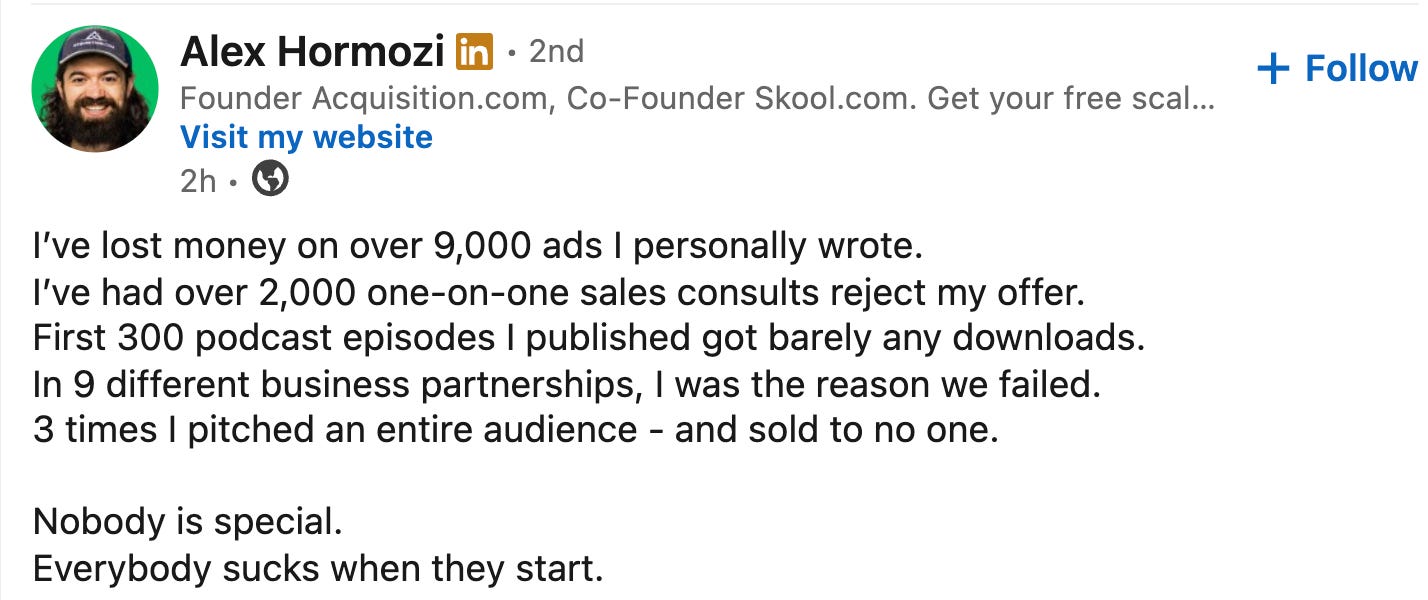
Volume, volume, volume. The top performers in their craft are often the ones who have produced, and failed, the most.
For example, Alex Hormozi is a wildly successful businessman and media personality, but he didn’t start that way:
Remember: while there will be some pain involved in performing below your high expectations, it won’t be as painful as neglecting your calling.
Had I stayed in NYC instead of moving back home with my parents in 2020, I doubt I would’ve been able to teach myself to write while also building a freelance business.
First, the absurdly high rent and the expensive lifestyles of my corporate-jobbed friends would’ve influenced me to stay in my sales job so I could afford to keep up.
Second I’d be too distracted to study, learn, and acquire skills. I would’ve gone for a stroll and, instead of coming up with ideas for my writing, wandered into a bar.
Yes, moving home was key, and I’m grateful that my parents welcomed me.
People make fun of those in their twenties for living in their parents’ basement, but it can be an incubator of sorts, provided you have a plan to get out.
What was most beneficial about moving home?
The long stretch of solitude, enforced no doubt by the pandemic that had swept across the globe months after I moved back in with my parents.
At the beginning of a mastery quest, or really any transformational period, you need to read, think, learn, and reshape your value system and the habits that flow from it. Too many outside influences can disrupt that delicatae process.
In the book Solitude: A Return to The Self, psychoanalyst Anthony Storr writes about how solitude is a tool for changing your philosophy of life, habits, and behavior:
“The capacity to be alone is a valuable resource when changes of mental attitude are required… Suppose that I become dissatisfied with my habitual self, or feel that there are areas of experience or self-understanding which I cannot reach. One way of exploring these is to remove myself from present surroundings and see what emerges.”
Not all of us will be able to move home with our parents, rent a secluded lake-house, or remove ourselves from our community and friend groups to promote habit change.
But most of us can at least take a little break from the social world in which we inhabit. We can make some space and time to focus on our crafts.
Monk mode is a period of intense self-improvement done in solitude, without socializing, drinking, television, or other bad habits.
It is often sold as the key to lifestyle change, and I have mixed feelings about it.
Like any solution, when taken to the extreme, it can have negative consequences: in this case, social isolation, self-obsession, depression, and a tendency to talk politics with the neighborhood squirrels and deer.
But in the short-term, monk mode can be a useful strategy for rapid skill acquisition, especially if you are someone who is sick of the cycle of making progress on a hard goal, going out on the weekend, and then losing momentum.
Total Monk Mode is nearly impossible for anyone with a job or social responsibilities—that’s why it’s popular among young single people—but anyone can do a Lite version of it.
For a period of time, 2 weeks to 3 months, you can make your mastery quest your focus.
If this sounds right for you, here are 5 tips for doing a Lite Monk Mode:
The rest of the guide is for paid subscribers.
To read the rest of phase 2, phase 3, and the startup protocol for your self-directed apprenticeship, you can either take out a paid subscription ($7/mo) or buy the PDF guide ($12). Thank you for your support. It helps tremendously.
Comments
Nothing yet. Say the first thing.
Sign in to join the conversation.