
You were probably never taught how to deep read a classic novel.
Or maybe you were, but like me, you were too busy doodling stick figures or daydreaming about a particularly cute classmate to listen to your teacher’s lecture on the value of historical context or why every reader—scholar or not—should try to interpret a classic novel in their own words.
Most of us leave our formal education knowing how to study a textbook. We can find takeaways in practical non-fiction and lose ourselves in the latest fantasy novel. But when it comes to classic works of literature, we feel a bit out of our depth. Or at least, I sure did.
At age 24, when I set out to become a writer, I began inching my way through the canon. I wanted to immerse myself in the best writing available, experience the stories that form the bedrock of my culture, and learn a thing or two from these authors about how to live.
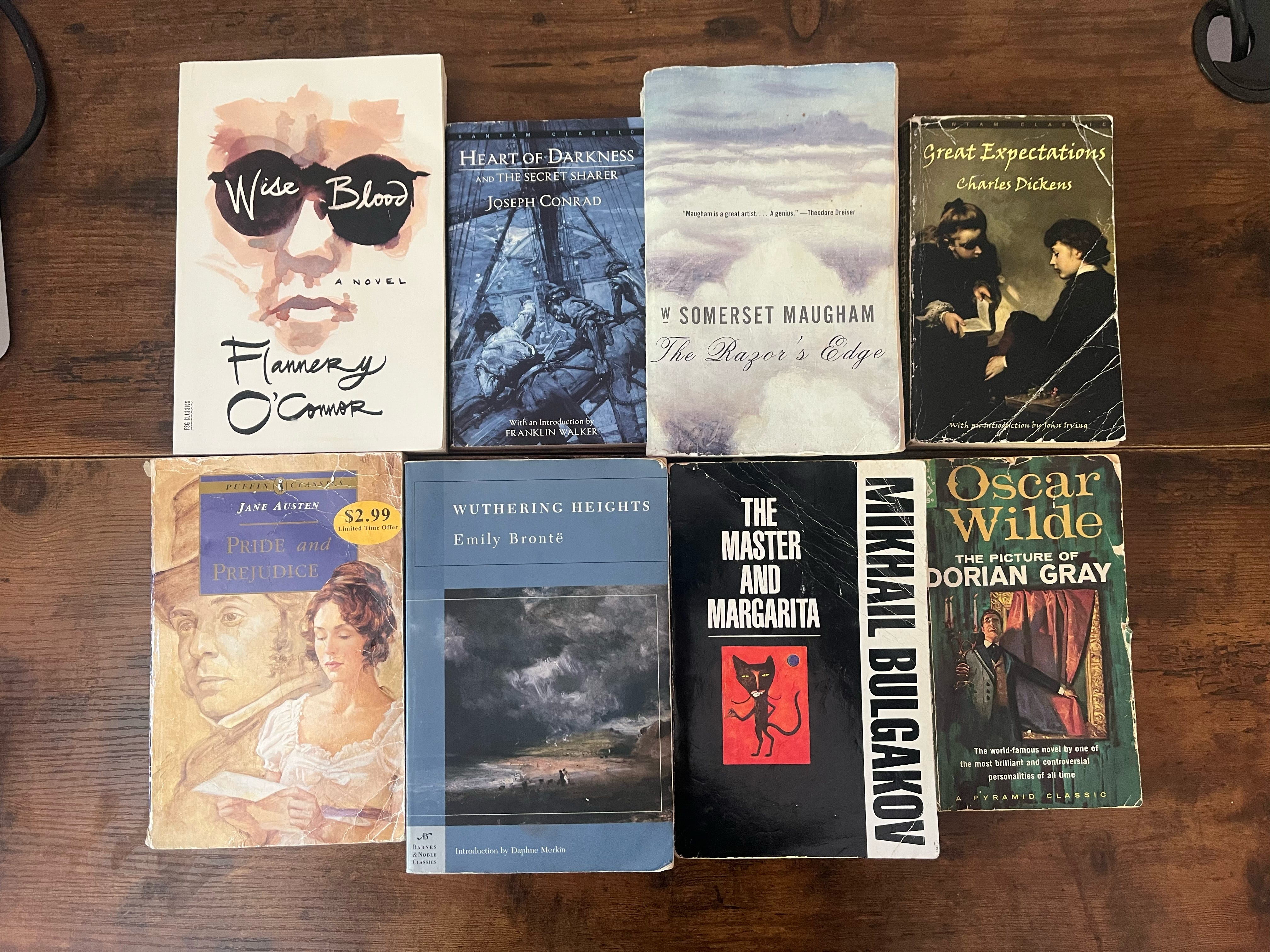
In this quest, I often felt this literary gap in my formal education.
In reading works like Madame Bovary and The Brothers Karamazov, I often wondered if the true meaning was flying over my head. I worried about missing references. I felt there were techniques I should be using to extract more wisdom from these texts.
For intellectual reinforcement, I would watch lectures on these great books. The effect these had on me was usually a mix of awe and frustration.
How did these professors and YouTubers know so much more about these books than I did? And why were their opinions of these books so subtle and interesting?
What were they doing that I wasn’t?
Over the last five years, I’ve found many answers to that question. And I’ve stolen many study habits from readers far more skilled than I am:
Critics like Virginia Woolf
Educators like Benjamin McEvoy
Novelists like Amor Towles
Serious readers and autodidacts online
From literary common-placing and topical reading to making personal interpretations, the nine habits I’ll teach you today are easy to implement, yet immensely powerful for enriching your reading life.
I don’t tell you to write a 20-page critical analysis of the thematic use of the color green in the novel My Antonia. (Although, if you want to, that’s awesome!).
Instead, these are techniques we can all use to become more thoughtful readers, more capable of accessing the soul-nourishing—if not life-changing—insights that await us in the pages of these hallowed tomes.
Quick Note: This is mainly written as a guide for reading classic novels, but all of these tips can be applied to any classic text, be it an epic like The Odyssey, a work of philosophy, or The Decline and Fall of the Roman Empire.
When people are looking for their next read, what do they usually do?
They think about their interests, and then look for books that match these interests.
For whatever reason, when it comes to the classics, people don’t do this. Instead, they feel there are a select few they must read first. They pay no attention to their inner voice and instead default to an authority’s reading list, some article like “You must read these 5 books to become educated!”
But this is not how you become obsessed with literature. It is how you become jaded and bored by it.
You become obsessed by choosing books based on your curiosity, not to feel smart. If there is an author you’ve always been interested in reading, go to them first, rather than feeling you must start with the biggest names.
And think about the genres, plots, and themes you already love, then pick a classic that fits:
Enjoy thrillers? Read Daphne De Maurier’s Rebecca.
Intrigued by stories of infidelity? Madame Bovary.
Revenge? The Count of Monte Cristo.
Lost young people who drink too much? The Sun Also Rises
Funny novels? The Confederacy of Dunces
With a quick Google search, you can find classics that align with a very particular appetite. For example, I was in the mood for classic novels about autodidacts and their quests for an education. I found several: Jude the Obscure, Martin Eden, and Sentimental Education.
The old rule about how to become a reader remains true for the classics: read what you love, and soon you will love to read.
At the beginning of my literary self-education, I aimed to read about one classic per week.
I was intimidated by the sheer magnitude of all the great novels—not to mention poems, plays, epics, and great books in subjects like philosophy and economics. I wanted to make up for lost time.
But this was a fool’s errand. It was the same logic as the scrawny teenage boy eating 10,000 calories per day in an attempt to become muscular in a single month. The body cannot turn all those calories into muscle. Most of it will turn into fat. There must be time to digest. The boy must choose gradual progress over shortcuts.
Benjamin McEvoy, founder of Hardcore Literature, once said that he didn’t read a book for an entire year after graduating from Oxford’s literature program.
He was burnt out from all the assigned reading. Often, he was expected to finish multiple classic novels in a single week, alongside critical essays (which is astonishing, seeing as I’ve been working on War and Peace for six months).
McEvoy eventually recovered. He now reads publicly, teaching literature online. But he says it still wasn’t until years after graduating that he actually learned how to read great literature.
His big revelation? Slow down.
Don’t rush through big reading lists, sacrificing understanding and personal transformation to reach some arbitrary number goal (I actually stopped the Goodreads challenge for this reason).
Treat classics like a monk treats their religious scripture.
Take your time on the pages:
Take a moment to taste the beautiful language. Let it sit atop your tongue like a good red wine. Repeat a moving metaphor out loud.
Pause to reflect on a character’s strange decision. Think about what that says about them, what you would’ve done in their circumstances, and what that says about you.
Envision a well-described setting or character. Close your eyes and see the picture they are painting with their words, and feel the emotions these images bring up for you.
There is value in slowness. Often, it is necessary to go deep. And it is in the depths of a classic where the greatest wisdom and joy will be found.
To help you slow down, here’s a method I like to use:
I have a literary commonplace book (LCB) that I keep next to me while reading.
In it, I capture any sentences or passages that ring true to me, strike me as particularly beautiful, teach me a craft lesson, or say something wise about the human experience. Underneath these quotations, I might jot down a few notes about why I captured it.
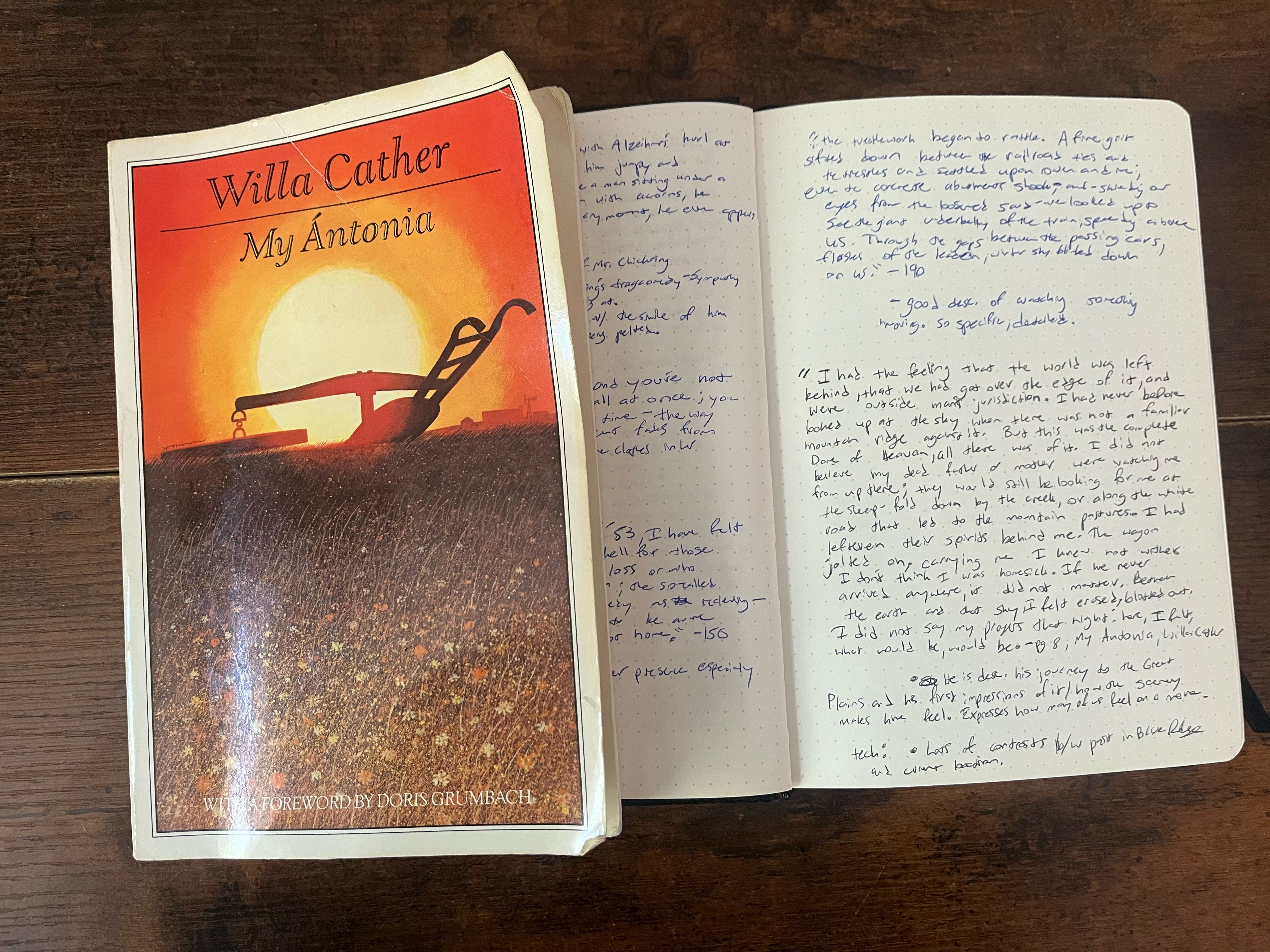
I used to take extracts after finishing the novel, re-reading my marginalia and underlines and and copying them to the LCB.
But I switched to doing it while reading, so as to slow me down (and because I kept being lazy and never taking the time to re-read the marginalia).
During the brief pause, I might lose a bit of narrative momentum. But it’s worth it to feel more immersed in this particular passage that grabbed me by the heart. I want to let it squeeze and see what comes out, whether that’s vivid images in my imagination or tears streaming down my cheeks.
Sometimes, my mind summons up delightful memories from my own life that correspond to the passage, and which I have not visited in some time.
For example, last night, I read a passage in My Antonia about Antonia, a Bohemian immigrant living in Nebraska. She was sharing a memory of her dead father. She tells her friend that back in her home country, her father used to sit on a green bench in their yard and talk with his friend, a trombone player, and how she used to sit nearby to listen to them speak about music and their childhood.
This passage reminded me of how I used to wake up at my grandma’s house and lie in bed upstairs listening to all the adults talk and laugh in the kitchen down below, and how comfortable and happy their voices made me feel.
My grandmother passed several years ago, and big family reunions are less frequent, so it was well worth sacrificing pace to hear all their happy voices in that yellow kitchen once again.
For the longest time, I didn’t understand the point of struggling my way to the meaning of a classic novel when a quick Google search would bring up a scholarly consensus on the matter.
Why should average readers who aren’t book reviewers, scholars, and critics make their own interpretations? Unless I had someone to discuss the book with (I love a good debate!), this all seemed like a massive waste of time and mental energy.
That illusion perished, of course, when I read Professor Mark Edmundson’s book, “Why Read?”
In it, he makes the case for literary interpretation, stating that it’s a valuable habit because it holds the power to positively influence your philosophy of life, which directly or indirectly determines how you live.
But how does interpretation influence your philosophy of life?
Well, when you search for the meaning of a work, you’re reflecting on what the author has said about life—morality, fate, love, revenge, or any existential themes—and you’re then using that wisdom to refine your personal worldview.
I like to think of reading the novel as the conversation with someone wiser than you, in some respects at least, and the interpretation as the post-talk reflection, where you change your views, beliefs, and habits based on what you two discussed.
Don’t worry about being accurate or original. This isn’t about impressing a teacher. It’s not about being more clever than SparkNotes’ interpretations. It’s about growing as a human.
According to Mark, “The test of an interpretation is not whether it is right or perfect, but whether it leads us to a worldview that is potentially better than what we currently hold. The gold standard is not epistemological perfection. The gold standard is the standard of use.”
Interpreting a classic in the way Mark recommends is a highly personal act.
Your answer is heavily based on your own reading of the text, which is influenced by your own background reading and experiences. Provided there is evidence in favor of your interpretation, that subjectivity doesn’t make it any less valuable to the common reader in search of how to live a good life.
Ask yourself: What is the author trying to tell me about life? Some might get better results from asking: What is the novel trying to tell me?
Then dig for clues in the work, looking for patterns and evidence. You can also consider historical, biographical, and cultural context to help you figure it out.
Write up an answer: it can be 50 words or 100,000. Write as much as you think is necessary to explain the meaning of the work to yourself. Aim for clarity and resonance. The answer should feel true to you.
Review the insights you’ve discovered, and think about how you can integrate them into your life. How can you use it to make sense of your own journey? How should you change your behavior in light of these insights?
If you want, you can compare your interpretation to those of scholars and seasoned readers. But don’t fret so much over “correctness”.
My interpretation of Martin Eden as an inspiring story about the power of self-education sent me on a path of self-directed reading. If I had read it strictly as a cautionary tale about individualism (which it surely is), who knows where I would be. This newsletter may not exist.
There are many good interpretations of a single work. Again, as Mark says, the measure of a good interpretation is its ability to positively influence our worldview.
So, has your interpretation helped you solve a problem in your life? Weakened a limiting belief? Understand something you are going through? Will it help you navigate your next big quest in life with more confidence and wonder? If so, you are on the right track.
When I first started reading the classics, I was always wondering how to structure my reading.
At first, I thought it wise to read the classics chronologically to watch the development of the form.
This is what Susan Wise Bauer recommended in her book The Well-Educated Mind. Despite getting a lot of value from the book, this particular method made me feel like I was stuck in a straitjacket.
I read The Iliad, and next up was The Odyssey. But I didn’t want to read The Odyssey next. I couldn’t handle another epic poem. So I didn’t read at all, and felt like a failure.
Then I overcorrected. I started reading randomly, choosing classics based on my current curiosity. This worked for a bit. But soon, it felt a bit too scattered. I wanted to build expertise in certain authors, movements, and subjects. I wanted to go a little deeper.
It came from Amor Towles, the author of A Gentleman in Moscow.
With a group of friends, he has been nibbling his way through the Western canon for over twenty years now.
In an interview, he shared how he organizes his reading: He breaks the canon into small reading projects—groups of classic novels organized around a specific time period, region, theme, or author—and reads them, gaining micro-expertise along the way.
“We will take an author and read five, six, seven of their novels chronologically. Or we’ll take a region or a time period or a theme and we’ll do multiple books from that place that time that theme whatever it is, generally working chronologically over half a year, and then we’ll shift gears and do something new… For instance, we did a period where we took a year and read Nobel prize winners who had not written in English…” — Amor Towles
I have come to call this approach topical reading, and it is my favorite way to read not only classic novels, but also non-fiction books.
A topical reading project could be any of the following:
3 novels by Virginia Woolf
5 dystopian novels
3 great epic poems
4 novels about men coming of age
5 novels written by the existentialists
4 novels written in 20th-century Hungary
This approach is wonderful because your reading commitments are small enough that you can finish them in 12 weeks (my ideal self-education planning rhythm). But they are big enough that you can earn a deep understanding of your topic and start to make connections across books.
A topical reading project is basically like taking a course in the topic, especially if you pad the primary reading with secondary sources or related books in other subjects like history and philosophy (check out interdisciplinary reading).
For example, right now I’m reading four novels about The American Dream, written in the early 20th century. To enhance my studies, I’m also reading a history book about that period, as well as a few scholarly essays on The American Dream in literature.
If you have an urge to read through the canon, this is a fun way to do it, cycling through topic after topic, choosing the next based on this month’s curiosity. It’s also highly educational, which makes it motivating for the autodidact driven by the thrill of having lofty and original thoughts.
My reading journal is a relatively new addition to my reading life, and I’m angry I didn’t start it sooner!
I was inspired to do it when I dug into the reading life of Virginia Woolf. In her diaries, she would write about the books she read, jotting down her initial impressions, which she would later use to write her full book reviews.
I use my reading journal in the same spirit: As a way to generate and capture my raw and original thoughts about what I’m reading.
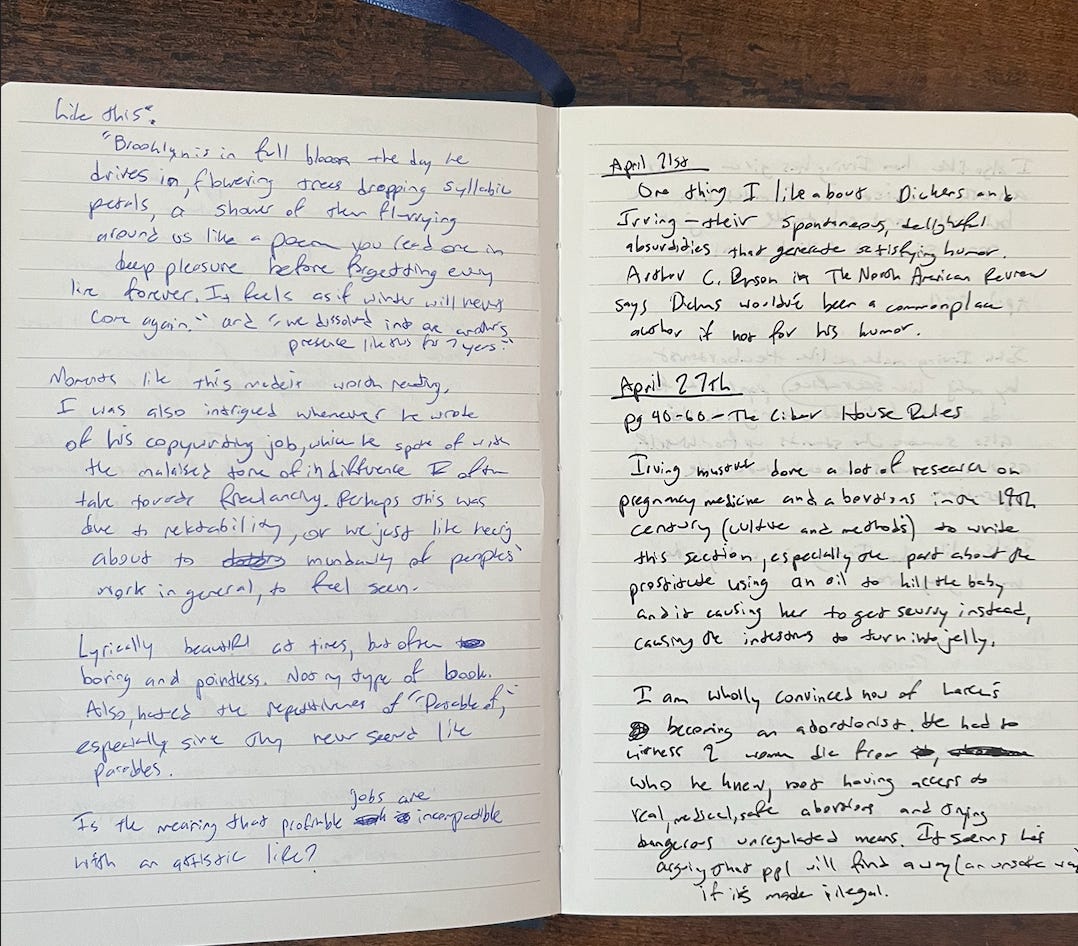
After a reading session, I write down my off-the-cuff impressions and judgments:
”She is so skilled at describing the relationship between a person and the nature surrounding their home.”
Or, I ask questions about the author’s choices:
“Why did she include a long description of the prairie followed by the jarring image of a tractor in front of the setting sun? How does that serve the story or theme?”
Other times, since I am a writer, I jot down a technique and the effect it had on me:
“I like how he opened the story with the character eating dirt. What an odd quirk. It characterized and immediately raised a question I want to find the answer to.
And sometimes, it’s a connection to my own life that preoccupies me:
“The idea that the professor could’ve been a poet had he not expended all his energy in talking makes me wonder if I expend too much creative energy writing short-form notes.”
Often, after finishing the book, when I go to write a book review, I rely heavily on these immediate impressions, expanding them into more substantial reflections.
I don’t always write in my reading journal after a reading session. Sometimes I don’t feel like it. But when I do, it certainly deepens the experience and, I think, makes more of the material of literature stick and work its magic on me.
I wrote an article a while back about some advice that can hurt your ability to enjoy the classics.
That advice: read only the classics, nothing else.
While it is true that anybody can enjoy a great book without any additional help, it is also true that secondary literature can aid in your understanding and appreciation of that work.
Rather than force-feeding you interpretations and ruining your ability to creatively read, scholarly articles, YouTube explainer videos, and works of criticism are often springboards for your own creative thinking.
Aside from often being fun to read in itself, a good scholarly article can provide you with knowledge about the book that you can use to think more deeply about its meaning. After all, knowledge is the material of critical thinking.
Like an expedition leader in the rainforest pointing out a tree frog camouflaged against a leaf, a piece of literary criticism can help you spot aesthetic qualities and literary references you might’ve missed on your first pass.
And in the same way an informed tour guide can help you appreciate the architecture of a Roman cathedral, a book’s introduction can teach you about the history, society, and culture of the author’s world—the world that shaped, and was shaped by, the author’s novel.
Learn about the author: I love watching documentaries about the author. I find it motivates me to attend to their words, since I see them as an individual behind the work of art. You can find some good documentaries on YouTube on channels like Author Documentaries. Here’s one I’m watching on Willa Cather.
Get general context: I do a quick Google search and just ask “what’s the historical, social, and cultural context of [novel]?” If your book comes with an introduction, that’s another way to get some context.
Know why the book is a classic: I usually want to know why this novel is so well-known before I start it. This helps me focus on that aspect of the novel. It also helps me choose if it’s actually something I want to read—if the reason it’s famous is for its long and intimate descriptions of Victorian furniture, I might take a rain check.
Read the book: I don’t really use any secondary resources while reading the book. I like to be totally in the story. But if you want to, check out this article on the companion text method.
Read 2-3 scholarly articles: If you look up the novel on Wikipedia, its references section will point you towards interesting articles. JSTOR also gives you 100 free articles per month with a free sign-up. Focus on reading articles on aspects that interest you, whether that’s the theme or a specific character. Norton Critical Editions are also great, as they provide an introduction to the novel and several critical essays after it.
Before moving on from this topic, here’s one final rule from Virginia Woolf:
Try to form your own opinion about the book before reading, and deferring to other people’s.
In her essay How Should One Read a Book?, Woolf writes:
“It is now, when we have kept closely to our own impression, formulated independently our own judgment, that we can most profitably help ourselves to the judgments of the great critics—Dryden, Johnson, and the rest. It is when we can best defend our own opinions that we get most from theirs.”
I think she’s right. I get more from another person’s review or interpretation if I have already made my own. There is a productive tension between mine and theirs, especially if we disagree, and this will lead to more revelatory and original thinking on my end than if I were to just read their thoughts without first consulting my own.
If I did that, I doubt I’d have the power to make up my own independent opinion—my mind full of weak half-baked notions, theirs would dominate.
I never know what I think of a book until I write about it.
Writing about the book turns my half-baked notions and feelings into clear, fleshed-out insights and opinions. The result is that, when somebody asks me about the novel I just read, I actually have something cogent to say (most of the time—I’m still not immune to blabbering hopelessly).
When you write about a book (or anything really), you are forced to put your thoughts down on the page, examine them closely, and refine them until they are crisp, clear, and articulate.
I resisted writing book reviews for a while—for years! It is only recently that I started to actually do it for every book I read.
You may have noticed that last month I wrote an article on “The 4 books I read in July.” That new series is very much to hold me accountable to write reviews, because they are so valuable to deepening my understanding of the book and how it impacted me, while also helping me retain the story and its major life lessons.
Your review doesn’t have to be long, in-depth, or NY Times worthy.
I keep mine to a couple hundred words and use this basic template, though I sometimes depart from it in the heat of writing:
Briefly summarize the story (a few sentences on what I thought the story was about at its core)
Give my honest opinion of the novel—often 2 things I like and 1 thing I disliked.
Share how it impacted me (if there were any life lessons or takeaways)
Often, it’s after the first draft where I feel safe to read some other people’s reviews and criticism. Usually, this sparks new ideas. By the end of writing it, I feel so much better acquainted with the work.
If you are publishing these publicly, you may wonder if writing reviews of classic novels is silly.
After all, there are already so many scholarly articles and reviews about them online. How could you say anything new? Why would anyone care about your opinion? You have no PhD.
I used to think this. But it’s not true. People will care about your perspective. Your perspective will add to the conversation.
Why?
Because if you are honest, it will be original, for one has your mix of background reading, experiences, and taste.
The trick is to just let it rip. Give your view of the novel, how it changed you, what you loved and hated. Compare it to the novels you’ve already read. This is what people are interested in anyway. They want to hear about somebody’s personal experience with the classic, not a summary that they can find on SparkNotes.
At some point in your literary education, you may wish to specialize—to gain mastery over one aspect of classic literature.
About a year ago, I realized that almost all my favorite works of literature were 20th century American novels. And so, I’ve been devoting myself to mastering that subject over the last year.
To help me organize my study materials, I even built a massive targeted reading plan that is meant to approximate what graduate students create and read through to prepare for their comprehensive exams.
I call it a Mastery Subject Reading Plan. I’ve been reading through my list of over 100 books in topical fashion, and I expect to continue doing this for some time.
It’s satisfying to start to go deep into one part of literature. If you want to do the same, check out my 6-step guide on building a mastery subject reading plan.
After reading Mortimer Adler’s How to Read a Book, I became overwhelmed by all the things I should be doing to read a book well.
I was petrified by the notion of becoming a “bookfull blockhead”—it sounds terribly painful.
So I only read when I felt I was alert and energetic enough to properly summarize, evaluate, and analyze the text. But I’m rarely that awake! So I read less than I would’ve liked. I was suffering from reading perfectionism.
These days, I worry less. I know there’s no such thing as a perfect read. Every read is special and unique in its own way.
And even if I do nothing but read the novel, and do it in a semi-lobotomized state of brain fog, I’ll still come away with gems, far more gems than if I never read at all because I was too scared to mess it up.
So go read the classics, and marvel at the treasures you find. The more you read and apply some of these habits, the better you’ll get at it, and the more fun you’ll have.
Happy studying,
Sam
P.S. If you want to learn how to plan a well-rounded self-education across the 4 key dimensions of lifelong learning, consider reading my new ebook, The Lifelong Learning Compass. Any purchase helps support this newsletter.
No posts
Comments
Nothing yet. Say the first thing.
Sign in to join the conversation.