
The average American consumes about as many hot dogs per week as books per year.
According to data from The Hot Dog and Sausage Council (I’m happy this exists), the average household eats around 70 hot dogs per year (1.33 per week). Meanwhile, a YouGov poll found that the median American read only 2 books in all of 2025.
While I love myself a hot dog, especially blackened on a grill, when you bite into this report, the state of intellectual life in 21st century America looks even bleaker:
40% of Americans read zero books in 2025
27% read between 1 and 4 books
In other words, if you read more than 5 books last year, you’re a freaking nerd!
Now, I have no issue with someone reading just 2 books in a year. Better than none. It’s their life.
They may have other priorities. Maybe they like magazine articles. Maybe they just had a kid. Maybe their job is draining. Maybe they hate books.
Who am I to judge? In my younger days, I went entire years without reading a single book.
Still, when I compare our present state to that of the 19th and early 20th century in England, among busy working-class autodidacts no less, I feel an ache for what’s been lost.
As Jonathan Rose shows in his book, The Intellectual Lives of the British Working Class, there’s was a world where books were central to culture. Novelists were inspiration for street names. Economic theories were fodder for dinner-table conversation. Classics were pathways to freedom.
In researching library records, adult course curriculums, reader surveys, and numerous letters and autobiographies describing their reading lives, Rose explores the tremendous lengths that miners, factory workers, loom operators, and busy homemakers went to pursue a liberal self-education.
They devoted themselves to the task with a rigor common among the readers of this newsletter (and much of Substack), but uncommon in the world at large. And they did so without guidance, without the preparation of a half-decent k-12 education, and often under poor economic conditions.
They read classic works of literature, philosophy, history, politics, economics. They joined essay competitions, formed self-education groups, and discussed stories and ideas after work.
Some even managed to study and think about literature while on the job, debating Shakespeare in the mineshafts or, in the case of weaver David Livingstone, propping open a Latin textbook on his loom while he wove cloth.
These autodidacts went to the books not only to escape from the brutal realities of industrial labor, but also for the same reasons many of us are questing for knowledge.
They sought moral development, intellectual cultivation, and to forge that liberating understanding of themselves and the world around them, so they could better navigate it.
Some of them went on to become self-taught writers, thinkers, political leaders, and scholars. All of them had lively minds—for what reading human does not?
In this issue of Thinkers, I want to share my three favorite takeaways from this book. I hope it provides you with some ideas for enriching your own intellectual life, and serves as a reminder for why reading books matters.
Over the last several decades, many universities have turned their backs on the classics and the teaching of Western Civilization.
Among other reasons, critics and educators worry that drinking from the cultural inheritance may cause readers to become indoctrinated into certain unsavory ideologies of the past, like imperialism, racism, and patriarchy.
While these concerns stem from a good place (I hope so at least!), Rose argues that these claims are often made without understanding of how readers actually reacted to texts.
In studying records of readers’ responses to classic novels and books, Rose found that, “far from inscribing traditional ideologies, canonical literature tended to ignite insurrections in the minds of the workers.”
In working through canonical lists like John Lubbock’s Hundred Best Books or The Everyman’s Library, the autodidacts of working-class England exposed themselves to a plethora of nuanced perspectives on the world, many of them subversive to the status quo.
That broadening of the mind, by synthesizing the views of a variety of the most insightful and critical writers, many of whom were in disagreement, served to inoculate many autodidacts against uncritical ideological thinking, whether that was unquestioning traditionalism or the strict, dogmatic form of communism that was spreading at the time (and which was directed at these hardworking people).
The classics inspired them—and gave them the tools—to spot problems with society, influence politics, and separate propaganda from wisdom. “They resisted ideologies from above,” Rose writes, “in order to discover for themselves the world of God, standards of beauty, philosophical truth, the definition of a just society.”
In consuming great thought, they became better thinkers themselves—more capable of seeing both sides of an issue or critically examining ideas thrown their way.
As a result, they felt themselves emancipated. Perhaps this is best demonstrated by the words of circuit preacher Joseph Baker. After reading Hobbes, Milton, Locke, and Newton, and other great writers, he felt the general effect had been:
“To make me resolve to be free.”
While autodidacts often studied in a self-directed manner, that does not mean they always studied alone.
In autodidact culture in Victorian and Edwardian England, mutual improvement societies were common, providing ongoing education and intellectual fellowship to adults who had not been able to go to school.
These societies were groups of people who met regularly to progress their educations, read with others, and practice the intellectual arts of thinking, writing, and speaking.
“Typically, at each meeting,” Rose writes, “one member would deliver a paper on any imaginable subject—politics, literature, religion, ethics, “useful knowledge”—and then the topic would be thrown open to general discussion.”
I am proud to say that today, good teachers and readers are still offering such collaborative ways to engage in self-education. And I don’t mean graduate degrees.
Many substackers offer reading groups on various subjects. Paul Musso, PhD, for example, runs an online philosophy school.
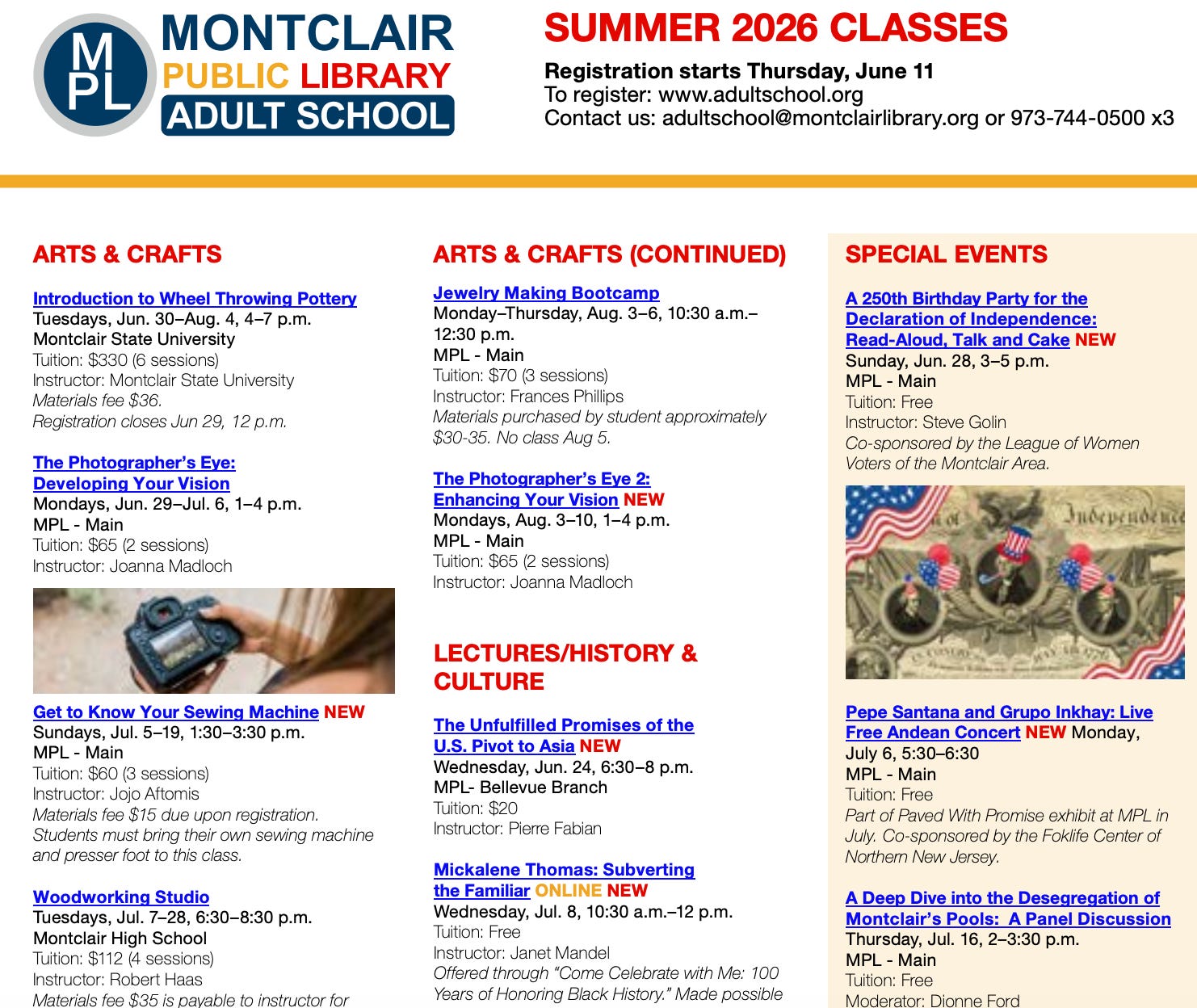
Local libraries often host in-person adult courses on a range of subjects. While there aren’t many literature or philosophy classes at my library, at least there’s some history, art, and politics:
And then there is Zena Hitz’s The Catherine Project, which seems to most closely match the rigor and subject matter of the mutual improvement societies of the past.
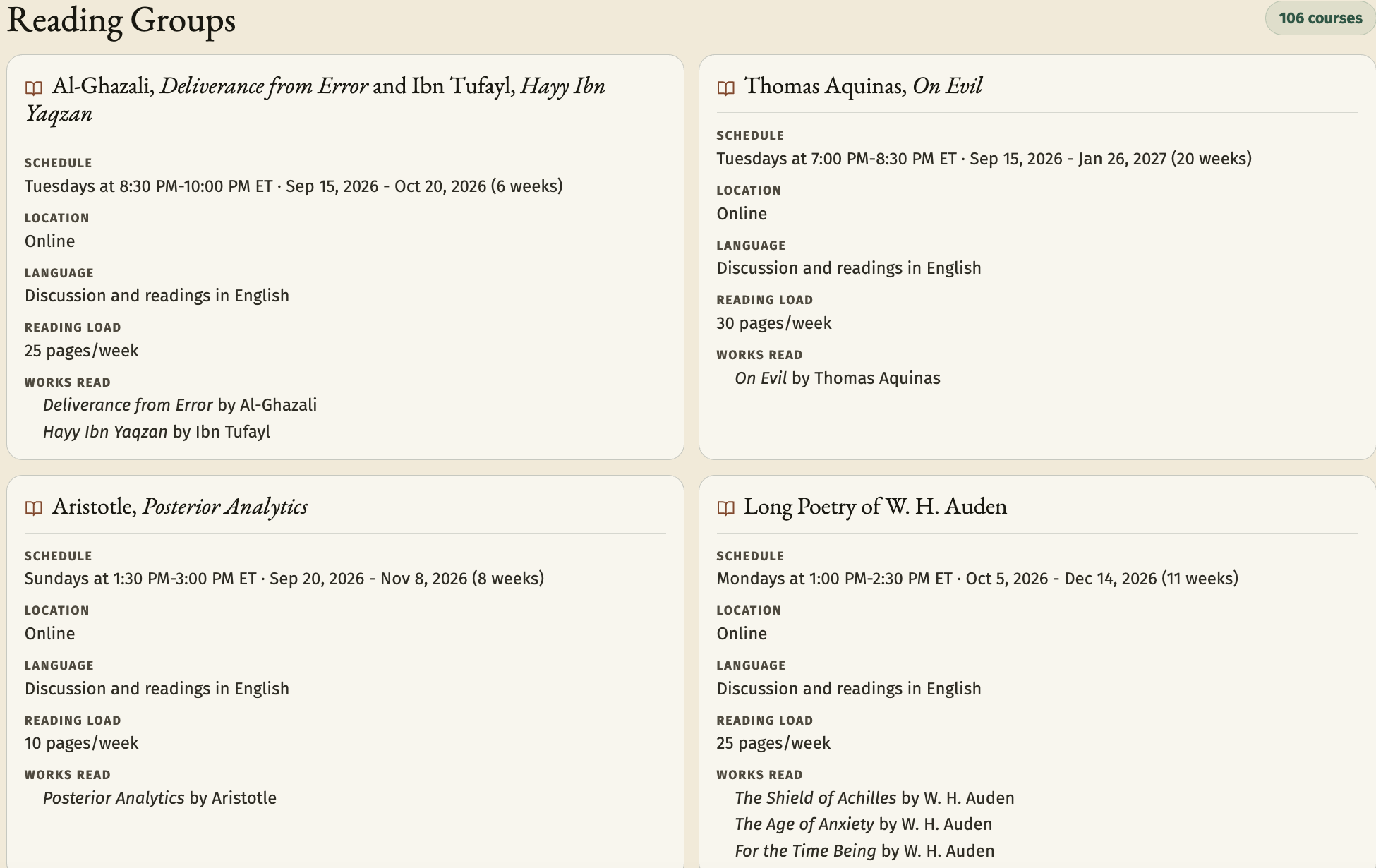
For free, you can enroll in reading groups on a variety of classic books, tutorials on academic subjects, and intensive reading groups where you are expected not only to read, but also write and share essays on what you have read.
Enrollment for Fall semester is open (closes August 14th). Here’s a taste of some of their course offerings:
Learning alone in a room is great. An introvert, it’s always been my go-to.
But studying with other people who love what you love—stories, books, ideas—can enhance the experience and push you to think clearly, speak articulately, and read carefully.
While some autodidacts engaged in self-education for career advancement, many pursued knowledge for knowledge’s sake.
They knew self-directed study was intrinsically valuable, a true source of joy itself.
Take the cotton-spinner Charles Campbell (born in 1793) for instance.
He saved up money to subscribe to a library, where he adventured happily in the realms of history, travel, and the English classics. Later, he joined a group of fellow mechanics and artisans to discuss literary topics.
“The lover of learning,” Campbell writes, “however straitened his circumstances, or rugged his condition, has yet a source of enjoyment within himself that the world never dreams of.”
This love of learning for learning’s sake, without consideration of monetary payoff, aroused much suspicion, as it still does today.
It was especially alarming to the upper class who feared an educated working class capable of questioning the social structure that had them at the top. But middle and working class philistines expressed their concerns as well.
Mr. Campbell’s reading was often treated like a bad drug habit. “Every cross accident—every misfortune, that chequered my early life, was ascribed to my love of books, and the influence of our club.”
When I ponder such suspicions, I cannot help but think of Paul Kingsnorth’s Against the Machine, where he critiques the reigning technocapitalist worldview of the modern day that measures everything activity by its favorite word: profit.
If only humanity could see that profit does not have to be financial. It appears our autodidact ancestors were struggling with the same worship of the almighty dollar.
Education and information have become so accessible that we have lost our appreciation for it.
We are like the person who, so surrounded by loving family members, takes them for granted, neglects them, and one day loses their love.
In the 19th and early 20th century, it was not easy to find books, to go to school, to get an education.
Ordinary people struggled for a glimpse of that liberating light, while we are complacent in the dark.
As a culture—as a world—we must regain our sense that beneath a book’s cover lies something dazzling, something that Frederick Douglass once risked his life to find.
No posts
Comments
Nothing yet. Say the first thing.
Sign in to join the conversation.