
It is 6pm. You are walking home from the tube, tired, with the workday still humming in your head. All you want is to eat. Something nourishing, comforting, fresh, healthy, quick and above all, easy. You do not want to go to the supermarket. You do not want to follow a recipe with twenty-seven ingredients (I have, regrettably, written some of those). You want simplicity.
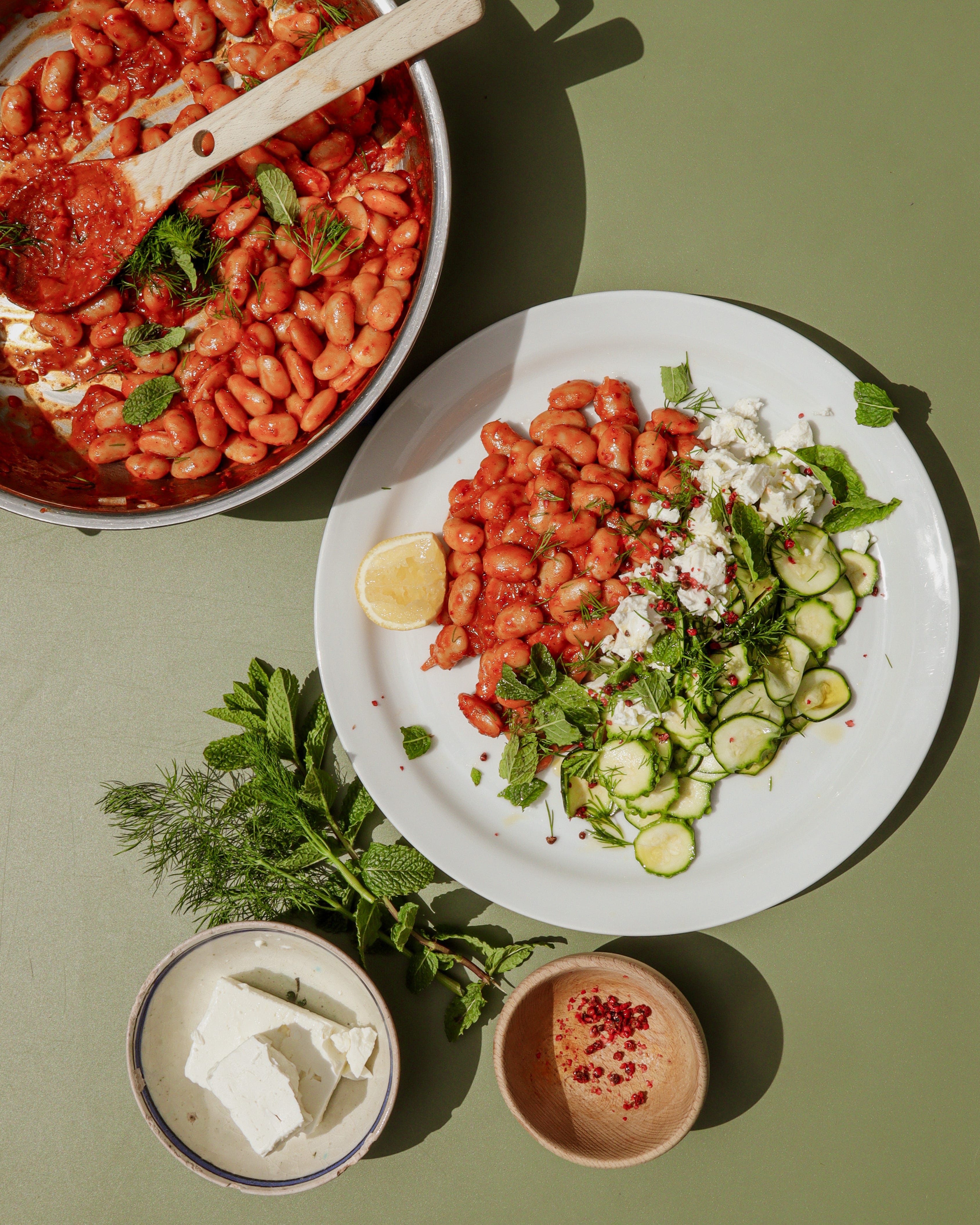
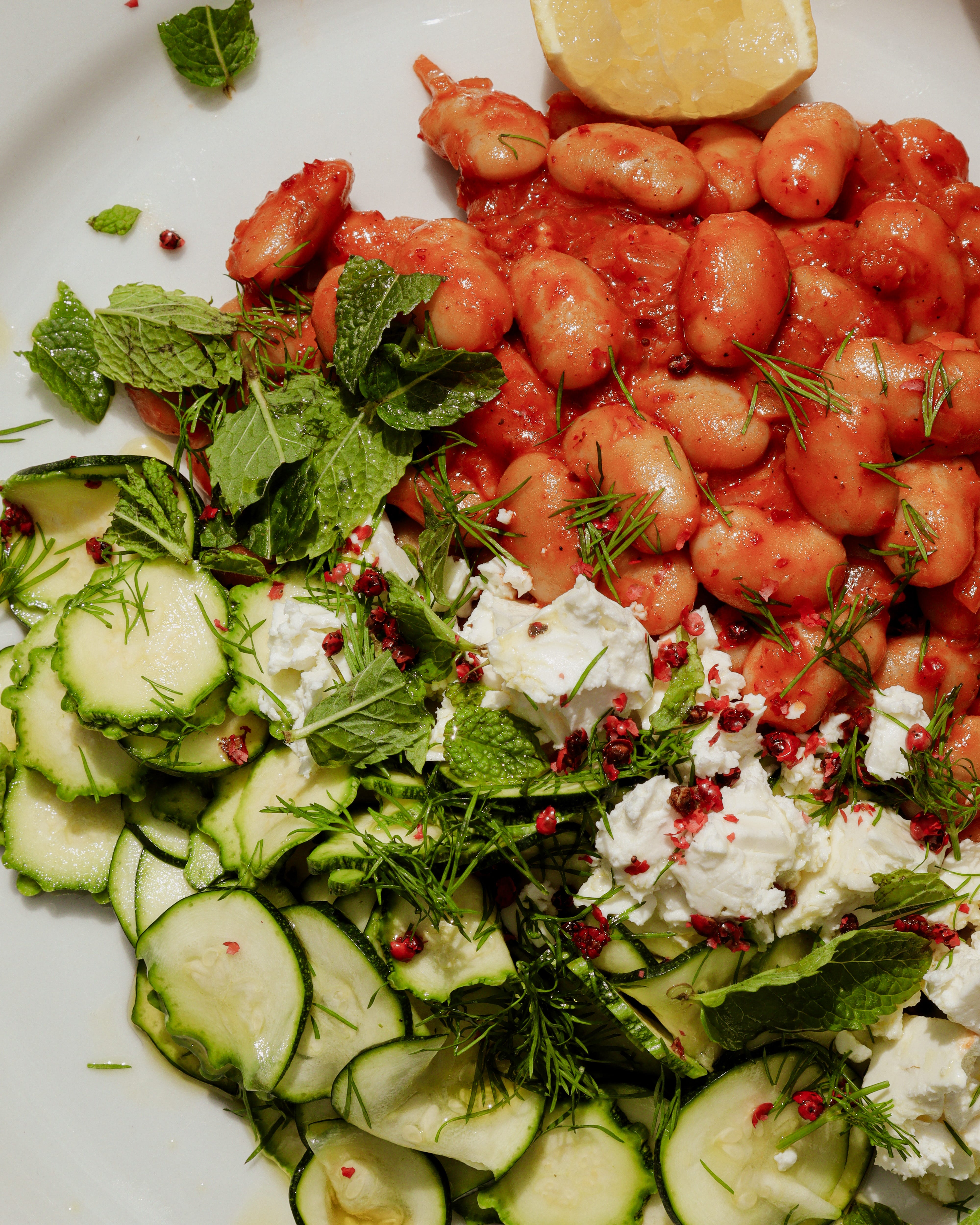
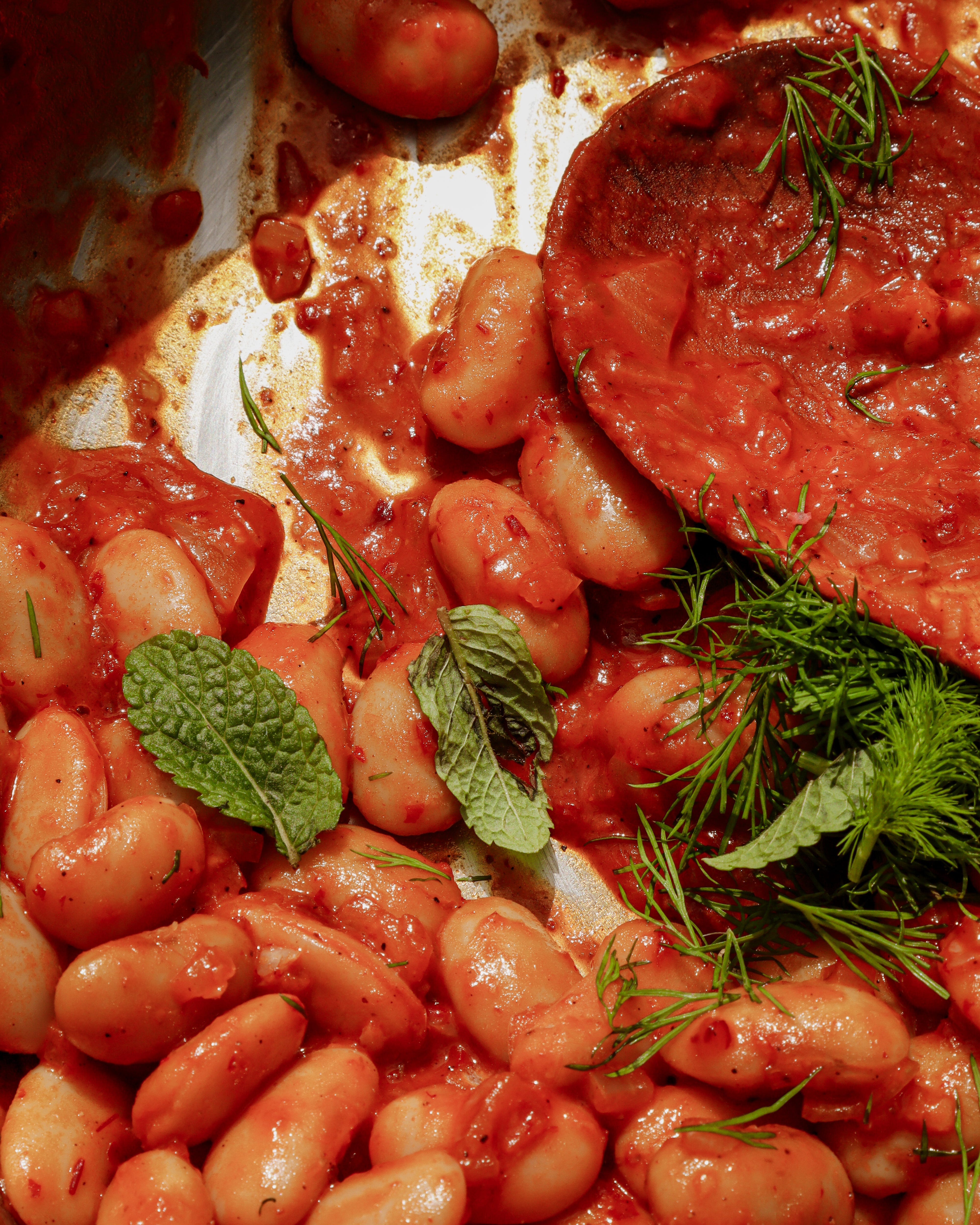
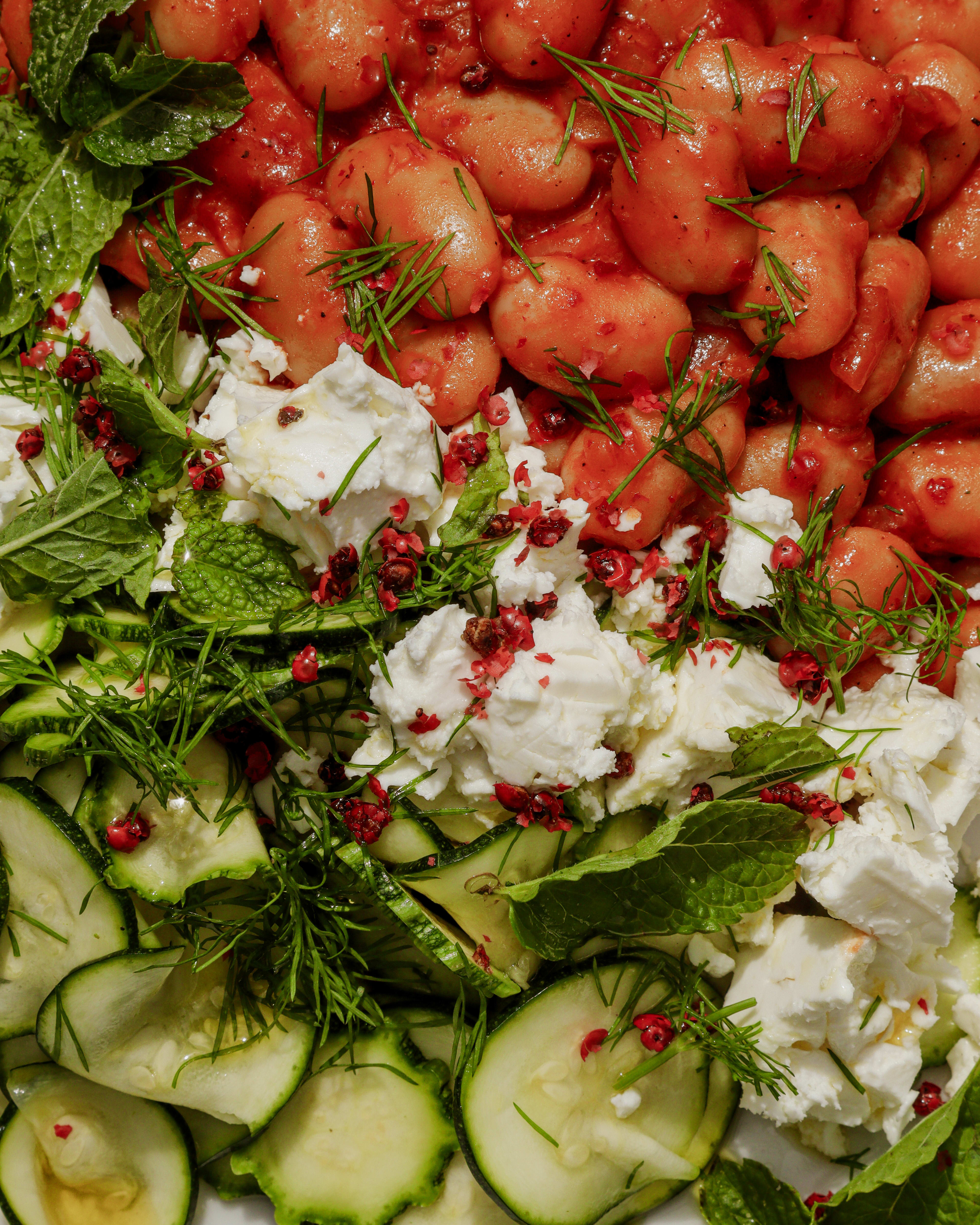
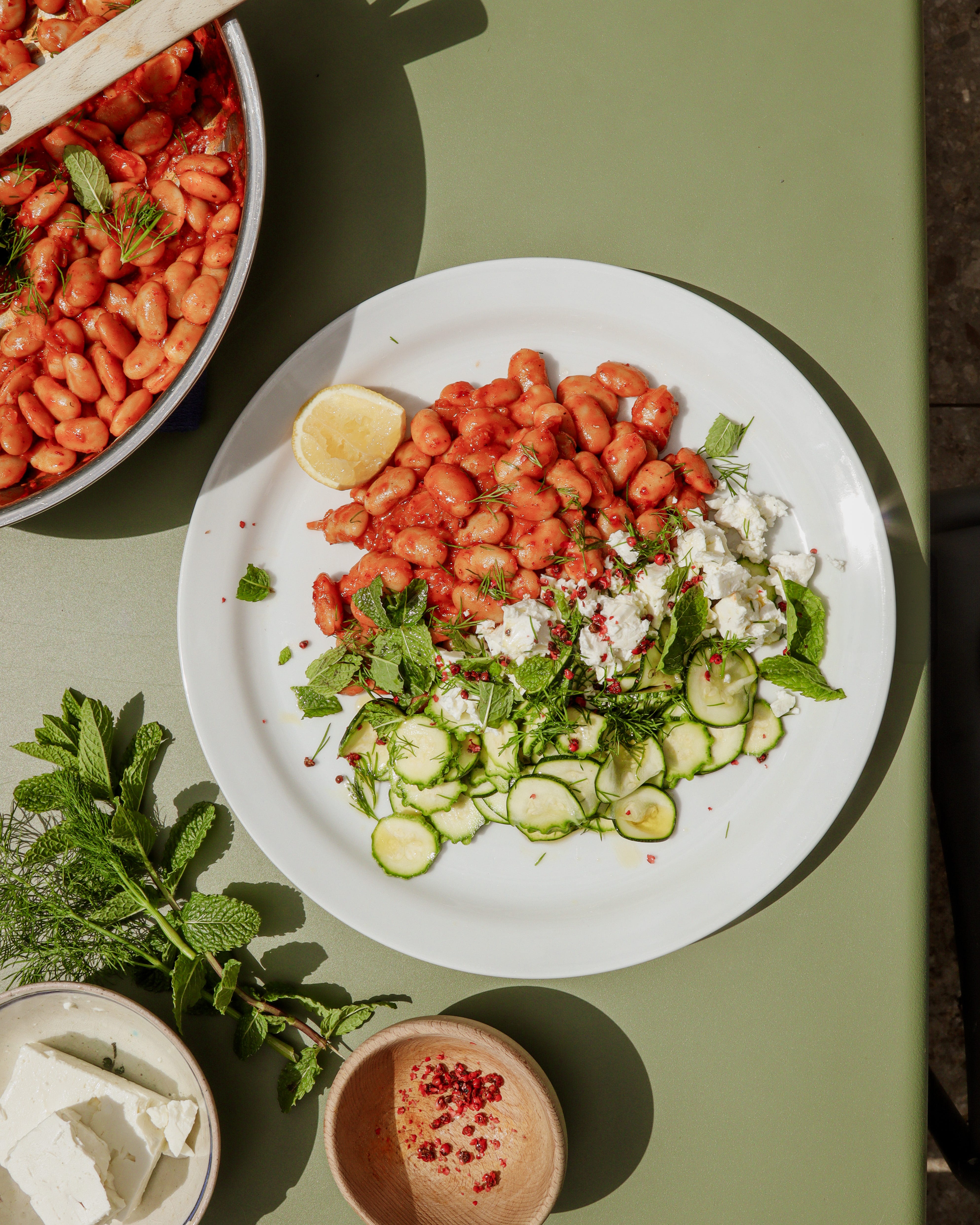
Warm butter beans cooked down with onion, garlic, harissa and red pepper paste, topped with cold raw courgettes sliced thinly and softened in salt and lemon, finished with crumbled feta, mint, dill and a scatter of sumac. Hot underneath, cool on top. Soft underneath, crisp on top. Spicy and savoury underneath, fresh and herby on top. The whole thing comes together in about twenty minutes and uses two tins of butter beans, courgettes and a few things you probably already have.
This is the kind of dish that has saved many of my midweek evenings.
Let me take you back to such a day. I think it was 2018, but the year is less important than the day.
That morning I was in Notting Hill, working alongside Francis, the head chef and Luana, the general manager. As executive chef I was overseeing a new menu rollout and we were finalising some of the new summer dishes. One of the standouts that day was a salted courgette salad with feta and mint and a few other ingredients I cannot now precisely recall. It is the nature of menu development - by the time a dish settles into its final form, eight different iterations have passed through your hands and palate. What I remember clearly is the dish working. Chilled, crunchy, fresh. Exactly right for the summer that was coming.
After Notting Hill I jumped on the tube to Upper Street, to talk to another head chef, David, about a new direction we were taking. Then on to Spitalfields, to see Ezra, who had made me promise I would come and taste her manti, small handmade Turkish dumplings, dressed in garlic yoghurt and chilli butter, which she made better than anyone I knew. I do remember too many of these utterly delicious dumplings...
By the time I was on the District Line heading home, the day had caught up with me. I dozed off somewhere around Sloane Square and woke up disoriented at Hammersmith, not entirely sure how I had got there. My phone was buzzing. Jeremy: what time are you back?… in my head that rings, what’s for dinner?
As I have always done, I have no idea what I’m going to make for dinner. I had not done the shopping. I had eaten manti at four in the afternoon and that had been my last considered food decision of the day.
I walked home slowly and went straight to the kitchen.
This is the moment I love most about home cooking. Even when I am tired. The moment when you open the fridge and the pantry and you take a look of what’s there.
I had: a few courgettes from the garden, some feta, an opened tube of red pepper paste, a jar of harissa, two tins of butter beans, a half-bunch of mint, some dill. An onion. A lemon. Olive oil. Sumac. The makings of something, but not yet a dish.
Jeremy, helpful as always, called from the living room: we could just have beans on toast.
I acutely love beans on toast, but I could not let him have beans on toast on a Tuesday night. Not after a day of restaurant work. Not when the cupboard had a tin of butter beans and the courgette salad from Notting Hill was still in the back of my mind.
The dish assembled itself in my head while I was standing at the open fridge. And miraculously, by the time I had the onions in the pan, the dish was already cooking itself. Twenty minutes later we were eating it from bowls at the kitchen table.
It was extremely good. It has been extremely good every time I have made it since, which is often. It almost made it to Boustany, but I kept it only for myself a little longer.
Share Sami Tamimi - notes from my kitchen
Let me say a word about the courgette, because I think it is one of the most consistently mishandled vegetables in the British kitchen.
The courgette grows abundantly across the Mediterranean and the Middle East. It is one of those vegetables that is genuinely difficult to do badly. The problem is that most British recipes treat the courgette like a potato, boiled, roasted, stewed until soft and beige and apologetic. The courgette, in fact, is at its very best when it is barely cooked at all.
Here is the secret, if it can be called a secret. Slice it very thinly. Salt it. Leave it for fifteen or twenty minutes. The salt draws out the water and softens the flesh without any cooking at all. What you end up with is something extraordinary - silky, slightly translucent, intensely flavoured and still crunchy. Dressed in lemon and olive oil, scattered with herbs, this is the courgette at its absolute best. It is the way the people of eastern Mediterranean have always done it. Do this with your courgettes from now on. A whole new vegetable will be available on your table.
In this dish, the salted courgette goes on top of the warm beans, and the contrast is the whole point. The beans give you the comfort of a stew. The courgette gives you the freshness of a salad. Together they give you a meal that feels both substantial and light, which is a difficult balance to strike and one I am genuinely proud of when I get it right.
When I opened the fridge that evening, I was not consulting a recipe. I was running through three or four years of cooking memories at the same time, in parallel, almost without realising it. The courgette salad from Notting Hill that we had just put on the menu. A butter bean stew I had eaten on a holiday a long time ago. A red pepper paste I had been using in another dish that week. The Palestinian instinct to put something cool and sharp on top of something warm and savoury runs through several dishes I had grown up with. All those things were sitting in the back of my mind and the open fridge gave them somewhere to land.
This, I think, is what cooking is actually all about, after so many years doing it. Not the recipe. Not the technique. Just an accumulated set of references that you can recombine on a Tuesday evening when you are tired. The recipe is what you write down afterwards, once the dish has worked, so that other people can enjoy it too.
It is also a welcome change to the way recipes are sometimes presented in cookbooks, mine included. A recipe with twenty-seven ingredients suggests that the cook sat down and designed it deliberately, like an architect with a blueprint. The truth is almost always less grand and more generous. Most of the dishes I am proudest of came together at home, on a weeknight, with whatever was in the fridge and were refined later.
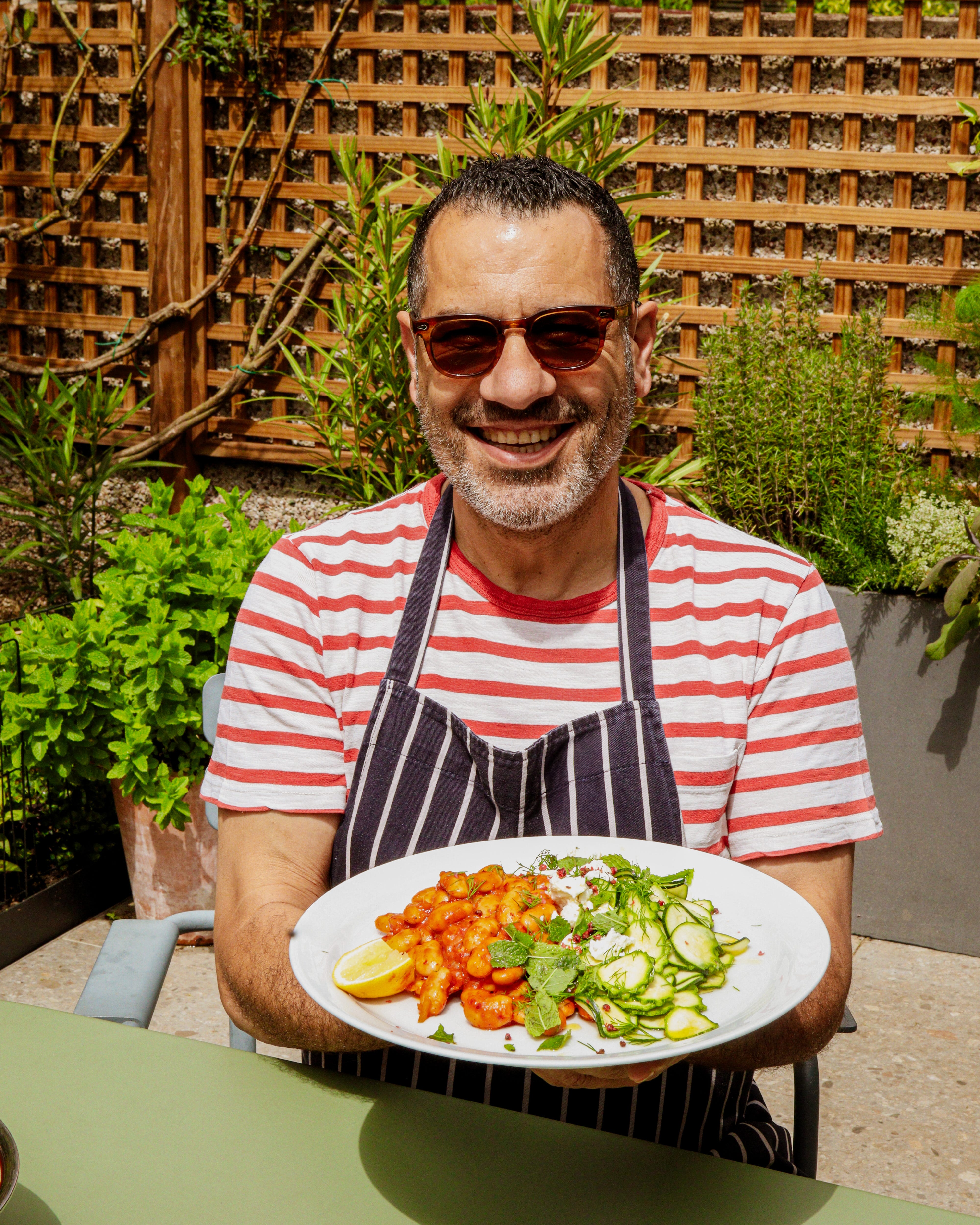
Jeremy and I ate the dish at the kitchen table that Tuesday with some bread and the rest of a bottle of white wine. There was no one else there. It was the best meal I had eaten in a week.
This is what I want this Substack to be for, sometimes. Not just the celebration food or the dishes with the long histories. Sometimes just the food that gets you through Tuesday, Wednesday or Thursday with a little bit of grace. If you are tired this week and your fridge has roughly what mine had, try this. It will not let you down.
Let’s cook. I am hungry.
Serves 4
Comments
Nothing yet. Say the first thing.
Sign in to join the conversation.