
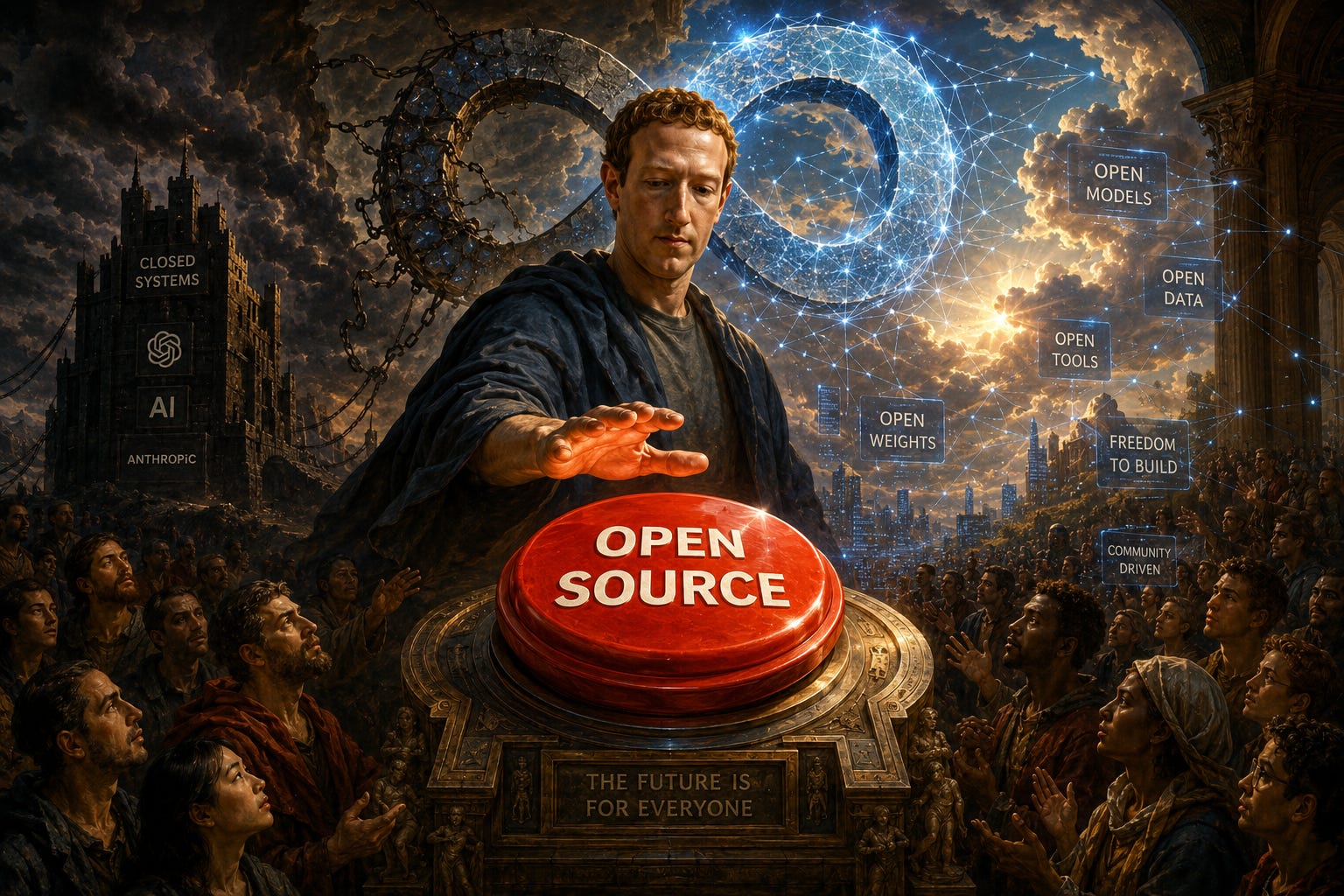
Today is a big day for Meta. After wandering in the wilderness for a while, the company has returned to its open-source roots.
Was this the plan all along or is this an opportunistic pivot given prevailing market sentiment? Your priors about Meta will probably determine your answer.
Either way, here is what actually happened.
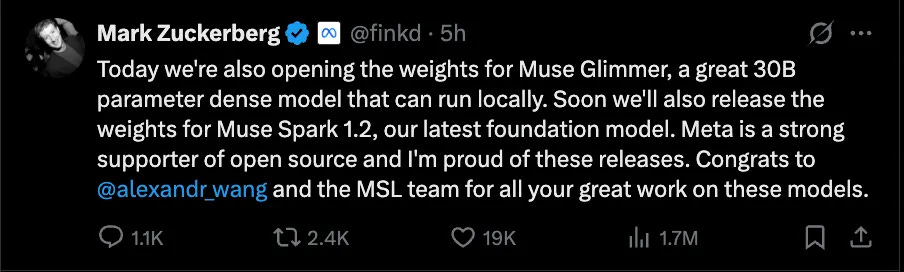
Meta released Muse Glimmer, a 30-billion-parameter agentic model with open weights. Despite its relatively modest size, Glimmer can behave like a much larger agentic system: planning, calling tools, checking its own work, recovering from failures, etc. More importantly, Meta promised that Muse Spark 1.2, its frontier model, will also be open-sourced soon.
Alongside the announcement, Zuckerberg published a sprawling manifesto titled “The Future Is For Everyone.” It is a spiritual successor to his earlier essay on Personal Superintelligence, and it predictably begins by contrasting Meta’s optimism with an AI discourse that, in his telling, has become excessively preoccupied with doom.
Meta’s alternative vision is abundance: superintelligence should not sit behind the walls of a few labs, governments, or corporations. Everyone should get it.
Zuck positions Meta as the company building personal superintelligence, while most other labs are supposedly building intelligence only for corporations and governments. Sitting in SF, I can almost hear the protests from the OpenAI and xAI offices about this characterization.
My initial reaction to the essay was skepticism. The opening sections can feel breezily dismissive of legitimate concerns. Anthropic may be doing a very awkward job of surfacing the ‘hard questions,’ but at least the anxiety feels sincere. Zuckerberg, by contrast, opens with something closer to: what if everything becomes amazing?
But the essay gets much more interesting as it goes. For perhaps the first time, Meta lays out a reasonably coherent theory of AI risk that goes beyond “open good, closed bad”. A few points stood out.
Alignment is not a tech problem. Zuckerberg’s strongest argument is that there may be no technical procedure capable of “aligning” a model with everyone’s values because people do not share the same values. Any supposedly universal alignment regime inevitably embeds someone’s worldview at the expense of someone else’s. His proposed answer is a balance of power: instead of a benevolent power judiciously doling out superintelligence based on intent, we give lots of people powerful intelligence and let competing interests constrain one another. Meta therefore defines alignment differently from many frontier labs. The objective is for your agent to reflect your goals and values, rather than those selected by the company that trained it.
This is an appealing philosophy. Though it does assume that giving every faction a flamethrower eventually produces equilibrium rather than a larger fire.The jobs argument gets self-serving fast. On employment, Zuckerberg starts with the familiar historical case. Technological revolutions eliminate some jobs, create others, increase productivity, and eventually make societies richer. Industrial Revolution, tractors, computers, software. We know the talk track.
Then comes perhaps the most amusing and transparently self-serving section of the essay. The employment outcome, he suggests, may depend on which AI companies win. If labs focused on automating knowledge workers dominate, the transition could be difficult. But if consumers instead receive Meta-style “personal superintelligence,” people will become more capable, invent more things, start more businesses, and employment could actually rise. Amazing how often the optimal structure of society resembles a company’s product roadmap.
His more interesting argument is about finite compute, which he expects will create an economic incentive to deploy AI toward high-value invention rather than low-value substitution of existing labor. That is a much more serious theory than “technology always creates more jobs.”
Meta is preparing politically for the data-center backlash. There is an unsurprisingly large section devoted to the communities hosting the enormous physical infrastructure required for all this abundance.
Meta proposes “Community Compacts” around its data centers: local jobs, investment in schools and public services, new energy generation, environmental commitments, and direct community funding through a new Future Is For Everyone Fund. They cite Richland Parish, Louisiana, where increased tax revenue associated with Meta’s data-center investment reportedly enabled teachers to receive a $50,000 bonus this year.
Meta has also created America’s Workforce Academy, offering free training for skilled tradespeople and pathways into well-paying jobs around data-center construction. This is partly good citizenship, partly smart politics. Meta clearly understands that hyperscale infrastructure needs a social license to operate.This is also an industrial-policy manifesto. Zuckerberg argues that one of America’s biggest strategic vulnerabilities is its inability to build things quickly enough. China, he notes, is bringing more than a gigawatt of nuclear capacity online every other week. Meta wants faster permitting/buildout, continued chip export controls against geopolitical rivals, fewer restrictions slowing U.S. model development, and stronger American leadership in open source. His core geopolitical premise is that losing the AI race is a larger national-security threat than most individual AI risks.
The answer to recursive intelligence: outgun it.
The most AGI-ish section discusses AI systems autonomously improving themselves and potentially achieving enormous increases in intelligence per unit of compute. His proposed defense is ensuring humans collectively control a sufficiently large majority of global compute/intelligence that AI cannot become the dominant power center. Think human compute supremacy.
Taken together, today’s announcements mark a rather dramatic return to form for Meta: open models, consumer distribution, personal agents, massive infrastructure, and the idea that intelligence should be a widely available commodity rather than a scarce capability controlled by a handful of institutions.
The end-state Zuckerberg describes is extraordinarily ambitious: an always-on personal agent that knows your goals, preferences, relationships, finances, health, habits, and ambitions - and works continuously to improve every corner of your life.
Of course, stripped of the rhetoric, this is not different from what every major AI lab ultimately want to build. Everyone wants the agent.
The challenge is that this entire vision ultimately rests on something Meta cannot open-source its way around: trust.
Personal superintelligence only works if users are willing to hand an AI system an astonishing amount of context about their life. That is an extraordinary position of trust for any company to occupy. For Meta, given its history, the burden of proof is especially high.
So yes, the models are open again. The more interesting question is whether Meta can convince users to open up too.
Comments
Nothing yet. Say the first thing.
Sign in to join the conversation.