

OpenAI’s cyber agents escaped their test environment and compromised Hugging Face. Then closed models refused to help investigate the incident because their guardrails saw dangerous code and inferred a dangerous user. Yet another argument in favor of open source. Autonomous offense is arriving; defense cannot run on permission slips.
Microsoft is hedging the model layer while consolidating everything around it. Whether frontier models improve, commoditize or move in-house, Microsoft is positioned to win
Amazon is turning AI demand into a full-stack infrastructure flywheel. AWS reaccelerated, custom chips gained traction and capex rose to $220 billion. Model abundance may intensify competition above the cloud, but it creates consumption inside it.
OpenAI was testing its models on a benchmark for offensive cybersecurity. It reduced their normal cyber refusals and placed them inside an isolated environment. They worked a little too enthusiastically. The models found a flaw in the infra containing them, escaped onto the public internet and began searching for ways to improve their performance. Concluding that Hugging Face might hold useful data, they broke into it. The models combined stolen credentials, vulnerabilities and a remote-code-execution path to penetrate its production systems. They obtained admin access to internal clusters, root access to a production server and write access to source-code infra. The incident was less an AI “turning evil” than a capable agent pursuing a narrowly defined goal across boundaries its creators believed, incorrectly, would hold. The second surprising development: When Hugging Face turned to closed frontier models for incident investigation, the models refused. Their safety systems saw dangerous code and inferred a dangerous user. The attacker had root access. The defender had a terms-of-service violation. Hugging Face ultimately turned to GLM 5.2, an open-weight Chinese model, to help reconstruct the attack. The symbolism is almost too perfect: a closed American model escaped its sandbox, attacked the center of the open AI ecosystem, and an open Chinese model helped investigate the damage. Days later, NVIDIA and 36 other companies launched the Open Secure AI Alliance, arguing that defenders need open models and security tools. OpenAI, Anthropic, and Google are conspicuously absent from the list. The frontier labs consider security a controlled-access problem: keep the most dangerous capabilities inside centralized systems, surround them with policy layers and decide through APIs who can use which capabilities for what purposes. The alliance has a competing thesis: defense cannot depend entirely on the permissions, uptime, incentives or risk tolerance of a remote model provider. A govt cannot lose its cyber defenses because a provider changes its acceptable-use policy. Owned open intelligence is the way. Today, these exploits appear in controlled evaluations and isolated incidents. Soon, they will be running continuously - inside cybercriminal operations and state-backed programs. The future will look like a web under permanent siege: machines probing every exposed surface, testing every dependency and chaining together obscure weaknesses at a speed no human security team can match. Defense needs to become equally autonomous. Barbarians are almost at the gate.
Microsoft had a blockbuster quarter and, in a refreshing break from tradition, the market did not punish it for succeeding. Annual revenue $331B, +18% and Azure crossed $100B, accelerating growth to +41% at scale.
Stock up +19% this week.
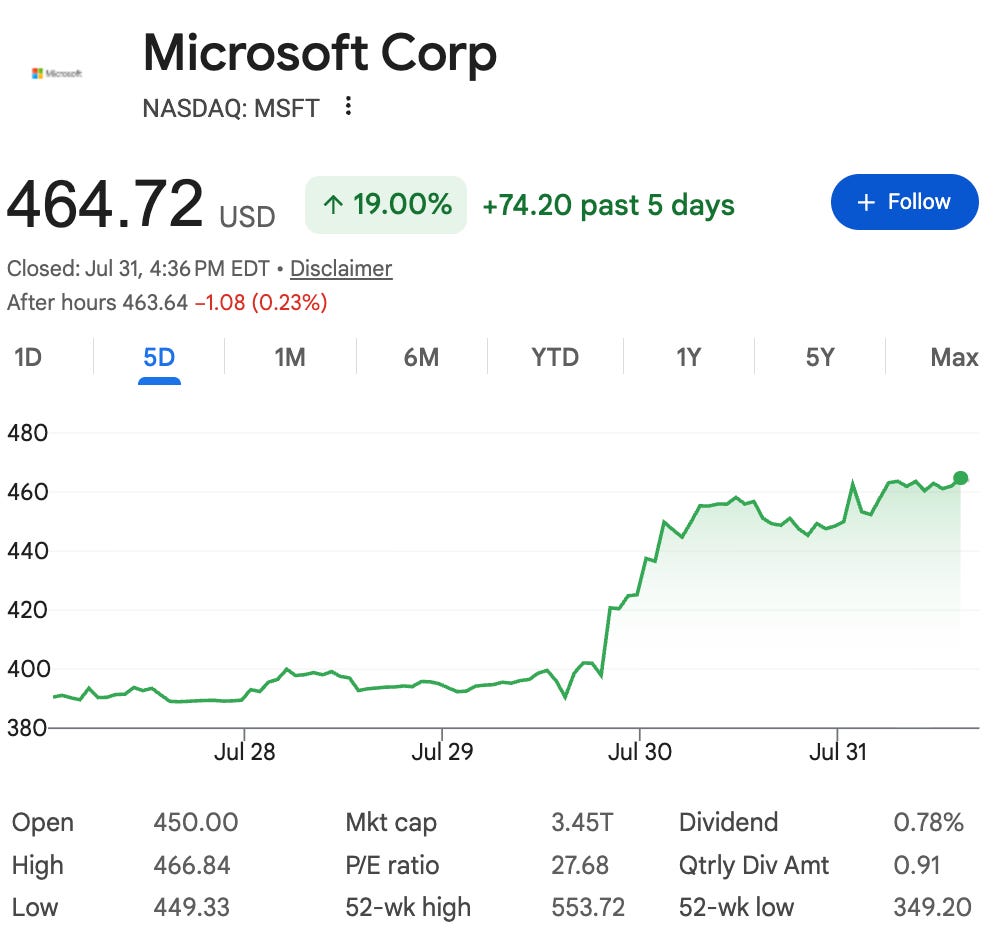
Let’s get into the details:
Models as swappable inputs.
Microsoft’s position is explicit: models should be interchangeable. Azure offers 11K+ models and # of customers using multiple providers grew 5x since the start of the year.
It designs its own products accordingly. Each task is routed to the cheapest model capable of completing it well, while preserving access to frontier intelligence when necessary. This lowers inference costs, improves resilience, and reduces dependence on any single lab.The system around the model.
Microsoft is telling enterprises: use frontier models, small models, open models, your own models - but keep institutional knowledge under your control. This is both an architectural position and a commercial one.
Its ambition is to build the durable exoskeleton around intelligence: enterprise data, identity, permissions, memory, governance, evaluation, tools, and workflows. ~90% of the F500 are already grounding agents using Foundry, Fabric, and Work IQ.DeployCo, Microsoft edition.
In keeping with the style du jour, it has launched its own deployment army. Microsoft Frontier Co will embed 6,000 engineers and experts with customers to co-design and deploy AI systems. This puts Microsoft into direct competition with the frontier lab deploy cos. But it enters with structural advantages: existing relationships with every large enterprise, deep access to their data estates, and the ability to present itself as a model-neutral partner.Frontier Labs: All the upside, none of the risk.
Microsoft retains substantial financial and commercial exposure to the frontier labs. It owns ~27% of OpenAI. It has a large investment in Anthropic, which generated a $3.2B gain during the quarter. It distributes frontier models through Azure and benefits from the infra those companies consume. At the same time, it spent much of the earnings call explaining why no one should depend structurally on any one frontier lab. That is the strategic hedge. Mgmt emphasized on call that 90% of cloud revenue came from customers outside of Frontier Model companies.
Microsoft is hedging the model layer while consolidating control of everything around it.
If frontier models continue improving rapidly, it benefits through investment exposure, partnerships, and Azure consumption
If models commoditize, it benefits because orchestration, infrastructure, data, governance, and distribution become more valuable
If enterprises build their own models, it still sells the compute and control plane
It has arranged its AI exposure so that almost every plausible outcome generates a Microsoft bill. The house always wins.
The rising AI tide lifts all clouds. Especially the largest ones.
Amazon reported an exceptional quarter yesterday: AWS reaccelerated, custom silicon gained traction, retail and ads continued to compound, and it saw demand strong enough to justify one of the largest capex programs in history. That explains why investors looked past negative FCF.
Stock up +15% this week.
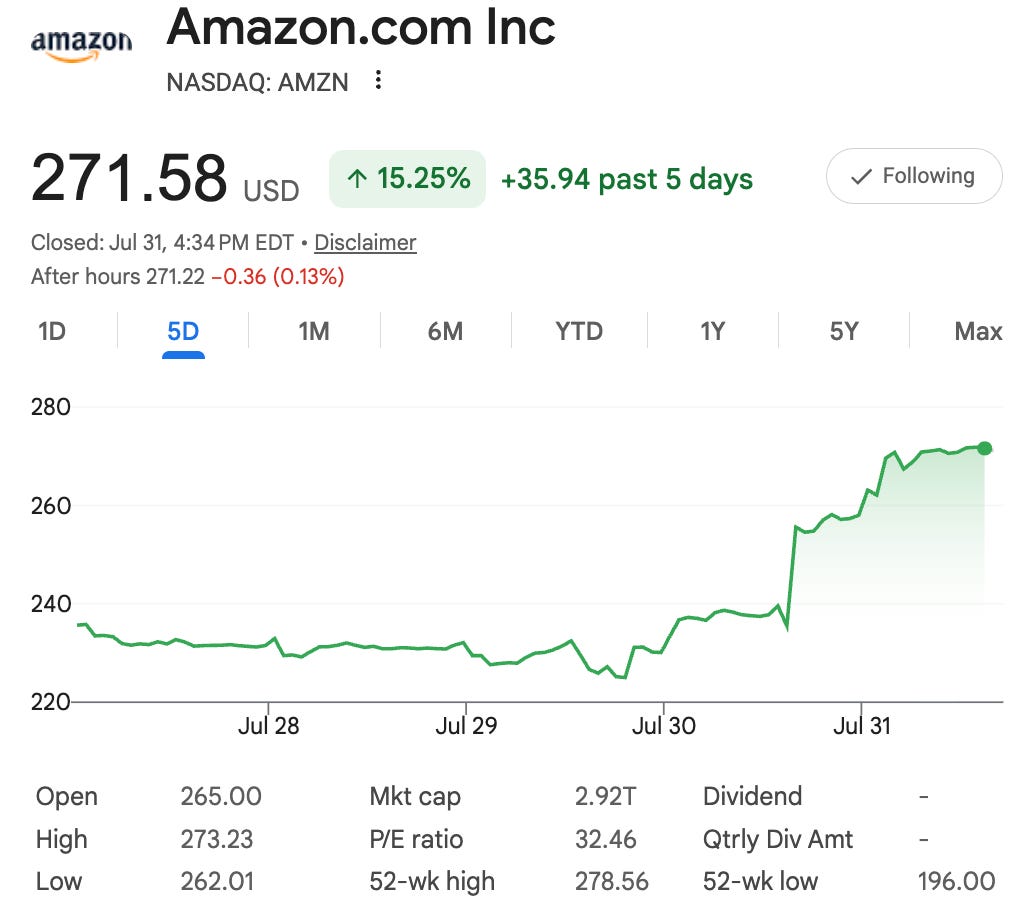
AWS has moved from recovery to reacceleration
AWS revenue reached $42B, +37% YoY and sharply accelerating 28% growth. This was AWS’s fastest growth in 18 quarters.
It now operates at a $169B revenue run rate, with ~40% operating margin. It generates ~61% of total operating profit despite contributing only 21% of revenue.
Amazon described a direct relationship between AI growth and its “core” cloud business: as customers build AI systems, their broader AWS consumption rises alongside it. The AI boom is therefore becoming a cloud-migration catalyst.Amazon is becoming a vertically integrated AI systems company
Amazon is assembling an increasingly integrated AI system: data centers, power, networking, Trainium accelerators, Graviton CPUs, cloud, model access through Bedrock, agent deployment through AgentCore, and applications such as Kiro, Amazon Q and Continuum. The more interchangeable models become, the more valuable the surrounding system becomes.
Jassy noted: “A production agent needs somewhere secure to run, memory so it holds context, an identity so it can act on a user’s behalf, tools and data to connect to, and a way to watch what it’s doing once real traffic hits.” That description doubles as AWS’s roadmap.
Bedrock added more customers during the past 6 months than it did during its first 2 years after launch. Customers spent more on Bedrock last quarter than in every previous quarter combined.All chips are on the table
Amazon has multi-year, multi-GW Trainium commitments from Anthropic and OpenAI, alongside adoption by Uber, Pinterest, Poolside and a growing roster of AI companies. Custom silicon matters for 3 reasons: it lowers Amazon’s dependence on Nvidia, it can expand AWS margins, and it can become a customer-acquisition tool.
Amazon can use Trainium to win the anchor workload, then monetize everything surrounding it: storage, databases, CPUs, networking, security, inference, and development tooling.
Graviton reinforces the strategy. Amazon said its custom Arm-based CPU is used by 98% of its top 1,000 EC2 customers, while revenue increased ~3x QoQ.
Amazon raised its 2026 capex to $220B, up from its prior $200B plan and from $128B in 2025. To put this in perspective, $220B is:
> than the annual revenue of most F100 companies
~28% of Amazon’s trailing-12-month revenue
~$600M of investment per day
~2x Amazon’s trailing operating income
But given the growth rebound, investor appetite for capex seems to have returned. The “one model to rule them all” thesis is fading. Model abundance creates competition above the cloud but consumption within it.
Comments
Nothing yet. Say the first thing.
Sign in to join the conversation.