

You know an industry is growing up when its financing moves from Silicon Valley to Wall Street.

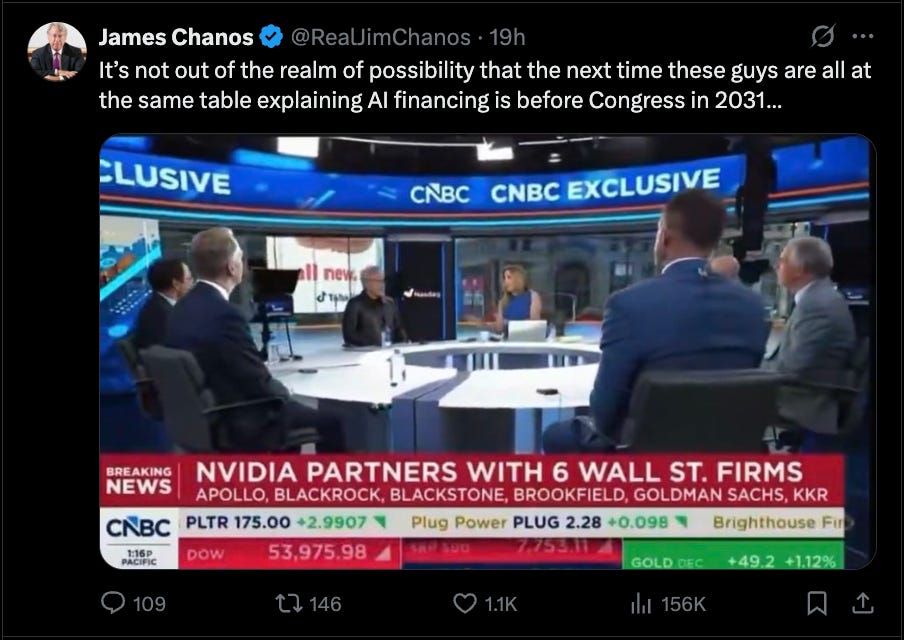
Yesterday, Nvidia announced partnerships with six of the biggest names in global finance - Apollo, BlackRock, Blackstone, Brookfield, Goldman Sachs and KKR - to create independent “compute financing platforms” intended to mobilize more than $500 billion of third-party capital for AI infrastructure.
The idea is straightforward: Nvidia’s customers want far more compute than many of them can comfortably finance themselves. So instead of Nvidia stretching its own balance sheet - or customers writing enormous checks upfront - Wall Street will provide pools of capital to finance the buildout.
Lenders typically love infrastructure because it produces predictable cash flows against durable assets. A toll road has decades of traffic. A power plant has long-term contracts. An airplane can fly for decades, move between carriers and be repossessed and leased to someone else if its owner gets into trouble.
A GPU has traditionally offered a somewhat less soothing credit profile: extremely expensive silicon whose newer, faster replacement is already somewhere on Nvidia’s product roadmap.
Nvidia is trying to change that perception. Its pitch is that Nvidia compute possesses four properties that make it unusually financeable:
Fungible. The same AI factory can serve multiple customers, models and workloads.
Ubiquitous. Nvidia’s architecture is deployed across the major clouds, OEMs, enterprises and AI labs, creating a deep pool of potential users.
Software-upgradable. CUDA improvements can increase the performance and economics of hardware that has already been installed.
Redeployable. If one customer no longer needs a cluster, Nvidia argues there should be plenty of others who do.
Jensen Huang’s thesis, in effect, is that Nvidia compute is not a bespoke asset tied to one buyer or workload. It sits inside a broad ecosystem of potential users and “offtakers,” while software improvements continue to enhance the productivity of the installed base. Those characteristics extend useful life and support residual value.
Nvidia wants lenders to believe that a Blackwell cluster behaves less like an enterprise server and more like a Boeing 737. The airline might fail. The airplane remains valuable.
And Wall Street appears willing to make that bet. Goldman CEO David Solomon explicitly described an opportunity to create a market for credit backed by Nvidia compute.
AI infrastructure projects routinely require tens of billions of dollars. Even hyperscalers cannot indefinitely finance every incremental gigawatt of compute exclusively from corporate balance sheets. Frontier labs and neoclouds have an even more obvious problem: their compute ambitions are orders of magnitude larger than their current cash flows.
So Nvidia is introducing leverage. Instead of asking an AI company, “Can you afford $5 billion of GPUs?”, the relevant question becomes, “Can you support the debt service on $5 billion of GPUs?” That dramatically expands the potential buyer base. It also creates a potentially powerful flywheel:
more financing → more Nvidia infrastructure → more CUDA adoption → deeper utilization and secondary-market liquidity → stronger residual values → cheaper financing → more Nvidia infrastructure
If this works, it will lower the weighted average cost of capital of the Nvidia ecosystem. Competitors would then face a problem that has little to do with FLOPS. AMD might build a competitive accelerator. Google might build a better TPU. A startup might develop dramatically more efficient inference silicon. But if buying Nvidia comes bundled with a deep, liquid financing market, then it starts competing not merely on performance-per-dollar but on performance-per-dollar-per-unit-of-financing-cost.
The entire structure ultimately rests on one very large assumption:
Today’s GPUs will remain economically useful long enough to repay yesterday’s debt.
That is not obviously crazy. Older Nvidia GPUs have retained meaningful utility, and Nvidia’s enormous software ecosystem increases the number of places where used hardware can theoretically find a home. But it is also not the same thing as financing an airport.
Imagine a $2 billion cluster financed on the assumption of five years of attractive inference economics. Two years later, a new architecture delivers 5x better tokens-per-watt. Or model architectures become dramatically more efficient. Or inference shifts toward specialized silicon. The cluster still works, but the economics underwriting the loan may not.
Technology does not need to render an asset useless to impair its economics. It only needs to make the next asset dramatically better.
Nvidia’s announcement includes a section titled “The Important Questions,” which begins with a question on everyone’s mind: is this circular financing?
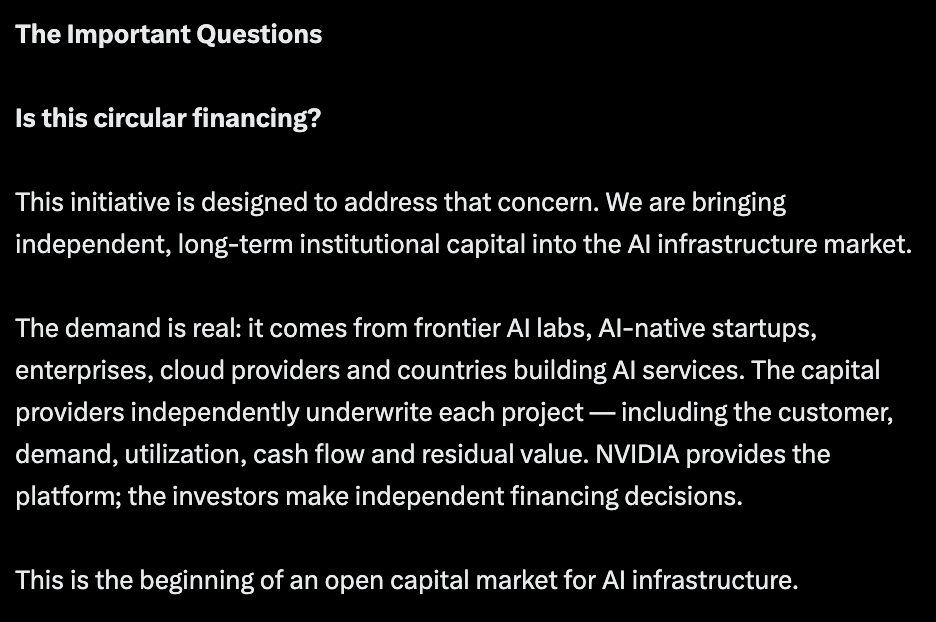
Nvidia’s answer emphasizes that these are independent financing platforms.The company has already been using its own balance sheet to support parts of its ecosystem. Bringing major outside lenders into the market moves underwriting risk toward institutions whose actual job is to price credit.
But declaring the end of “circular financing” would be premature. Third-party underwriting can reduce circularity but it does not repeal incentives. Nvidia wants more GPUs sold. Borrowers want access to enormous amounts of capital. Asset managers want assets to manage. Private-credit firms want loans to originate. Insurers and pensions want yield. Every participant can behave rationally on its own while the system collectively becomes less rational.
Market crises are rarely driven by one villain sitting in a conference room saying, “What if we destroy the financial system?” There usually are 10,000 people saying, “This deal works at an 8% return.”
Financial innovation often begins by solving a genuine economic problem. The defining infrastructure booms in history eventually became too large to fund with corporate equity alone. Railroads required railroad bonds. Housing required mortgages. Cars required auto loans. Aircraft required leasing. AI infra may require compute credit.
There is real elegance in the idea. Compute can generate revenue, but the upfront capital required to produce it is enormous. Bringing in outside capital to bridge those two things is exactly what financial markets are supposed to do.
The danger usually begins a few turns of the crank later. A good loan becomes a security, the security becomes a structured product, the structured product gets sliced into different risk tranches, those tranches become inputs to still more products, and eventually everyone can explain their own piece of the system but no one can quite explain the whole thing. We have seen this film before.
Securitization itself is not the problem. It is one of the most powerful mechanisms modern finance has developed for connecting capital with productive assets.
The problem arises when the market begins confusing liquidity with safety. An asset does not become less risky because you can sell it faster.
Credit booms have a recurring pattern. When asset values are rising, everybody looks like a genius. Good underwriting and a bull market produce remarkably similar results in the short term.
That does not mean Nvidia’s financing push is reckless. It just means we have to be careful to not let greed outrun caution.
For the last few years, the most important Nvidia metrics have been things like GPU shipments, data-center revenue and tokens per watt. Soon, the most important metric determining the health of the company, and even our economy at large, may become the assumed residual value of a three-year-old GPU.
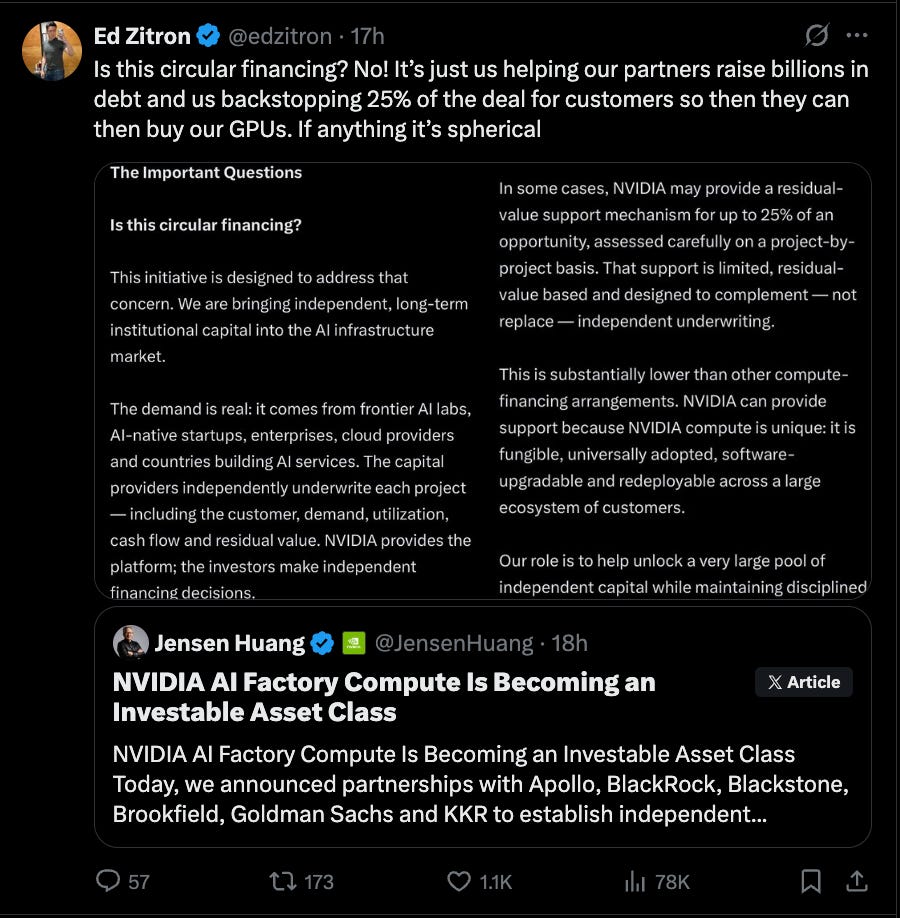
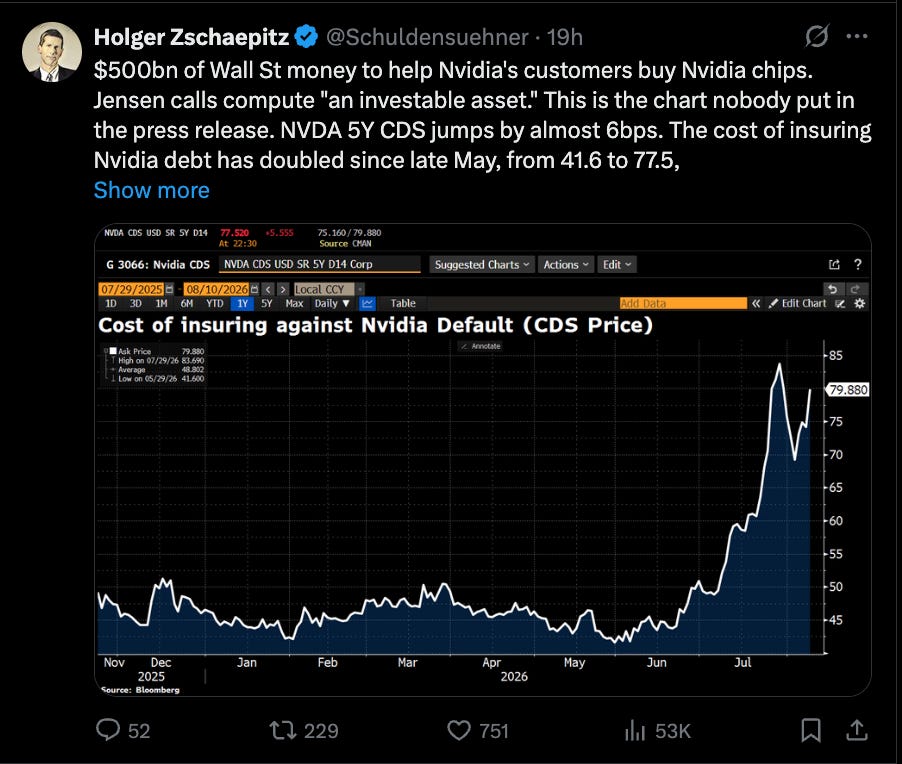
Some funny reactions from the fine people of X:
Comments
Nothing yet. Say the first thing.
Sign in to join the conversation.