
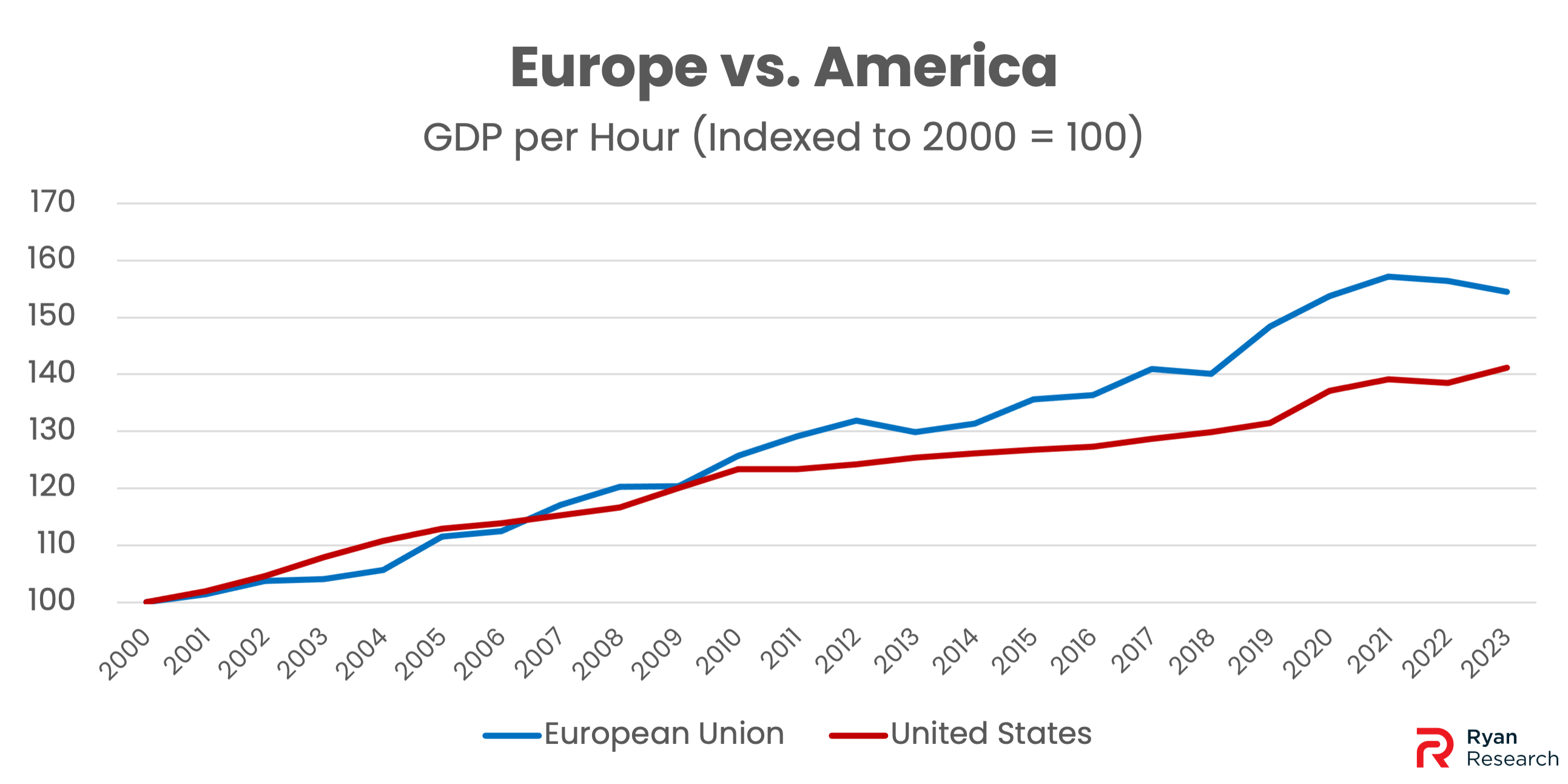
The European Union grew faster than the United States of America, in GDP per hour relative to their starting point in 2000. The European Union grew 55 percent while America grew only 41 percent. Each grew at par in the early 2000s but, after the 2008 Global Financial Crisis, the European Union diverged upward and America never caught back up.
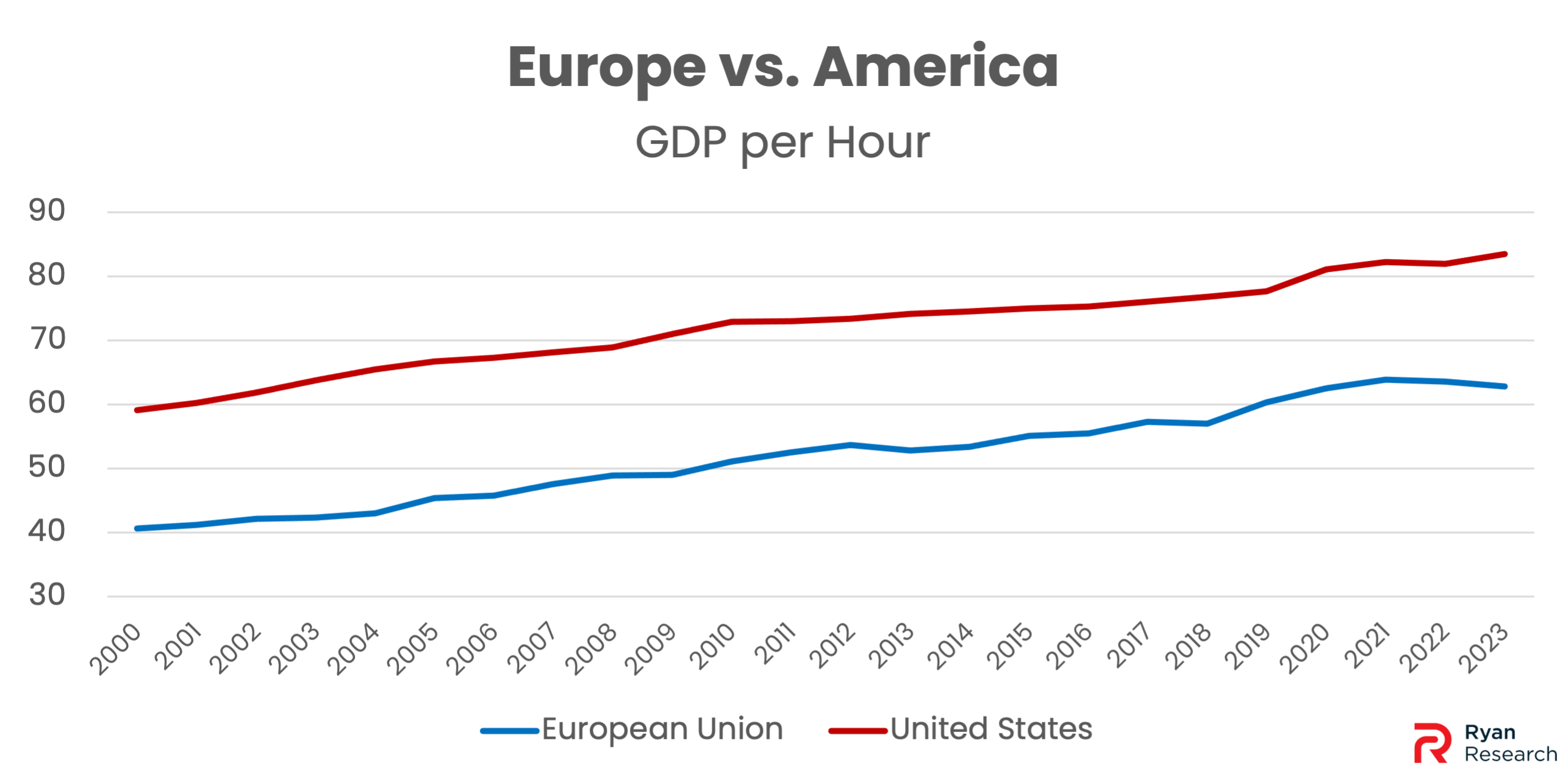
In absolute terms, America’s GDP per hour remained higher than that of the European Union’s, from 2000 to 2023. America’s GDP per hour grew from 59.15 to 83.53. The European Union’s GDP per hour grew from 40.68 to 62.87.
As a side note, China’s grew by 405 percent, during this period, but its current absolute value is about a quarter to that of the European Union’s and America’s.
This data was sourced from Feenstra et al. - Penn World Table (2025) – with major processing by Our World in Data. This data is expressed in international-$ at 2021 prices.
This data focused on GDP, however, that is not always a reliable measure to evaluate the economic living standards experienced by the common man. In a past essay, I broke down how to think about GDP relative to median wages and costs of living.
American vs. European GDP Per Capita
·
August 28, 2025

American economic well-being is suggested to be much greater than European economic well-being, but closer examination revealed more nuance that inverted that suggestion. Sam Bowman’s Reason Magazine article compared America and Europe to make the pro-American and anti-European case. His argument was most reliant on GDP per capita comparisons. He wrote, “In Western Europe, GDP per capita—the average economic output per person—is about $63,000 per year, adjusted for the cost of living. In the United States, it is $86,000.” Without this comparison, the rest of Bowman’s essay is much less compelling. This difference is the necessary conceit to justify lauding the American economic model over that of Europe.
My essay:
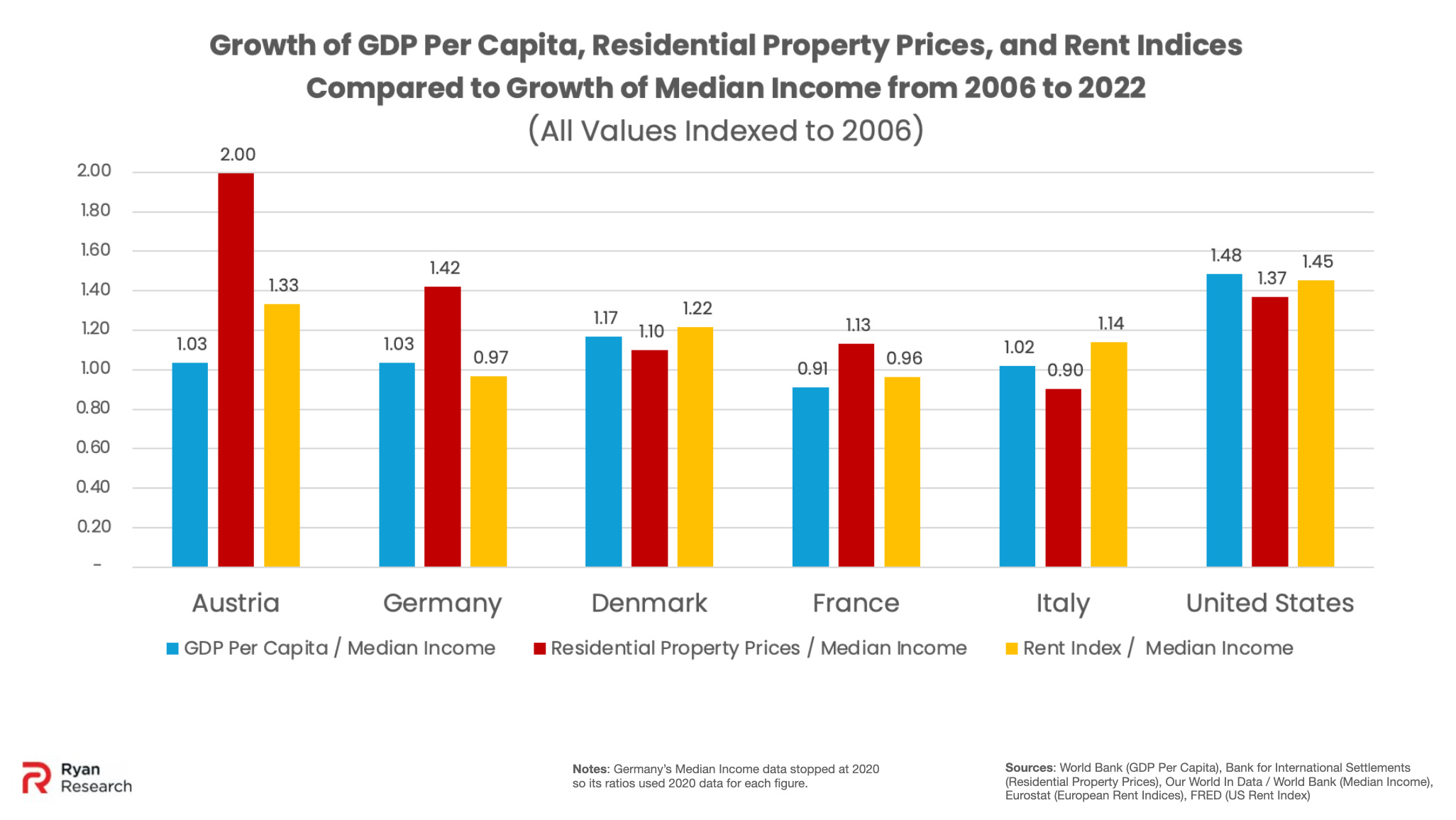
The results revealed that American GDP per capita growth overstates actual American well-being which is better captured by American median income growth. American GDP per capita growth was 48 percent more than American median income growth. In contrast, Austria’s was 3 percent more, Germany’s was 3 percent more, Denmark’s was 17 percent more, France’s was 9 percent less, and Italy’s was 2 percent more. The average of the European sample was a 3 percent overstatement making the American overstatement 44 percent worse. This means that in the European sample, GDP per capita and median income can be seen as fair proxies for one another as they are almost equal.
However, American GDP per capita appeared much more decoupled from American median income. American median incomes only grew by 13 percent from 2006 to 2022 while American GDP per capita grew by 68 percent in the same period. GDP per capita is simply averaging the total GDP which means when it overshoots median incomes then economic gains are not evenly distributed. This uneven distribution of economic gains is due to America’s greater economic inequality compared to Europe.
According to Our World in Data in 2023, much of Europe had a Gini coefficient of 0.2 to 0.4 while America’s averaged to 0.45. According to World Inequality Database in 2023, the top 1 percent in America earned 21 percent of all income compared to the top 1 percent cohorts in Austria at 11 percent, Germany at 13 percent, Denmark at 12 percent, France at 12 percent, and Italy at 12 percent. America’s top 1 percent earns almost double the share of income as the European sample’s top 1 percent.
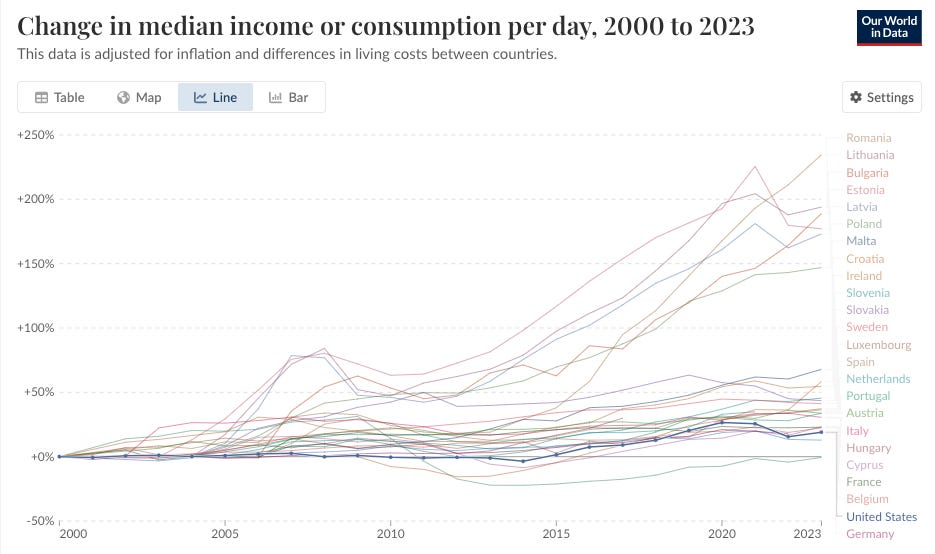
America’s lack of ability, relative to the European Union, to translate overall GDP growth into proportional median income growth can been seen in the trends of median income from 2000 to 2023. America’s median income only increased by 19 percent. Meanwhile, Belgium’s grew by 22 percent, France’s by 23 percent, Italy’s by 30 percent, Spain’s by 36 percent, and Sweden’s at 41 percent. Most countries in the European Union saw their median incomes grow at faster rates than median incomes in America.
While America can demonstrate a high level of GDP, it has a harder time demonstrating that its high GDP, for lack of a better term, trickles down from the heights of the economy to the ordinary American. The European Union’s GDP demonstrated a more proportional relationship with median incomes. The European Union’s public benefits and more attractive costs of living also increase the realized living standard relative to America which lacks those aspects.
In the Europe vs. America debate, it is important to contextualize headline data and pick apart what really matters from what is fluff.
No posts
Comments
Nothing yet. Say the first thing.
Sign in to join the conversation.