
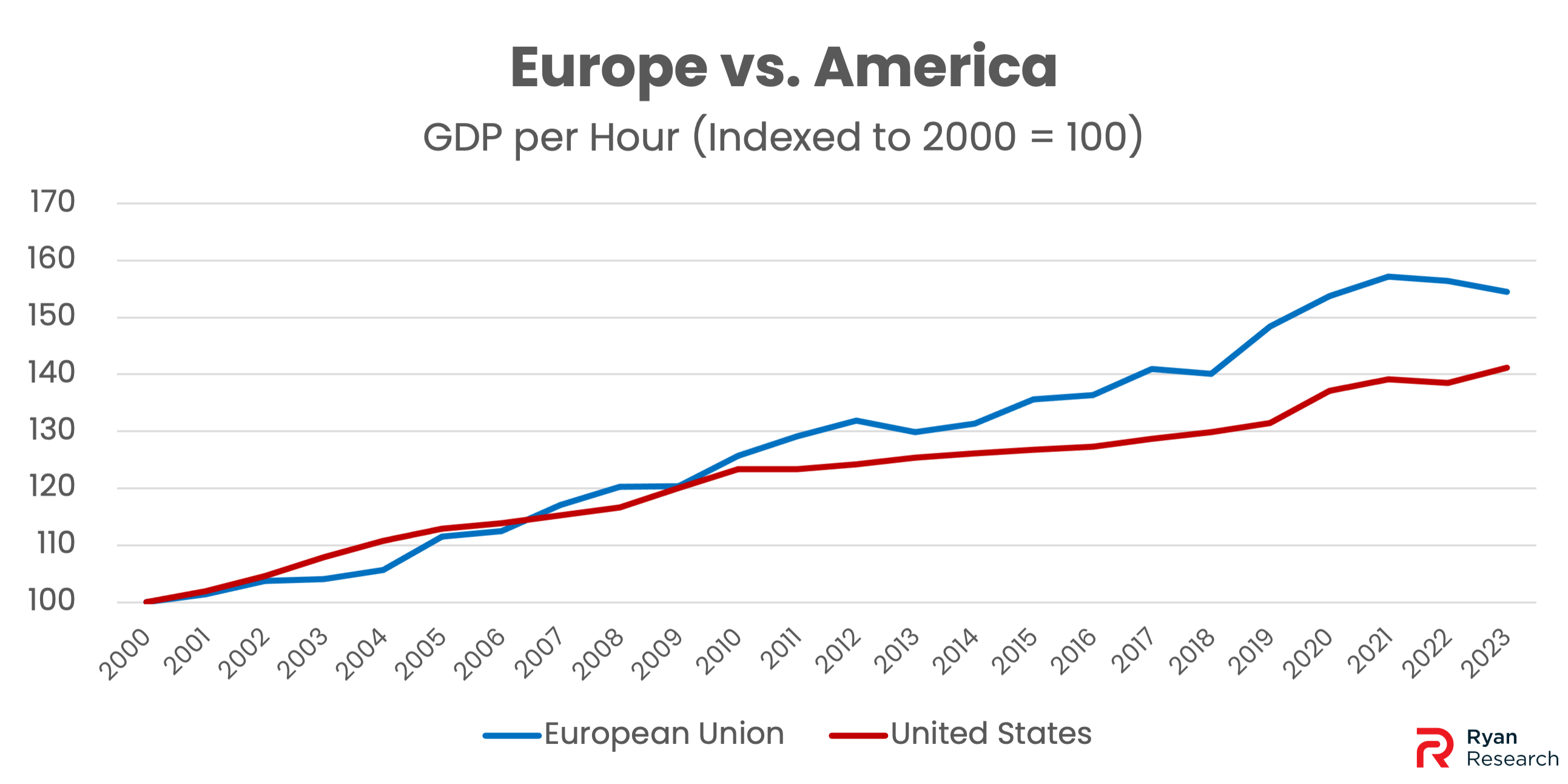
The European Union grew faster than the United States of America, in GDP per hour relative to their starting point in 2000. The European Union grew 55 percent while America grew only 41 percent. Each grew at par in the early 2000s but, after the 2008 Global Financial Crisis, the European Union diverged upward and America never caught back up.
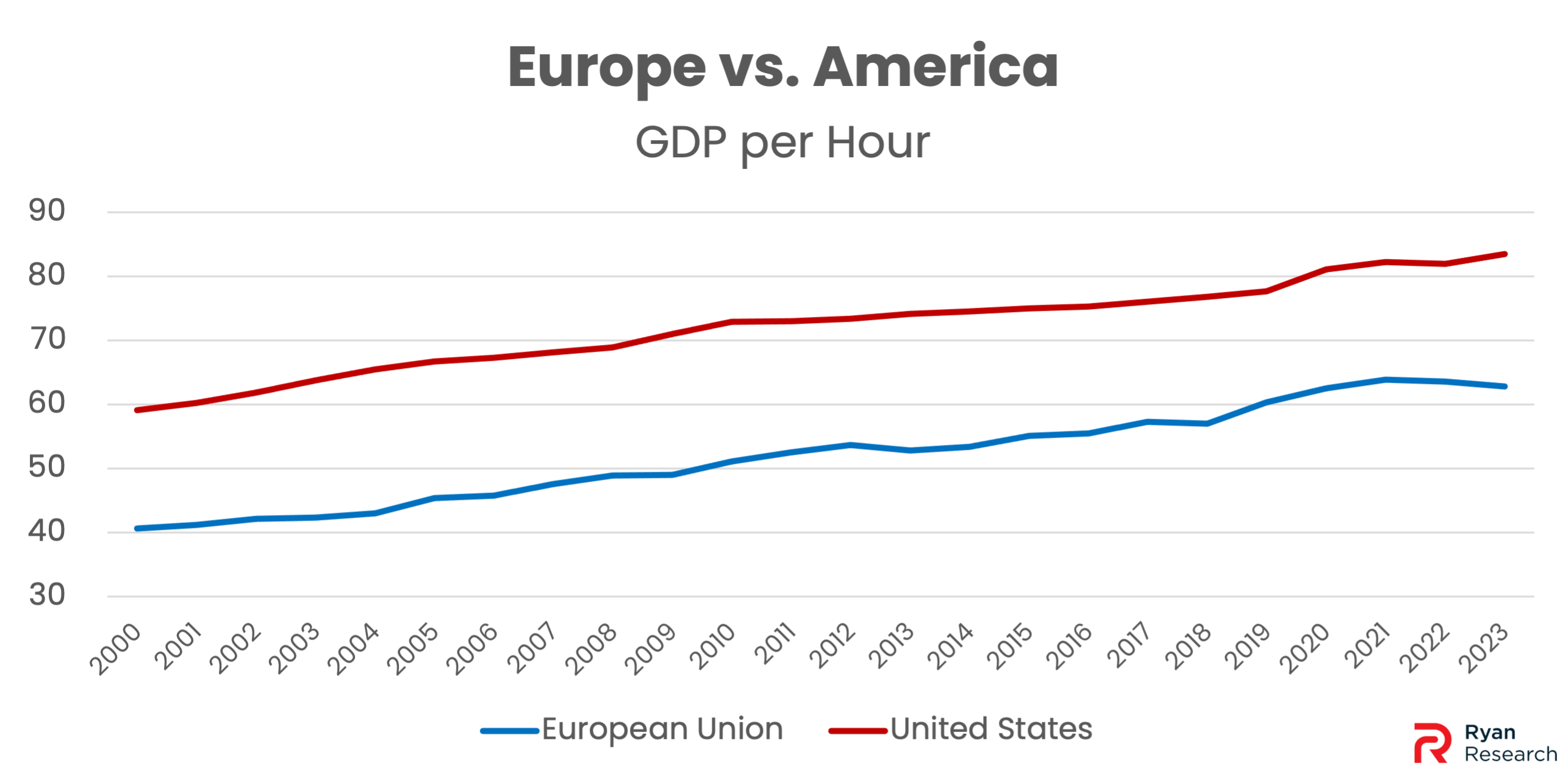
In absolute terms, America’s GDP per hour remained higher than that of the European Union’s, from 2000 to 2023. America’s GDP per hour grew from 59.15 to 83.53. The European Union’s GDP per hour grew from 40.68 to 62.87.
As a side note, China’s grew by 405 percent, during this period, but its current absolute value is about a quarter to that of the European Union’s and America’s.
This data was sourced from Feenstra et al. - Penn World Table (2025) – with major processing by Our World in Data. This data is expressed in international-$ at 2021 prices.
This data focused on GDP, however, that is not always a reliable measure to evaluate the economic living standards experienced by the common man. In a past essay, I broke down how to think about GDP relative to median wages and costs of living.
American vs. European GDP Per Capita
·
August 28, 2025

American economic well-being is suggested to be much greater than European economic well-being, but closer examination revealed more nuance that inverted that suggestion. Sam Bowman’s Reason Magazine article compared America and Europe to make the pro-American and anti-European case. His argument was most reliant on GDP per capita comparisons. He wrote, “In Western Europe, GDP per capita—the average economic output per person—is about $63,000 per year, adjusted for the cost of living. In the United States, it is $86,000.” Without this comparison, the rest of Bowman’s essay is much less compelling. This difference is the necessary conceit to justify lauding the American economic model over that of Europe.
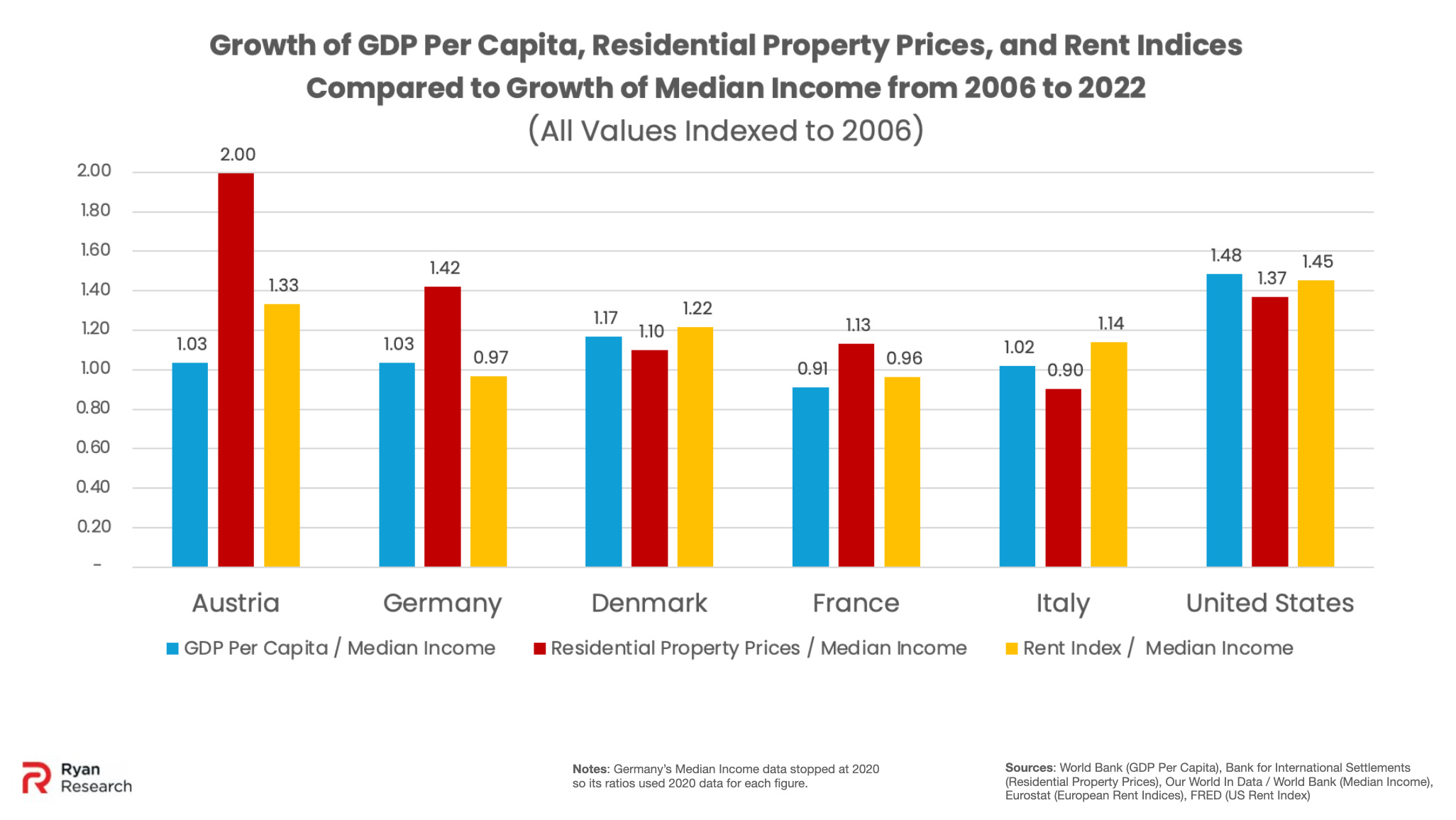
The results revealed that American GDP per capita growth overstates actual American well-being which is better captured by American median income growth. American GDP per capita growth was 48 percent more than American median income growth. In contrast, Austria’s was 3 percent more, Germany’s was 3 percent more, Denmark’s was 17 percent more, France’s was 9 percent less, and Italy’s was 2 percent more. The average of the European sample was a 3 percent overstatement making the American overstatement 44 percent worse. This means that in the European sample, GDP per capita and median income can be seen as fair proxies for one another as they are almost equal.
However, American GDP per capita appeared much more decoupled from American median income. American median incomes only grew by 13 percent from 2006 to 2022 while American GDP per capita grew by 68 percent in the same period. GDP per capita is simply averaging the total GDP which means when it overshoots median incomes then economic gains are not evenly distributed. This uneven distribution of economic gains is due to America’s greater economic inequality compared to Europe.
According to Our World in Data in 2023, much of Europe had a Gini coefficient of 0.2 to 0.4 while America’s averaged to 0.45. According to World Inequality Database in 2023, the top 1 percent in America earned 21 percent of all income compared to the top 1 percent cohorts in Austria at 11 percent, Germany at 13 percent, Denmark at 12 percent, France at 12 percent, and Italy at 12 percent. America’s top 1 percent earns almost double the share of income as the European sample’s top 1 percent.
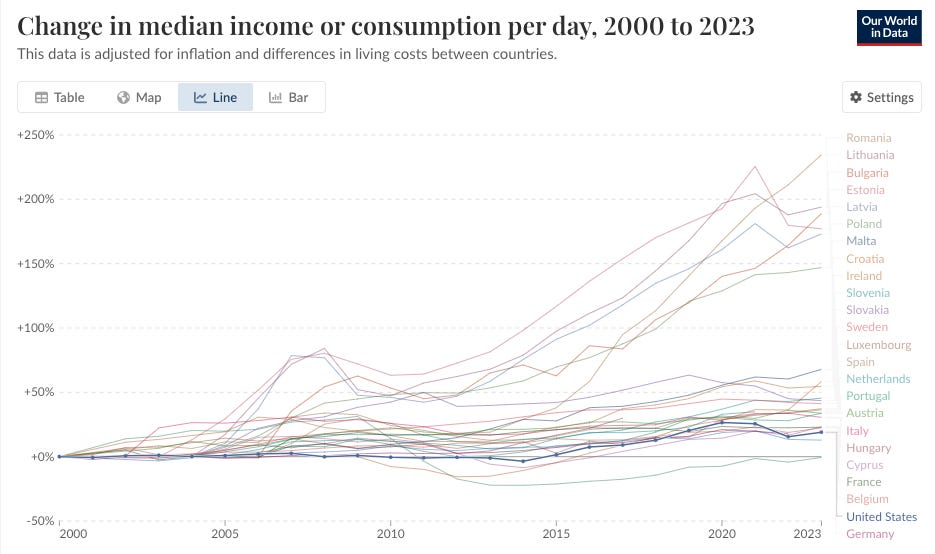
America’s lack of ability, relative to the European Union, to translate overall GDP growth into proportional median income growth can been seen in the trends of median income from 2000 to 2023. America’s median income only increased by 19 percent. Meanwhile, Belgium’s grew by 22 percent, France’s by 23 percent, Italy’s by 30 percent, Spain’s by 36 percent, and Sweden’s at 41 percent. Most countries in the European Union saw their median incomes grow at faster rates than median incomes in America.
While America can demonstrate a high level of GDP, it has a harder time demonstrating that its high GDP, for lack of a better term, trickles down from the heights of the economy to the ordinary American. The European Union’s GDP demonstrated a more proportional relationship with median incomes. The European Union’s public benefits and more attractive costs of living also increase the realized living standard relative to America which lacks those aspects.
In the Europe vs. America debate, it is important to contextualize headline data and pick apart what really matters from what is fluff.
Sources: Ryan Research, Our World in Data
This is an informative video that explained a lot of the same themes as my above analysis. They included a section that explained nuances between current and constant prices.
Source: TLDR News
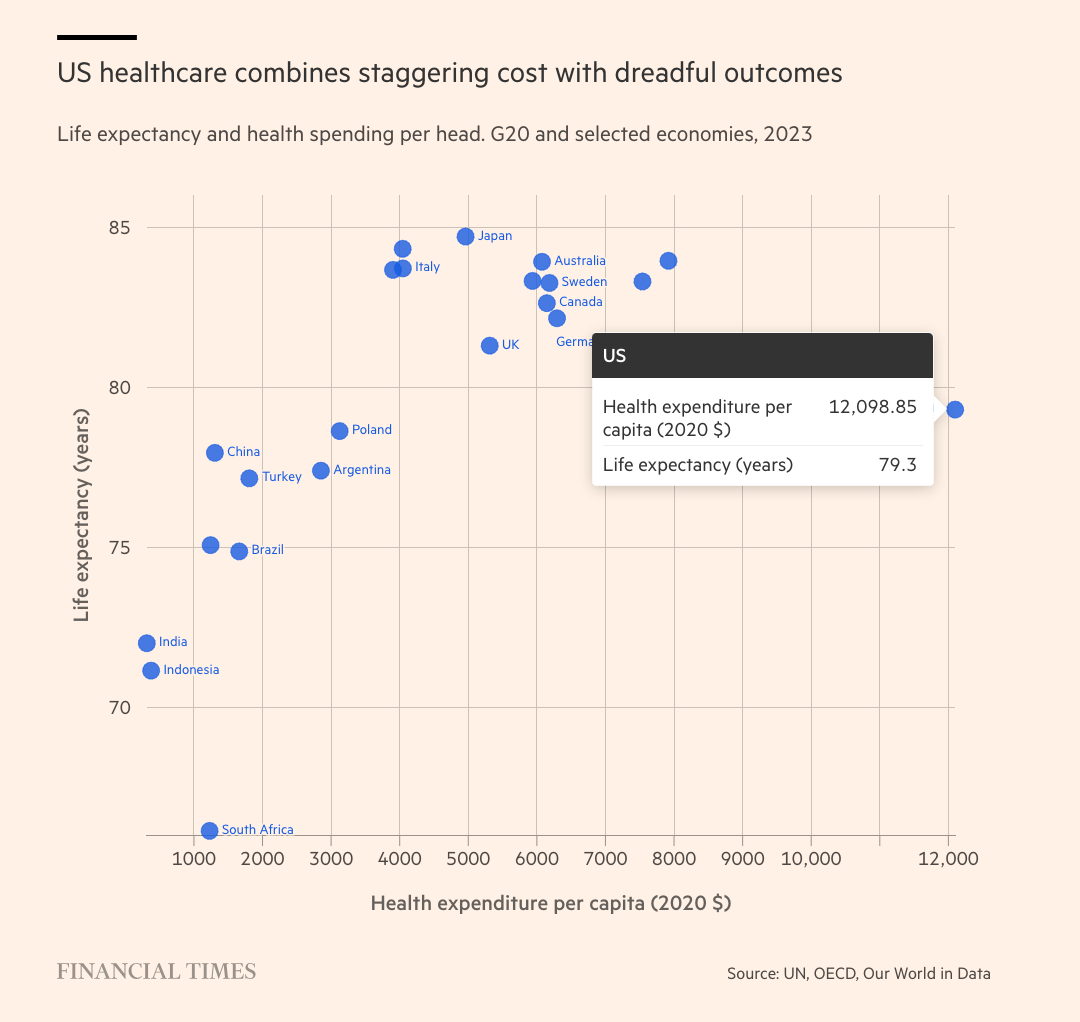
Martin Wolf tackled the Europe vs. America debate with some interesting figures.
At the same time, we should remember those bold words about “life, liberty and the pursuit of happiness” in the Declaration of Independence. Life expectancy for US men was 76.5 in 2024, against an average of 80.5 in comparable high-income countries. For women, it was 81.4 against 84.8. That is despite spending a far higher proportion of its GDP on health. The US homicide rate was 5.9 per 100,000 in 2023, against 1.3 in France and 0.9 in Germany. Its prison population was 542 per 100,000 in 2023, against 130 in France and 69 in Germany. Thus, if one takes a wider view of human welfare, the US is very far from superior. Indeed, it is arguably the reverse if one measures it against the aims of its founders.
Here he found some indication of how living standards are really experienced vs. glossy abstract GDP figures. However, he further inquired into the discrepancy between European and American GDP, in absolute terms.
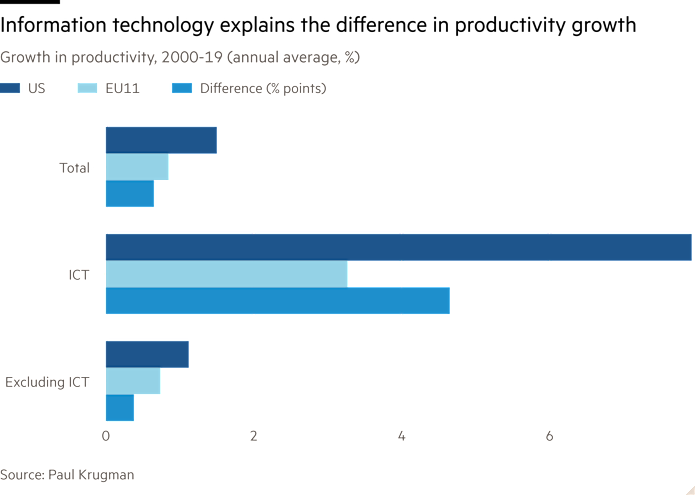
He located most of the source in the discrepancy through the tech sector. The American tech sector certainly innovates but is also accused of having entered a bubble phase. Additionally, it receives monopoly privileges in non-American markets because those markets, such as Europe, have never aggressively used carrot and stick policies to prohibit American tech firms and develop infant tech industries. Think of how Europe protected its traditional manufacturing industries throughout the 20th and 21st centuries for a stark comparison to how it does not protect its own tech sector. In this light, this tech advantage that America has looks more fragile.
Source: The Financial Times
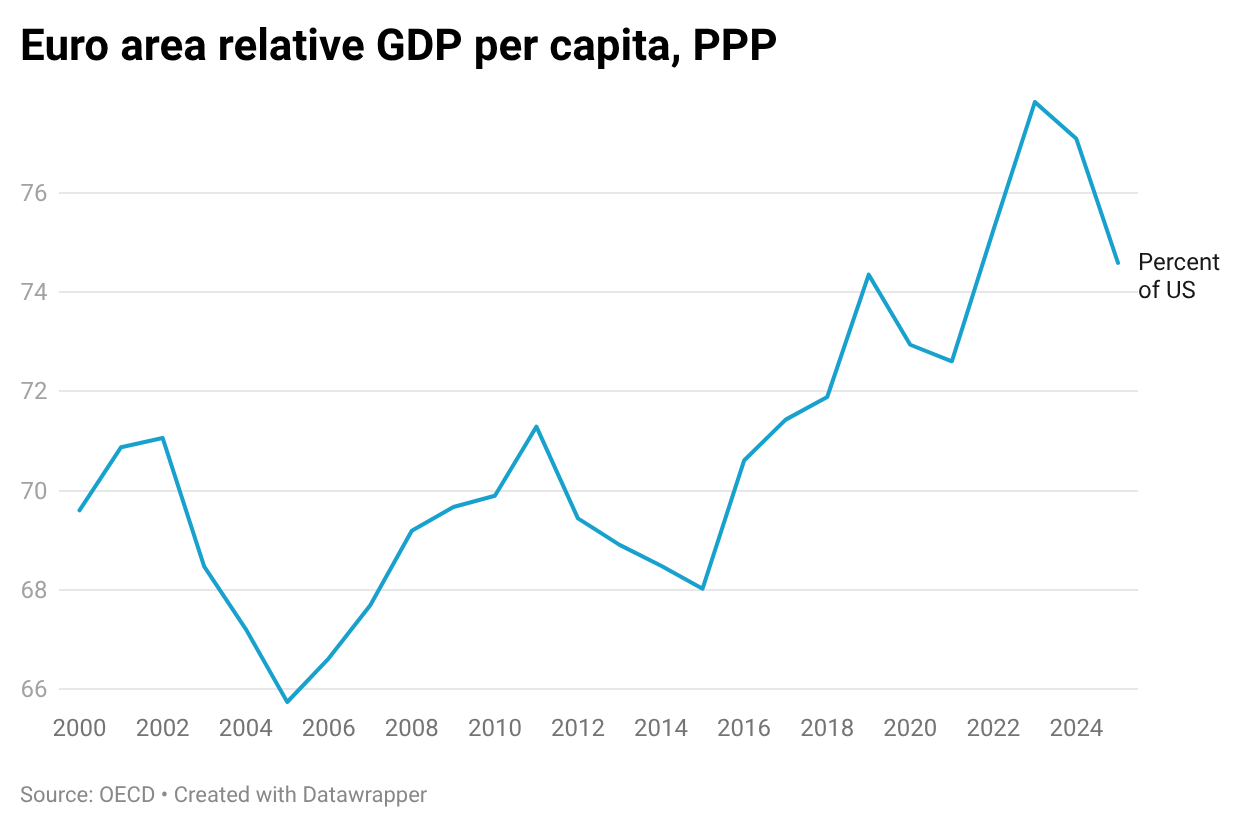
Wolf referenced Paul Krugman’s essay quite a bit. Krugman tackled this topic and argued against the notion that Europe is drastically failing. As can be seen in his chart above, in some measures, Europe is narrowing the gap between itself and America.
I will argue that the preponderance of the evidence supports the view that Europe is not in relative decline. I will show that comparisons that seem to show Europe lagging ignore important qualifications – qualifications that can render those comparisons misleading. First, there is a big difference between the EU and the US in industrial mix: the U.S. economy is more highly concentrated than Europe in “tech”, which creates a divergence in measured growth but not in living standards. Second, it is inherently difficult to measure growth in the face of technological change – a problem that doesn’t arise, notably, when comparing economies at a given point in time.
…
I’ve argued at length in this post that Europe is doing much better…Europe is not a museum, a monument to vanishing glories. By what are arguably the most important measures, Europe is holding its own against the United States…We can reject the idea that Europe is an irreversible decline. It would be tragic if the narrative of decline led Europe to abandon its achievements in social justice, allow a destructive free-for-all in AI, social media and so on…The data simply do not support the extremely pessimistic European stories that are so widely circulated.
Krugman also hinted at the need for Europe to think more about developing infant tech industries to have its own domestic tech sector.
Source: Paul Krugman

Jesús Fernández-Villaverde@JesusFerna7026
If you ever took a course in economic history, chances are you heard the argument that the trade embargo of 1807, the subsequent non-importation measures, and the War of 1812 gave a big boost to U.S. manufacturers. I certainly did! This is a common argument in favor of tariffs,


Jesús Fernández-Villaverde @JesusFerna7026
A post of mine on industrial policy from last July is having a second life, so let me rewrite it more clearly now that I have more experience with X. Can industrial policy work? Yes. The East Asian experience shows it can, at least partially. But its success rests on a key https://t.co/uoMZ3Ua6gQ
1:03 PM · Jul 21, 2026 · 73.8K Views
11 Replies · 106 Reposts · 491 Likes
AEI fellow Jesús Fernández-Villaverde simplified a new paper by Joseph Davis and Douglas Irwin on trade disruption in the early 19th century to evaluate effects on economic output. He turned economic history into a partisan hyperbole, that I assume Davis and Irwin would not endorse. Mercatus fellow David Beckworth further embellished along with him, through his tweet: “Big blow to all the Ha-Joon Chang/industrial policy fans.” Fernández-Villaverde’s claim that the paper demonstrated that there is “no evidence” to the efficacy of protectionism is a drastically misleading thing to say when the paper goes out of its way to say it’s not making that claim and provides nuance to even suggest otherwise.
The paper focused on the period of the European Napoleonic Wars and the American War of 1812. This was a period of reactionary American policy towards chaotic events when Jeffersonian-Madisonian Southern Agrarian liberalism, and their allies of Boston Brahmin trade mercantilism, still dominated the American political zeitgeist.
The paper’s data revealed that, while the overall industrial production trend was neutral, types of industrial production differed. Infant industry production was 31 percent higher and foreign trade dependent production 58 percent lower. However, upon the conclusion of the period, with a resumption of trade, both trends canceled out.
So, this episode revealed both the rise in infant industry production because of the trade disruption but also the limits of this cause and effect (or otherwise considered reactionary/dumb policy). This is why the conclusion of the War of 1812 is such a watershed moment. That’s because both US presidents during this period, Jefferson and Madison, admitted their southern agrarian liberalism was naive and the zeitgeist shifted towards northern industrial protectionism.
Both Jefferson and Madison wrote to Mathew Carey about how he was right and they were wrong. Mathew Carey was the leading Hamiltonian protectionist economist whose Olive Branch book/pamphlets of 1814-1815 became American best sellers. It is suggested that only bibles sold more copies than the Olive Branch during this time. Carey’s Hamiltonian protectionist vision gained popularity.
As a result, the Dallas Tariff (America’s first manufacturing oriented protectionist tariff) and the Central Bank rechartering took place in 1816. Federal internal improvements were also pushed by measures such as the 1817 Bonus Bill but were slower to implement. Eventually federal internal improvements would manifest in 1820s. State level improvements were faster such as the commencement of the construction of the Erie Canal in 1817.
This was a proactive and systematic/smart approach to industrial protectionism distinct from the prior period’s neglect and reaction. Carey disciple Henry Clay would eventually call this set of policies the American System.
What did Davis and Irwin have to say about what happened next? The “actual infant industry production is about 40 percent higher than forecast in the early 1820s.”
The paper highlights the realities of nation building, economic development, and scientific vs. reactionary statecraft. To build a secure and sovereign nation one needs economic development. To do the later one needs industrial protectionism (the scientific kind not the reactionary kind). This means protectionism is not simply broad brush trade isolationism but a variety of technical policies.
However, there are trade offs. The biggest problem being foreign trade dependent industries who tend to be losers of this paradigm shift. If they are not handled delicately, they will fight you tooth and nail. The haphazard 1820s-1850s (think President Andrew Jackson and the Panic of 1837) and the American Civil War are the fruits of not handling these losers properly.
The paper is not a slam dunk case against protectionism as Fernández-Villaverde hinted at. It is rather a window into the complex and challenging history of how to build a nation. It revealed the nuances of how to effectively apply protectionist policies. These neoliberal academics sought to use the paper to push their agenda without having properly read the very thing they were weaponizing. All they did was demonstrate that neoliberal academics are incompetent and deceptive.
Source: The Economic History Review via Wiley
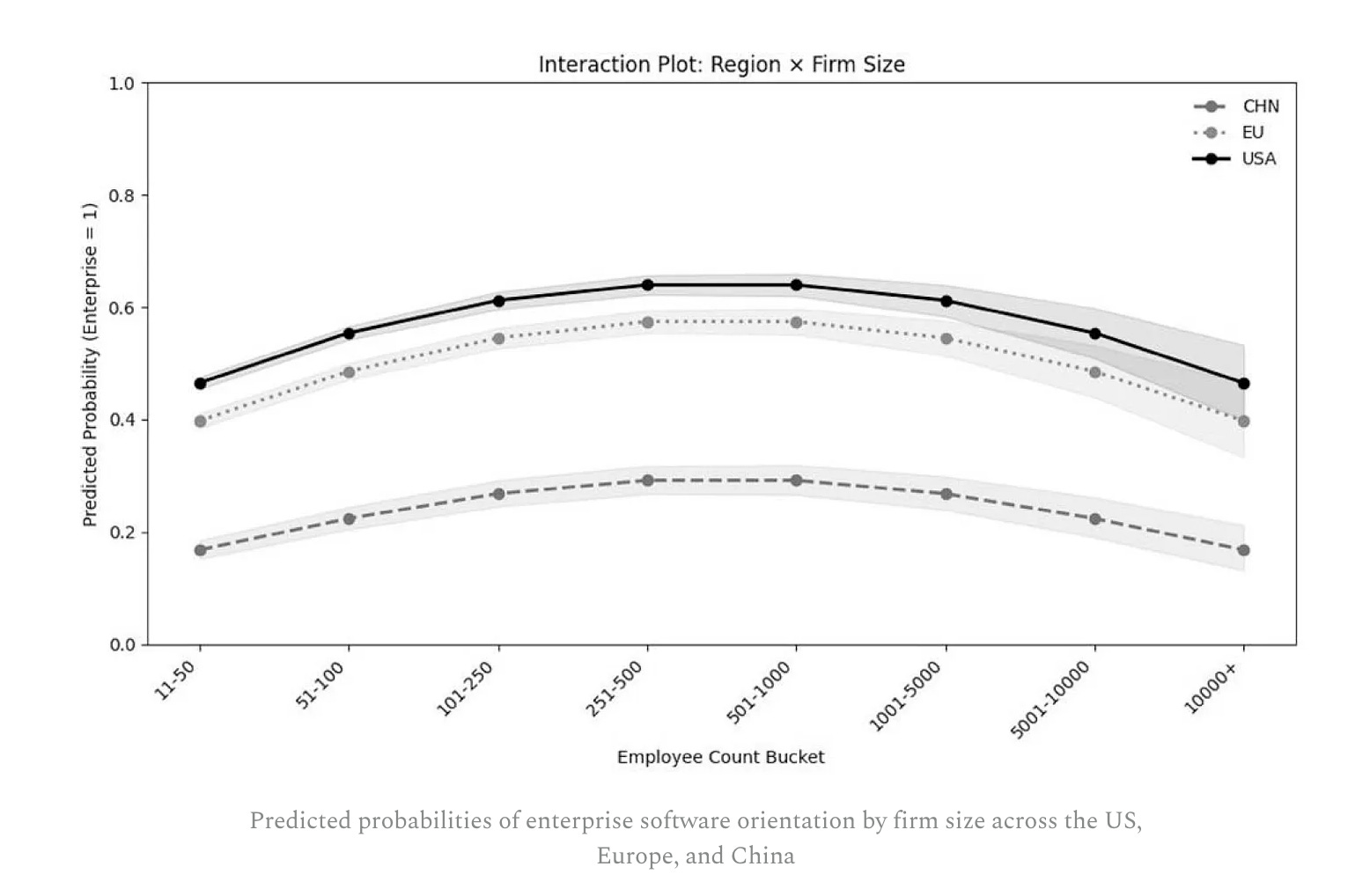
JS Tan published some interesting research that offered a more nuanced understanding of China’s economy. While conventional wisdom and China whisperers, like Dan Wang, emphasize China’s engineering prowess, such a big picture analysis may miss some details. Tan provided those details. He explained the lack of Chinese enterprise-facing software platforms relative to consumer-facing ones. He also expanded on the features and consequences of this unique structural dynamic.
There is no doubt that China has great tech companies—Tencent, ByteDance, Alibaba, to name a few. But virtually all of them have built their digital empires on consumer-facing services…Puzzlingly, what is missing are enterprise software and SaaS giants—the building blocks of a thriving software ecosystem. China in fact seems to have no counterparts to [American SaaS] companies…Despite the size of its digital sector and access to plenty of software talent, the development of the Chinese tech sector has indeed taken a very different path, and this is what I show in a new paper published earlier this month in Industrial and Corporate Change where I analyze over twenty thousand tech companies founded between 2000 and 2020. My key empirical finding is that, between consumer-facing platforms and the kind of enterprise-facing ones you would expect to find in a dynamic software ecosystem, tech companies in China are 76% less likely to be in the latter category when compared to their American counterparts.
What explains this? My paper spends a significant amount of time with exactly this question so I’ll encourage you to read it (dm me for the pdf since it is behind the paywall). For now though, what I’ll say is that China’s political economy makes for a uniquely inhospitable environment for such enterprise software and SaaS companies. At its core, the business model underpinning these enterprise software/SaaS requires longterm inter-firm relations because, unlike consumer platforms, most of their revenue comes from far fewer customers to whom they provide much deeper services. However, these longterm relationships require trust, and China is in short supply of that…At the core of this is a deep-rooted belief that software is not a productive investment but simply a cost to minimize. And so, wherever they can, businesses will internalize the cost of software by hiring budget engineers to develop solutions at much lower costs. This, of course, is only possible because of the large supply of inexpensive engineering labor in China.
Source: Value Added
a new study from Gartner…surveyed 350 global business executives whose companies are pulling in at least $1 billion annually to investigate whether all these AI layoffs are paying off in the real world…a total of 80 percent admitted to trimming their human staff to make investments in AI or autonomous technology. But they say they had no idea if AI would actually generate any benefits — they were simply buying into the promise of automation via AI.
That’s where things get interesting. The Gartner survey found that execs who slashed staff to invest in AI have seen the same financial gains as those who held onto their employees. In other words, attempting to replace workers with AI isn’t showing any detectable returns for these companies. And to make matters worse, many of these businesses specifically reduced their headcount to free up the cash needed for AI technology, meaning they sacrificed valuable institutional knowledge and employee goodwill for nothing.
Source: Futurism
A landmark AI development billed as delivering jobs and prosperity has misrepresented its plans to channel a nuclear reactor’s worth of power to a site in rural Scotland, a Guardian investigation has found.
When it was announced in January, the government promised that an £8.2bn AI datacentre complex in Lanarkshire – built by the US firm CoreWeave and the Scottish company DataVita – would be powered entirely from on-site renewables and built by 2030…A central plank of the project’s viability was its ability to power itself.
But documents obtained through freedom of information (FoI) requests and analysis of public records suggest the datacentre has no prospect of meeting that goal…In response to questions from the Guardian, the government said the Lanarkshire complex would connect to the grid. This means it will either join a years-long queue or be expedited ahead of hundreds of other projects also vying for a connection…The findings raise critical doubts over the UK’s ability to confront the key question now facing the world’s massive AI buildout: how to provide the extraordinary energy required to make it plausible.
…
“It indicates that the AI growth zone designation is based more on optimistic and flashy promotional material than anything technically viable,” he said.
Source: The Guardian
Data centres accounted for almost a quarter of the electricity consumed in Ireland last year, up from 5 per cent in 2015, the Central Statistics Office (CSO) said on Tuesday, amid continuing public debate around the strain the sector is putting on Irish energy infrastructure.
A total of 7,663 gigawatt-hours (GWh) of electricity from Ireland’s expanding grid capacity was used by data centres in 2025, up 10 per cent from 6,973GWh in 2024…Data centres are forecast to account for a third of electricity consumption by the end of the decade.
Source: The Irish Times
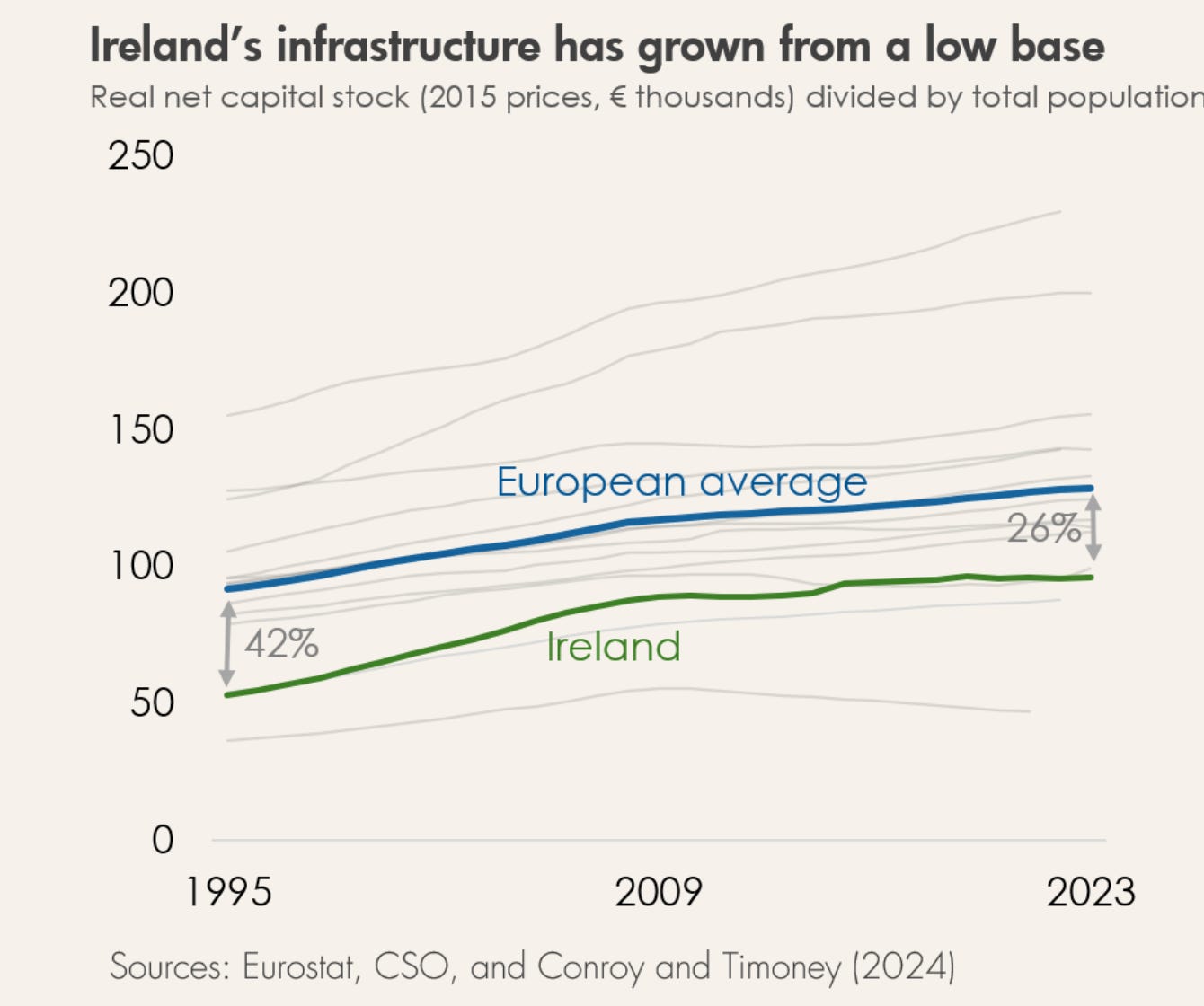
The Irish economy has experienced rapid growth in recent years. This is evident from rising employment levels, net inward migration, and population growth. All of these factors point to an increasing demand for infrastructure.
…
Households, businesses, and the government all rely on large-scale infrastructure. Businesses rely on roads, bridges, and ports to move goods efficiently. They need reliable electricity and internet access to produce and deliver their products and services.
Households depend on essential utilities like water and electricity for daily living, as well as roads and public transportation to get around. Meanwhile, critical government services—such as hospitals—require consistent access to electricity and water to operate safely and effectively.
Infrastructure plays a critical role in economic competitiveness. Ireland’s economy is heavily dependent on foreign multinational companies, and infrastructure is a key factor in their decisions about where to locate their operations.
…
Compared to other high-income European countries, Ireland has historically had a low level of infrastructure. This is not surprising—Ireland has only relatively recently become a high-income country. In the 1970s and 1980s, Ireland did not have the financial resources to invest in its infrastructure.
By the mid-1990s, Ireland’s infrastructure was about 50% lower than that of other European countries. While progress has been made since then, a gap of around 25% still remains. In short, it’s a case of “a lot done, more to do”. EU Structural Funds provided funding to upgrade Ireland’s infrastructure in the 1990s and early 2000s.
…
Ireland faces significant infrastructure shortages in four key areas: housing, healthcare, transport, and electricity. The housing shortage is particularly well documented. Since 2008, the supply of new housing has not kept pace with population growth. As a result, Ireland’s housing stock is estimated to be around 250,000 units below the European average (on a per capita basis). For citizens, this shortfall is most acutely felt through high rents and house prices.
Source: Irish Fiscal Advisory Council
The Ditch’s Paulie Doyle wrote an effective critique of Ireland’s state-sponsored relationship with its international diaspora. It’s both disposable and cynical. It doesn’t see anything more than transient tourists that will spend American moolah on Irish gift shops; or some guy with the surname Sullivan who can introduce them to the non-Irish executive of a multinational corporation to plant FDI colonial outposts in Ireland.
As an Irish diasporan, I agree with Doyle’s critique. The logical inverse solution is a rooted and productive diasporan relationship that both seeks to develop a more democratic Irish economy while retaining (if not expanding) Ireland’s unique political perspective. My Irish relationship has drastically influenced how I see economics and politics. Ireland’s offer to its diaspora should be that gift. Ireland should not reverse that transmission which would transform itself into something not indigenously Irish.
Our political establishment mostly offers this island as a novelty destination to the diaspora. It asks little of them – to spend their money in Temple Bar and to be invoked, when useful, as evidence of the “deep ties” that will attract more foreign capital…In his 2013 article “What’s in a Name: The Dialectics of Diaspora and Irish Emigration,” published in the Irish Studies journal Breac, David Lloyd wrote that Ireland’s conception of “diaspora” and our relationship to it is relatively new. For much of our history, he wrote, leaving Ireland was shameful – the welcoming language of “diaspora” arrived with prosperity.
“The invocation of the Irish diaspora was nowhere more powerful than during the Robinson presidency that coincided with the emergence of the ‘Celtic Tiger,’ and its function was deeply implicated in the pursuit of Irish emigrant investment in Ireland,” he wrote. The Irish eventually blended in to most of the places they went, undermining the criteria for “diaspora” as some scholars understand it, which is defined by difficulty assimilating, of missing an out-of-reach homeland, rather than making it.
Irish officials however pitch Ireland to Washington through those who made it.
The state’s latest diaspora strategy launched in July 2025 says Ireland will “write the next chapters of this trade and investment story by investing further in the vital relationships and harnessing the invaluable connections, expertise and insights that can promote Ireland’s advantages for foreign direct investment, support Irish business access new markets and drive job creation and innovation”.
…
In the south we exist…in a polity colonised by foreign capital – whose tax returns place parameters on what is politically possible. The academics Patrick Bresnihan and Patrick Brodie have named the ideology responsible, “FDI nationalism”, which conflates Ireland’s interests with the interests of multinational corporations, for whom the state builds bespoke infrastructure at the expense of the general population…None of this is what the diaspora is meant to think about. Because the likes of Micheál Martin and Simon Harris have no use for a diaspora that wants to help secure a state resolved “to pursue the happiness and prosperity of the whole nation and of all its parts”. It is safer to keep them engaged in a transaction with an Ireland that has never existed – one designed, above all, to keep their gaze averted from the Ireland that actually does.
Source: The Ditch
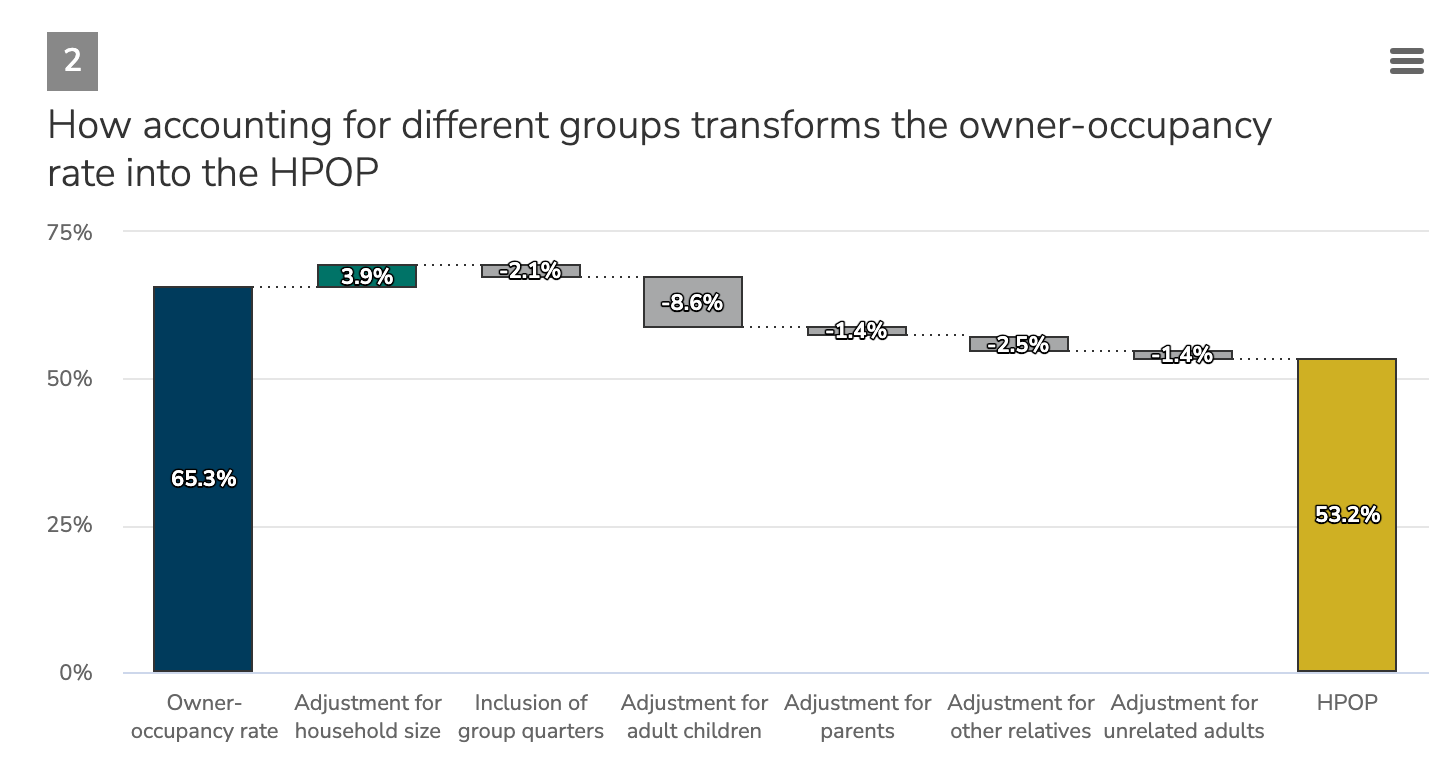
The homeownership rate in the United States is reported to be 65 percent. But this commonly cited data point on homeownership is actually the owner-occupancy rate, which tells us how many housing units are occupied by an owner. While owner occupancy is an interesting measure, it doesn’t tell us how many people own their home. As an alternative to better reflect the share of adults who are homeowners, we offer the homeowners-to-population ratio, or HPOP, a measure that lends a more nuanced view for important policy considerations and context. Using this new measure, the U.S. homeownership rate is 53 percent.
Source: Federal Reserve Bank of Minneapolis
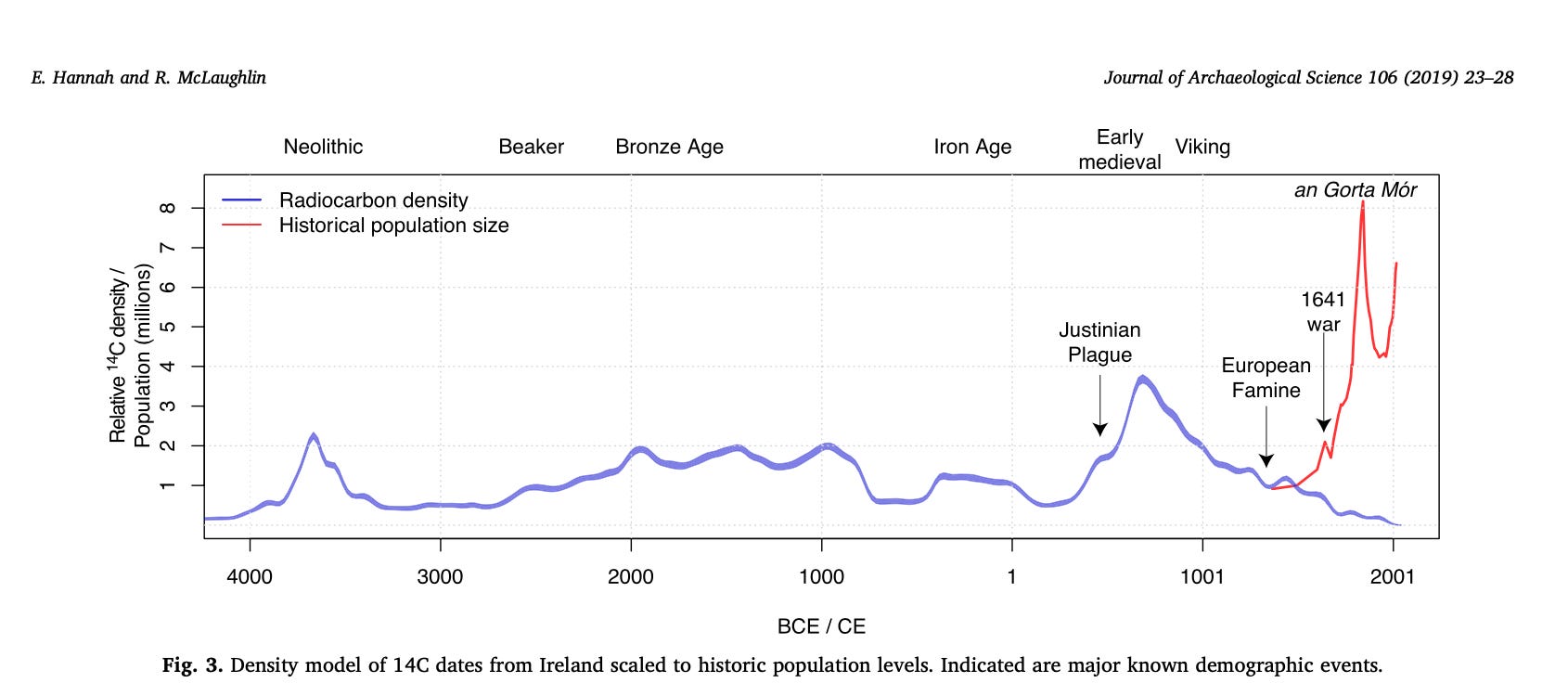
A paper published by Emma Hannah and Rowan McLaughlin in the Journal of Archaeological Science revealed an interesting factoid that recasts Irish history. Far from being a primitive backwater, Ireland’s early history was advanced enough to support a very large population. Their model suggested that Ireland may have had a population of almost 4 million in the 7th century. A level that wouldn’t be crossed again until the 18th century.
The authors used “a large database of recently discovered archaeological sites with radiocarbon dates that [they] have analysed using Kernel Density Estimation techniques.” Their key insight was that the viking invasion period of Ireland began after a 300 year period of population decline. This would suggest that Ireland faced severe problems that impacted its population and, therefore, weakened it before any vikings arrived. This context provides more nuance to understanding the societal status of Ireland in those times. Ireland’s population kept declining until about the 16th century.
Their model also suggested that from about 2000 BC to 1000 BC, Ireland supported a population of about 2 million. After halving for the next 1000-1200 years, Ireland experienced rapid growth from 200 AD to 700 AD and reached its 4 million figure.
What could explain all this? How could the primitive backwater of Ireland, which the English tell us so much about, produce a society to support this?
Ireland had somewhat of a monopoly on copper from 2400 to 1100 BC. Then by the time their copper mines ran dry in 1100 BC, they started to exploit native gold mines until about 500 BC. They didn’t stop at being just a main supplier of the raw commodities but also advanced in the craft of metallurgy that would outlast their native mine reserves. Hence, they eventually started to import copper and tin from western Britain. Researchers have found Irish metalwork as far inland as Germany.
Ireland wasn’t a primitive backwater in ancient times. It was the ancient Silicon Valley of Europe. Their metals and metallurgy were in high demand across Europe and this made Ireland an active trade hub. This economic comparative advantage was why the geographically western fringe of Europe became a central node. The dawn of the Iron Age, with iron supplies being much more widely dispersed and its final products much more durable, reduced Ireland’s advantage which explains the thousand year lull after the Bronze Age.
By around 50 AD, the Roman Empire expanded to Britain and Ireland gained a massive trade partner. It’s residual economic niche combined with the new Roman demand are the core reasons Ireland’s population shot up to about 4 million by 700 AD. The subsequent population decline could have various factors. It’s likely that the collapse of the Roman Empire in the 5th century would diminish the capacity for trade with its post-Roman territories. The Plague of Justinian of 541 AD continued to impact the wider world for decades. It reached Ireland in the Plague of 664 AD. This would line up perfectly with the inflection point. There’s also evidence that persistent volcanic effects forced severe winter cold events between 431 and 1649 AD on Ireland which could have led to worse harvests. The paper’s authors provided some reasons:
Nor was there a single root cause for the decline, and although the cumulative effects of political unrest, famines and plagues could take their toll (e.g. Dooley, 2007), the radiocarbon KDE between 400 and 700 CE offers compelling evidence that early medieval society had been resilient against such events during its phase of growth. Furthermore, because the aged fall victim to plague more readily than those of child-bearing age, their long-term demographic effects tend to be over-emphasized in medieval narratives, as economic historians are keen to point out (e.g. Russell, 1958: p139). We suggest instead that the long-term oscillation seen in early medieval Ireland, and indeed during earlier prehistoric phases, could represent a so-called structural-demographic cycle (Goldstone, 1991). During its phase of population growth, the secular élites in Ireland would have faced ever increasing competition with each other, as the agricultural surplus of the land was redirected to nourish a growing population. Land would have become prized though demand, and labour cheapened by over-supply. Declining living standards therefore constrained fertility rates, as did the related milieu of political strife. Into this vacuum stepped the church, whose influence steadily spread over the centuries in question (e.g. O’Sullivan and McCormick, 2017), but did not halt the loss of popula- tion. Another possible and perhaps related explanation is continued outwards migration to Britain or Europe. In particular, the strong linguistic and archaeological connections between northern Ireland and Scotland are well known (although see Campbell, 2001 for a nuanced view) and recent genomic evidence confirms a close bond with Ireland. Today’s residents of southwest Scotland have greater haplotypic similarity with southern Irish populations than those now living in the north of Ireland (Byrne et al., 2018), consistent with a significant past migration that fossilised a group of Irish haplotypes in a corner of Britain.
This paper provided a new way to look Ireland. Ireland’s population did not start small and then grow in linear fashion after Normans and English “brought civilization to Ireland”. Ireland’s population was already huge. Its native civilization was already sophisticated, relative to Europe, long before Norman identity was constructed. Ireland’s population went up and down due to macro-economic shifts from the Bronze Age to the Iron Age, the expansion and contraction of the Roman Empire, severe plagues, and internal societal dysfunction caused by all that.
Source: The Journal of Archaeological Science via ScienceDirect

As corroboration of the prior paper’s population model findings, a recent archaeological discovery also rewrote the perception of ancient Ireland as more sophisticated than previously thought.
A significant prehistoric settlement uncovered in eastern Ireland challenges how archaeologists had previously understood population density and social organization during the Late Bronze Age. New research published in Antiquity details how evidence for over 600 dwellings was contained within the Brusselstown Ring hillfort in County Wicklow, making it the largest nucleated settlement to have been identified so far in prehistoric Britain or Ireland.
…
Airborne and topographical surveys identified more than 600 subtle platforms interpreted as former house foundations. Ninety-eight lie within the inner enclosure, while more than 500 occupy the area between the inner and outer ramparts. This is a dense concentration of dwellings, implying a permanently occupied, tightly organized community rather than the small, scattered farmsteads that dominate most of prehistoric Ireland.
Source: Archaeology News

As someone who respects history and its use in our present society, the debut of Christopher Nolan’s The Odyssey resonated with me. It badly resonated to be exact. The bastardization of Homer’s original source material is obvious to everyone. This is a problem, I recall one reviewer who I forgot suggest, for future generations to pick through the built up rubble of modern adaptations like Nolan’s to decipher the true meaning of Homer. But besides that problem, the use of history to reify modern interpretations that communicate modern messages is a second concern.
Nolan attempted to say something about our modern times. It’s very muddled but if one can understand all of Nolan’s implications then there’s a clear message: reBushification.
The core takeaway, for our 2026 times, is the rehabilitation of US President George W. Bush to combat the real enemy at home: millennial anti-war democratic socialism. When reviewing quotes from Bush in the 2008 to 2010 period, he said that he was reluctant and never planned to go to war, made the decision emotionally, feels terrible about all the deaths, and even had a dog best friend like Nolan’s Odysseus. This is Nolan’s implicit mirroring in his characterization of Odysseus.
Emily Wilson is a professor of classical studies at the University of Pennsylvania. She translated a version of the Odyssey, that Nolan allegedly used as his primary source. She wrote a fantastic and scathing review of Nolan’s film in the London Review of Books, in which she called it “abysmal.” She wrote,
But the representation of Odysseus as a reluctant warlord makes a nonsense of the movie’s imagined world. We are not shown that war or killing are bad, only that good men sometimes feel bad about it – a very different point.
Wilson’s characterization corresponds to my Bush theory of Nolan’s Odysseus. It’s actually not hard to find many film critiques of Nolan’s past films, especially his Batman series, as essentially Bush propaganda. I didn’t pull this out of nowhere. Nolan first started thinking about a film adaptation of The Odyssey when he was enlisted to almost-direct its prequel The Iliad for the early 2000s film Troy. This would be right around the start of the Iraq War. Coincidentally, Odysseus is away from home for 20 years. 20 years after Nolan’s Troy experience and the start of the Iraq War would be when he would have began creating his recent Odyssey film.
Nolan is trying to tell the audience that as long as Bush feels kind of bad about the Iraq War (after all the damage is done and there are no consequences) he should be allowed to return home and save it. In fact, Bush (or his abstract ideology of Anglo-American neoconservativism) is the only one that can, just as Nolan’s Penelope aggressively tells her weakling son only their Odysseus can.
Nolan’s millennial Antinous is the main villain. Nolan bashed us over the head with his 1980s bully aesthetics to make sure we know he’s the bad guy. But those are just forms. Nolan tells us that the substance for why he is the villain is because he materially rejected the Trojan War and consumed Odysseus’ property’s resources. In fact, the rejection of the war appears to dominate the Nolan’s Odysseus revenge the most. When reinterpreted through our Bush theory, these reasons for villainy become anti-war and economic populisms. Those who don’t become pawns in a pointless and illegitimate war (which Nolan confusingly also communicates) and those that over-tax the rich to overspend on lazy layabouts.
The fact that Nolan provided surface-level aesthetics or very confused writing (by his own logic) does not detract from the implicit meaning provided to audiences. At present, we don’t need audiences sympathizing with those who led us into stupid and evil wars or those that left their home economies defunct and chaotic. We especially don’t need that because we have spent the better part of a decade reconciling our collective understanding of the wars in the Middle East and the Global Financial Crisis. It appeared as if a consensus was forming on what was bad about those events and what needs to happen to change things so they never happen again. Instead, we now have a new, perhaps worse, war in the Middle East with Iran and economic crisis of public sector dysfunction and private sector oligarchic bubbles.
The rehabilitation of Bush and his neoconservative ideology would be a huge benefit for the people pushing these things. Nolan’s Odyssey should be rejected for its abuse of the original text, bad writing, bad filmmaking, and so forth but it should mostly be rejected for its potential to be neoconsevative propaganda to influence audiences to support war and oligarchy. Nolan’s used Homer’s mythology to add historical gravity to his modern message. History should not be used to reify a monstrous present to become another monstrous history. As historian Arnold Toynbee wrote, “history…grew out of mythology.”
Source: London Review of Books
No posts
Comments
Nothing yet. Say the first thing.
Sign in to join the conversation.