
AEI fellow Jesús Fernández-Villaverde simplified a new paper by Joseph Davis and Douglas Irwin on trade disruption in the early 19th century to evaluate effects on economic output. He turned economic history into a partisan hyperbole, that I assume Davis and Irwin would not endorse.
Mercatus fellow David Beckworth further embellished along with him, through his tweet: “Big blow to all the Ha-Joon Chang/industrial policy fans.” Fernández-Villaverde’s claim that the paper demonstrated that there is “no evidence” to the efficacy of protectionism is a drastically misleading thing to say when the paper goes out of its way to say it’s not making that claim and provides nuance to even suggest otherwise.

Jesús Fernández-Villaverde@JesusFerna7026
If you ever took a course in economic history, chances are you heard the argument that the trade embargo of 1807, the subsequent non-importation measures, and the War of 1812 gave a big boost to U.S. manufacturers. I certainly did! This is a common argument in favor of tariffs,


Jesús Fernández-Villaverde @JesusFerna7026
A post of mine on industrial policy from last July is having a second life, so let me rewrite it more clearly now that I have more experience with X. Can industrial policy work? Yes. The East Asian experience shows it can, at least partially. But its success rests on a key https://t.co/uoMZ3Ua6gQ
1:03 PM · Jul 21, 2026 · 75.5K Views
10 Replies · 108 Reposts · 495 Likes
The paper focused on the period of the European Napoleonic Wars and the American War of 1812. This was a period of reactionary American policy towards chaotic events when Jeffersonian-Madisonian Southern Agrarian liberalism, and their allies of Boston Brahmin trade mercantilism, still dominated the American political zeitgeist.
The paper’s data revealed that, while the overall industrial production trend was neutral, types of industrial production differed.
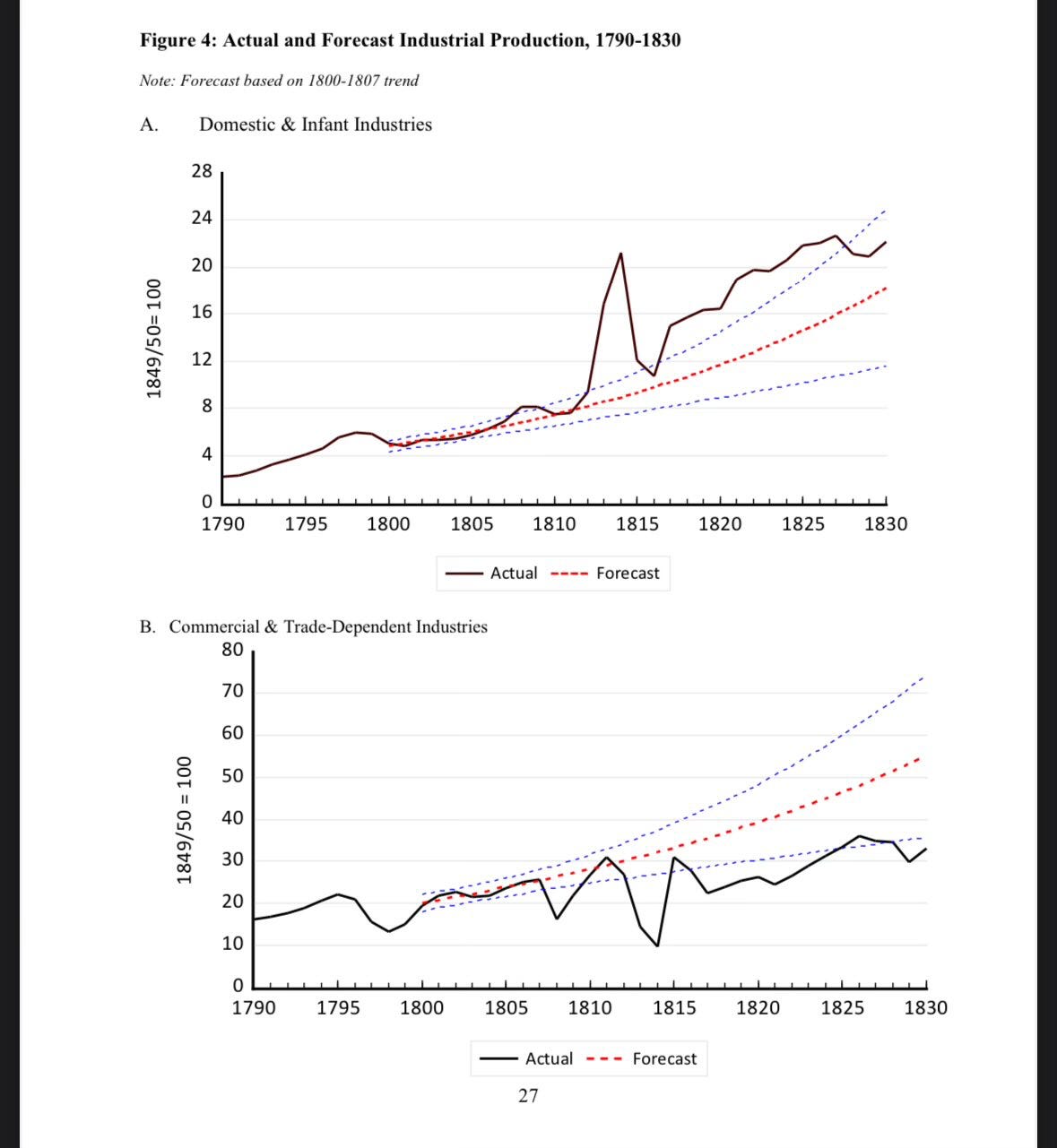
Infant industry production was 31 percent higher and foreign trade dependent production 58 percent lower. However, upon the conclusion of the period, with a resumption of trade, both trends canceled out.
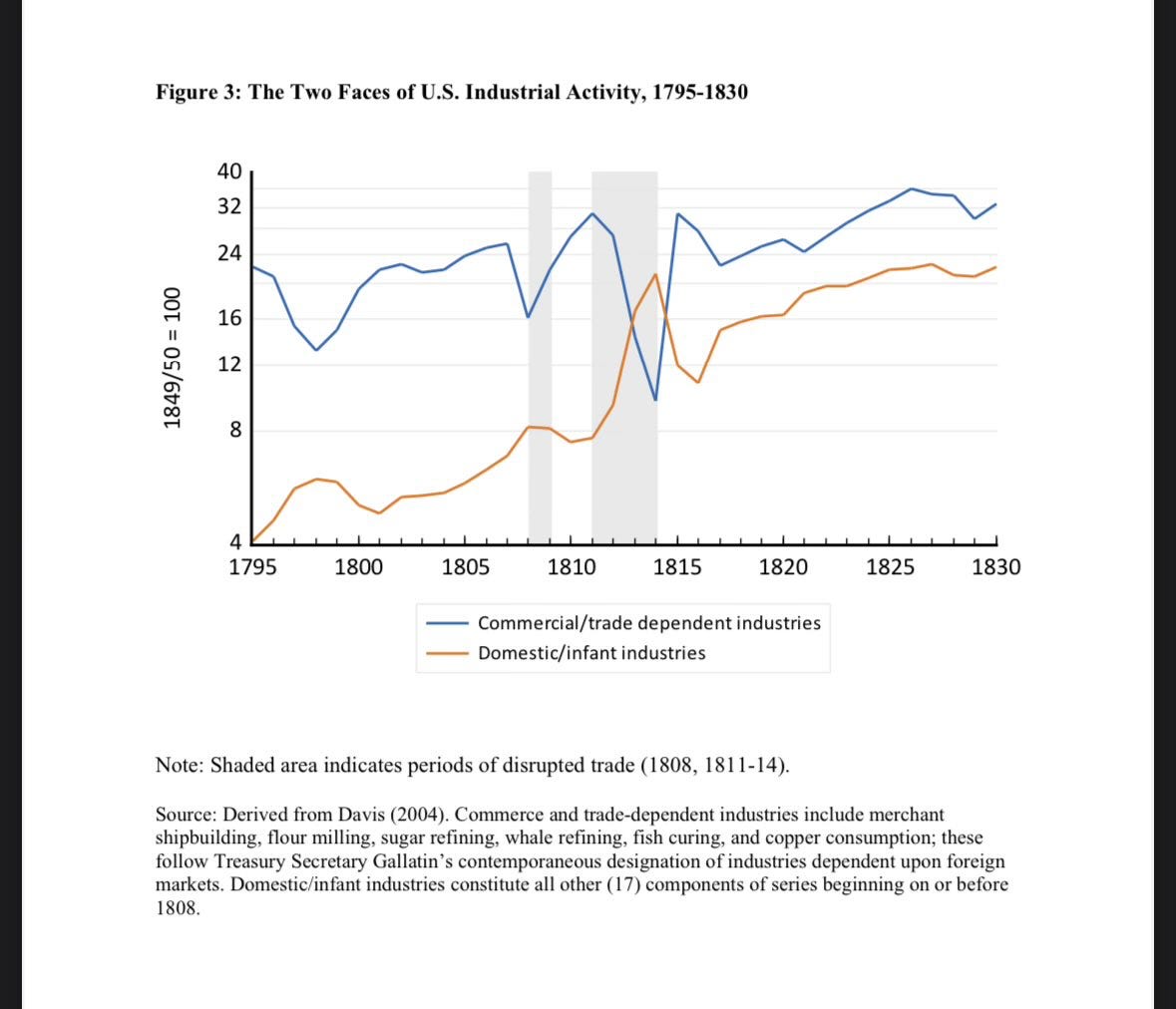
So, this episode revealed both the rise in infant industry production because of the trade disruption but also the limits of this cause and effect (or otherwise considered reactionary/dumb policy). This is why the conclusion of the War of 1812 is such a watershed moment. That’s because both US presidents during this period, Jefferson and Madison, admitted their southern agrarian liberalism was naive and the zeitgeist shifted towards northern industrial protectionism.
Both Jefferson and Madison wrote to Mathew Carey about how he was right and they were wrong. Mathew Carey was the leading Hamiltonian protectionist economist whose Olive Branch book/pamphlets of 1814-1815 became American best sellers. It is suggested that only bibles sold more copies than the Olive Branch during this time. Carey’s Hamiltonian protectionist vision gained popularity.
As a result, the Dallas Tariff (America’s first manufacturing oriented protectionist tariff) and the Central Bank rechartering took place in 1816. Federal internal improvements were also pushed by measures such as the 1817 Bonus Bill but were slower to implement. Eventually federal internal improvements would manifest in 1820s. State level improvements were faster such as the commencement of the construction of the Erie Canal in 1817.
This was a proactive and systematic/smart approach to industrial protectionism distinct from the prior period’s neglect and reaction. Carey disciple Henry Clay would eventually call this set of policies the American System.
What did Davis and Irwin have to say about what happened next? The “actual infant industry production is about 40 percent higher than forecast in the early 1820s.”
The paper highlights the realities of nation building, economic development, and scientific vs. reactionary statecraft. To build a secure and sovereign nation one needs economic development. To do the later one needs industrial protectionism (the scientific kind not the reactionary kind). This means protectionism is not simply broad brush trade isolationism but a variety of technical policies.
However, there are trade offs. The biggest problem being foreign trade dependent industries who tend to be losers of this paradigm shift. If they are not handled delicately, they will fight you tooth and nail. The haphazard 1820s-1850s (think President Andrew Jackson and the Panic of 1837) and the American Civil War are the fruits of not handling these losers properly.
The paper is not a slam dunk case against protectionism as Fernández-Villaverde hinted at. It is rather a window into the complex and challenging history of how to build a nation. It revealed the nuances of how to effectively apply protectionist policies. These neoliberal academics sought to use the paper to push their agenda without having properly read the very thing they were weaponizing. All they did was demonstrate that neoliberal academics are incompetent and deceptive.
No posts
Comments
Nothing yet. Say the first thing.
Sign in to join the conversation.