
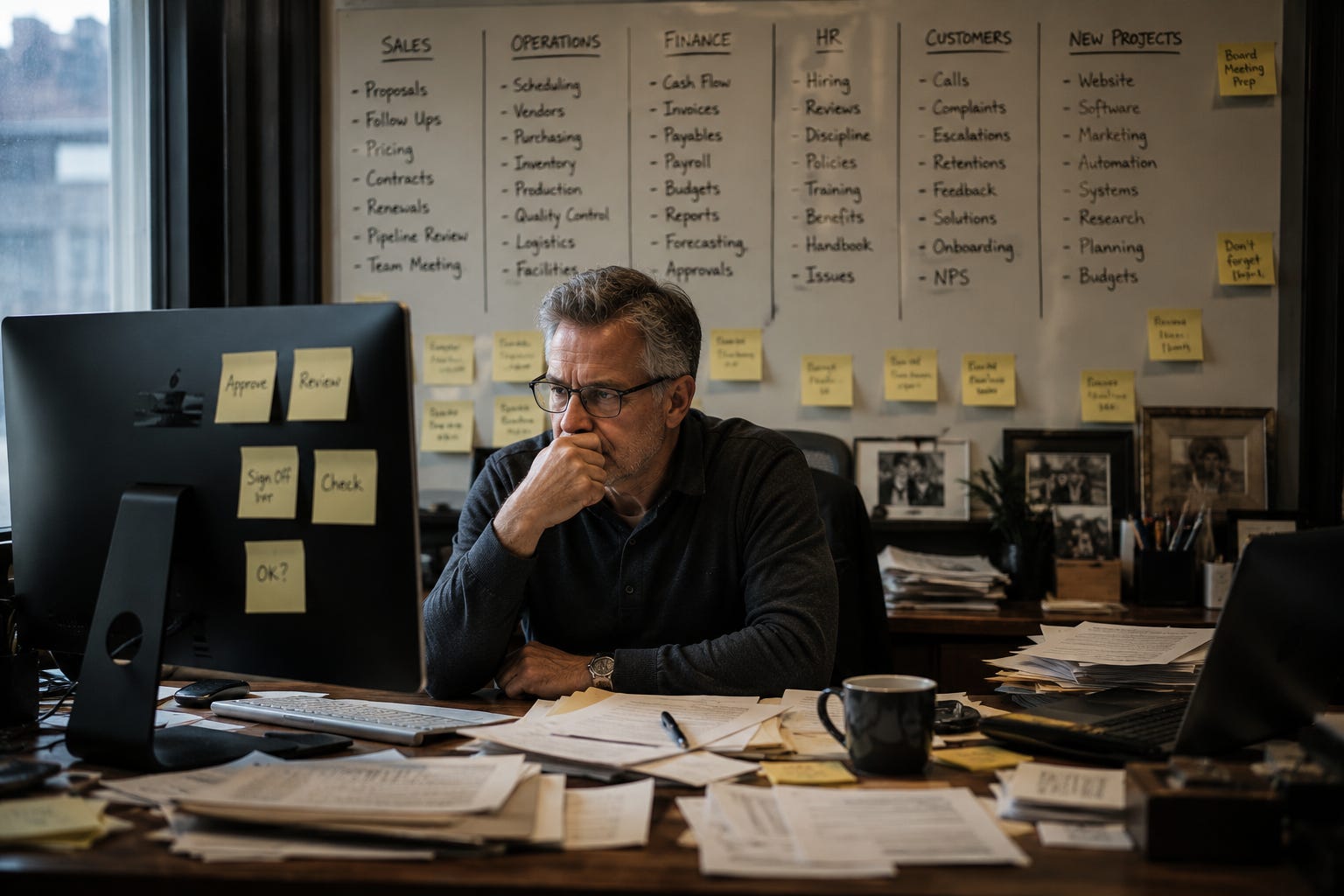
“The company wasn’t struggling because the owner wasn’t working hard enough. The company was struggling because the owner was involved in everything.”
I have walked into a lot of struggling companies over the years.
Construction companies. Transportation companies. Retail businesses. Manufacturers. Service providers. Family-owned businesses. Companies with ten employees and companies with hundreds.
Some were losing money. Some were growing too slowly. Some had employee turnover problems. Some had customer service issues. Some couldn’t figure out why profits never seemed to increase despite rising revenue.
The details varied.
The industries varied.
The personalities varied.
Yet one pattern appeared so often that eventually it became impossible to ignore.
The owner had become the bottleneck.
This is not an article about lazy owners.
Quite the opposite.
Most small-business owners work harder than almost anyone else in their organization. They take risks most employees would never consider. They sacrifice evenings, weekends, vacations, and sometimes their health in pursuit of building something that matters.
The irony is that many companies eventually become limited by the very person who created them.
The owner who once drove growth becomes the thing preventing it.
Not intentionally.
Not maliciously.
Almost always with the best of intentions.
That’s what makes it so difficult to recognize.
Most entrepreneurs start businesses because they are exceptionally good at something. They understand a trade. They understand a service. They understand a product. They see an opportunity and decide they can do it better than their employer, better than their competitors, or simply better than the market currently allows.
In the beginning, this approach works beautifully.
The owner does everything.
Sales.
Customer service.
Operations.
Accounting.
Purchasing.
Marketing.
Collections.
Human resources.
If a toilet overflows, they fix it. If a customer complains, they handle it. If payroll doesn’t process, they stay late until it does.
At that stage, being involved in everything is not a weakness. It is often a necessity.
The problem is that many owners never stop.
What works at five employees becomes disastrous at fifty.
What works at fifty becomes catastrophic at one hundred.
Growth demands a different version of leadership than startup survival.
Many owners never make the transition.
The first warning sign usually appears in decision-making.
Every decision flows through one person.
Employees need approval.
Managers need approval.
Customers need approval.
Vendors need approval.
The office cannot order paperclips without approval.
I’m only exaggerating slightly.
I’ve seen businesses where routine decisions sat on someone’s desk for days because nobody felt empowered to move forward without permission from the owner.
The result is predictable.
Employees stop thinking.
Managers stop leading.
Problems pile up.
Everyone waits.
The organization becomes dependent on a single individual for movement.
Ironically, the owner often interprets this as proof that they are indispensable.
In reality, it is evidence that the system is broken.
Healthy organizations distribute decision-making.
Unhealthy organizations concentrate it.
One company I worked with had managers who seemed incapable of solving even minor issues. The owner complained constantly about their lack of initiative. According to him, nobody could think for themselves anymore.
After a few days of observation, the explanation became obvious.
Every time a manager made a decision, the owner overruled it.
Every time an employee solved a problem independently, the owner inserted himself into the process.
Every time someone attempted to take ownership, they were reminded who was actually in charge.
Eventually people learned a simple lesson.
Stop making decisions.
Wait for instructions.
Avoid blame.
The owner had unintentionally trained the organization to become dependent on him.
Then he became frustrated by the dependency he had created.
Human beings adapt to incentives far faster than most leaders realize.
The second warning sign is micromanagement.
Micromanagement rarely begins because someone enjoys controlling others.
It usually begins with fear.
Fear that quality will decline.
Fear that customers will suffer.
Fear that mistakes will occur.
Fear that standards won’t be maintained.
Those fears are understandable.
The owner’s name is often on the building. Their reputation is attached to every outcome. Their financial future is tied directly to the organization’s performance.
Of course they care.
The problem is that caring and controlling are not the same thing.
Many owners confuse the two.
The more successful a company becomes, the more important it becomes for leaders to focus on outcomes rather than methods. Yet some owners continue reviewing every estimate, approving every purchase order, proofreading every email, and inserting themselves into every conversation.
They become organizational traffic jams.
Everything slows down because everything must pass through them.
I’ve met owners who proudly told me they worked eighty hours per week.
They expected admiration.
Instead, I often saw a warning sign.
Working eighty hours a week twenty years into running a business is not always evidence of dedication. Sometimes it is evidence of a system that never matured.
A business should not become increasingly dependent on its owner over time.
It should become increasingly capable without them.
That statement makes some entrepreneurs uncomfortable.
For many owners, the business becomes intertwined with identity.
The company is not merely something they own.
It becomes who they are.
Their reputation.
Their accomplishment.
Their purpose.
Their legacy.
When that happens, delegation begins to feel dangerous.
If someone else can do the work, what does that say about me?
If someone else can make decisions, where does that leave me?
If the company operates successfully without my involvement, am I still important?
Those questions are rarely spoken aloud.
They don’t need to be.
Their influence appears everywhere.
The owner inserts themselves into every process because stepping away feels like losing control.
In reality, refusing to step away often guarantees it.
One of the strangest truths in business is that growth requires surrender.
Not complete surrender.
Not negligence.
Not disengagement.
But surrender nonetheless.
A company cannot scale if every decision remains trapped inside a single brain.
There are simply not enough hours in the day.
This is where founder syndrome begins to emerge.
Founder syndrome occurs when an organization continues operating as though it is still in startup mode long after it has outgrown that structure.
Processes remain informal.
Authority remains centralized.
Accountability remains inconsistent.
The owner remains the answer to every question.
Employees stop bringing solutions.
They bring problems.
Managers stop managing.
They escalate.
Departments stop collaborating.
They wait.
Everyone learns that the safest strategy is pushing responsibility upward.
Eventually the owner becomes overwhelmed.
Then something fascinating happens.
The owner becomes convinced the solution is working harder.
Longer hours.
More involvement.
More oversight.
More meetings.
More approvals.
More control.
The exact behaviors causing the bottleneck are intensified.
Imagine trying to solve a traffic jam by adding more cars to the highway.
That’s often what this looks like.
The deeper issue is decision fatigue.
Every decision requires energy.
Every interruption consumes attention.
Every approval steals focus from something more important.
When owners insist on making every decision, they eventually exhaust themselves.
Then the quality of their decisions begins to decline.
Not because they lack intelligence.
Because they are human.
No one performs well while carrying the cognitive burden of an entire organization.
The owner becomes tired.
The team becomes frustrated.
The company slows.
Meanwhile competitors continue moving forward.
What makes this problem particularly challenging is that the owner is often both the hero and the obstacle simultaneously.
Without them, the business would not exist.
Because of them, the business cannot grow.
Both statements can be true.
I’ve seen owners build extraordinary companies through sheer determination, resilience, and talent. The same traits that helped them survive the startup years later prevented them from evolving into the leader the organization needed next.
Success created its own trap.
The skills required to launch a company are not always the skills required to scale one.
The entrepreneur who personally handles every customer may need to become a leader who develops managers.
The owner who solves every problem may need to become someone who teaches others how to solve problems.
The person who built the company may need to stop behaving like the person who built the company.
That transition is difficult.
For some, it is nearly impossible.
The businesses that break through this barrier usually share a common characteristic.
The owner learns to trust.
Not blindly.
Not recklessly.
Strategically.
They build systems.
They establish expectations.
They develop leaders.
They create accountability.
Then they allow people to do their jobs.
Mistakes happen.
They always will.
Employees occasionally disappoint expectations.
Managers sometimes make decisions differently than the owner would.
That’s part of growth.
The goal is not perfection.
The goal is capacity.
A business that depends entirely on one person is not truly scalable. It is simply busy.
The longer I work with organizations, the more convinced I become that the greatest challenge facing many small and mid-sized businesses is not competition, technology, marketing, or even capital.
It’s leadership evolution.
The company grows.
The market changes.
The organization becomes more complex.
The owner must evolve as well.
Some do.
Some don’t.
The ones who succeed eventually recognize a difficult truth.
Their job is no longer to be the best employee in the company.
Their job is to build a company that no longer requires them to be.
That realization is uncomfortable.
It can also be transformative.
Because the owner is often the company’s greatest asset.
But when growth stalls, they are frequently its greatest limitation as well.
~Ryan Gartrell has spent years helping businesses identify bottlenecks. More often than not, the bottleneck had a reserved parking space and their name on the building.
No posts
Comments
Nothing yet. Say the first thing.
Sign in to join the conversation.