
Lately, I have been binge-watching old episodes of Kitchen Nightmares, Hotel Hell, and 24 Hours to Hell and Back.
My wife walks through the living room, sees Gordon Ramsay screaming at a restaurant owner about frozen ravioli, and immediately asks the same question every time.
“Why do you keep watching these?”
The answer is simple.
Because I see the same businesses every day.
The names are different. The industries are different. The logos are different. The uniforms are different. The hairstyles have definitely changed.
The problems have not.
The funny thing about Kitchen Nightmares is that most people think it is a show about restaurants.
It isn’t.
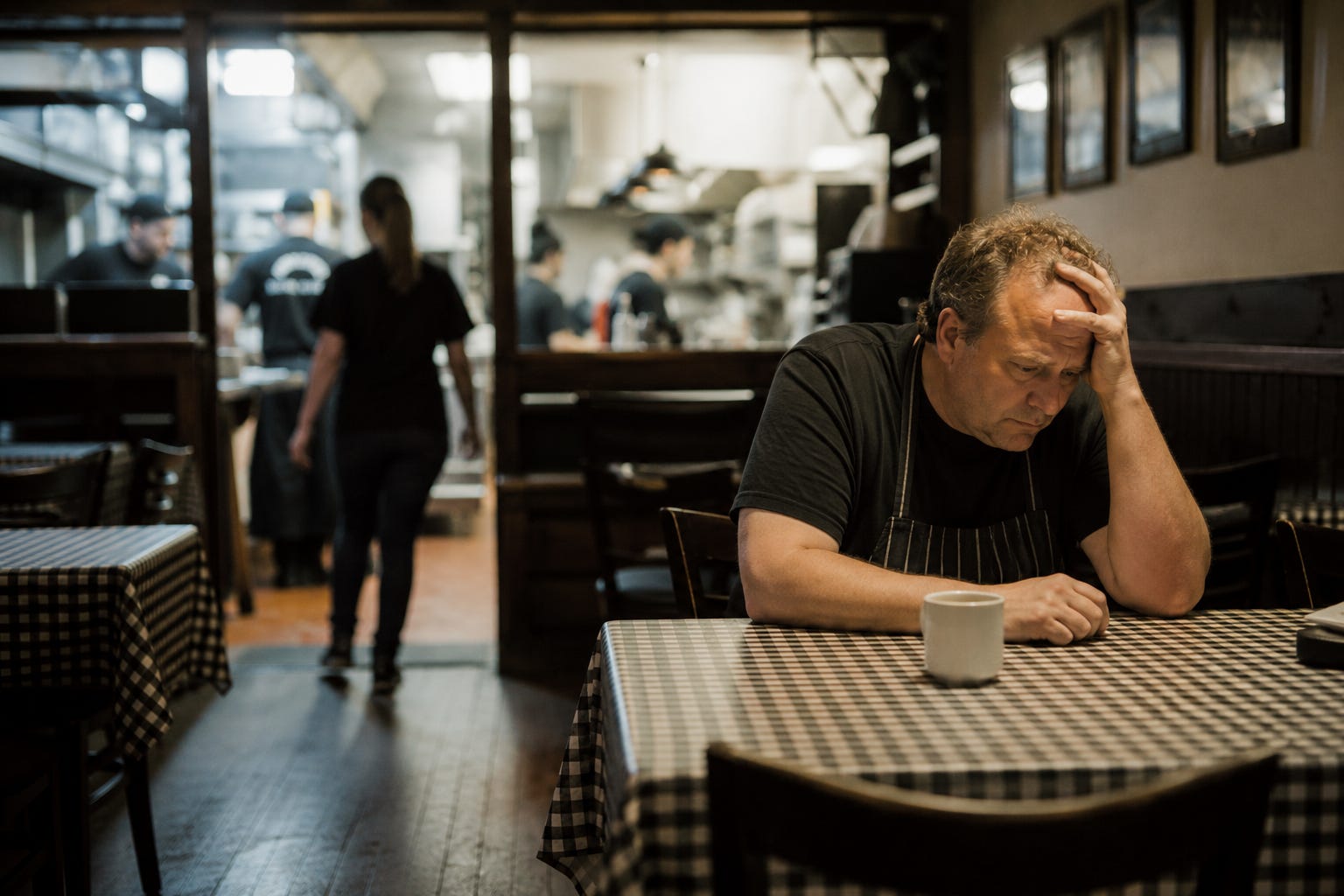
It is a show about business owners who can no longer see their own businesses.
That’s what makes it fascinating.
Every episode follows roughly the same formula.
Gordon walks into a struggling restaurant. The owner insists everything is fine. The staff insists everything is not fine. Customers are unhappy. The food is terrible. The dining room is empty. Money is disappearing at an alarming rate.
Then comes the inevitable conversation.
The owner blames the economy.
The owner blames the customers.
The owner blames the staff.
The owner blames competitors.
The owner blames social media.
The owner blames weather patterns, planetary alignment, and occasionally the fact that Mercury appears to be in retrograde.
Everyone is responsible except the person staring back at them in the mirror.
Then Gordon starts pulling back layers.
The food is frozen.
The kitchen is filthy.
The menu is 147 items long.
Nobody follows procedures.
Employees are confused.
Customers are frustrated.
The business is bleeding cash.
By the end of the episode, everyone acts shocked.
As if these problems somehow appeared overnight.
What always makes me laugh is that these businesses rarely fail because of one catastrophic mistake.
They fail because of hundreds of small decisions that nobody challenged.
That is true whether you’re serving lasagna, building roofs, managing a trucking company, running a medical office, operating a retail store, or leading a marketing agency.
Business failure is usually death by a thousand paper cuts.
I once watched an episode where customers were required to remove their coats before being seated.
Not encouraged.
Required.
Imagine arriving at a restaurant on a cold evening, being told to surrender your coat at the door, and thinking, “Yes, this seems perfectly reasonable.”
Now imagine being the owner who created that rule.
More importantly, imagine defending it.
That sounds ridiculous until you realize every industry has its own version of the coat policy.
I have seen companies require five approvals to purchase a thirty-dollar office supply.
I have seen customers forced to call during a narrow two-hour scheduling window because that was easier for the company.
I have seen organizations maintain duplicate information in four different software systems because nobody wanted to make a decision.
I have seen salespeople spending half their day performing administrative work because management refused to hire support staff.
I have seen businesses create complicated policies to address the behavior of one difficult customer while inconveniencing the other thousand.
The coat rule exists everywhere.
It just wears different clothing.
One of the most common problems I encounter is what I call “The 150-Item Menu Syndrome.”
Restaurant owners love this one.
Business owners do too.
The logic usually goes something like this:
“If customers have more choices, more customers will buy.”
Sounds reasonable.
Until you realize nobody can execute it.
A restaurant offers burgers, seafood, Italian food, Mexican food, steak, sandwiches, pizza, salads, and somehow sushi.
The freezer is packed.
Inventory costs explode.
Food quality declines.
Employees cannot master anything because they’re trying to learn everything.
Customers receive mediocrity disguised as variety.
Businesses do the exact same thing.
A company starts offering services it has no business offering.
Website design.
Marketing.
Consulting.
Photography.
Video production.
Branding.
SEO.
Business coaching.
Social media management.
Drone services.
Podcast production.
Probably dog grooming if someone asks nicely enough.
Eventually nobody knows what the company actually does anymore.
Including the employees.
Especially the customers.
The owner mistakes activity for strategy.
More services.
More products.
More offerings.
More complexity.
Then they wonder why profits disappear.
The answer is usually hidden somewhere between service number fourteen and service number fifteen.
Another lesson from Gordon Ramsay is that owners often become emotionally attached to bad decisions.
This might be the most dangerous thing in business.
There is always a menu item nobody orders.
Always.
The owner loves it.
The chef loves it.
The owner’s grandmother apparently loved it.
The problem is nobody else does.
Yet the item remains.
Year after year.
Losing money.
Taking up inventory.
Consuming resources.
Occupying menu space.
Why?
Because the owner likes it.
Business owners do this constantly.
They keep products nobody buys.
Services nobody wants.
Employees everybody knows should have been terminated three years ago.
Software nobody uses.
Reports nobody reads.
Processes nobody follows.
Meetings nobody enjoys.
The business becomes a museum of old decisions.
Every artifact preserved because someone once thought it was a good idea.
The most uncomfortable truth is that hard work does not automatically produce good decisions.
Most struggling owners are not lazy.
Quite the opposite.
Many are working themselves into exhaustion.
They arrive first.
Leave last.
Answer emails at midnight.
Take calls during dinner.
Work weekends.
Miss vacations.
Sacrifice family time.
Then wonder why the business still feels stuck.
The answer is often hiding in plain sight.
The owner has become the bottleneck.
I see this constantly.
Every decision requires their approval.
Every question requires their answer.
Every problem requires their involvement.
Employees cannot move without permission.
Managers cannot act independently.
Customers wait for responses.
Vendors wait for approvals.
Projects wait for direction.
Growth slows to the speed of one human being.
Ironically, the owner who built the business becomes the biggest obstacle to scaling it.
Not because they are incompetent.
Because they are indispensable.
And no business can truly grow if one person must remain involved in everything.
That brings us to something Gordon Ramsay understands better than most consultants.
Fresh eyes are valuable.
Extremely valuable.
When Gordon walks into a restaurant, he notices things the owner stopped seeing years ago.
The sticky menu.
The dirty vent.
The broken sign.
The empty dining room on Friday night.
The confused servers.
The poor customer experience.
The owner sees none of it because familiarity creates blindness.
The same thing happens in every business.
When I walk into a company, I am often able to identify major operational issues within the first hour.
Not because I am smarter than the owner.
Not because I know the business better.
Quite the opposite.
I know less.
And that is precisely the advantage.
I ask questions nobody inside the company asks anymore.
Why are we doing it this way?
Who approved this process?
Why does this require four people?
Why are customers waiting three days for a response?
Why is accounting entering the same information twice?
Why does nobody follow this procedure?
Why does this report exist?
Why does everyone hate this software?
Why is your best employee considering leaving?
Simple questions.
Uncomfortable answers.
Powerful results.
The irony is that most business owners assume bringing in outside help is prohibitively expensive.
Yet they think nothing of losing customers for years because of broken processes.
They tolerate poor communication.
They accept inefficiency.
They absorb turnover.
They endure missed opportunities.
They spend money treating symptoms while ignoring causes.
The cost of inaction is almost always higher than the cost of improvement.
By a wide margin.
The businesses featured on Kitchen Nightmares are extreme examples because television requires drama.
But the underlying lesson is remarkably ordinary.
Most businesses are not failing because of one giant problem.
They are struggling because nobody has stepped back far enough to see the collection of smaller ones.
The owner is too close.
The staff feels unheard.
The customers feel frustrated.
The problems compound.
Then one day everyone acts surprised when the numbers stop working.
I suspect that is why these shows remain popular years after they first aired.
People recognize something familiar.
Not the restaurant.
Not the hotel.
Not the food.
The human nature.
The stubbornness.
The blind spots.
The unwillingness to question our own assumptions.
The belief that if we simply work harder, everything will somehow improve.
Sometimes it does.
Most of the time, it doesn’t.
Sometimes what a business needs is not another software platform.
Not another employee.
Not another marketing campaign.
Not another meeting.
Sometimes what it needs is someone willing to walk through the front door and ask the questions nobody else is asking.
Someone willing to challenge assumptions.
Someone willing to identify bottlenecks.
Someone willing to point out the coat rule.
Because every business has one.
And if you cannot identify yours, your customers probably already have.
The difference is they’re not writing television episodes about it.
They’re simply taking their business elsewhere.
Thankfully, unlike Gordon Ramsay, most of us can solve those problems without anyone getting called an idiot sandwich.
Most of the time.
~ Ryan Gartrell is an operations consultant, business strategist, and founder of Ryan Gartrell, P.A. He helps business owners identify operational bottlenecks, improve customer experiences, and build companies that can grow without relying on constant firefighting.
No posts
Comments
Nothing yet. Say the first thing.
Sign in to join the conversation.