
Over the past year we have been running a loose experiment across our fractional clients. When a founder asks us for help on a deal or a pipeline issue, we offer two options.
Option one: ask a question in a dedicated Slack channel and get AI-generated answers from our vast proprietary knowledge base, available in seconds. Objectively as good as what any of our team would produce.
Option two: wait for the human expert. The answer will be aligned with what the AI produces, after-all it’s essentially the same knowledge base, but it arrives in hours, not seconds.
They want both. Every time.
They want the AI answer immediately so they can act. And they want the human in the loop because the human underwrites the decision in ways the AI cannot. The cost of being wrong is too high to trust the fast answer alone.
Our own delivery model is moving from ~80% human and ~20% software to the inverse. 80% software, 20% human. In my opinion, that 20% never goes to zero. It is where judgement sits, and in the enterprise it is not negotiable. The trade, in theory, is that we serve more founders, at better margins, with the same senior bench.
The same rearrangement is coming for software sales teams, and I don’t think most founders are reading the tea leaves correctly.
This essay is an attempt to explain what sophisticated founders seem to know that the data does not capture. The argument is a hypothesis. It is too early to prove. But the signal is consistent enough across our assessment base of 159 B2B software founders and hundreds more founder conversations, that it deserves a framework.
Economics is the study of decision-making under scarcity. When AI can run outbound, qualify inbound, personalize messaging, summarize discovery, and draft proposals, the things that were scarce about sales work (time, attention, research, reach) stop being so scarce. Every question about the future of selling in an AI world begins with identifying what becomes rare after that.
Alex Imas makes the cleanest version of this argument in What Will Be Scarce? (Ghosts of Electricity, 2025). Scarcity does not disappear. It relocates. As automation consumes commodity production, demand shifts to what Imas calls the “relational sector.” Goods and services whose value is inseparable from the human who provided them. Status, provenance, exclusivity, meaning. The human doesn’t get expelled from the economy. The human migrates to a different part of the value chain.
Imas and colleagues have the experiments to back this up. In one study, willingness to pay for an identical good roughly doubled when buyers knew a random subset of people were excluded from acquiring it. Neither status signaling, or scarcity heuristics. A pure preference for having something others cannot have. In a follow-on experiment, the same team found that AI involvement specifically undermines that premium. Human-made artwork gained 44% in exclusivity value. AI-generated artwork gained less than half of that. The mere involvement of AI makes the product feel inherently less exclusive, and easier to reproduce.
The analogue for sales is obvious to me. As AI commoditizes the delivery of the product and the automatable layers of the sales motion, the premium moves to whatever the buyer perceives as non-reproducible. The human doing the work AI cannot do is a big part of that.
Labor economists have watched this pattern before. Autor and Thompson's 2025 work on expertise (NBER) gives it the cleanest treatment. They distinguish "expert" and "inexpert" tasks within an occupation. When automation removes the inexpert tasks, the remaining work concentrates into fewer, more specialized, higher-paid roles. When it removes the expert tasks, the job commoditizes and wages fall.
Their accounting clerk example is the clearest case. Over four decades, accounting clerks saw wages rise 39% while employment fell 32%. Inventory clerks experienced the opposite. Wages fell 13% while employment rose 175%. The same technological force resulted in strikingly opposite outcomes. What distinguished them was whether automation took the inexpert tasks or the expert ones.
The question for sales is not whether the hollowing applies. It does. The question is which tasks in a sales motion are expert and which are inexpert. I took a look at RVNU’s field data to ground my opinion here.
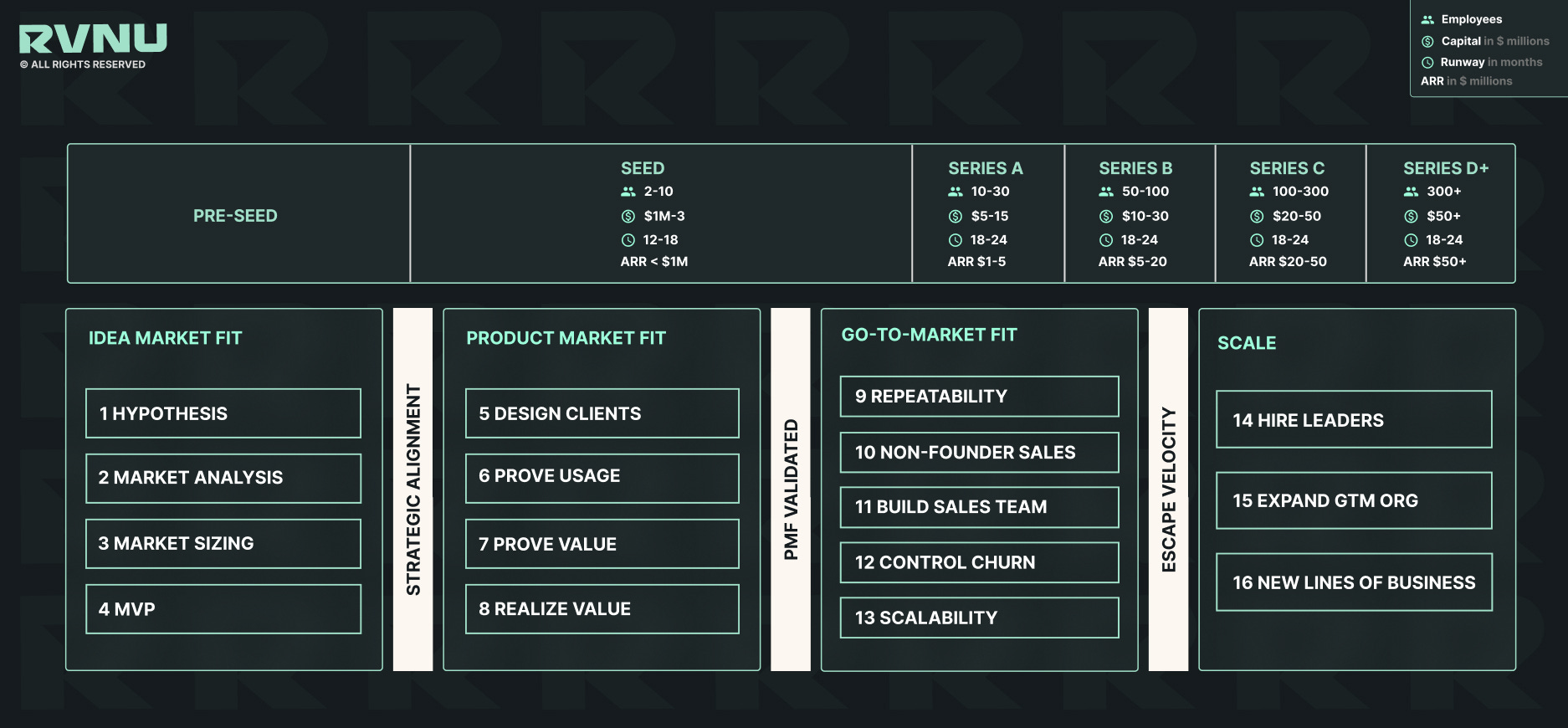
RVNU’s V1 assessment scores 159 B2B software founders across 16 pillars of GTM maturity. Each pillar is a discrete capability, and founders answer a set of questions about their own state of play. Answers roll up to a score between 0 and 100 for that pillar. Above 75 is the exit threshold, where the capability is mature enough to carry weight into the next phase. Between 50 and 74 is moderate debt, the capability partially exists but has structural gaps. Below 50 is the anti-pattern zone, the capability is missing or actively harmful.
The phase that covers the systematizing of the sales motion is Go-to-Market Fit, Pillars 9 through 13 (see fig 1 above). It is where founders most often ask whether AI can replace the human. The data, pillar by pillar, shows where AI deployment exposes the debt founders have been living with.
Pillar 9, Repeatability. Scores: Mean 27.9, median 15, 69% below 50
Founders cannot articulate a sales process that works without their own heroics. This is precisely the pillar AI is now best at addressing. Playbook documentation, process codification, message testing, cadence operation. These are inexpert tasks. They look like founder magic until you break them down into bitesize chunks. They are not magic. They are codifiable, and AI can codify them faster than the founder will.
What AI exposes. The minute you point AI at the founder’s recorded sales conversations and CRM history, the gap between what the founder actually does and what the playbook says becomes impossible to ignore. The conversations uncover the real process.
Pillar 10, Non-Founder Sales. Scores: Mean 28.3, median 15, 71% below 50
The transition from founder-led to non-founder-led selling is where 68% of founders fail. AI changes the shape of this pillar more than any other.
What AI exposes. By analyzing founder discovery calls, deal reviews, and customer conversations at scale, AI surfaces what is transferable from the founder’s instinct into a real enablement plan. The hidden gap between “what the founder does” and “what we tell the new hire to do” gets exposed. That has historically been a common failure point but AI makes it addressable. The failure point shifts from codification to hiring calibre, which I come back to below.
Pillar 12, Control Churn. Scores: Mean 27.7, median 13, 70% below 50
Post-sale value delivery, expansion, renewal. A human who has been inside the deal understands the political geography of the account in ways the buyer themselves cannot fully articulate. This is expert work. AI assists. It cannot lead or own.
What AI exposes. AI can summarize every email, call, and ticket in the account. It cannot tell you which stakeholder championed the purchase against internal resistance, or who is quietly looking for a reason to pull the plug at renewal. That knowledge sits with the human who was in the room when the deal was won. When that human leaves, the account leaves with them. AI exposes how much of the account’s institutional memory lived inside one person’s head, and how little of it the founder ever saw.
Step back from the pillars and the shape is hard to miss. The tasks AI can replace cheaply (qualification, research, message drafting, proposal generation, cadence hygiene, and prospecting into single threaded low value deals) are inexpert. They are what a typical lower-ACV (annual contract value) AE or SDR spends most of their week doing. The tasks AI struggles with (prospecting into complex enterprise accounts, champion building, executive alignment, political navigation, value negotiation, renewal quarterbacking) are expert. They are what the founder has been doing personally, which is why 92% of founders who believe they have reached Go-to-Market Fit have a Product-Market Fit foundation scoring below the exit threshold.
Two rep archetypes carry most of the commodity sales work today. The lower-ACV AE or SDR working deals under $30K, and the mid-ACV AE working deals between $30K and $100K. Both are now in the path of AI.
A comfortable reading of this shift is that displaced reps will pivot into content, community, and product-adjacent work. Some will. Most will not.
The honest picture is three outcomes.
First, the relational work that reps used to carry gets absorbed by other functions. PLG loops, community teams, developer advocates, content operators, founder-led social presence. These functions expand. They do not absorb the displaced reps. They hire different people, with different skills, for those roles.
Second, a small number of reps retrain up into enterprise work. This has always been the exception not the norm. Enterprise selling at $100K+ ACV requires pattern recognition across complex deals, political instinct, and an ability to absorb accountability that rarely transfers from a cadence-driven role. Most lower-ACV and mid-ACV reps do not make the jump.
Third, the rest leave the profession. Not because they chose to. Because the role underneath them disappeared and the adjacent roles are not open to them.
This matters for founders because it shapes the labor market you are hiring from. The pool of enterprise-capable sellers does not grow when mid-ACV work disappears. It shrinks. The reason is structural. The old path to enterprise ran through the rungs underneath. Start as an SDR, become an AE, graduate to a senior AE, earn your way into strategic accounts. Most reps never made it all the way up, but the small number who did came through that ladder. Each rung taught a different part of the craft. Remove the lower rungs and the training ground goes with them, along with the minority of reps who would otherwise have climbed it. Autor and Thompson flag this directly. When automation eliminates the inexpert tasks in a craft, entry paths narrow and the supply of future experts thins. Sales is about to live that out in real time.
The pushback we see in the field today from sophisticated founders concentrates in specific moments. Discovery with a champion. Executive alignment. Late-stage negotiation. Contract closing. The conversation when a deal goes sideways. In those moments, founders with the AI-is-cheaper-and-better data in front of them still choose the human.
Enterprise sales, which we define as $100K+ ACV and up, is not complex in the way AI is good at complex. It is complex in the ways AI is structurally bad at. Reading a room of stakeholders with competing incentives. Navigating a procurement process where the technical buyer, the economic buyer, and the champion have misaligned goals. Absorbing accountability when a deal goes sideways. Providing the provenance the economic buyer needs to defend a seven-figure decision to their board.
Autor and Thompson’s mechanism runs toward concentration here. Removing the inexpert tasks around an enterprise deal (research, note-taking, proposal drafting, follow-up cadence) makes the remaining work more specialized and higher-paid. The seller who can do the expert work is rarer, and rarity lifts the price.
Adam Ozimek’s AI and the Economics of the Human Touch (2025) offers a parallel from the consumer economy. Self-checkout has not replaced cashiers at scale. Tabletop ordering tablets have not replaced waiters. “The human touch,” Ozimek argues, behaves as a normal economic good. As buyers get richer, they demand more of it, not less. The enterprise equivalent is the buyer’s demand for a human underwriter on decisions that carry career risk.
This is where our own data gets interesting. 68% of founders fail the transition from founder-led to non-founder-led sales today (P10). AI properly deployed should lower that number considerably. Capturing founder conversations, codifying what transfers, building realistic enablement, all of that is now tractable in a way it was not two years ago.
The problem is no longer the codification. The problem is who you hire into the codified role. The work that remains after AI strips out the automatable layer is harder to hire for, harder to train, and harder to diagnose when a rep underperforms. Mediocre reps used to be hidden by volume. AI removes the volume and suddenly the mediocrity becomes visible.
We are early. Three honest caveats.
First, does the pushback from sophisticated buyers hold as AI head towards AGI? Today’s preference for a human underwriter may reflect current model limitations rather than a durable feature of enterprise buying. The pushback is loudest in the moments that look most structural, not most technical. The economic buyer is not refusing AI because the model is not good enough. They are refusing it because they need a human accountable for the decision.
Second, is this a durable structural shift or a transitional moment? The next year or two will tell, maybe the next few months! What we can say with confidence is that the shift is visible at the edges, and the founders reading it correctly are already making very different hiring decisions.
A concrete example. Instead of hiring six SDRs and three mid-ACV AEs, the founders reading this right are hiring two senior enterprise AEs on a $250K to $350K OTE, deploying AI across prospecting and research, and redirecting marketing spend into thought leadership and community. The cost base looks similar. The motion is completely different. Fewer bodies, higher calibre, more AI leverage, tighter focus on enterprise.
Third, what happens when the buy-side deploys AI to the same extent? The direction of the argument accelerates in my opinion. The inexpert work on both sides collapses into AI-to-AI workflows. The buyer's AI does the vendor research and shortlisting. The seller's AI does the outreach and qualification. The mid-ACV motion, already under pressure from sell-side AI, loses the other end of the interaction too. The expert work stays human on both sides because accountability stays human. The economic buyer still needs a person to underwrite a seven-figure decision, and that person needs a counterpart on the sell-side. The barbell gets sharper.
If the hypothesis holds, the playbook most founders are still running is broken. It assumed a continuous ladder from SDR to AE to senior AE to enterprise rep. It assumed you could build a mid-ACV motion (deals in the $30K to $100K band) by stacking SDRs underneath AEs and scaling from there. It assumed volume and velocity were the right levers at every deal size.
That playbook worked in a world where a mid-ACV motion could be built cheaply on human reps doing inexpert work at scale. AI is compressing that motion fast. What is left is a barbell.
One end is PLG, or what might be more honestly renamed AI-led growth. Supported by brand, community, and content. Humans are visible but not transactional. Deals close through the product and the relational signal around it. This motion is moving up the ACV band as AI improves, but it halts at the $100K enterprise line.
The other end is enterprise. A small number of high-cost expert operators closing complex deals where the human element is the value itself.
Founders sitting in the middle have three options.
One, collapse down. Invest in brand, community, and an AI-led growth motion. Treat the sales team as thin and technical. This works if your ACV can support a low-touch motion and your product adopts without a champion.
Two, move up. Close the PMF debt first. Pillar 5 (Design Clients), is where 67% of founders score below 50. It is the foundation layer that has to be rebuilt before any enterprise motion works. Then hire the small number of people who can actually do enterprise work, and pay them what the market demands.
Three, stay in the middle. This is where most founders default, because it requires no decision. It is also the option with the lowest survival rate over the next five years in my opinion.
The lower-ACV and mid-ACV human-powered sales roles are disappearing. Both gone within 5 years. Not transforming into something else. Disappearing from the GTM motion, then either leaving the profession or being absorbed into adjacent functions that hire differently.
What replaces those roles is not a better rep. It is software. PLG, or rather AI-led growth, is moving up the ACV band and eating into what used to be mid-ACV territory. It halts at the $100K enterprise line, because that is where asset-specific trust has to be underwritten by a human.
Above that line, sales becomes more concentrated, higher cost per head, and harder to hire for than at any point in the last twenty years. The survivors are the ones who already excel at enterprise work. The supply of these high-grade enterprise sellers does not grow with demand, not in the near term at least. But the cost per head is only half the story. With AI handling the inexpert work around them, the enterprise rep covers more accounts, runs more deals in parallel, and closes faster. Revenue per head goes up faster than cost per head.
Founders who assume AI will make sales cheaper are going to be surprised. AI makes the automatable part of sales cheaper. The enterprise piece per head will cost more, because the supply of people who can do it does not grow and AI cannot commoditize it. The arithmetic changes in your favour if you hire the right person, because the revenue they produce grows faster than their base. And if you hire the wrong one, AI tells you within weeks rather than eighteen months. The feedback loop on a bad hire has collapsed. You can course correct faster than at any point in the last twenty years.
Most reps die. The rest get rich.
Wayne
If you want to see where in the 16-pillar framework your own GTM sits, take the assessment at gtmscore.ai. The work of preparing for this shift starts with intellectual honesty about where the debt actually is.
Sources
Autor, D., & Thompson, N. (2025). Expertise (NBER Working Paper); Beyond Job Displacement: How AI Could Reshape the Value of Human Expertise.
Imas, A. (2025). What Will Be Scarce? The Economics of Structural Change and the Post-Commodity Future of Work. Ghosts of Electricity.
Imas, A., & Madarasz, K. (2024). Superiority-Seeking and the Preference for Exclusion. Review of Economic Studies.
Ozimek, A. (2025). AI and the Economics of the Human Touch: A Reason for Optimism. Economic Innovation Group.
Comments
Nothing yet. Say the first thing.
Sign in to join the conversation.