
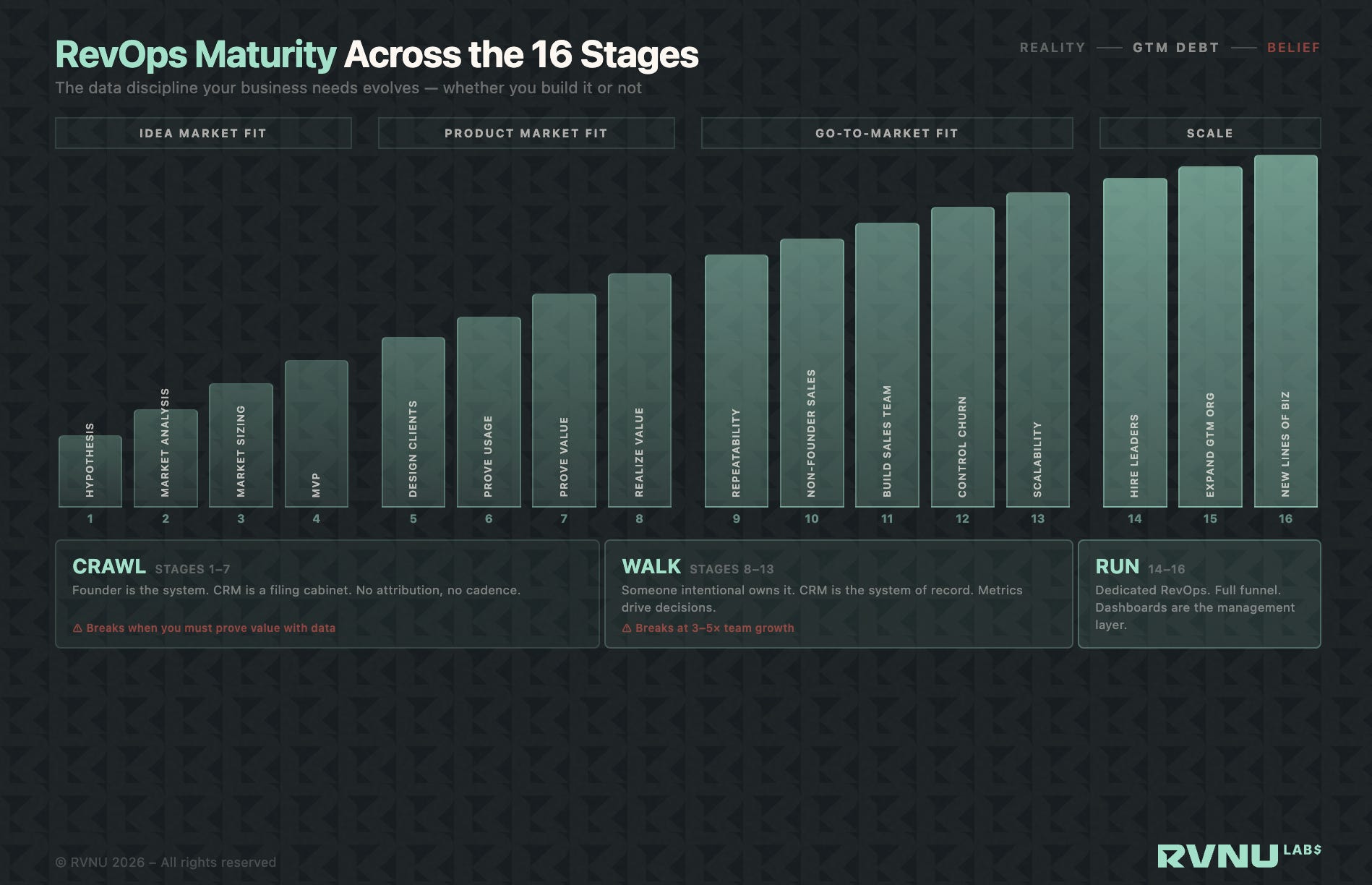
Fig 1: RevOps maturity across the stages of startup growth
Most founders think of RevOps as a hiring decision. Something that shows up on the org chart after you raise your Series A, or once the CRM gets messy enough that someone has to clean it up.
That framing is backwards. By the time you’re hiring a RevOps person, you’ve already accumulated months, sometimes years, of GTM debt. Bad pipeline stage definitions. No attribution. Forecast data that lives in a spreadsheet someone built for a board meeting and never updated. Post-sale tracking that doesn’t exist. An operating cadence that amounts to “the founder checks the CRM when they remember to.”
The discipline you need at $20M ARR should have started maturing at $1M. Not as a headcount line item. As a set of behaviors, systems, and data standards that evolve alongside the business.
RevOps isn’t a person or function you bolt on. It’s a maturity curve. Every stage of growth has different demands, and each one has a predictable breaking point where the current version stops working.
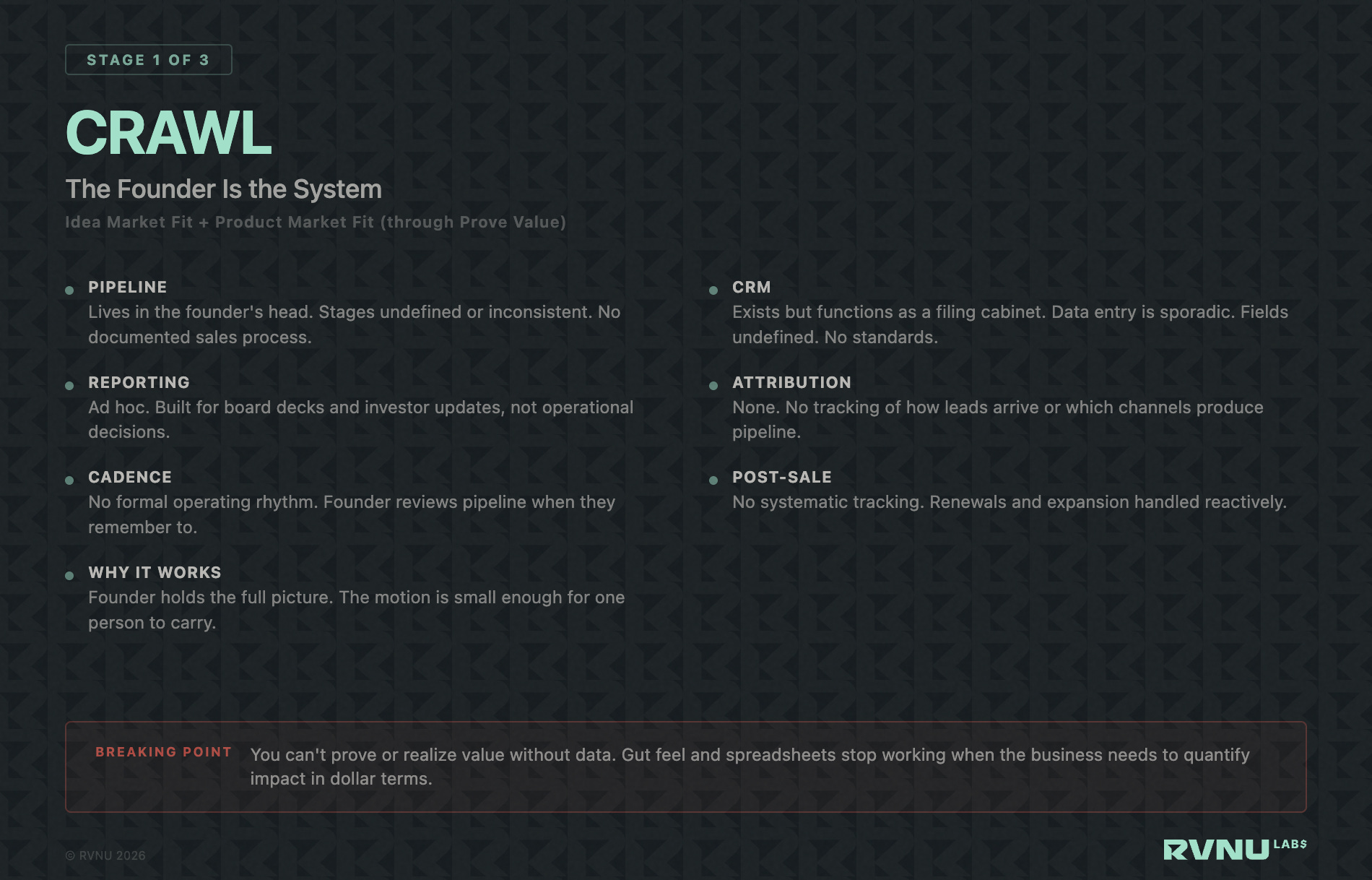
Fig 2: RevOps in Crawl mode
In the earliest stages of a company, validating the hypothesis, building the MVP, landing design partners, proving usage and value.
The founder is the pipeline. The founder is the forecast. The founder is the CRM, whether they realize it or not. Pipeline stages live in their head. Reporting is reactive, something pulled together for a board deck or investor update. There’s no attribution model, no operating cadence, no post-sale tracking infrastructure.
This works because the founder is the motion. When you’re running every deal personally, you can hold the full picture. You know which prospects are real, which deals are stuck, what the quarter looks like. The picture is small enough to carry, until it isn’t. RevOps doesn’t exist as a person yet - but as a discipline. What matters here is documentation.
The problems are invisible at this stage, which is exactly what makes them dangerous. Every shortcut, the process you didn’t define, the conversations undocumented, the win/loss data you never captured, is a deposit into your GTM debt account. It’s accruing interest. You just can’t see the balance yet.
The breaking point: You can’t prove or realize value without data. When the business needs to quantify what the product actually does for customers, in dollar terms, not anecdotes, gut feel and ad hoc spreadsheets stop working. The first real RevOps demand isn’t a person. It’s the moment the business needs data discipline to take action and discovers it doesn’t have any.
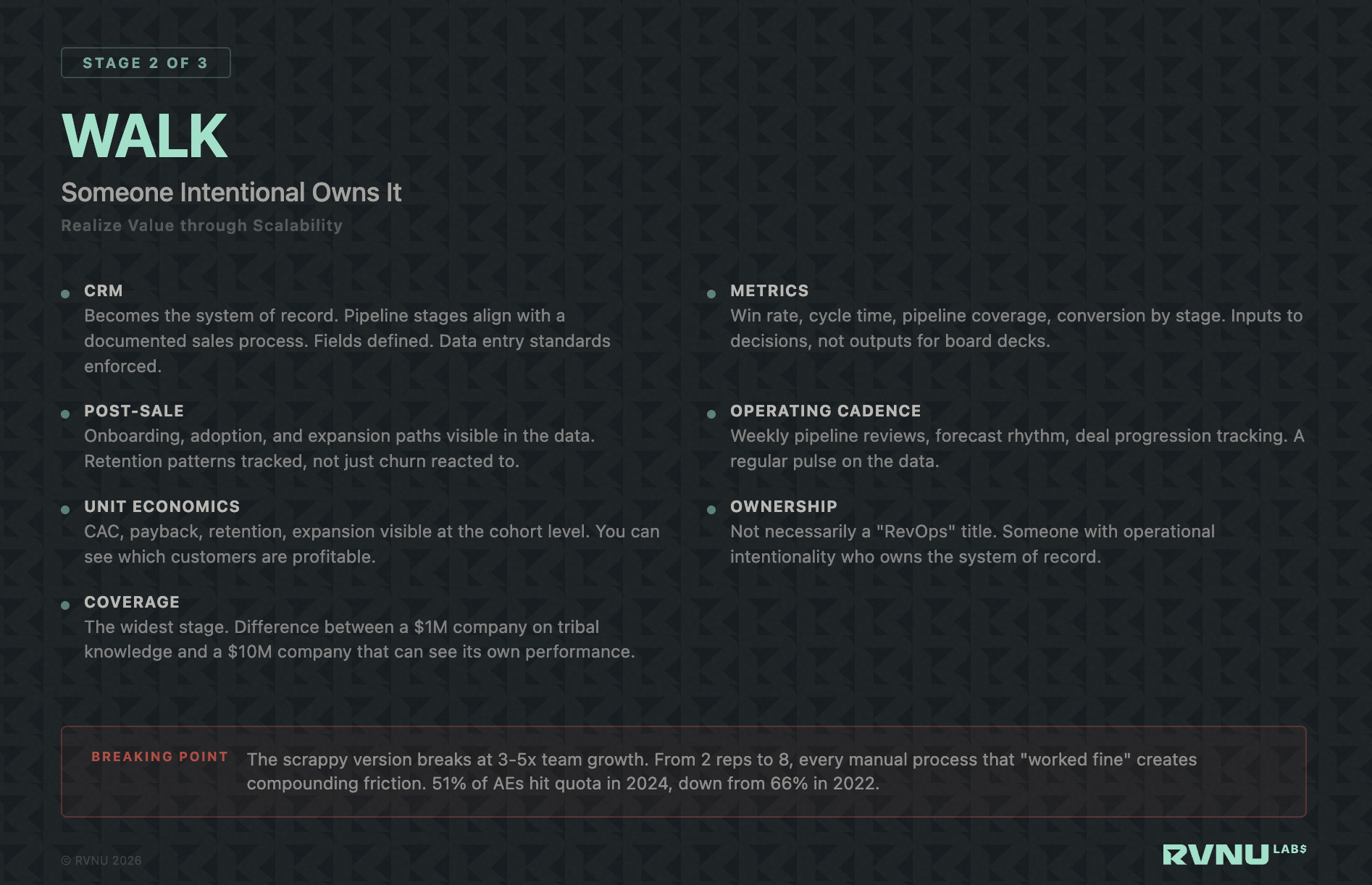
Fig 3: RevOps in Walk mode
Once value has been realized by the customer and the business shifts into repeatable sales, non-founder selling, and team building, the data demands outstrip what any one person can hold in their head.
This is where someone, not necessarily a “RevOps” title, but someone with operational intentionality, takes ownership of the system of record.
What changes:
CRM becomes the operating system, not a filing cabinet. Pipeline stages align with a documented sales process. Fields are defined. Data entry standards exist. The CRM starts telling you something useful instead of just storing contact information.
Metrics drive decisions. Win rate, cycle time, pipeline coverage, attribution by channel. These become inputs to management decisions, not outputs for board decks. There’s a meaningful difference between reporting metrics and managing with them.
Post-sale takes shape. Onboarding, adoption, and expansion paths become visible in the data. You can start to see retention patterns, not just react to churn after it happens.
Operating cadence is established. Weekly pipeline risk reviews, targeted call coaching, lengthening forecast visibility, customer churn is controlled and identified. The business starts to see early warning and discuss solutions across executive leadership. The business moves from static reporting to aligned signal-based action.
Unit economics become measurable. CAC payback, customer lifetime value through retention and expansion, all at the cohort level, not the average. You can start to see which customers are actually profitable and which are underwater.
The Walk stage covers a lot of ground. It’s the difference between a $1M company running on tribal knowledge and a $10M company that can actually see its own performance in the data. Most of the RevOps maturity work in a startup’s life happens here.
The breaking point: The scrappy version breaks at 3-5x team growth. When you go from 2 reps to 8, the tribal knowledge transfer problem becomes a data infrastructure problem. The documentation debt that accumulated during Crawl becomes a ticking time bomb. Conversion metrics degrade because new hires can’t replicate what existing reps do through institutional memory. Every manual process that “worked fine” with a small team creates compounding friction as the team scales.
Industry data reinforces this. Salesforce's 2025 research found that two-thirds of reps didn't meet quota by year-end and attributed it to a likely lack of cohesion and collaboration among go-to-market teams. That's the tell. When the majority of your reps are missing, the instinct is to look at the reps. But the data points somewhere else: the process, the pipeline visibility, the enablement infrastructure holding it all together. That infrastructure is RevOps. And by the time it's visibly broken, it's been broken for a while.
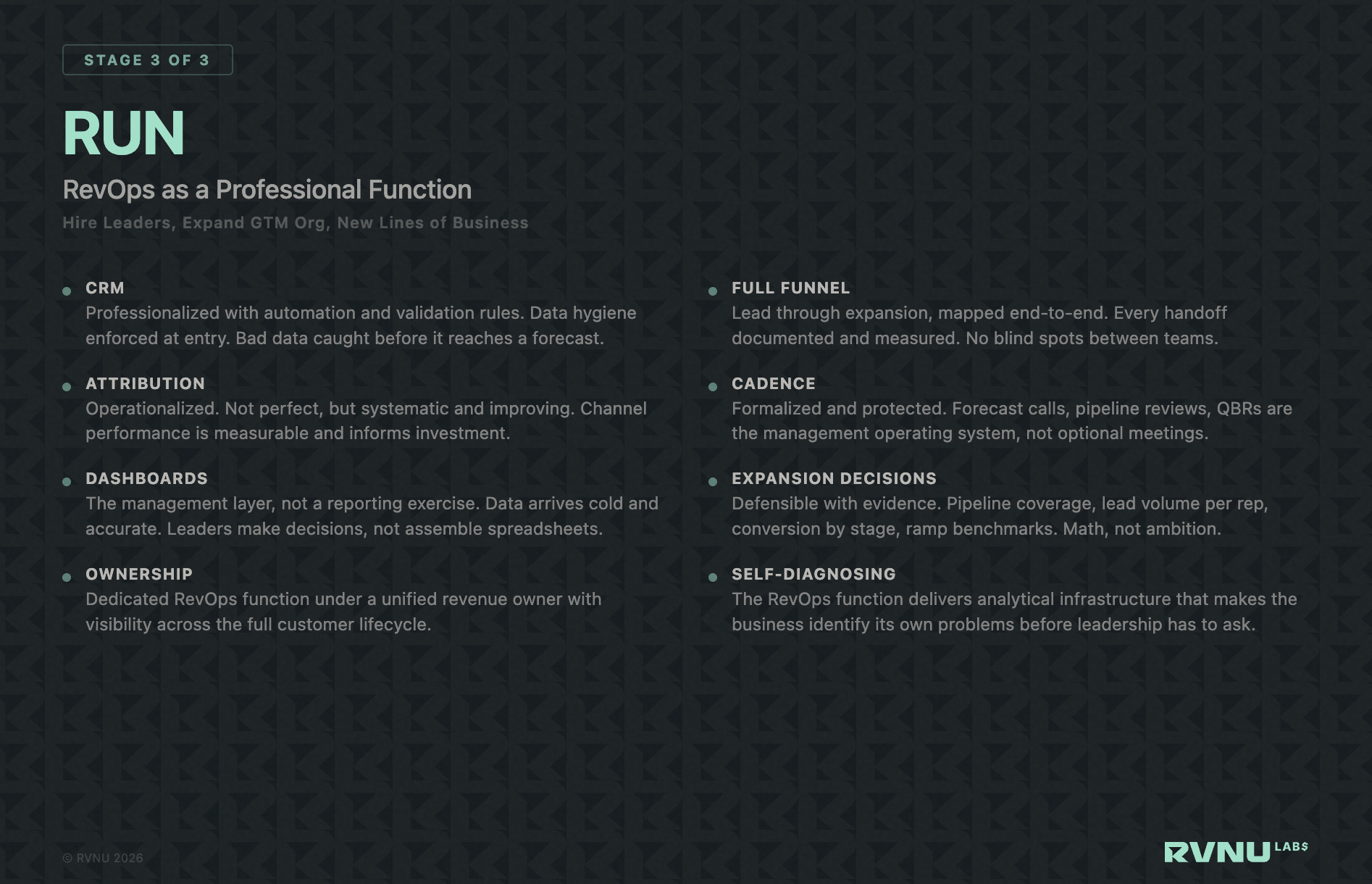
Fig 4: RevOps in Run mode
At scale, when you’re hiring leaders, expanding the GTM org, and potentially launching new lines of business, RevOps becomes a dedicated function. Ideally under a unified revenue owner who has visibility across the full customer lifecycle.
What changes:
Systems are professionalized. Automations, validation rules, data hygiene enforcement. The system doesn’t just capture data. It enforces quality. Bad data gets caught on entry, not discovered during a forecast review.
Full funnel process is mapped end-to-end. Lead through expansion, with every handoff documented and measured. Marketing attribution is operationalized. Not perfect, but systematic and improving.
Operating Cadence is formalized and protected. Forecast calls, pipeline reviews, customer QBRs aren’t optional. They’re the management operating system. Skip one and you’re flying blind.
Dashboards are the management layer. In Walk, dashboards are reporting. Someone builds them, leadership intreprets them. In Run, dashboards are monitoring. Metrics are benchmarks and thresholds based not on industry averages, but YOUR historical data. These deliver signal if you are on or off track, where leadership takes action immediately. The RevOps function’s job isn’t to produce reports. It’s to deliver the analytical infrastructure that makes the business self-diagnosing.
Expansion decisions are defensible. Identifying revenue potential in customer accounts, pipeline coverage, capacity, conversion rates by stage, ramp time benchmarks. Every growth investment is justified by data that holds up to scrutiny. Not ambition. Not board pressure. Math.
The reason this matters isn’t just efficiency. It’s compounding. Every stage of RevOps maturity that you skip or defer creates GTM debt that the next stage inherits.
❌ Skip CRM discipline during Crawl? Your Walk-stage rep onboarding is chaos.
❌ Skip operating cadence during Walk? Your Run-stage forecast is fiction.
❌ Skip attribution during Walk? Your Run-stage expansion lacks evidence behind it.
The founders we work with at RVNU, across 200+ B2B SaaS companies, almost universally underestimate how early this starts. Our assessment data shows that 68% of founders fail the transition from founder-led sales. A major contributor is the gap between where the founder believes the business is operationally and where it actually is. RevOps maturity is one of the widest gaps.
The fix isn’t complicated. It’s sequential. Match the data discipline to the stage. Don’t over-build for where you’re going. Don’t under-build for where you are.
Not sure where your RevOps maturity actually sits? The GTM Debt Assessment quantifies the gap between where you think you are and where you actually are, across all stages of growth. It takes 10 minutes and the output is objective.
Happy operating!
Wayne Morris & Laura Wheeler - Founders of RVNU
About RVNU
RVNU helps B2B enterprise software founders navigate the 16 critical stages of startup growth through our comprehensive framework and GTM Debt Assessment. Our expertise comes from hands-on experience scaling companies from early revenue through successful exits, and from working with hundreds of founders to achieve sustainable product-market fit and efficient go-to-market execution.
Comments
Nothing yet. Say the first thing.
Sign in to join the conversation.