
You built a PLG motion…now what? Here’s the part nobody tells you at the beginning.
Product-led growth is not a business model. It’s a top-of-funnel strategy and if you don’t eventually connect it to a commercial motion, all you’ve built is a very expensive free tier.
I’ve chatted & seen first-hand several founders who spend 18 months optimizing activation flows, onboarding sequences, and in-app nudges. Usage goes up. Signups go up. ARR stays flat. They blame the product. They hire a growth PM. They blame the growth PM. They consider a rebrand.
The product was never the problem.
The problem is that PLG generates signal. And most early-stage B2B SaaS founders have no idea how to read it, route it, or turn it into pipeline.
That’s what we’re unpacking today.
PLG carries real costs. Engineering investment in self-serve infrastructure. Support overhead for a large free user base. Product complexity from maintaining multiple tiers. And the organizational cost of actually instrumenting all of this so it produces something useful. This is why organizations go hybrid (PLG + SLG) as they move into more mature GTM motions.
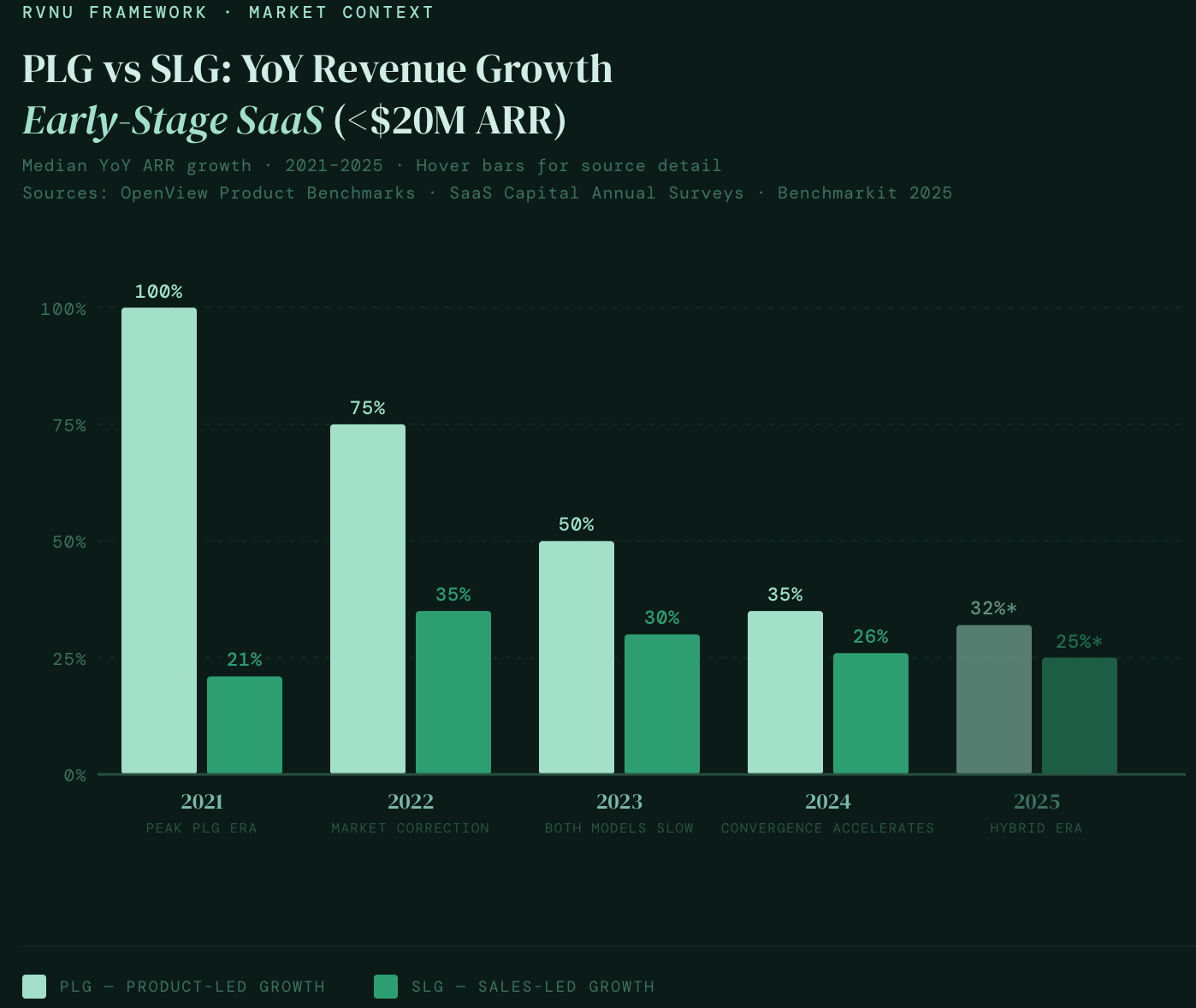
Data note: 2021–2024 figures are median YoY ARR from OpenView Product Benchmarks (600–1,000 respondents), SaaS Capital Annual Surveys, and Benchmarkit. 2025* is estimated — OpenView’s 2025 Product Benchmarks have not been published. PLG advantage narrows in 2024–2025 as hybrid/PLS models dominate and pure PLG hits a ceiling at the $10–20M ARR stage. All figures are medians; individual performance varies by category, ACV, and execution.
58% of B2B SaaS companies now run a PLG motion, and 91% of those plan to increase their PLG investment (ProductLed PLG Benchmark, 600+ companies). PLG-leading companies grow at roughly 50% YoY — more than double the 21% median for traditional sales-led SaaS (OpenView Product Benchmarks). PLG companies also carry 15–20% higher Net Revenue Retention on average (G2/DataDab 2024).
I have to admit: Those are seductive numbers.
Here’s the one that matters: 60% of PLG initiatives fail within 18 months.
The leading causes? Cross-functional misalignment. And poor activation design.
In other words: not the product. The plumbing.
At RVNU, we’ve worked with and seen 200+ GTM assessments with early-stage B2B SaaS founders. What we’ve consistently found is that founders are trying to build and operate four stages ahead of where their actual GTM maturity sits. (read more here gtmdebt.com)
That gap is what we call GTM Debt. In PLG specifically, the debt usually looks like this:
You have thousands of free users and no definition of what “activated” actually means
You can’t tell a business user from someone who signed up with a personal Gmail
Your sales team, if you have one, has zero visibility into the free user base
Nobody owns a conversion number. PLG lives in Product, not Revenue.
When no one owns PLG as a revenue motion, it doesn’t produce revenue. It produces brand value, user volume, and a support queue. All of which are lovely. None of which pay salaries.
“PLG is not a free-user management problem. It’s a top-of-funnel pipeline problem.”
The sooner you treat it that way, the sooner it becomes a commercial asset. Lets see it mapped through the RVNU framework starting with Product Market Fit.
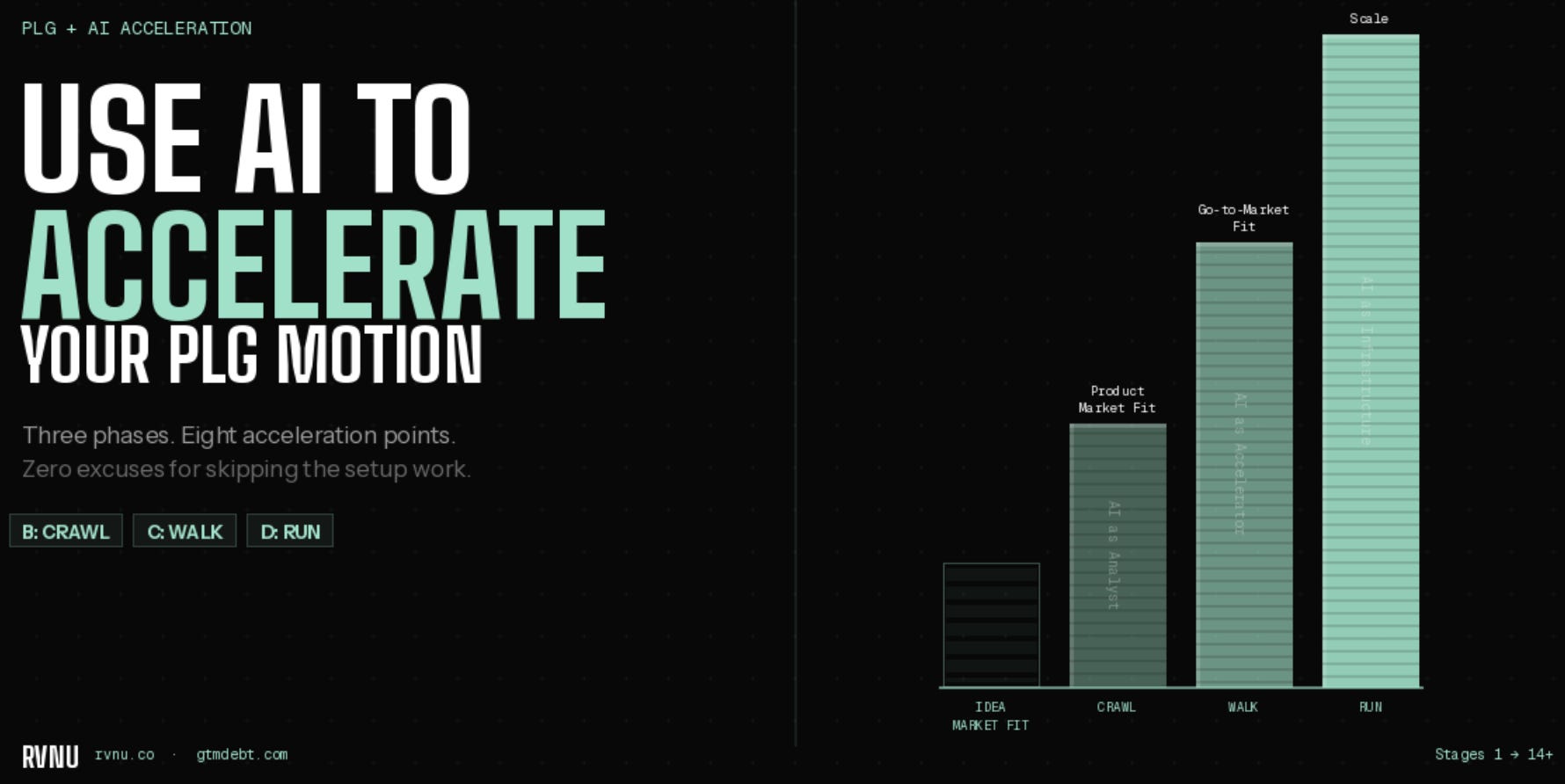
You’re getting paying customers. You’re proving usage and adoption of features. You’re establishing that value exchange is real. At this stage, your only PLG job is to get organized. That means:
Get product telemetry in place.
1. What are they using, how often? Define what good “usage and adoption” looks like.
AI Acceleration: Once your telemetry is flowing (Mixpanel, Amplitude, PostHog), use AI to do the pattern recognition work that would otherwise take days in a spreadsheet. Paste your event data (non PII) or a usage export into Claude and ask it to surface which feature sequences correlate with retention or upgrade. You’re not building a model — you’re using AI as a fast analyst to help you form hypotheses before you invest in formal definitions. Prompt: “Here are 90 days of feature usage events for 200 users. What patterns do you see in the users who came back more than 3 times in 30 days?”
2. Enrich the demographic information of the user base. Separate business users from hobbyists. Tag your existing user base in your CRM.
AI Acceleration: Tools like Clay now have AI-native enrichment built in — you can drop a list of email/company domains and have AI infer company size, industry, funding stage, and persona without manual research. For founders not yet on Clay, use Claude to write the enrichment prompt logic: give it a sample of your user list and have it draft the classification rules you’ll apply (e.g., “If domain is a .edu or personal Gmail, tag as hobbyist. If domain resolves to a funded company with 10+ employees, tag as business user”). The output is a tagging rubric you apply in your CRM — no tool cost required at this phase - other than tokens.
3. Build two cohorts: activated + business-associated and everyone else.
AI Acceleration: Once you have your two cohorts defined, use AI to synthesize the demographic signal. Export the cohort data, drop it into Claude, and ask: “What firmographic or behavioral patterns are overrepresented in the activated + business-associated cohort versus everyone else?” You’re looking for the 2–3 variables that predict fit. AI compresses a week of manual analysis into an afternoon. The output is the targeting brief you’ll use for outreach in Phase C.
4. Then AND ONLY THEN, reach out to those activated + business-associated users and do interviews.
AI Acceleration: Use AI before, during, and after the interview. Before: generate your interview guide in 10 minutes — prompt with your product description, your two cohorts, and ask Claude to draft 8–10 open-ended discovery questions focused on value realization and workflow context. During: record with Otter.ai or Fathom. After: paste the transcript into Claude and ask it to extract: (1) the specific trigger that drove sign-up, (2) the moment they realized value, (3) the language they use to describe the problem. That language becomes your messaging. This is the cheapest possible version of a research function.
Cost at this phase: time only. No new tooling required.
AI doesn’t change that math — it makes the time go further. You’re still doing the thinking. AI is doing the summarization, pattern recognition, and first-draft work that previously required a analyst hire or a research vendor.
This is where you start translating organized signal into commercial action. You’re proving repeatability by selling outside your network, building out your first AE, and specializing your sales roles. You’re also, for the first time, in a position to layer PLG into your pipeline motion.
Define your first Product Qualified Lead criteria (activated user + ICP match + at least one additional behavioral signal).
AI Acceleration: Use AI to draft and pressure-test your PQL definition before you build the workflow. Feed Claude your activation definition, your ICP criteria, and your behavioral event library, then ask: “Draft three versions of a PQL definition — conservative, moderate, and aggressive — and explain the tradeoffs of each.” This forces precision early and prevents the common failure mode of a PQL definition so broad it’s meaningless. Once defined, use AI to write the scoring logic in plain English before handing it to your ops person or RevOps contractor to implement in HubSpot or Salesforce.
Enrich your user base. Check whether any users are already customers; route those to CS, not Sales.
AI Acceleration: Use an AI-native enrichment layer (Clay, Apollo’s AI fields, or even a custom GPT prompt running against your contact list) to continuously append company context — headcount, funding round, tech stack, job title normalization — to inbound signups at the moment of registration, not weeks later. For founders doing this manually: use Claude to write a batch enrichment prompt you can run weekly against new signups in a Google Sheet. This is the “$300–800/month enrichment tool” phase — AI makes that spend go further by helping you define what fields to enrich for and what rules to apply downstream.
For net-new accounts, build lightweight outreach that acknowledges they already use the product. Don’t treat them like cold prospects. They’re not.
AI Acceleration: This is where AI delivers outsized ROI with minimal setup. Build a simple outreach template in Claude that takes three inputs — the user’s activated features, their company context from enrichment, and their behavioral signal — and outputs a personalized first-touch message. You’re not automating 10,000 emails. You’re giving your first AE a drafting assistant that can produce a contextually relevant, product-aware outreach note in 90 seconds instead of 15 minutes. At 20–30 PQLs per week, that’s material time savings and meaningfully better conversion because the message is specific. Prompt: “Write a 4-sentence outreach email to [Name] at [Company]. They signed up for [Product], activated [Feature A] and [Feature B], invited 2 teammates, and work at a 45-person Series A SaaS company. Acknowledge their usage, don’t pitch from scratch, and suggest a 20-minute call to understand where they want to take it.”
Track PLG-sourced results separately from your core pipeline.
AI Acceleration: Ask Claude to design your PLG tracking taxonomy before you build it — what fields, what stages, what conversion events matter. Getting the data model right now prevents a painful retroactive cleanup at Stage 14. Once you have two to three months of data, use AI to do a first-pass analysis: paste your PLG vs. non-PLG pipeline summary and ask for a comparison across conversion rate, deal size, and cycle length. This is the internal business case you’ll need to make the investment at Phase D defensible to a board or a VP hire.
PQLs convert approximately 3x better than MQLs. Yet only 24% of PLG companies are actively using a PQL framework. That gap is your opportunity.
The increment at this stage: one enrichment tool ($300–800/month), 2–4 hours of focused attention per week. AI doesn’t add cost here — it multiplies the output of those 2–4 hours.
You’ve hired your VP RevOps. You’ve got your VP Sales or CRO in seat. You have at least two quarters of PQL-to-pipeline conversion data and 20+ PLG-influenced closed-won deals to build a scoring model from. Now you automate.
PQL identification is automated. Routing rules are defined.
AI Acceleration: This is where you graduate from AI-as-analyst to AI-as-infrastructure. Use your 20+ closed-won PLG deals as training examples to build a predictive PQL scoring model — either natively in your CRM (HubSpot’s AI scoring, Salesforce Einstein) or via a lightweight custom model in a tool like Coefficient or obviously.ai. The model ingests firmographic + behavioral signals and outputs a score. Your RevOps team sets the routing thresholds; the AI does the continuous scoring. Critically: have Claude help you document the model logic in plain English so your CRO and board can interrogate it. A black-box score nobody trusts won’t get actioned.
PLG-influenced pipeline shows up as a distinct line in your RevOps reporting alongside your other channels.
AI Acceleration: Build an AI-assisted reporting layer. Use Claude to write the SQL or HubSpot report logic that isolates PLG-sourced pipeline by channel, product motion, and cohort. Then go a step further: use AI to generate a standing weekly RevOps narrative template — a structured prompt that takes your pipeline metrics as input and outputs a 200-word plain-English summary of PLG channel health, ready to drop into your leadership sync. This is the kind of operational leverage that makes a VP RevOps look exceptional and keeps PLG visible at the leadership level where budget decisions get made.
You’re measuring it like one: meetings generated, pipeline created, close rate, deal size, time-to-close versus non-PLG-sourced.
AI Acceleration: Use AI to run ongoing channel attribution analysis. As deal volume grows, use Claude or a connected BI layer to identify which product behaviors are the strongest leading indicators of PLG-sourced closed-won — not just at sign-up, but across the full pre-sales lifecycle. Feed in your closed-won and closed-lost PLG deals and ask: “What product behaviors in the 30 days before outreach differentiate closed-won from closed-lost?” That output tightens your PQL definition in the next scoring iteration. The PLG motion gets smarter every quarter — but only if you’re feeding it clean data and interrogating it consistently.
At this phase, PLG is not a side project. It is a formalized revenue motion with an owner and a target.
AI at this phase isn’t a shortcut — it’s operational infrastructure. The founders who use it well don’t replace their RevOps function; they make their RevOps function faster to iterate, easier to explain to the board, and compounding in accuracy rather than stagnating at the model they built in year one.
The through-line: AI doesn’t change when you do each phase of PLG work. It changes how fast you move through the setup, how precise your definitions become, and how much leverage one or two people can generate before you have a full team. The failure modes are the same with or without AI — jumping to outreach before you have clean cohorts, building a scoring model on 5 deals, treating PLG as a side project at Stage 14. AI accelerates good process. It also accelerates bad process. Do the phases in order.
Thanks for reading The RVNU Newsletter! This post is public so feel free to share it.
You may be asking, how do I know its time to shift into a Sales-Led motion? No pivot is ever clean. But there are clear signals that your center of gravity needs to shift.
1. Your PLG LTV:CAC is below 3x and not improving. When the fully-loaded cost of running PLG (including engineering and support, not just tooling) divided into lifetime value of PLG-sourced customers is consistently below 3:1, the motion isn’t generating adequate return. This doesn’t mean kill PLG. It means the current investment level isn’t justified.
2. Your average deal size has outgrown self-serve. There is a deal size threshold above which self-serve conversion breaks down regardless of product quality. Enterprise procurement, security reviews, legal contracts, multi-stakeholder buying processes that a “product” alone cannot navigate. When your average ACV moves consistently above $15K, sales-assist becomes necessary. The product opens the door. Humans close the deal.
3. PLG-sourced accounts aren’t expanding. One of PLG’s core economic justifications is NRR. Customers who adopt bottom-up tend to expand naturally. If they’re not expanding, one of the primary reasons to invest in PLG is absent.
4. Free users are growing. Paid conversion is flat. This means the product delivers value but doesn’t create commercial urgency. The causes are usually: feature gating that’s too permissive, an ICP problem, or an undefined PQL. Each has a different fix. But if you’ve addressed all three and conversion still hasn’t moved then PLG is producing brand equity, not pipeline.
5. Enterprise demand is arriving uninvited. This is the good problem. Large organizations are showing up with procurement requirements, security questionnaires, and multi-seat contracts. PLG infrastructure cannot serve them. This is not a reason to panic. It’s the signal that you’ve outgrown pure product-led motion and it’s time to build what’s next.
They abandon PLG entirely.
Figma didn’t. Atlassian didn’t. The companies that navigate this transition well don’t replace PLG with SLG, they formalize PLG as the top of the funnel for a portion of their pipeline and build sales to serve what the product has already found.
HubSpot tried to run both simultaneously from the beginning without the operational infrastructure to support it. The result: too many SKUs, a pricing ladder that creates confusion, and a sales team that has to “sell value” earlier than is ideal because the self-serve motion isn’t doing the pre-qualification work.
The lesson isn’t one model over the other. It’s sequence. Don’t run before you’ve walked. Don’t walk before you’ve crawled.
And for the love of all things operationally sound, don’t build a full automated PQL scoring model before you’ve agreed on what “activated” means.
Five questions. Be honest.
Have you measured PLG CAC with fully-loaded costs including engineering time and support, not just tooling?
Do you have at least two quarters of conversion data after making a deliberate attempt to improve it?
Have you defined PQLs and actually tested whether PQL-triggered outreach converts better than untargeted outreach?
Have you identified 10+ PLG-sourced closed-won deals and characterized what they have in common?
Can you model what a comparable SLG investment would produce, based on your current close rates and ACV?
If you can’t answer yes to all five, you’re not ready for 'Run. And investing at Run-level before you’re there is one of the fastest ways to accumulate GTM Debt you’ll spend the next 12 months trying to untangle.
The founders who get this right are almost never the ones who had the best PLG product. They’re the ones who knew where they actually were and matched their investment to that reality.
Most of the founders we work with come to us thinking they’re at Go-to-Market Fit. Our assessment data consistently shows 68% are operating two to four stages earlier.
That gap is expensive. And it’s fixable but only once you can see it clearly.
If you want to know exactly where you sit in the RVNU framework and what your PLG motion should look like at that stage, then take the GTM Assessment. It takes 5 minutes and gives you a clear map of where you are versus where you’re trying to operate.
Take the RVNU GTM Assessment here
Happy Operating,
Laura Wheeler, COO of RNVU
Comments
Nothing yet. Say the first thing.
Sign in to join the conversation.