
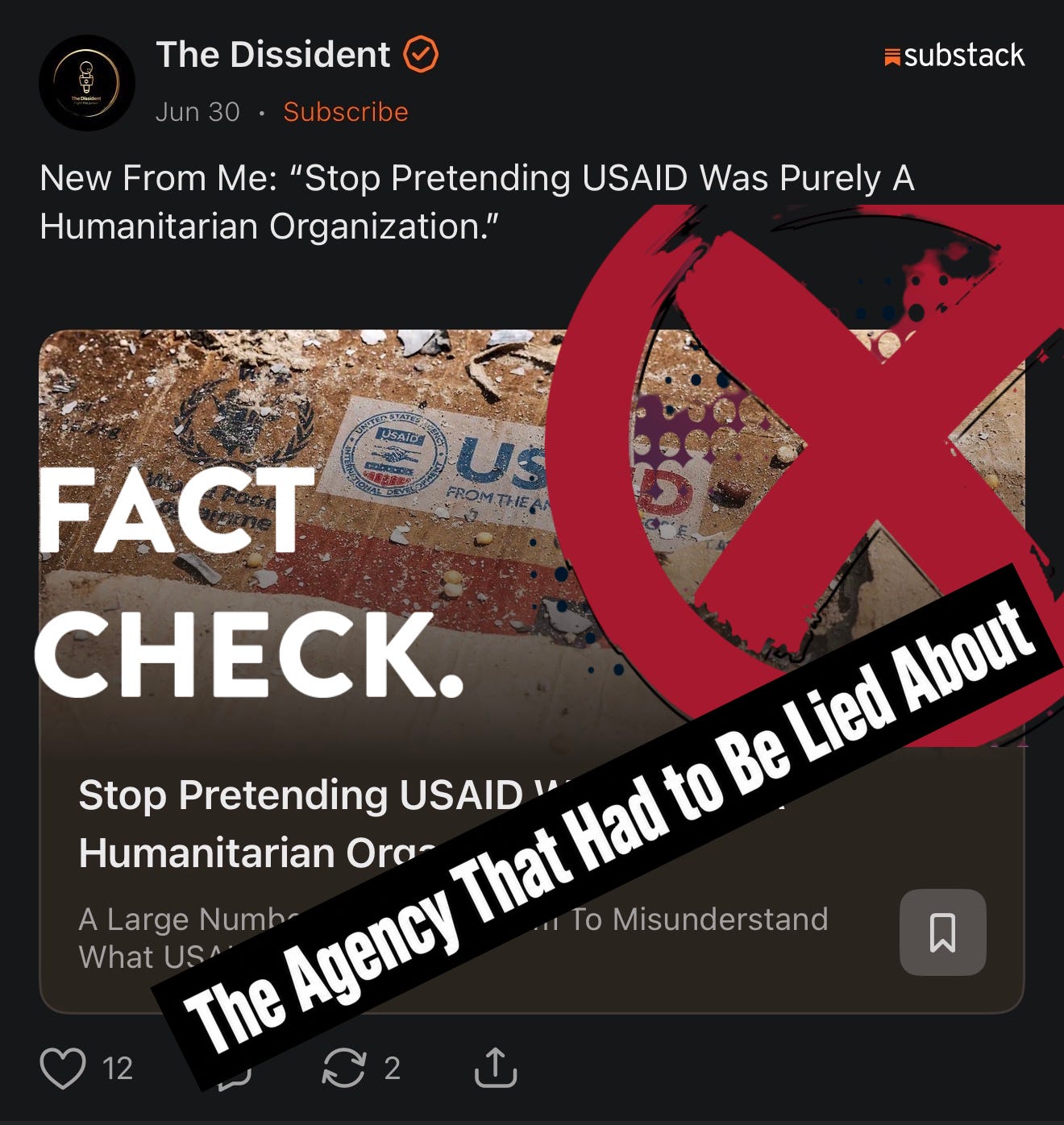
On June 30, 2026, Justin K.P. published Stop Pretending USAID Was Purely a Humanitarian Organization in The Dissident. Its subtitle reads: “A Large Number of People Seem to Misunderstand What USAID Was.”
That subtitle is half correct. Something has been misunderstood. This article proves it. The problem is not USAID. It is the standard of evidence used to judge it.
His case rests on one primary document: a classified diplomatic cable sent from the United States Embassy in Caracas on November 9, 2006. The cable, 06CARACAS3356, was later published by WikiLeaks under the subject line “USAID/OTI PROGRAMMATIC SUPPORT FOR COUNTRY TEAM 5 POINT STRATEGY.”
Written under Ambassador William Brownfield, the cable describes a strategy adopted by the embassy country team in August 2004: strengthening democratic institutions, penetrating Chávez’s political base, dividing Chavismo, protecting vital United States business interests, and isolating Chávez internationally.
Those words are real. The document is real. Its meaning can be tested against what it actually says.
Justin K.P. describes the document this way:
“Leaked documents show that in 2002, the U.S. gave $15 million to USAID and tasked it with undermining Venezuela’s then elected and popular president, Hugo Chávez.”
That sentence contains four errors.
The year is wrong. The cable was sent in November 2006 and describes a strategy adopted in August 2004. It does not document an assignment issued in 2002.
The money is mischaracterized. The $15 million figure referred to grants distributed among more than three hundred Venezuelan civil society organizations between 2004 and 2006. It was not a lump sum handed to USAID in 2002 with an order attached.
The institution is misidentified. This is a State Department cable describing a strategy adopted by an embassy country team. It is not a USAID document. That distinction matters because the article needs USAID to be the author of the strategy rather than one agency working within a broader embassy plan.
Finally, “tasked with undermining” is the article’s language, not the cable’s.
The sentence the article leaves out is the most important one. Brownfield wrote that strengthening democratic institutions “represents the majority of USAID/OTI work in Venezuela.”
The document offered as evidence that USAID was principally engaged in political subversion states that most of the work it describes fell under a different purpose. That contradiction establishes the method that follows.
Before examining what the article gets right, note what it gets wrong about its own premise. Justin K.P. opens by claiming that critics painted USAID as “a purely humanitarian organization.” But the articles he links in support do not make that claim. One describes USAID as the principal American agency for humanitarian assistance and development programs. The other reports deaths connected to program cuts. Neither calls the agency politically neutral, independent of foreign policy, or purely humanitarian. His entire frame is a correction of a misconception his own sources do not express.
What does he get right?
USAID was never a charity. It was created in 1961 to implement the Foreign Assistance Act and to advance the foreign policy of the United States. Its administrator operated under the foreign policy direction of the president and the Secretary of State. Congress appropriated its money. Its priorities followed American foreign policy.
ZunZuneo was real, and it was indefensible.
Alan Gross worked under a USAID-funded Cuba program and was arrested in December 2009.
The United States announced $52 million in assistance connected to Juan Guaidó in 2019.
The White Helmets received substantial American funding.
The Office of Transition Initiatives ran political programs in Venezuela, and the Caracas cable documents their alignment with the embassy’s strategy.
I worked inside this agency’s programs. I have no interest in defending what cannot be defended.
None of it proves what the article claims.
The article’s central claim is quantitative. USAID was, “the majority of the time,” a cutout for CIA coups.
A majority is a number. So test it.
In fiscal year 2023, the United States disbursed roughly $71.9 billion in foreign aid. Of that total, approximately $2.3 billion went to democracy, governance, and the rule of law, or about 3.2 percent.
USAID managed roughly $42 billion of that year’s assistance. Its largest areas of work included economic development, humanitarian assistance, and health.
The Congressional Research Service traces the sector history plainly. Health became USAID’s largest sector in the early 1990s, driven after 2004 by more than $120 billion for PEPFAR. Humanitarian assistance overtook health in fiscal year 2022 as crises multiplied. Governance led in fiscal year 2023 largely because of direct budget support to Ukraine, a wartime transfer to the government of a sovereign state under invasion. Humanitarian assistance returned to the top in fiscal year 2024.
Even if every dollar classified under democracy, governance, and the rule of law were treated as political intervention, the total would still amount to 3.2 percent of United States foreign assistance that year. That category also includes election administration, anticorruption work, judicial reform, and civil society programs that cannot reasonably be classified wholesale as coup operations.
Justin K.P. never cites a budget figure. He never counts programs, contracts, grants, personnel, missions, or years. He never establishes what fraction of the agency’s work he is describing. A claim of majority that never counts anything is an unsupported claim expressed as a statistic.
The article treats democracy promotion and CIA coups as the same activity wearing different clothes. In American law, they are different activities governed by different authorities.
Covert action is defined at 50 U.S.C. § 3093. It requires a written presidential finding and notification of the congressional intelligence committees.
USAID was not part of the intelligence community and had no standing authority to conduct covert action. Under Executive Order 12333, such operations normally belong to the CIA unless the president formally determines that another agency is better suited to a particular objective.
USAID’s appropriations and broad program accounts were subject to congressional authorization, budget justification, audit, and public reporting, even though individual activities were not always fully disclosed.
This is why ZunZuneo became a scandal, and why the article misunderstands its strongest evidence.
Senator Patrick Leahy, who chaired the appropriations subcommittee overseeing the program, objected in 2014 that it had a “clandestine nature” and had not been disclosed to the relevant subcommittee. The program prompted a Government Accountability Office review, a document demand from the Senate Foreign Relations Committee, and an Inspector General inquiry.
ZunZuneo became a scandal because it departed from the transparency and oversight expected of a development agency. The oversight fight does not excuse the program. It demonstrates that secrecy of this kind was treated as a breach, not as the agency’s ordinary operating model.
Justin K.P. also treats USAID and the National Endowment for Democracy as interchangeable. They are not. NED is an independent nonprofit grantmaking organization created by congressional mandate. USAID was a federal agency within the executive branch. That distinction matters because the article assigns to USAID a grant USAID never made.
The central claim, again: USAID was “a cutout to fuel CIA coups against mostly elected governments.”
Search the article for the CIA.
No CIA document. No presidential finding. No intelligence committee record. No named CIA operation. No communication between the CIA and USAID. No evidence that the CIA directed, financed, or controlled any grant, contract, or program the article describes.
The Caracas cable describes an embassy country team strategy and USAID/OTI activities. It does not identify a CIA operation. The Nicaragua section describes USAID grants to media outlets. The Ukraine section describes NGO funding. The Romania section describes think tank advocacy. The Syria section describes search and rescue funding.
The CIA appears in the thesis sentence and never again in the evidence. It is the most important word in the article’s argument, and the one for which the author produces no operational documentation of any kind.
A cutout, by definition, acts on behalf of the institution it conceals. Proving that relationship requires evidence that the concealed institution existed in the operation, gave direction, or exercised control. Justin K.P. does not attempt this. He asserts the relationship in the first paragraph and then spends the remaining three thousand words documenting activities of other institutions.
Beyond the cable, the article makes two claims about Venezuela. Both are easily checked.
First: “In 2019, USAID similarly funnelled 52 million dollars to Juan Guaido.”
The verb carries the accusation.
On September 24, 2019, USAID Administrator Mark Green announced $52 million in development assistance during the United Nations General Assembly. USAID issued a press release. The United States Embassy in Caracas published it. The State Department translated it. News organizations reported it immediately.
The stated purposes included support for the National Assembly, independent media, civil society, and the health sector.
Call it reckless. Call it political interference. Call it an effort to finance a parallel government. Those arguments can be made from the record. But “funnelled” invites the reader to imagine a concealed transfer. What occurred was publicly announced assistance, reported immediately. Remove that verb and the sentence describes a press conference.
The second claim is that USAID funded María Corina Machado.
The article’s hyperlink does not produce a grant agreement, award number, payment record, or USAID document. It points to a 2011 Venezuelanalysis article that asserts USAID support without identifying the award. The one underlying grant agreement that can be inspected is NED Grant Agreement No. 2003-548.0, which awarded $53,400 to Súmate on September 12, 2003, with Machado identified as vice president of the board. The grantor is NED, not USAID. If the author means a different award from a different institution, he must identify it. He does not.
The Chávez government later used that grant as the basis for conspiracy charges against Machado and other Súmate directors. Human Rights Watch described those charges as dubious and politically motivated.
The article then leaps from a grant made by one institution in 2003 to Machado’s support for American military action twenty-two years later. A $53,400 grant from NED does not make USAID responsible for Machado’s statements in 2025. That is not evidence of control. It is guilt by funding.
ZunZuneo is the strongest evidence in the article, so give it full weight and full contempt.
Between 2009 and 2012, USAID, working through the contractor Creative Associates International, built a text-message social network for Cuban users. It obtained roughly half a million Cuban cellphone numbers. It moved money through a Cayman Islands bank account and foreign shell companies. It concealed U.S. government involvement from its own users and from executives it recruited to run it. The plan was to build an audience with soccer scores, music, and hurricane updates, then introduce political content that might trigger “smart mobs.” One USAID document described the objective as renegotiating the balance of power between the state and society. Funds were publicly booked against an unspecified project in Pakistan.
The Associated Press broke the story on April 3, 2014, after obtaining more than a thousand pages of documents. Desmond Butler, Jack Gillum, and Alberto Arce did the work.
Every part of that is indefensible. I will not defend a word of it.
The program cost about $1.2 million. It reached roughly 40,000 users. It collapsed in 2012 when the money ran out. USAID’s fiscal year 2023 portfolio was roughly $42 billion. ZunZuneo is 0.003 percent of a single year. The article’s best case, the operation that comes closest to fitting its thesis, cost less than a mid-sized USAID mission spent on vehicle fleets.
One further note, because precision is not optional. Justin K.P. credits the ZunZuneo reporting to Foreign Policy. The Associated Press broke it. Foreign Policy published Peter Kornbluh’s analysis afterward. A writer who cannot correctly identify who broke the story on which he has built an entire paragraph has not read his own sources carefully, and the reader is entitled to weigh that.
Here the article makes a claim of fact.
“USAID similarly funded groups behind the 2014 Maidan coup that saw Ukraine’s democratically elected president Viktor Yanukovych overthrown and replaced by a U.S. puppet government, after U.S. backed far-right militants carried out a false-flag sniper massacre on protestors in the Maidan square.”
That sentence contains no source, no document, no name, no date, and no dollar figure. It welds four contested assertions into a single clause so the reader absorbs them as one settled fact.
The sniper claim is the one to test, because it is the only one with a court record behind it.
On October 18, 2023, the Sviatoshyn District Court in Kyiv issued its verdict in the Maidan massacre trial after seven years of proceedings. The verdict runs to roughly a million words. Five Berkut officers stood trial. Oleh Yanishevskyi, the deputy company commander, received a life sentence. Two others were convicted in absentia. Oleksandr Marynchenko received five years for abuse of power. Serhiy Tamtura was acquitted.
A Ukrainian court convicted state police officers of killing protesters, including one sentence of life imprisonment.
Ivan Katchanovski, a political scientist at the University of Ottawa, reads the same verdict as confirming that many protesters were shot from Maidan-controlled buildings by a far-right-linked armed group, and that the massacre was a false flag. He has published this argument in Cogent Social Sciences, in Russian Politics, and in a Springer volume. Others who have read the same verdict, including Ukrainian legal reporters covering the trial, read it as convicting the Berkut and rejecting the sniper theory.
The verdict is contested. The interpretation of the verdict is contested. Serious people who have read the same million words disagree about what it establishes.
Justin K.P. tells his reader none of that. He presents “false-flag sniper massacre” as established fact, in a subordinate clause, with no citation at all.
The more revealing move comes several paragraphs later, when the article introduces “Ukrainian scholar Ivan Katchanovski” as a neutral authority on which Ukrainian NGOs took Western funding.
The unnamed source for the article’s most extreme factual claim is the same man later presented as a disinterested expert on a separate question. The reader is never told they are the same person. The reader is never told that the sniper thesis is his, that it is contested, or that it is a minority position in his own field.
That is not carelessness. That is source laundering. One contested source is split into two appearances, stripped of its controversy in the first and granted independent authority in the second. The same source appears twice and reads like two sources. Nobody does that by accident.
The Minsk passage is the cleanest example of a recurring technique. The article makes an explicit causal claim and then declines to supply the causation.
The claim, sourced to Aaron Maté: USAID “played a role in preventing the end of the civil war in Eastern Ukraine.”
The evidence offered: in March 2020, Volodymyr Zelensky agreed to direct talks with representatives of the breakaway Donbas republics. Dozens of Ukrainian NGOs, media outlets, and political figures signed a statement opposing him. Some of the signatories, per Katchanovski, received Western funding. Three are named: Detector Media, the Institute of Mass Information, and Internews-Ukraine.
The causal evidence is entirely absent. No USAID document directed the statement. No cable linked the agency to its drafting. No grant condition required signatories to oppose the Minsk framework. No one has alleged that USAID knew of the statement before it was published. The article does not establish how many of the dozens of signatories received USAID funding, what share of their budgets it represented, or whether funded organizations were the decisive voices among the group. It does not explain how a public letter from civil society groups overrode the judgment of a president elected nine months earlier with 73 percent of the vote. And it does not mention that Russia invaded Ukraine in February 2022, which most observers consider relevant to why the Minsk framework did not end the war.
The argument amounts to this: USAID funded some organizations. Some of those organizations criticized a peace initiative. Therefore USAID prevented peace. Substitute any funder on earth and the accusation survives unchanged. An argument that survives every substitution explains nothing.
Mechanism is what separates journalism from insinuation. Who decided. What instruction was issued. What money moved, when, and under what condition. What changed as a result. What would have happened otherwise. Justin K.P. never once supplies a mechanism. He supplies adjacency and lets the reader do the rest.
The Nicaragua section depends almost entirely on Max Blumenthal and The Grayzone, an outlet with a declared position on the conflict it is covering. That does not invalidate its reporting. It does require disclosure. Justin K.P. provides none.
His larger failure is chronological.
The article says USAID directed money through the Chamorro Foundation to 100% Noticias, and that the station’s director, Miguel Mora, told Blumenthal in July 2018 that he wanted the United States to invade Nicaragua. The account ends there.
On August 29, 2018, the United Nations human rights office reported approximately 300 deaths and 2,000 injuries during the protests. It documented disproportionate use of force by police, extrajudicial killings, arbitrary detention, torture, abuses committed by protesters, and the deaths of 22 police officers. It found that armed groups supporting the government operated with impunity. The Nicaraguan government expelled the UN team the following day.
In December, the government expelled the Interdisciplinary Group of Independent Experts two days before it presented the findings of an investigation the government had itself agreed to, established through an accord with the Inter-American Commission on Human Rights.
Police raided 100% Noticias on December 21 and imprisoned Mora. In February 2023, the government expelled him along with more than 200 other political prisoners and stripped them of Nicaraguan citizenship.
In March 2023, the United Nations Group of Human Rights Experts on Nicaragua concluded that state authorities and pro-government forces had committed extrajudicial executions and other acts amounting to crimes against humanity.
In February 2025 the same body went further, finding that the government had weaponized every arm of the state through defined chains of command running from the presidency to local officials.
That last sentence is the one the article’s framing cannot accommodate, because it supplies a mechanism. Not an allegation of atrocity, but a chain of command, traced by investigators, running to the top.
None of this proves that 100% Noticias behaved responsibly. It shows what the article withholds. The station it depicts as an engine of insurrection was seized. Its director was imprisoned, exiled, and denationalized. International investigators later traced grave abuses through the institutions of the Nicaraguan state, to the presidency itself.
Justin K.P. asks his reader to judge the conflict from a story that ends before those facts arrive. The stopping point carries the argument.
The article says USAID heavily funded the Syrian White Helmets, that they were closely associated with CIA-backed, Al Qaeda-linked rebels, and that they were seen assisting crimes, including a public execution.
The funding is real, and I will state it more precisely than the article does.
The United States provided more than $33 million to Syria Civil Defence between 2013 and 2018, roughly a third of the organization’s budget, delivered largely through USAID and its contractor Chemonics. In April 2016 a State Department spokesman put the USAID share at approximately $23 million. The United Kingdom, the Netherlands, Denmark, Germany, Japan, Canada, and Qatar also funded the organization.
The Trump administration suspended American support in April 2018, then that June authorized the release of approximately $6.6 million, divided between the White Helmets and the United Nations investigative mechanism for Syria.
A third of the budget is a serious number. I am not going to soften it.
The accusation about the execution is another matter.
Which video. Which incident. Which volunteers. When was it recorded. What did the organization do afterward. The article supplies none of that. It leaves the accusation standing while denying the reader any means of examining it.
There are facts that can be checked. Syria Civil Defence reports that 204 of its volunteers were killed in the course of its work. Its teams searched Sednaya prison for survivors after the fall of the Assad government in December 2024. In 2025, the organization announced that its emergency operations would be integrated into Syria’s Ministry of Emergency and Disaster Management.
The organization the article calls an Al Qaeda front is now an arm of the Syrian state.
None of that settles every question about the White Helmets, nor should it. A 2018 review by the Netherlands Ministry of Foreign Affairs found serious weaknesses in the supervision of funding and warned that assistance risked reaching armed groups. The Netherlands ended its support on that basis. That criticism was made by a Western government, in public, on the record, and it can be read, tested, and challenged by anyone who wants to.
Justin K.P. had a documented failure available to him. Instead, he chose an unidentified video. The Dutch finding invites examination. His accusation forbids it.
The article says USAID-funded think tanks in Romania“pushed for a judicial coup” against presidential candidate Călin Georgescu.
The chronology is straightforward.
On November 24, 2024, Georgescu won the first round of Romania’s presidential election with 22.9 percent of the vote. Earlier that month, he had polled below one percent. He also reported zero campaign expenditures.
On December 4, President Klaus Iohannis declassified intelligence assessments describing a coordinated influence campaign behind Georgescu’s surge. The documents described more than 25,000 TikTok accounts promoting his candidacy and more than 85,000 cyberattacks targeting Romanian election infrastructure.
On December 6, Romania’s Constitutional Court annulled the election under Article 146(f) of the Constitution.
In February 2025, Romanian prosecutors opened a criminal investigation into Georgescu, including allegations that he made false declarations regarding campaign financing.
Nine Romanian judges made that decision under Romanian law, relying on intelligence files declassified by Romania’s president. USAID does not appear in that chain. What is there is a think tank that received Western funding and argued for closer scrutiny of the election. The distance between “a funded think tank called for an inquiry” and “a judicial coup” is the entire causal argument, and Justin K.P. never walks a single step of it.
The harder question is this. The annulment deserves criticism. Elena Lasconi, Georgescu’s own opponent, condemned it as a blow to democracy. Some legal scholars have likewise argued that the ruling was a constitutional nuclear option that may have inflicted lasting damage on Romanian democracy. Nine million Romanians voted, and a court set their votes aside.
Every one of those criticisms may be valid. None of them establishes that USAID orchestrated the court’s decision.
Nicaragua: Max Blumenthal and The Grayzone. Ukraine and Minsk: Aaron Maté. Maidan: Ivan Katchanovski, uncredited. Machado: Julian Assange. Romania: Lee Fang. Cuba: Foreign Policy, misattributed. Venezuela: “leaked documents,” misdated by four years and attributed to the wrong agency.
The pattern is consistent. Not once does the article rely on a USAID document explaining a USAID decision. It relies on writers describing what someone else who once received USAID funding supposedly said or did.
The lone exception is the Caracas cable. It is a State Department document. The article misdates it by four years, misidentifies its authorship, and omits the sentence that directly complicates its own thesis.
What Justin K.P. never cites is more telling. Not one Government Accountability Office report. Not one USAID Office of Inspector General audit. Not one congressional hearing or budget justification. Not one grant agreement, contract, or Federal Register notice. Not one entry from ForeignAssistance.gov, the government’s public database of foreign assistance.
Those are the records investigators begin with. They are public. They are extensive. For decades, USAID’s Inspector General documented the agency’s failures in unsparing detail, including in Cuba, Syria, and the Guaidó programs.
Anyone determined to build a documented indictment of USAID had an enormous archive available.
He never opened it.
There is a category of person who does not exist in this article.
The Ukrainian who stood in Independence Square in February 2014, in subzero cold, because he had watched his president’s estate fill with gold while the country’s institutions rotted.
The Nicaraguan student who marched in April 2018 over a pension cut and was shot in the head.
The Venezuelan, one of nearly eight million, who walked out of the country.
The Syrian who dug his neighbor out of a collapsed building with his hands.
In this article’s telling, none of them acted. They were funded. Every political movement in six countries is reduced to a disbursement, and every disbursement is reduced to an order.
That is precisely the framing authoritarian governments use to describe their own populations. Ortega called the 2018 protests a coup. Chávez called Súmate’s volunteers lackeys of Washington. The Kremlin calls Ukrainian sovereignty a Western project. In every case the claim is identical: our people did not want this, somebody paid them.
The article reproduces that framing without examining it, and in doing so echoes governments that expelled United Nations investigators when they arrived to count the bodies.
I do not think this is intended. I think the argument requires it, and the author has not noticed what he has agreed to.
Strip away the countries and the same moves appear in every section.
The missing denominator. The claim is quantitative and nothing is ever divided by anything. “The majority of the time” appears once, is never supported, and is never mentioned again.
Funding treated as command. USAID funded an organization. The organization did something. Therefore USAID did it. This appears in Venezuela, Ukraine, Nicaragua, Syria, and Romania. It is never once supported by evidence of direction, instruction, planning, or control.
Adjacency treated as causation. Two facts are placed in one sentence and the reader supplies the verb. USAID funded Ukrainian NGOs. Snipers shot protesters. The article never claims USAID directed the snipers. It does not have to. It put them in the same paragraph, and the paragraph does the work.
Contested claims presented as settled. The Maidan false flag. The “U.S. puppet government.” The characterization of Nicaragua in 2018. Each is a live dispute. Each arrives as a fact, usually inside a subordinate clause, which is where claims go when they do not want to be examined.
Institutional conflation. USAID, the CIA, the State Department, the National Endowment for Democracy, Chemonics, DAI, Creative Associates, and every grantee become one actor with one will. This is how a State Department cable becomes a USAID document, and how an NED grant to Súmate becomes a USAID grant to María Corina Machado.
Load-bearing verbs. Tasked. Funnelled. Cutout. The verbs assert what the evidence does not. Remove them and the sentences describe published appropriations announced at press conferences.
The stopping point. The story ends where the narrative is safe. Nicaragua ends in July 2018 and never reaches December. Syria ends before Sednaya. And when the article finally does reach January 2026, it walks straight past the one event that undoes it.
Category expansion. The article promises evidence of CIA coups. It delivers grants, journalism programs, communications platforms, sanctions advocacy, diplomatic pressure, opposition statements, NGO letters, and court challenges. Those are not one category of conduct. Some may be interventionist. Some may be reckless. But funding a media outlet and conducting an armed overthrow are not the same act. The word “coup” expands each time the evidence cannot support it, until virtually any attempt to influence another country qualifies. The conclusion depends on the enlarged definition the article created for it. This is how the numerator was manufactured.
Category expansion is the most powerful technique in the article. It is also the one that destroys it. A thesis about CIA coups that can only be supported by redefining “coup” until it includes journalism grants has conceded its own argument.
Justin K.P. never establishes scale, so it has to be supplied.
In fiscal year 2023, USAID managed roughly $42 billion in assistance. Across all U.S. foreign aid that year, approximately $15.6 billion went to humanitarian assistance and disaster relief, $10.6 billion to HIV/AIDS programs, and $2.3 billion to democracy, governance, and the rule of law.
The agency employed more than 10,000 people, roughly two-thirds of them serving overseas, across more than 60 country and regional missions, delivering assistance in about 130 countries in fiscal year 2024, with Ukraine, the Democratic Republic of the Congo, Jordan, Ethiopia, the West Bank and Gaza, Sudan, Nigeria, and Yemen among the largest recipients.
In June 2025, The Lancet published a study analyzing data from 133 countries and territories, estimating that USAID-supported programs were associated with 91 million averted deaths between 2001 and 2021, including more than 30 million children under five, and projecting more than 14 million additional deaths by 2030 if the cuts held.
That Lancet estimate carries a 95 percent uncertainty interval running from 8.5 million to 19.7 million. It is a modeling exercise, not a body count. It was criticized in The Lancet’s own correspondence pages as narrative formation dressed in statistics. The Center for Global Development, working from actual obligation data rather than the announced 83 percent cut, has published lower figures and cautioned that the pessimistic scenarios assume no compensating response by other donors or national governments. Nigeria, for one, moved a $200 million supplemental health budget within months.
The honest conclusion is simpler. The mortality effect of the dismantlement is large, it is real, it is uncertain at the margins, and the highest published figures should be handled with care.
I tell you that because it is what being believed costs.
The article reaches this date on its own. It says María Corina Machado “played a large role in manufacturing consent for Trump’s kidnapping of Venezuelan president Nicolás Maduro late last year.”
It does not notice what it has just admitted.
By the time Maduro was removed, USAID had already been dismantled as an independent agency. The institution the article presents as Washington’s essential instrument of regime change no longer existed. Yet the operation went forward.
On January 3, 2026, at roughly two in the morning, the United States bombed air defense and military infrastructure across northern Venezuela while an assault force struck a compound in Caracas. Nicolás Maduro and his wife, Cilia Flores, were seized, flown to the USS Iwo Jima, and transferred to a federal detention center in Brooklyn to face narcoterrorism charges. Cuba announced that thirty-two of its personnel had been killed. Delcy Rodríguez was sworn in as acting president. President Trump declared that the United States was “going to run the country until such time as we can do a safe, proper, and judicious transition.”
In February, licenses were issued permitting international companies to operate Venezuelan oil and gas projects, with royalties and federal taxes routed into a fund controlled by the United States. In the State of the Union address, the president announced that America had received more than eighty million barrels of oil from its “new friend and partner, Venezuela.”
This was regime change. The clearest example in the Western Hemisphere since Panama in 1989. It happened six months after USAID ceased to exist.
It required neither civic education grants nor text message platforms nor NGO workshops. It required aircraft, a warship, a sealed indictment, and a president willing to give the order.
María Corina Machado, the woman the article presents as Washington’s instrument, was not installed. President Trump said publicly that she “doesn’t have the support” to lead Venezuela.
The institution the article identifies as indispensable had already been dismantled. The person it identifies as Washington’s intended beneficiary was passed over. The operation went forward anyway. The article offers Maduro’s capture as confirmation of its thesis. It is the event that collapses it.
Aid agencies do not remove governments. States do.
Washington’s fifteen-million-dollar civil society program in Caracas and its one-point-two-million-dollar text messaging platform for Cuba were inexpensive, deniable instruments available when the United States was unwilling to use force. They were substitutes for military power, not expressions of it. Chávez died in office. The Castro government survived for decades.
When the United States finally decided it wanted Maduro gone, it did not reach for a grant.
It reached for the Iwo Jima.
Justin K.P. is not Elon Musk.
Justin K.P. approaches USAID through an anti imperialist framework. Elon Musk approached it from the populist right. They arrive at opposite political conclusions, yet both require a version of USAID that bears little resemblance to the institution documented in the public record.
That does not make them equivalent. Justin K.P. argues that USAID functioned as an instrument of American empire. Musk portrayed it as a nest of anti American radicals captured by the political left. They do not share a politics.
They do, however, require opposite histories of the same institution.
On February 2, 2025, as DOGE personnel were locking USAID staff out of their own computer systems, Elon Musk posted on X that USAID was “a viper’s nest of radical left Marxists who hate America.” He called the agency “evil.” He wrote, “USAID is a criminal organization. Time for it to die.” The following day, President Trump described its employees as “radical left lunatics.”
Justin K.P. tells the opposite story. In his account, USAID was not hostile to American power. It was one of its principal instruments, a cutout for overthrowing governments that resisted Washington.
One story portrays the agency as captured by America’s enemies. The other portrays it as one of America’s most effective weapons.
Both cannot describe the institution documented in the public record.
Musk himself drifted between the two. During the same burst of posts in which he called USAID a refuge for radical Marxists, he amplified another describing it as “the most gigantic global terror organization in history.”
Two irreconcilable histories of one institution, advanced within days, while that institution was being dismantled.
Neither account began with an investigation.
The verdict came first. The record was assembled afterward to support it.
The difference is that Musk’s verdict became policy.
In July 2020, responding to allegations that Washington had backed the overthrow of Bolivia’s Evo Morales to secure lithium supplies, Musk posted, in words he later deleted: “We will coup whoever we want! Deal with it.”
Money can shape politics. It can strengthen institutions. It can empower actors whose objectives later align with those of the donor.
But influence is not command.
Nor does funding establish control.
A grant agreement, standing alone, is not evidence of a coup.
Why tell the story this way?
Because the alternative is to defend what was actually done.
On March 10, 2025, Secretary of State Marco Rubio announced the cancellation of roughly 90 percent of USAID’s programs. Not merely the democracy programs, but all programs. Antiretroviral therapy. Bed nets. Ready-to-use therapeutic food. Tuberculosis treatment. Vaccine cold chains. Maternal health. Famine response in Sudan. Infrastructure built over six decades disappeared in a matter of weeks.
That decision required a different USAID than the one documented in budgets, audits, appropriations, inspector general reports, and sixty years of public work. It required an agency few people would mourn.
This is not history. It is permission.
It gives the reader permission to stop asking what was actually destroyed.
That is propaganda’s oldest function. It does not begin by changing the facts. It begins by changing the subject. Turn the agency into a monster and its destruction becomes a virtue.
I concede those things because an argument that cannot survive inconvenient facts is not an argument. I have conceded ZunZuneo, Alan Gross, the fifty-two million dollars announced for Venezuela, the Brownfield cable, the Office of Transition Initiatives in Caracas, the money that went to the White Helmets, and the Dutch government’s findings on oversight. I have said the Romanian annulment deserves criticism, and that the mortality estimates I find persuasive carry uncertainty and should be handled with care.
Justin K.P.’s argument cannot survive them.
He needed USAID to have been, “the majority of the time,”a coup organization. Demonstrating that required counting something. A budget. A program inventory. Personnel. Missions. Years. Anything capable of establishing a majority.
He counted nothing.
Instead he assembled nine episodes across twenty-four years and six countries. He misdated the central document. He attributed grants to institutions that did not make them. He presented a disputed reading of a court record as settled fact, then returned to the same scholar as though he were an independent authority. He used verbs implying secrecy to describe programs announced in public. Again and again he stopped the story at the precise point where continuing it would have complicated his conclusion.
USAID sometimes crossed the line. The question was never whether abuses occurred. It was whether they defined the institution. The documentary record says they did not.
The competing indictments were never reconciled because neither began with the evidence. Both started with the answer and worked backward.
There was never any shortage of genuine abuses to investigate. ZunZuneo deserved scrutiny. So did political intervention in Venezuela. So did the failures of oversight in Syria. Those subjects warranted investigation because they were real. That is precisely why they should be investigated accurately rather than exaggerated into a history they cannot support.
A writer owes readers more than outrage. Dates must be right. Institutions must be named correctly. Disputed claims must be presented as disputed. The conclusion cannot outrun the evidence. That obligation grows, rather than shrinks, when the institution under examination is powerful.
Institutions should be judged by the record they leave behind, not by the story someone needs them to tell.
The readers of The Dissident deserved evidence, not a verdict.
Note to readers: The Last Mile is reader supported. We are committed to documenting the historical record, especially when powerful narratives obscure it. If that work matters to you, please consider supporting independent journalism.
Comments
Nothing yet. Say the first thing.
Sign in to join the conversation.