
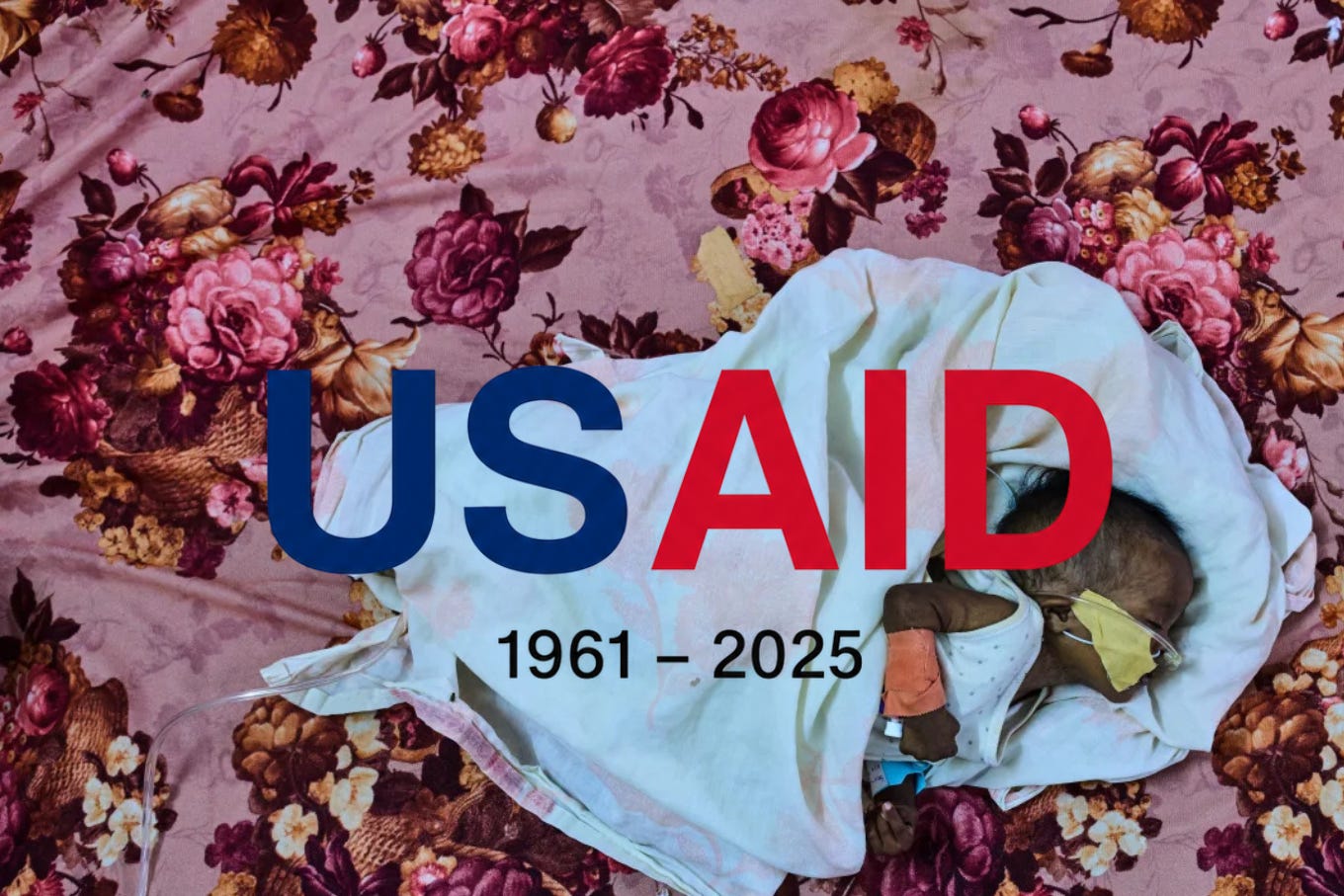
Four days in the summer of 2026, in order.
On Sunday, June 28, Elon Musk challenged critics of the USAID cuts to name a single person who had died because of them.
The next morning, Nicholas Kristof answered with four: Yamah Freeman, Gbessey Kiadu, Ibrahim Koroma, and Achol Deng. Kristof said he had spoken with their families or the health workers who cared for them. That same Monday, Devex reported that Jeremy Lewin, the State Department official who helped lead the realignment of former USAID functions, was expected to move to the White House as senior director for Western Hemisphere affairs at the National Security Council. That same Monday, Laura Loomer publicly targeted him.
By Thursday, the move had stalled. Lewin remained at State.
The dead were named on Monday. So was the promotion. What stopped the promotion was neither.
The sequence does not prove that Loomer alone caused the decision. It establishes the hierarchy. Reported deaths did not stop the promotion. Food assistance placed at risk did not stop the promotion. An agency’s collapsing ability to account for itself did not stop the promotion. A loyalty file was enough.
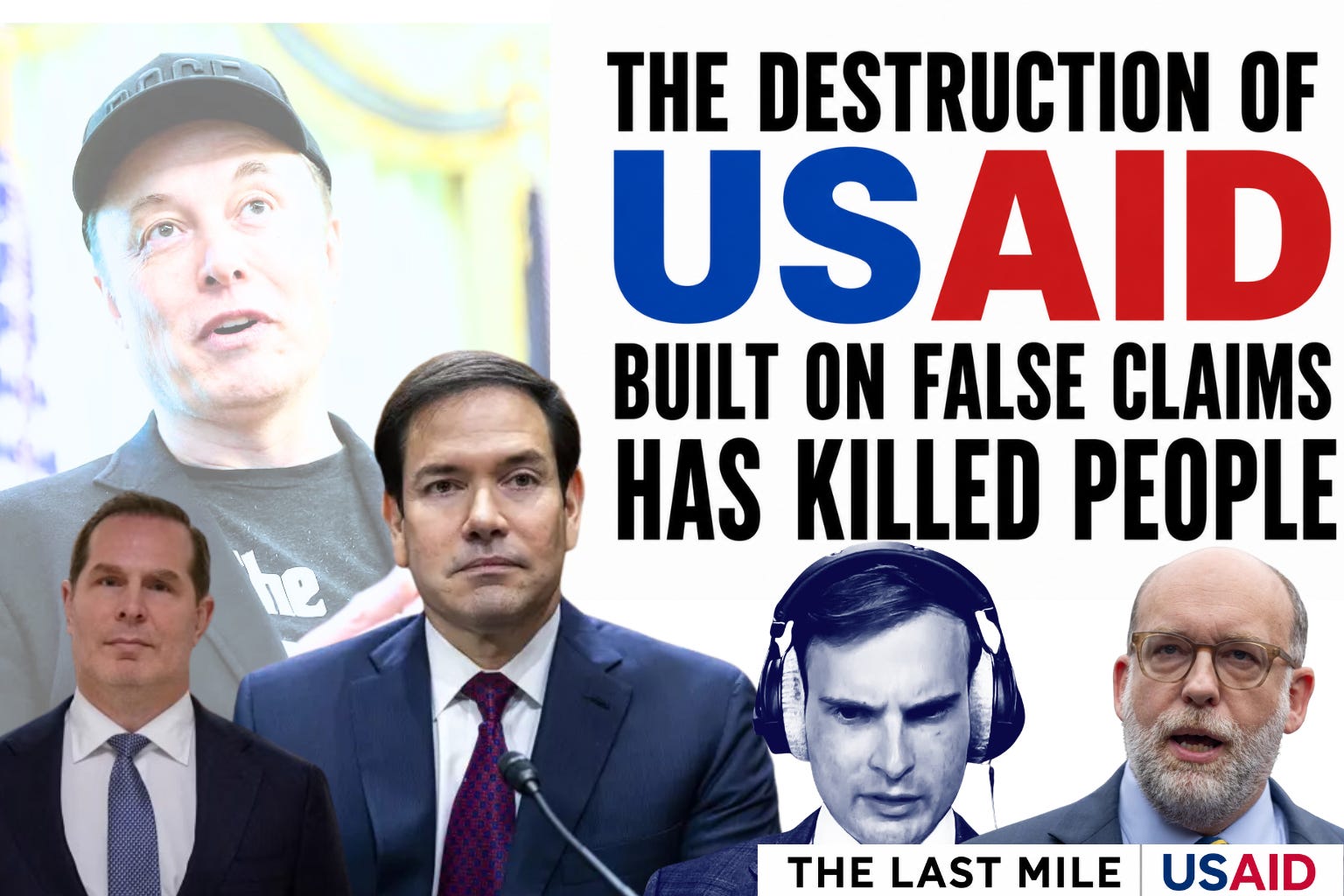
On February 3, 2025, Musk described the method. “We spent the weekend feeding USAID into the wood chipper.”
It was not a metaphor supplied after the fact by critics. It was a governing philosophy stated in public. Take a sixty-four-year-old institution built to deliver medicine, food, emergency relief, and economic development across the world, and reduce it to a joke about machinery.
Musk held Special Government Employee status. He was not a Senate-confirmed officer. Plaintiffs and legal scholars in federal litigation raised Appointments Clause questions about whether operational control of a federal agency could be delegated to an unconfirmed adviser. That remains a legal argument, not a final holding.
The stated purpose was a strike against waste. Oversight documented something closer to the opposite. In a February 2025 report, the USAID inspector general found roughly $489 million in food assistance stranded amid the funding freeze, at risk of spoilage, diversion, and mounting storage costs. The tonnage had addresses: Houston, Djibouti, South Africa, and a half-million tons grown by American farmers for Food for Peace, sitting at sea or waiting to ship. The safer claim is risk, not that the entire sum rotted. The risk was real, documented, and dated.
The White House fired Inspector General Paul Martin the day after his report published. A two-line email, effective immediately, after four decades of federal service.
The government called this an anti-fraud campaign. Its first visible achievement was to fire the official who documented the fraud risk. That is the administrative equivalent of pulling the smoke alarms out of a burning building and calling the silence progress.
By the spring of 2026, the damage reached the ledger. The inspector general’s Semiannual Report to Congress stated that independent auditors evaluating USAID’s 2025 financial statements could not obtain sufficient appropriate evidence to express an opinion, citing inadequate processes, internal controls, and recordkeeping. This was not a leaner apparatus. It was an institution whose own auditors could no longer verify enough of its records to render a judgment.
A separate advisory shows the mechanism in miniature. At the U.S. African Development Foundation, a small agency and not USAID, the inspector general reported that a contractor told investigators it had been instructed by Peter Marocco to strip the agency’s IT and server-room equipment. The agency lost access to Treasury systems, the advisory says, “due largely to the destruction of the Agency’s IT systems.” Some hardware was recovered. The firewall and internet router remained missing. Different agency, same hands, same result: severed systems become an accountability failure.
Governments leave paper trails. This one left auditors unable to find enough paper to issue an opinion.
That is what the wood chipper leaves behind. Not savings. Not discipline. It leaves the people who depended on the institution to explain why the medicine did not arrive, why the food stayed in the warehouse, why no one can now say with confidence where the money went. It leaves a government that destroyed the evidence, then mistook the silence for proof.

In July 2025, Jeremy Lewin became Senior Official performing the duties of Under Secretary of State for Foreign Assistance, Humanitarian Affairs, and Religious Freedom.
The title reads like a footnote. It is not. It placed an acting official, without Senate confirmation, atop a foreign assistance system built across six decades. The State Department’s own biography traces his record before government through law, finance, and a clerkship. It does not identify prior leadership of humanitarian operations, global health programs, or a development institution of comparable scale. That is the relevant point. He was handed operational authority over food pipelines, medical supply chains, and the records required to account for billions in public funds, without a public history of running anything like them.
The mismatch was not theoretical, and it is documented down to the paperwork. On June 19, 2025, the Gaza Humanitarian Foundation applied for a $30 million award. The foundation was a new private entity with no humanitarian track record. USAID’s own staff experts raised fifty-eight objections. An internal evaluation found the plan failed to meet minimum technical or budgetary standards. An action memorandum recommended waiving nine mandatory counterterrorism and internal-control requirements, citing humanitarian and political urgency.
On June 24, five days after the application, Lewin approved it. In an internal message reviewed by journalists, he wrote that there was strong administration support for the award and added, “I’m taking the bullet on this one.”
That is what bypassing expertise looks like in practice. Not speed alone. Speed over fifty-eight documented objections, and a written admission that he understood he was absorbing the risk himself.
What happened afterward near the foundation’s distribution sites belongs in the record with a clear line drawn through it. Reuters reported that more than five hundred Palestinians were reported killed near GHF aid hubs. The foundation acknowledged reports of violence but said the incidents occurred outside its operational areas. Those are reported casualties, not an adjudicated finding, and nothing establishes that Lewin caused any of them. The waiver and the deaths are separate facts, and I am keeping them separate. What the documents prove is the waiver: told by his experts that the plan failed minimum standards, he signed in five days and set aside the safeguards anyway.
A bureaucracy does not need to issue an order that anyone should die. It can approve a grant against its own experts, waive the vetting, and call the urgency humanitarian. Then it can call the result efficiency.

Models estimate the scale. Reporters found the names.
The individual accounts must be described honestly. They are reported accounts, not clinical findings adjudicated in the materials available here. But they describe what aggregate data cannot: the moment a delayed waiver or a broken supply chain becomes a family’s catastrophe.
Musk demanded a single name. Kristof gave four. Yamah Freeman, a young woman in Liberia, reportedly died in childbirth after funding lapsed for the fuel that ran ambulances in her region. Gbessey Kiadu, age one, reportedly died of malaria after an interruption in treatment. Ibrahim Koroma, an infant in Sierra Leone, reportedly died after an interruption in HIV-related supplies. Achol Deng, eight years old in South Sudan, reportedly died after funding stopped for the health worker who provided her medicine.
The names do not turn reported accounts into clinical proof. They do make the abstraction harder to sustain.
The broader evidence is bounded, and it is not trivial. A 2025 analysis in The Lancet estimated that USAID funding was associated with roughly 91.8 million deaths averted between 2001 and 2021, and projected more than 14 million additional deaths by 2030 if steep cuts continued. Those are the study’s own terms, an association for the past and a projection for the future, and other researchers have flagged its methodological limits. But “model” is not a synonym for imaginary. It is what happens when researchers take known disease burdens, known treatment gaps, and known mortality patterns seriously enough to calculate where the arithmetic leads.
The government did not need to order anyone’s death. It needed only to disrupt the systems that delivered medicine, food, and care. Then, when Musk demanded proof of a death, the burden fell on grieving families and reporters to produce the names.
This account relies on official records, public reporting, and consequences those sources can support.
The rest is noise.

Laura Loomer does not need a Senate vote. She does not need a portfolio, an oath, or a desk in the West Wing. She needs a target.
Her power is not formal. It is political, the ability to turn an opposition file into a test of survival and to force an administration to reveal what it fears more, ideological deviation or institutional collapse. The mechanism is documented. PBS reported that in April 2025, after an Oval Office meeting with Loomer, Trump dismissed six National Security Council officials. Trump’s own account is that she brings him names and he sometimes acts on them. She has claimed credit for more than a dozen removals. Those are her claims and a reported sequence, not proof of causation in every case.
The mechanism is the story. Personnel vetting that once ran through background checks, security clearances, and Senate committees now runs, at least in part, through a private dossier and a phone call. The question is not whether every official she named deserved to keep the job. It is who decides, by what standard, and with what record. The standard is undefined. The record is a social media post.
On June 29, as reporting emerged that Lewin was headed to the National Security Council, Loomer targeted him. The material was not corruption or incompetence. It was a pro-transgender-rights amicus brief he had helped author in private practice, work for the liberal legal scholar Laurence Tribe, and a text to classmates after the 2020 election saying he was proud to be part of team Joe. Politico reported that a State Department official called Loomer and urged her to stand down, saying Lewin had done good work. She declined. The Vice President’s chief of staff publicly called Lewin an invaluable asset in the fight against the deep state. The move stalled anyway.
What had Lewin done to earn the suspicion?
Not failed to dismantle USAID. The State Department says he helped lead the reform and the realignment of former USAID functions into State.
Not failed to execute the agenda. The department credits him with supporting the rescissions. In Gaza, the documents show he moved a $30 million grant in five days and waived nine safeguards over his experts’ fifty-eight objections.
Not failed to stay at his post through the wreckage. Food assistance was placed at risk. Safeguards were waived. Programs were disrupted. Auditors could no longer issue an opinion on the agency’s finances.
None of that disqualified him.
The question was never whether he had helped dismantle American foreign aid. He had. The question was whether he had shown sufficient ideological loyalty. A child can become a reported casualty after a broken supply chain, and it is filed as an administrative problem. A private dossier alleging ideological deviation becomes an urgent political emergency.
That is not conservatism. It is not reform. It is not governance. It is a political culture that treats human suffering as background noise and ideological betrayal as a crisis.
His White House move stalled. If he stays in contention, the lesson only sharpens. The work of dismantling American foreign aid was not disqualifying. He merely has to survive the purity test.
Institutional destruction was survivable. Ideological impurity was not.
Bell, B. (2026, February 12). Deposing the sorcerer’s apprentice. Yale Journal on Regulation: Notice & Comment. https://www.yalejreg.com/nc/deposing-the-sorcerers-apprentice/
Cai, S. (2026, July 2). DOGE official’s move to Trump’s NSC stalls following Loomer campaign. Politico. https://www.politico.com/news/2026/07/02/doge-officials-move-to-trumps-nsc-stalls-following-loomer-campaign-00986507
Cavalcanti, D. M., de Oliveira Ferreira de Sales, L., da Silva, A. F., Basterra, E. L., Pena, D., Monti, C., Barreix, G., Silva, N. J., Vaz, P., Saute, F., Fanjul, G., Bassat, Q., Naniche, D., Macinko, J., & Rasella, D. (2025). Evaluating the impact of two decades of USAID interventions and projecting the effects of defunding on mortality up to 2030: A retrospective impact evaluation and forecasting analysis. The Lancet, 406(10500), 283–294. https://doi.org/10.1016/S0140-6736(25)01186-9
Lynch, C., & Miolene, E. (2026, June 29). State Department’s foreign aid chief heads to the White House. Devex. https://www.devex.com/news/state-department-s-foreign-aid-chief-heads-to-the-white-house-112830
Meeks, G. W. (2025, August 6). Meeks demands answers on reports of Trump administration destroying emergency food assistance and wasting American tax dollars [Press release]. House Foreign Affairs Committee. https://democrats-foreignaffairs.house.gov/2025/8/meeks-demands-answers-on-reports-of-trump-administration-destroying-emergency-food-assistance-wasting-american-tax-dollars
Prager, S. (2026, June 29). Journalists set the record straight after Musk claims “not a single” child died from DOGE’s USAID cuts. Common Dreams. https://www.commondreams.org/news/musk-dead-children-usaid
Roush, T. (2026, July 1). Musk escalates unproven USAID claims in fiery posts as studies link DOGE cuts to child deaths. Forbes. https://www.forbes.com/sites/tylerroush/2026/07/01/musk-escalates-unproven-usaid-claims-in-fiery-posts-as-studies-link-doge-cuts-to-child-deaths/
Smith, B. (2025, February 12). Millions of dollars worth of American food rots at ports amid USAid shutdown. The Telegraph. https://www.telegraph.co.uk/world-news/2025/02/12/millions-of-dollars-american-food-rots-usaid-shutdown/
U.S. Agency for International Development, Office of Inspector General. (2026a). Semiannual report to Congress: October 1, 2025–March 31, 2026. https://oig.usaid.gov/reports-publications/semiannual-report-congress
U.S. Agency for International Development, Office of Inspector General. (2026b, May 29). U.S. African Development Foundation’s lack of responsiveness to oversight matters limits transparency into agency operations and management of funds (Report No. A-ADF-26-005-A). https://oig.usaid.gov/node/8014
U.S. Department of State. (2025, July 11). Jeremy P. Lewin. https://www.state.gov/biographies/jeremy-p-lewin/
Comments
Nothing yet. Say the first thing.
Sign in to join the conversation.