
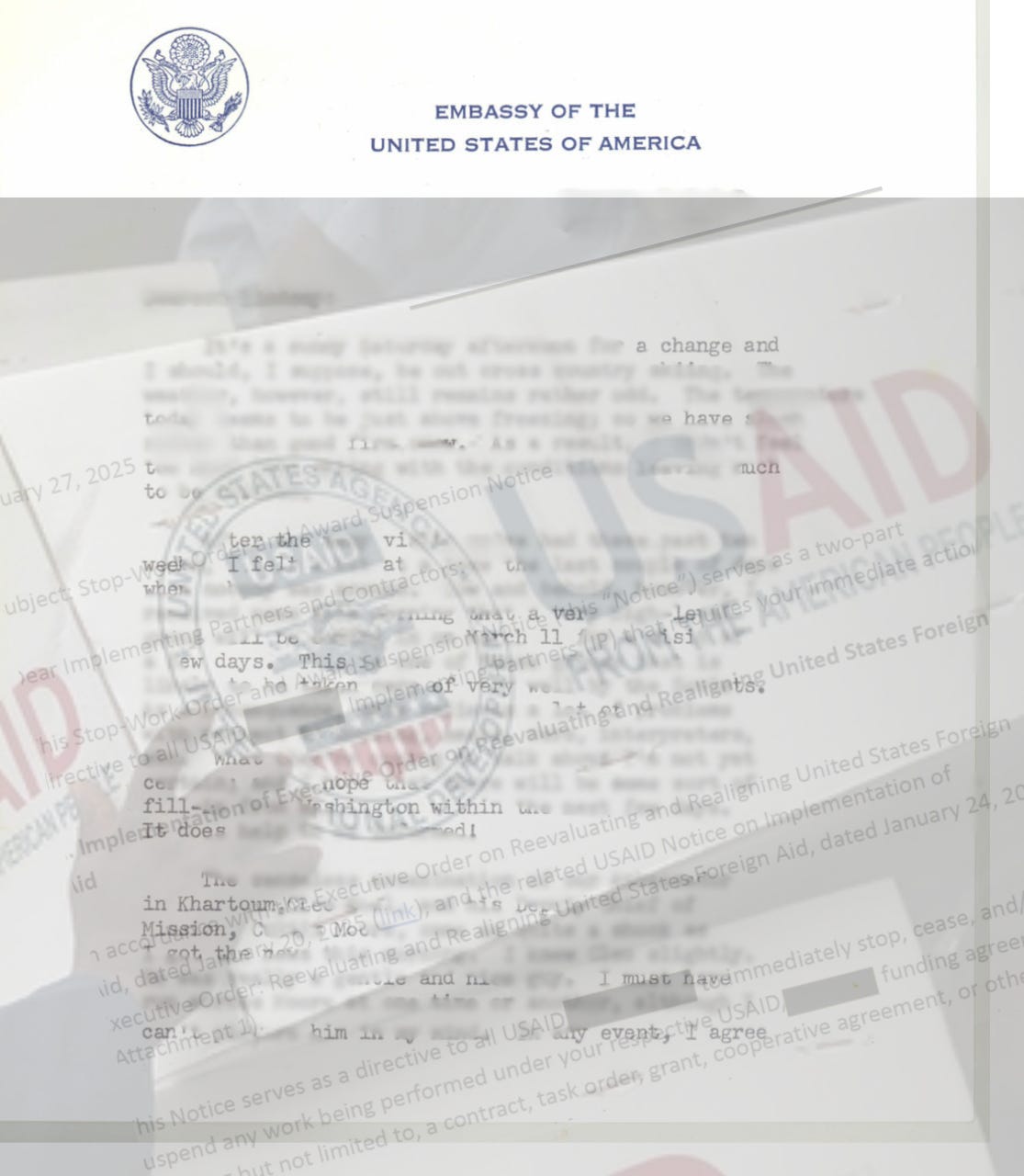
I thought the ambassador was being kind.
That was the mistake I carried out of the building with me.
The day USAID ended for me, I turned in the things that proved I had belonged there. Badge. Key card. Computer paperwork. The emergency radio that had sat beside my life overseas because somewhere, sometime, something could go wrong and the United States might need to reach you. The room had the specific fluorescent cheerlessness of bureaucratic endings. A plastic bin. A form. Sign here.
Then someone handed me an envelope.
Don’t forget your letter.
It was addressed to me. It was signed in ink by an American ambassador. No one had ordered him to write it. No regulation required it. No Washington office had discovered decency at the bottom of a clearance checklist.
The letter said my service had been honorable. It said my dismissal was not because of misconduct. It said, in the formal language available to a man of his position, that I had not done anything wrong.
I rode the elevator down. The numbers changed. I was holding the envelope.
I read it as a courtesy.
He had written it as protection.
That took time to understand. I called colleagues in other countries, other posts, other embassies. Had they received anything like it?
Most had not. Their ambassadors had not put their names on paper. Their embassies had not given them a document to carry out into whatever came next.
I kept wondering why mine had.
Then the job postings answered.
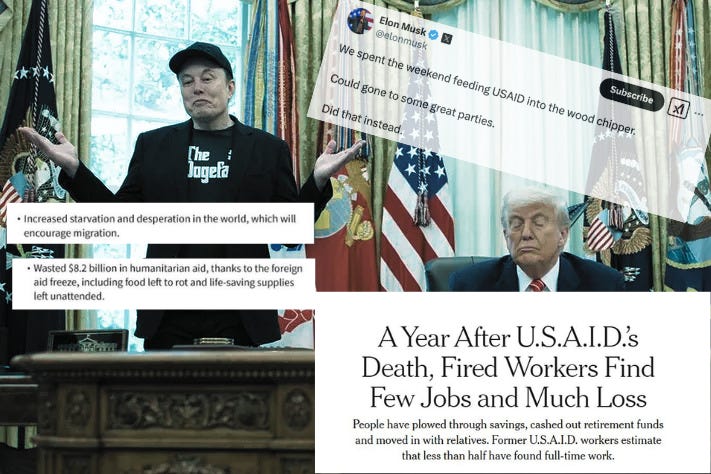
On January 20, 2025, Elon Musk was handed a government office inside the newly created Department of Government Efficiency. Musk had spent nearly $300 million helping elect the president, the largest individual political contribution in American electoral history, confirmed by Federal Election Commission records. Within days, DOGE had set its sights on USAID.
Musk called USAID a criminal organization. He called its employees an arm of the radical-left globalists. Trump said the agency was run by a bunch of radical lunatics and that he was getting them out.
None of this was accidental. DOGE was not created by Congress. It was not shaped through public hearings. It was not accountable to anyone. It was a billionaire with a key to the building.
And there was something else. Something that did not make the front pages.
USAID’s own Inspector General had been examining the government’s oversight of Starlink satellite terminals in Ukraine. Starlink belongs to Musk. The man whose company was under federal scrutiny was now the man deciding which federal agencies survived. The agency whose watchdog had been asking questions about his business was among the first to be destroyed.
On February 10, 2025, Inspector General Paul Martin filed his notice. The administration’s freeze of more than $76 billion in foreign assistance had left $8.2 billion in humanitarian funding with no one watching it. More than $489 million in American food commodities were rotting in ports, sitting in warehouses, stranded in transit. The controls that kept that money from reaching violent extremist groups in active conflict zones were, in Martin’s own words, largely nonoperational.
Martin filed on a Monday.
Tuesday he got an email. Two sentences. Terminated, effective immediately. No reason given. The law required thirty days notice to Congress and a substantive, case-specific rationale before any Inspector General could be removed. None of that happened. His team lost access to their systems before the day was over.
The man asking the questions was gone.
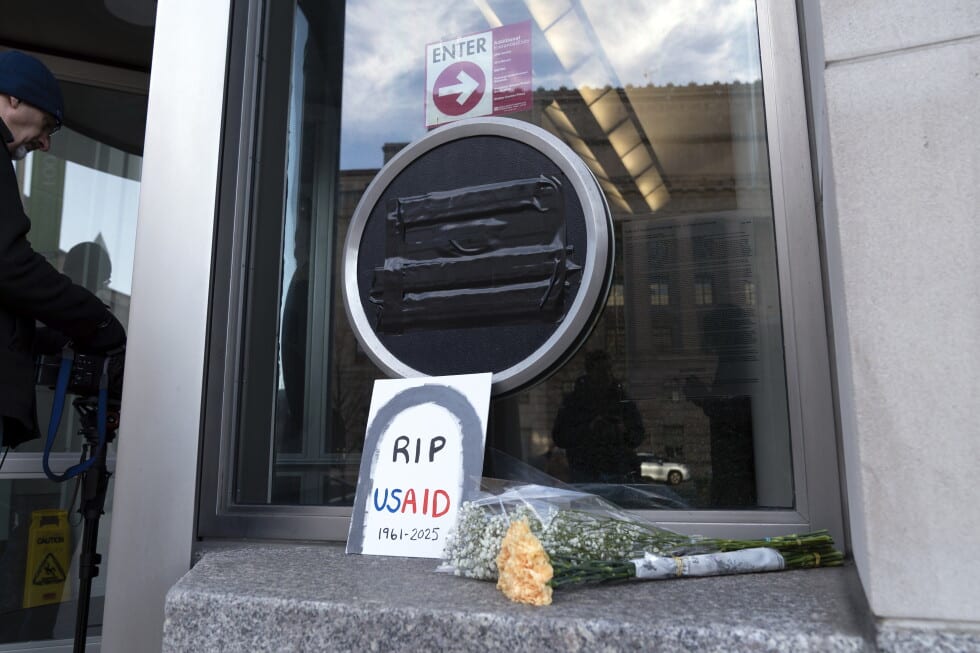
By 2025, USAID was gone too. What remained was swallowed by the State Department, a tiny shell consuming itself from the inside, with a closing date and a skeleton crew and not much else.
On August 29, 2025, President Trump appointed Russ Vought as Acting Administrator of what remained of USAID. By then, Vought was hardly an outsider arriving to oversee the wreckage. As Director of the Office of Management and Budget, he had been one of the chief architects of the campaign against the agency. The appointment simply placed him inside the building whose demolition he had already been supervising from across town.
We now know what that trauma looks like. Lost careers. Lost homes. Missed mortgage payments. Families where both parents lost their jobs on the same day. People moving back in with relatives. Children absorbing a fear their parents cannot name. The loss of purpose and identity and everything that follows.
Those are the consequences we can talk about.
Then there are the ones we cannot, because some of the people who lived through them are no longer here to speak.
Vought held the acting role through November, then stayed on as a senior advisor, his name kept on the books of an agency he had helped dismantle. While billions in funding for HIV treatment, polio vaccination, and malaria prevention sat canceled, Reuters obtained internal documents showing that Vought’s office pulled $15 million from what remained of USAID’s operating budget and sent it to the U.S. Marshals Service. His personal security detail. Funded by the last cash reserves of an agency down to fewer than a hundred people.
Foreign governments in authoritarian states do not need a press release. They watch. They read the signals. When Washington calls its own public servants radical lunatics and arms of the globalist left, those governments know which of their own citizens are now safe to question, to detain, to destroy. They took note. They acted.
Then the contracts opened.
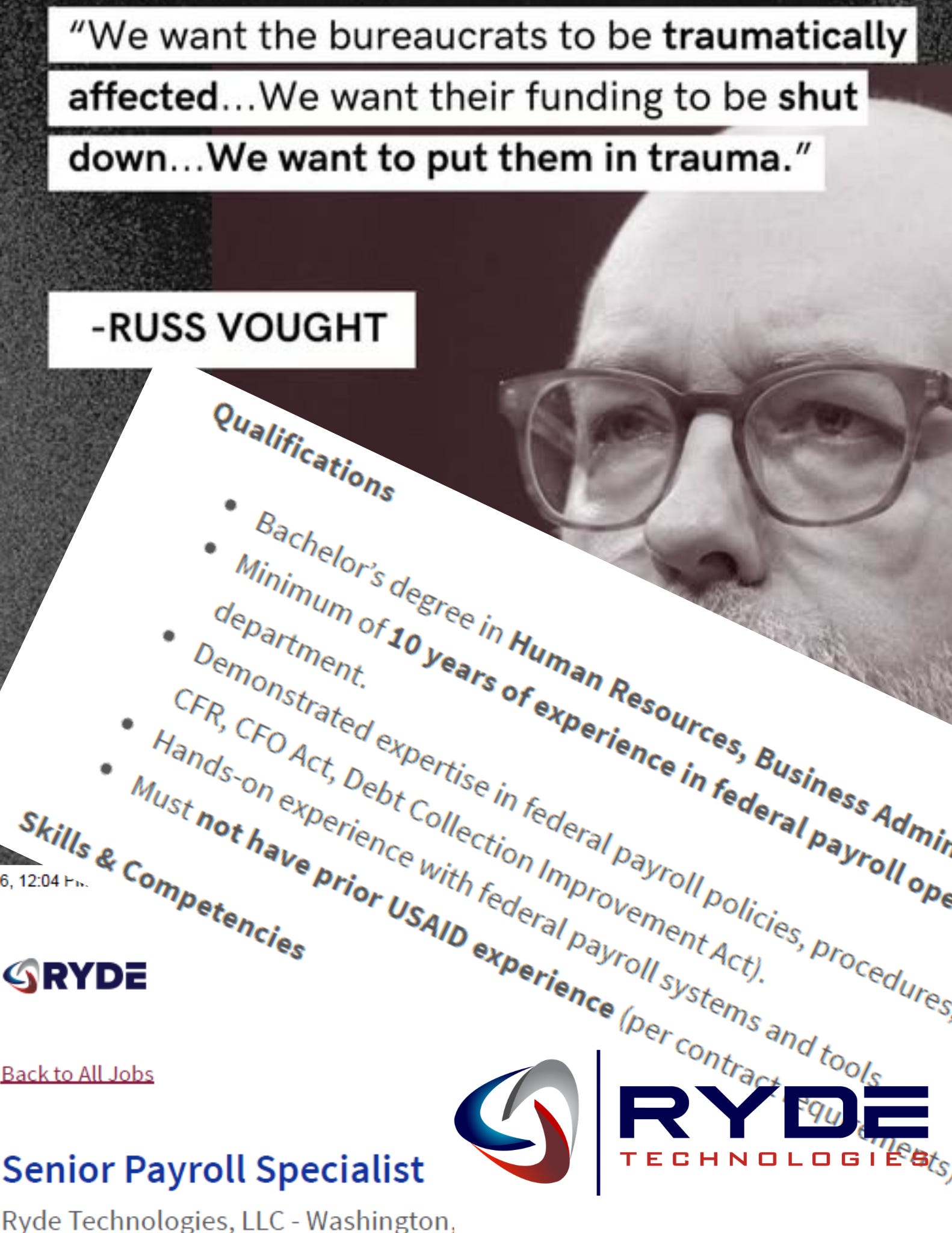
Ryde Technologies, LLC posted two jobs in May 2026. Federal payroll positions. USAID closeout work.
They wanted people with five to ten years inside the United States government. People who knew the systems, the regulations, the retirement codes, the machinery that only makes sense after you have lived inside it.
Then came the line buried in the qualifications.
Must not have prior USAID experience (per contract requirements).
They were hiring for the burial of an agency and banning the people who built it from touching the body.
Ryde Technologies did not invent that requirement.
On January 29, 2026, Devex obtained the internal government activity memo that created it, authored by the closeout task force operating under Russ Vought’s direction. The memo did not hide its reasoning. Former USAID employees were to be excluded from the closeout process because, it said, the work should be handled by people with no prior experience in the matters being settled.
They wrote that down.
Someone drafted it.
Someone reviewed it.
Someone approved it.
Someone signed it.
The United States government created a formal policy that treated ignorance as a qualification.
The people who knew the most about what was being destroyed were prohibited from participating in how it ended.
This was not an accident.
This was not bureaucratic drift.
This was not a computer error or a misunderstood instruction.
Someone sat at a desk in the United States government, typed those words, and sent them to the next desk.
Then other people carried them out.
At the bottom of the same Ryde Technologies job posting, the company affirmed its commitment to equal employment opportunity. Race. Religion. National origin. Veteran status.
The box was checked.
The form was complete.
The exclusion remained.
The cruelty moved on.
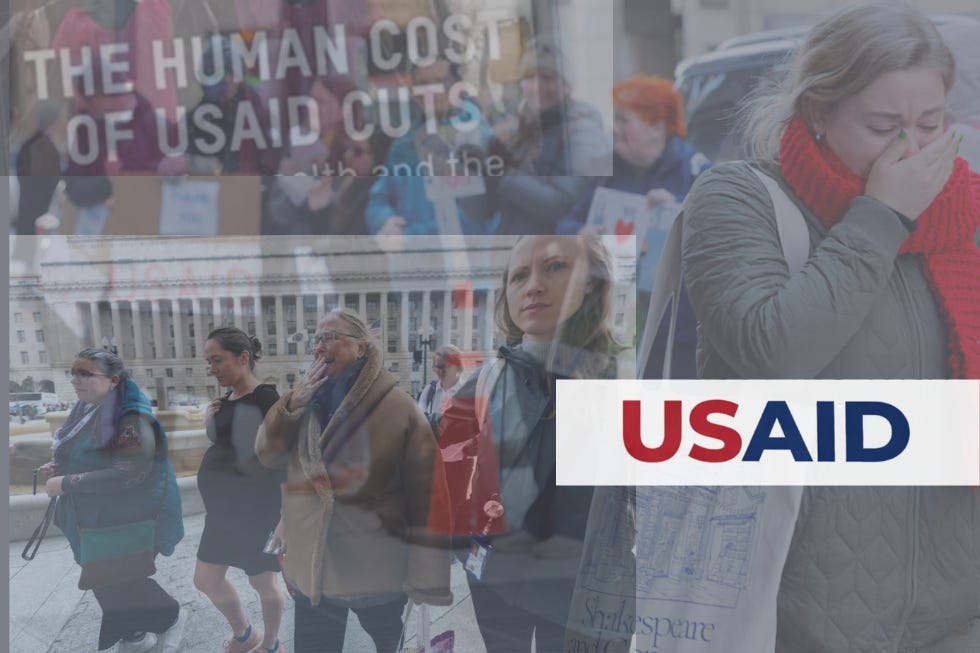
A person can spend years serving the United States overseas.
They can miss funerals because the flight home is too far, too expensive, or simply impossible. They can raise children who know three currencies before they know how to drive. They can work through coups, epidemics, wars, and disasters. They can keep a radio by the bed because sometimes the phones stop working and their country still needs to find them.
Then one day they can discover that the most toxic line on their resume is the one that says they served.
I do not know if I am making rent next month. That is not a metaphor. It is not a literary device. It is the arithmetic. After years of going where my government sent me, after years of doing work my government said mattered, I now sit at a kitchen table calculating how many weeks remain before the numbers stop working.
I am not alone.
Across the country, former civil servants are draining savings accounts that took decades to build. People who spent careers responding to crises now find themselves unable to solve the crisis in their own homes. Families that followed government orders across continents are moving back into spare bedrooms. Children are watching parents who once carried enormous responsibility struggle to explain what happened.
The public story is that an agency was closed.
The private story is that lives were.
A mortgage payment missed here. A retirement account liquidated there. A medical appointment postponed because the insurance disappeared. Another postponed because the money did. Small decisions at first. Then larger ones. Then the slow humiliation of explaining to strangers that yes, you had a career. Yes, it was real. Yes, your country asked you to do it.
Some people have found their footing. Some are still searching. And some have vanished from the story altogether, worn down by financial strain, isolation, and a public conversation that counts budget lines and head counts while ignoring the human beings left underneath the rubble.
Those losses do not appear in government reports.
They exist anyway.
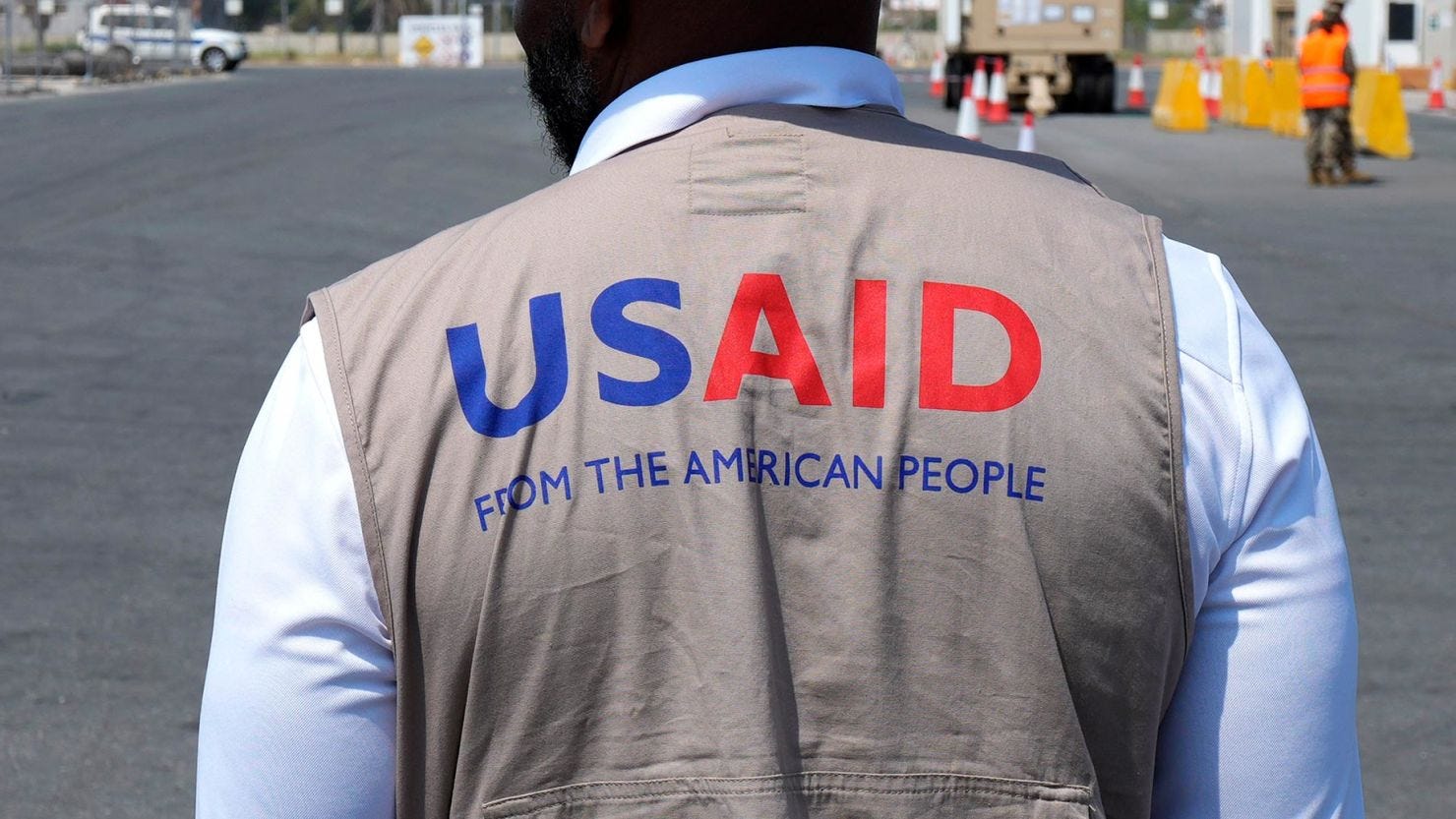
The ambassador gave us proof before we knew we would need it.
The officials who wrote that memo saw the same people and made the opposite choice.
I understand now what he saw. He had spent a career watching governments turn on their own people. He knew how quickly the story hardens into fact, and what foreign regimes conclude when Washington leads by example. So he signed his name in ink. He addressed every letter individually. He made a record before any of us understood why a record might matter.
He still works. I will not name him. What I will say is this: in 2025, an American diplomat had to calculate whether an act of ordinary decency toward his own staff was professionally survivable.
That calculation is not supposed to exist.
I still have the letter. Ryde Technologies still has the contract. Somewhere there is still a copy of the memo.
Three pieces of paper. One says I served honorably. One says people like me cannot be hired. One explains why ignorance was preferred over experience.
They were all written by Americans.
I keep thinking about those signatures. The people who held the pens. Did they know what the ink would do when it dried? Did they care? Or will they look at those documents years from now and not even remember signing them at all?
Comments
Nothing yet. Say the first thing.
Sign in to join the conversation.