
The Twisha Sharma case is a tragedy. What’s worse is that there are hundreds of thousands of women going through this every year and only a couple of cases will make the news. Violence against women needs to go down. Until such cases go down below a certain threshold, it is hard to argue that India would be a civilized country.
At a structural level, how do you get violence against women to go down? There are many explanations in the zeitgeist, and I don’t really agree with any:
Electing more women representatives doesn’t work. You have a Mamata Banerjee that is victim-blaming the rape victim in the R.G. Kar case. On journalist Soumya Vishwanathan’s murder, ex-Delhi CM Sheila Dikshit said that “girls shouldn’t be so adventurous”. On the Nirbhaya gangrape, she said the case was blown out of proportion. Kirron Kher says that a Chandigarh rape victim shouldn’t have boarded an auto with three other men. Maneka Gandhi said that the concept of marital rape couldn’t be applied in the Indian context.
There’s the cultural decline story pushed by some folks, trying to pin the rise in rapes and other crimes onto the Westernization (or modernity) of Indian society. If Westernization is causing these crimes, such crimes should be highest in the West. Yet, they’re not. That should tell you something.
Infrastructure bros point out the lack of state capacity and technology as a contributor to crime. CCTV’s, street lighting, panic buttons and safety apps can make the streets safer for women. Keeping aside privacy issues and the added burden of safety on women themselves, why do places with such infrastructure still see crime? It isn’t as if CCTVs prevent vehicle theft or any other type of crime. Why should crime against women be different?
The “boys will be boys” framing irks me the most1. Deployed most famously by Mulayam Singh Yadav, it frames men as animals without any control over base instincts. Even worse, this was said in the context of opposing the death penalty to racists. Throughout evolution, humans have constantly preferred friends and companions that have more prosocial behavior and are more cooperative. The more aggressive ones simply didn’t get mates or didn’t reproduce. That led to a drop in aggression, implying a self-domestication among humans. Similarly, rapists should just be given the death penalty. Over time, that will lead to such behaviors being purged out of the gene pool2.
The “it’s the mindset, not the clothes” explanation also leaves much to be desired. Patriarchy and objectification are said to cause violence against women. It definitely has its merits. Women in highly conservative societies (and covering themselves a lot) face higher levels of violence. But as an explanation, it isn’t sufficient. The slogan originated in Western countries, that aren’t as patriarchal as India. Even if things in the West aren’t ideal, male violence is constrained a great deal. How does India get from here to there?
None of these really explain why violence against women happens. Without knowing the root cause, it is difficult to solve it. There’s always the standard solution of having more policing and reducing crime in general. But often, such things are intertwined. It is hard to improve state capacity when women have restrictions on their freedom.
There’s strong evidence that more female police officers help with making women comfortable enough to report crime. But that only improves visibility, not incidence. Coupled with the slow court systems, that’s not enough to move the needle.
If you improve state capacity, but patrimonialism, low impersonal trust, honor-based regulation of women remain, do things really change?
I looked at some data on National Crime Records Bureau (NCRB) on crimes against women for 2023. The NCRB takes a long time to clean up and release its data, so 2023 is the latest year that we have data for. There are problems with NCRB data too. So I won’t take the numbers in there as the gospel truth, but merely as an indication of the trend line.
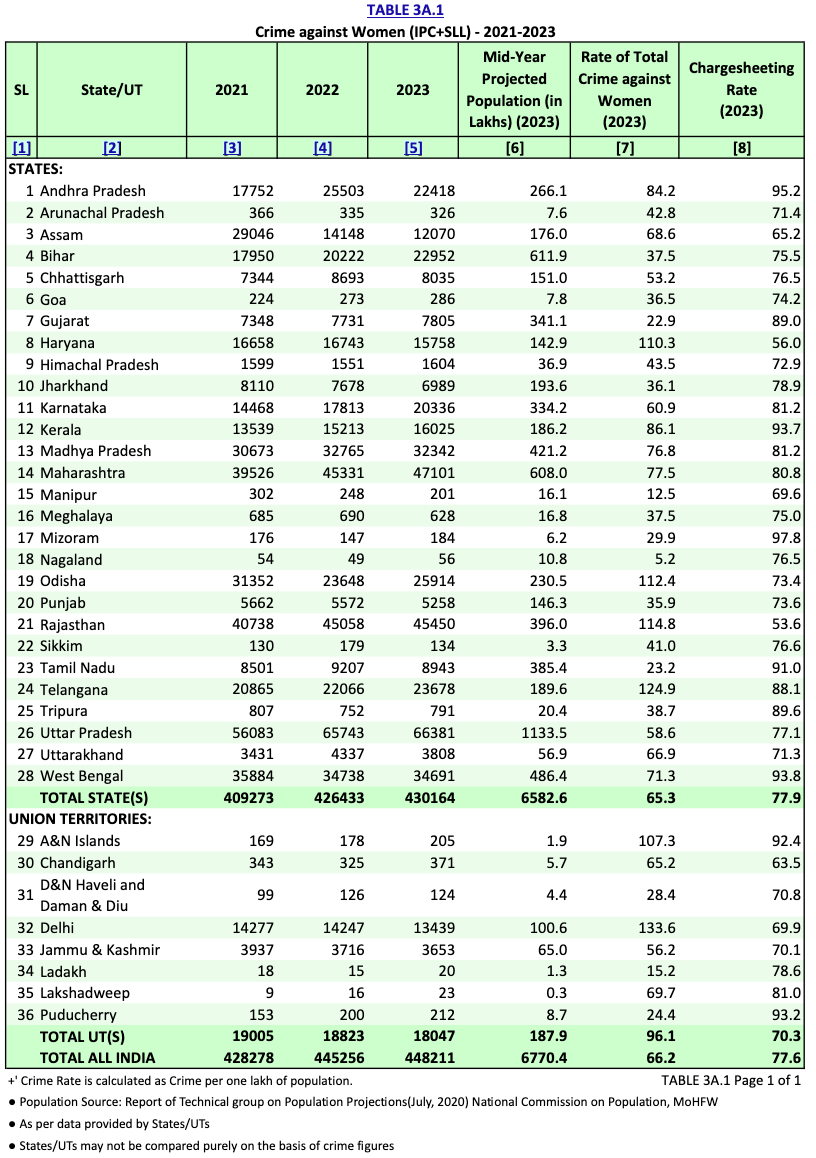
This table shows the incidence of crime against women in just raw statistics. More than the raw numbers, the rate of crime per one lakh of population is more important. An important caveat is that crimes are dependent on accurate reporting. If there’s not enough police capacity (or willingness to register crime), it won’t show up in the stats.
How much is such underreporting? We don’t really know. The 5th round of the. National Family Health Survey (NFHS-5) reports that about 30% of married women between the age of 18-49 experienced sexual or physical violence by their husbands. How that translates into under-reporting numbers is really dependent on the methodology used.
There are different buckets of crime against women. The biggest is the infamous section 498A which is basically cruelty against by wife by her husband or in-laws. The next one is section 354, which is basically “assault with intent to outrage modesty”. It encompasses groping, pinching and eve-teasing among others.
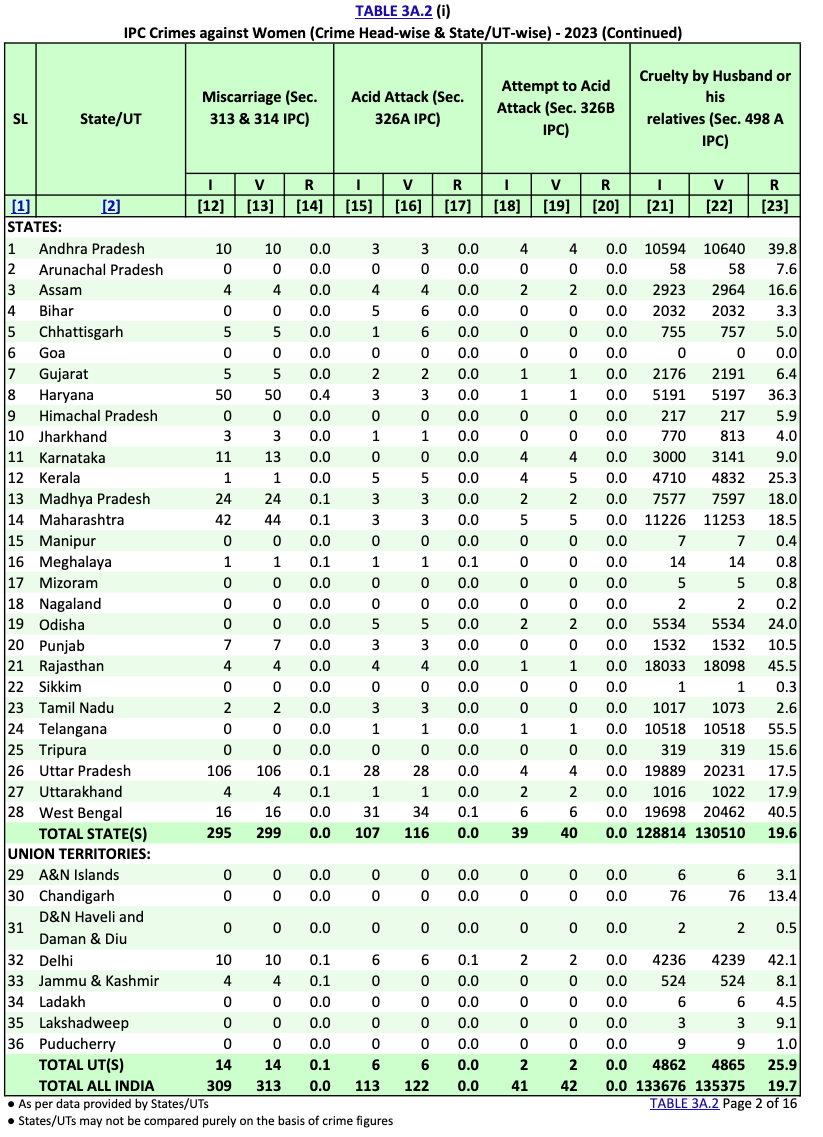
As seen in the above table, about 30% of the cases are 498A cases. Another 20% are cases that outrage the modesty of a woman (shown in the table below). Together these constitute half of the total crimes against women. The next biggest bucket is rapes comprising about 6% of total crimes. Rape underreporting is a problem that I am not sure how to account for empirically. The data does show that in almost all rape cases, the offender was known to the victim.
Another confounder is that many women constrain themselves from public spaces. They might choose to forgo job opportunities, or the pleasure of a late night stroll. Crime numbers don’t necessarily capture that. For that we would have to turn to high-quality, well-conducted surveys. Unfortunately, I am not aware of any.
However, that shouldn’t affect the general trend that the majority of crimes against women seem to be through sections 498A and 354. There’s no reason to think that underreporting of crimes wouldn’t affect these sections.
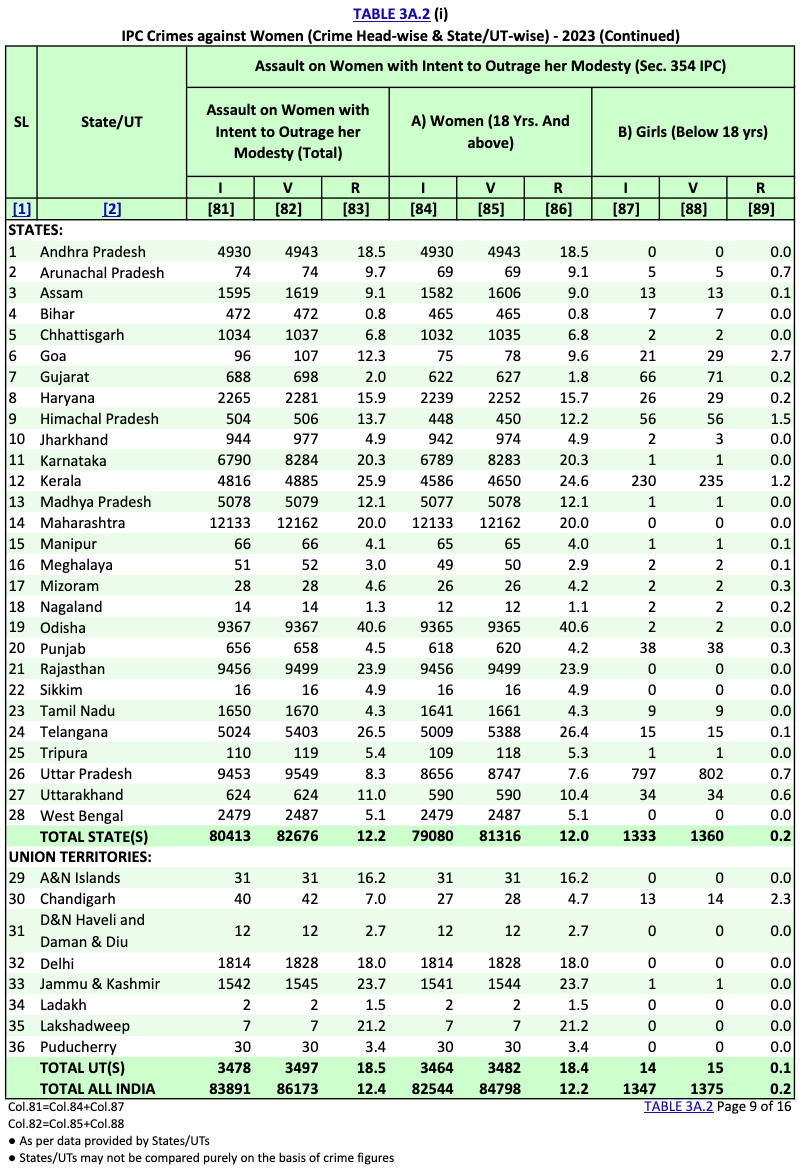
Some of these crimes are simply due to less state capacity. Street sexual harassment is due to emboldened perpetrators and low policing capacity. Similarly, the brazenness of public assault can only be explained by a low fear of the state. Because these happen in public spaces, the probability of detecting these increases with increased police presence.
With data, the question becomes a bit easier to solve. If dowry crimes and assaulting modesty crimes go down, suddenly half the crimes against women disappear. Police capacity is freed up to focus on other crimes, reducing them too.
So my proposal to reduce crimes against women is the following:
Cousin marriage needs to stop. Pakistan has the highest rates of cousin marriage in the world, and that’s leading to the prevalence of genetic diseases. Southern states aren’t as high, and they practice cross-cousin marriage rather than the much more harmful Pakistani version of parallel-cousin marriage3.
Freedom to marry must be a fundamental right without any parental coercion.
Marrying outside one’s caste needs to be normalized and even encouraged. Caste endogamy is leading to lower genetic diversity which causes rare genetic diseases.
Joint ownership of kin property must be dissolved. Hindus, Jains, Sikhs and Buddhists can’t choose to disinherit daughters. But this isn’t applicable to Christians and Muslims.
Why these specific proposals? They reduce the intensity of kinship, while still protecting the nuclear family. Before explaining why I think this would work, I’ll take a quick digression into one classification of culture types.
Out of the many ways to classify cultures, one that’s used is the guilt-vs-shame axis. In guilt-based cultures, morality comes down to an internal conscience. Shopping carts are returned to their proper place to preserve order in society. People are more impersonally prosocial. Individuals feels bad for violating their own moral standards.
In shame-based cultures, morality is externally driven. That drives the infamous saying “kya kahenge chaar log”? The fear of ostracism or community judgement is the primary driver of morality. Chinese culture is shame-based as seen in Confucian teachings. In such cultures, while people are still prosocial, that prosociality tends to be interpersonal rather than impersonal.
As seen in the above map above, many Asian societies including China, Japan and India are shame-based to various extent. The Americas are more guilt-based and the US, being a highly individualistic culture, is also quite guilt-based.
A caveat here: There are many ways to classify cultures and there’s no one correct way. I’m just picking up one useful axis for my current thesis.
In the above map, one thing that stands out is the relatively safety women have in guilt-based cultures. East Asian countries also have lower crime rates, but they have lower crime in general.
The chain of reasoning is simple.
Caste endogamy creates intensive kinship networks. These networks extend quite a bit and sometimes replace the functions that the state is supposed to perform.
Such intensive networks cause reputation to be collective and familial. Womens’ actions bring disrepute to their entire extended family. Men aren’t excluded from it. That’s why in some cultures, there’s the concept of blood money, where a murderer (and his extended kin) can wash off the stain of the murder by paying the dead man’s kin.
Social control is intensified when women are deprived of inheritance. That reduces exit options. In the process, it ends up strengthening the patriarchs of the family, who have the authority to direct finances
Because of shame-based cultures, crimes like section 498A tend to be more suppressed for fears of reputational loss. That’s a reason why I suspect (although I can’t prove) that underreporting for 498A might be significant.
How does a change in marriage patterns work to reduce kinship intensity?
Joseph Henrich’s book, The WEIRDest People in the World, explains precisely that. He’s studying marriage patterns for a different reason, but they’re relevant to our conversation.
Essentially, Europeans are the only cultures in the world that have a bunch of weird traits: individualism, zero polygamy, high-trust societies and some more. All of them, to some degree, make economic development much easier. High-trust makes it easier to sustain impersonal institutions like the police and the courts.
Absence of polygamy makes society much less violent. Unpaired males tend to have higher testosterone and hence, are prone to more violence. Higher status males monopolizing brides leaves less women for other males. Since men can get brides only through becoming high status, they’re willing to commit more violence. This is borne out by the fact that in our species’ history, 17 times as many women as men have been able to reproduce.
Finally, individualism tends to co-evolve with being more guilt-based than shame-based cultures.
Henrich strongly lays out the case for the Catholic Church’s Marriage and Family Program (MFP) hollowing out kinship ties4. Around AD 600, the Catholic Church tried to enforce a collection of rules with varying degrees of success. The main ones were:
Prohibiting marriage to anyone closer than 6th degree cousins. In medieval times, that often meant moving villages to find a bride.
Prohibiting of polygamy and the practice of concubines. With varying degrees of success, the Church was also able to enforce this on some of Europe’s rulers.
Property could be disposed of individually without taking into account the extended kin. Daughters could also inherit property.
All of these rules loosened kinship ties, which the Church wanted so that it could be the recipient of people’s loyalties rather than their kin. The other side effects of these rules would require entire doctoral theses to explore, so I won’t get into that.
For my present claim, I want to present the Kinship Intensity Index (KII) that measures the strength of family and clan ties in different (anthropologically) defined cultures.
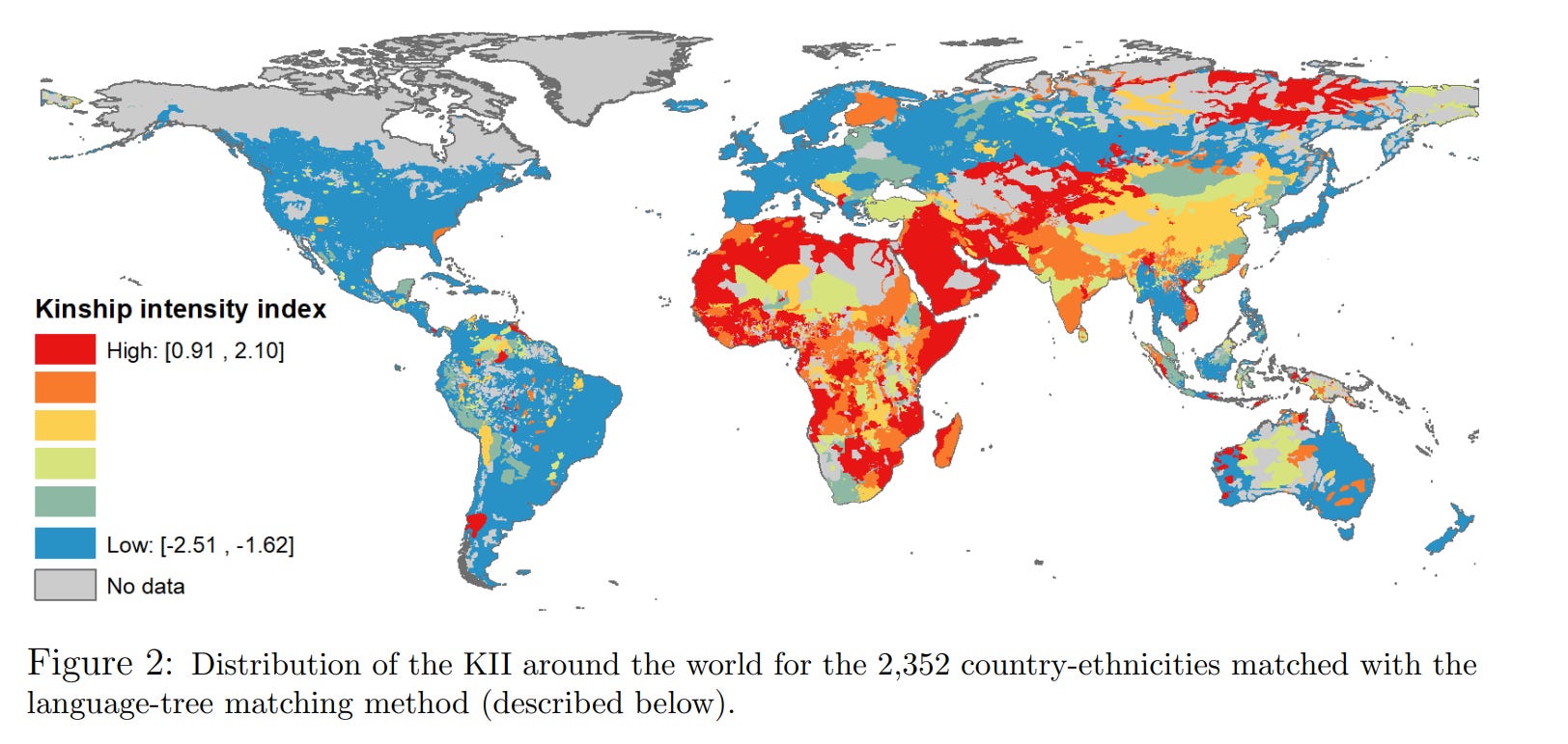
Unfortunately, I don’t have a perfectly places map that would measure the level of women safety and freedom in these places. But just going by spot-checks, my claim does hold.
How would other crimes on women reduce? Well, if extended caste networks get dismantled, and caste endogamy is no longer a thing, suddenly state institutions also get much more neutral and fairer. There’s not much incentive to suppress registering crimes for fear of upending the honor of the community. Police officers no longer are part of the same extended network of kin and don’t have an incentive to put their toe on the scale.
Changing marriage patterns has a lot of side effects apart from making a place more progressive for women.
Changes in family structures directly bear on traits like intelligence, risk-taking and individualism. With less intensive kinship structures, individualism rises. Extractive institutions are less likely to rise. Groups don’t view the state as a prize to be captured. Consequently, that makes the way for inclusive institutions. Impersonal high-trust cultures start to develop. Asian cultures are high-trust, but in an interpersonal way. The way to really scale up societies is to have impersonal high-trust.
Ultimately, these are momentous changes. And it takes a long time to dismantle such structures. It took centuries for Europe to do so.
Until then, more policing, more state capacity and technological solutions will have to do.
Thanks for reading The Indic Prism! This post is public so feel free to share it.
I do realize the irony in getting offended over a comment on boys in a piece on racism.
Of course, it isn’t as simple as this. But anything that reduces the chance of a rapist reproducing would slowly weed out these behaviours from the gene pool.
Cross-cousin refers to marrying the cousin of the opposite sex of your parents. So mother’s brother or father’s sister’s kids. Parallel cousin refers to the same sex cousin of your parents. So your aunt on your mother’s side and uncle on your father’s side.
There’s some dispute here that the WEIRDness goes back to Roman times. However, that is an interesting debate, but immaterial to the purpose here.
Comments
Nothing yet. Say the first thing.
Sign in to join the conversation.