
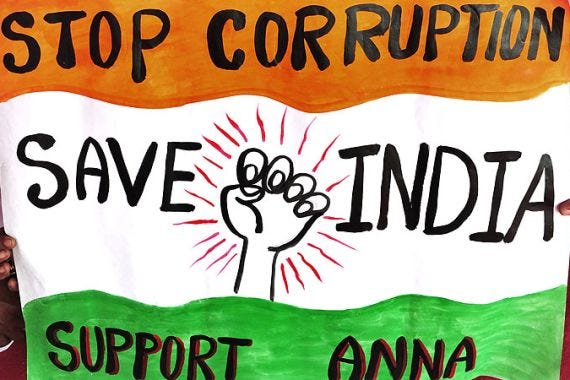
In 2011, the Anna Hazare anti-corruption movement was at its peak with countless scams being uncovered. Arvind Kejriwal got his Aam Aadmi Party (AAP) started through the movement. The BJP toppled the Congress-led UPA government in 2014. And since then, the BJP has been wildly successful in shifting the Overton window of Indian politics.
The BJP’s victory in the 2014 elections is often ascribed to the wanton corruption in the later years of the Congress government. And while the BJP did campaign on the issue, how much did corruption really factor into the results?
A strong predictor for whether an incumbent political party would return to office, is their record on economic growth. It varies across countries and different time periods, but the relationship holds. If the social sciences could have an inviolable law, then this relationship would be it.
In the abstract, it does make sense. While voters might swear fealty to liberalism, conservatism, socialism, communism, Hindutva, Islamism or any other -ism, that is merely a stated preference. Words are cheap. The same Chicago voters that that voted for progressive taxation policies, voted with their feet when taxes were raised.
The above graph shows the outmigration of top earners from a state after increases in corporate tax rates and high earners’ top tax rates. There’s clear indication of voting with feet after state tax changes, which hit top earners the hardest.
Similarly, while Venezuelans voted in Chavez with overwhelming majorities, there was a mass cross-border movement of Venezuelans seeking to escape oppressive economic policies.
It holds closer to home as well. Incumbents across the world lost elections in 2024 as the post-Covid inflation hit their economies. The BJP government lost its majority going down from 303 seats to 240, while losing vote share as well1. Going into 2024, jobs and inflation were key concerns.
In the recently concluded spate of state elections in 2026, voters threw out the incumbent governments in West Bengal, Tamil Nadu and Kerala. In West Bengal, economic concern were paramount along with lawlessness concerns. The DMK in Tamil Nadu had one of the highest growth rates among all Indian states. But looking closely at the numbers, one can see that GST collections in Tamil Nadu grew only by 3% over the year ending March-20262. How is double digit growth in GDP possible without a commensurate increase in taxes? The same is the case for Kerala as well. The Communist-led government had plunged Kerala into fiscal crisis. The Congress campaigned well against them and won a well-deserved victory.
Coming back to the 2014 general elections, I don’t think it was corruption that swept the Congress away and got the BJP into office. In the 1980s, economic performance wasn’t rewarded by voters very much. Consequently, there’s a proliferation of caste-based parties, trying to capture a share of the pie and extract rents for their caste-brethren. Since 2000, there’s been a shift towards economic voting, where concerns of the economy translate into reward or punishment for the incumbent.
By 2014, voters had experienced the effects of the 2008 global financial crisis. The growth rate of the Indian economy was 5% for the two years preceding the election. Inflation was high. Morgan Stanley had put the Indian economy into the Fragile Five. Banks had many non-performing loans going into the elections.
While Modi made corruption a part of his campaign, his entire plank was economic in nature. He never mentioned Hindutva. The “Gujarat model” was proffered to voters. He appealed to Muslim voters from West Bengal, saying that they too could go to the Hajj pilgrimage like Gujarati Muslims if only they were able to become richer3.
What are some counter-examples to this claim?
The 2019 Indian election where the growth rate was low due to the GST rollout and demonetisation. According to this predictor, the BJP should have faced strong anti-incumbency. But the campaign turned into a national security election with the Balakot airstrikes. National security trumps economic concerns.
Erdogan survived the 2023 presidential election, even though inflation in Turkey had been pretty high and it was facing other economic issues. While Turkey’s electoral process leaves much to be desired, it isn’t an autocracy and if the opposition comes together, they could still unseat Erdogan. The very fact that Erdogan survived is a counter-argument to this thesis.
Viktor Orban of Hungary won a fourth consecutive term in 2022, with post-Covid inflation peaking at 25%. But even Orban had to roll out populist schemes — similar to the Ladli behna schemes — to avoid the threat from the opposition’s challenger.
Obama’s 2012 re-election to office despite the jobless growth (until then) of the 2008 financial crisis is another exception to this rule.
In other words, even though economic performance can predict election outcomes, it isn’t the sole predictor. It simply has the most predictive power and much of the explanation of the election outcome, can be understood through the economics. But other factors, like candidate charisma and immigration4 can capture popular imagination.
So my basic claim is this - Corruption isn’t a deal breaker to the Indian population as long as economic growth can be delivered.
Without clear definitions, the claim collapses. Broadly speaking, there are four types of corruption:
Petty corruption - You have to bribe a government officer to grease the wheels and get your work done faster.
Political corruption - The line between this and crony capitalism is thin. But essentially, it would be the various scams towards the tail end of the UPA. The 2G scams, CWG scams and so on. This also encompasses lobbying where you are primarily paying for access to politicians.
Rent Seeking - Manipulating public policy to enrich yourself or your cronies without wealth creation. Electoral bonds, Floor Space Index (FSI) approvals, environmental clearances and other regulatory approvals fall into this bucket. This would also be access money. Money is being paid for high-stakes, politically mediated, asset allocation corruption. This is different from grease money paid by ordinary citizens.
Theft - Plain old theft where public money is stolen by well-connected actors. Examples would be food leakage from the Public Distribution System (PDS), withholding of MGNREGA wages by intermediaries and ghost beneficiaries in mid-day meal programs.
Most Western countries have very less forms of petty corruption, rent seeking or theft. If found, it’s prosecuted swiftly and harshly. But almost all Western countries have some form of political corruption. China is no exception. And India isn’t an outlier either.
I’ll make a stronger claim now: Voters will happily accept corruption in exchange for economic growth. As long as they don’t have to face theft or petty corruption, voters will take the deal.
To bolster my claim, I want to turn to empirical data. There are a variety of corruption indices, each with their own strengths and weaknesses. Each illuminates a different aspect of corruption. And voting results over a 5-year period can serve as a test to this theory.
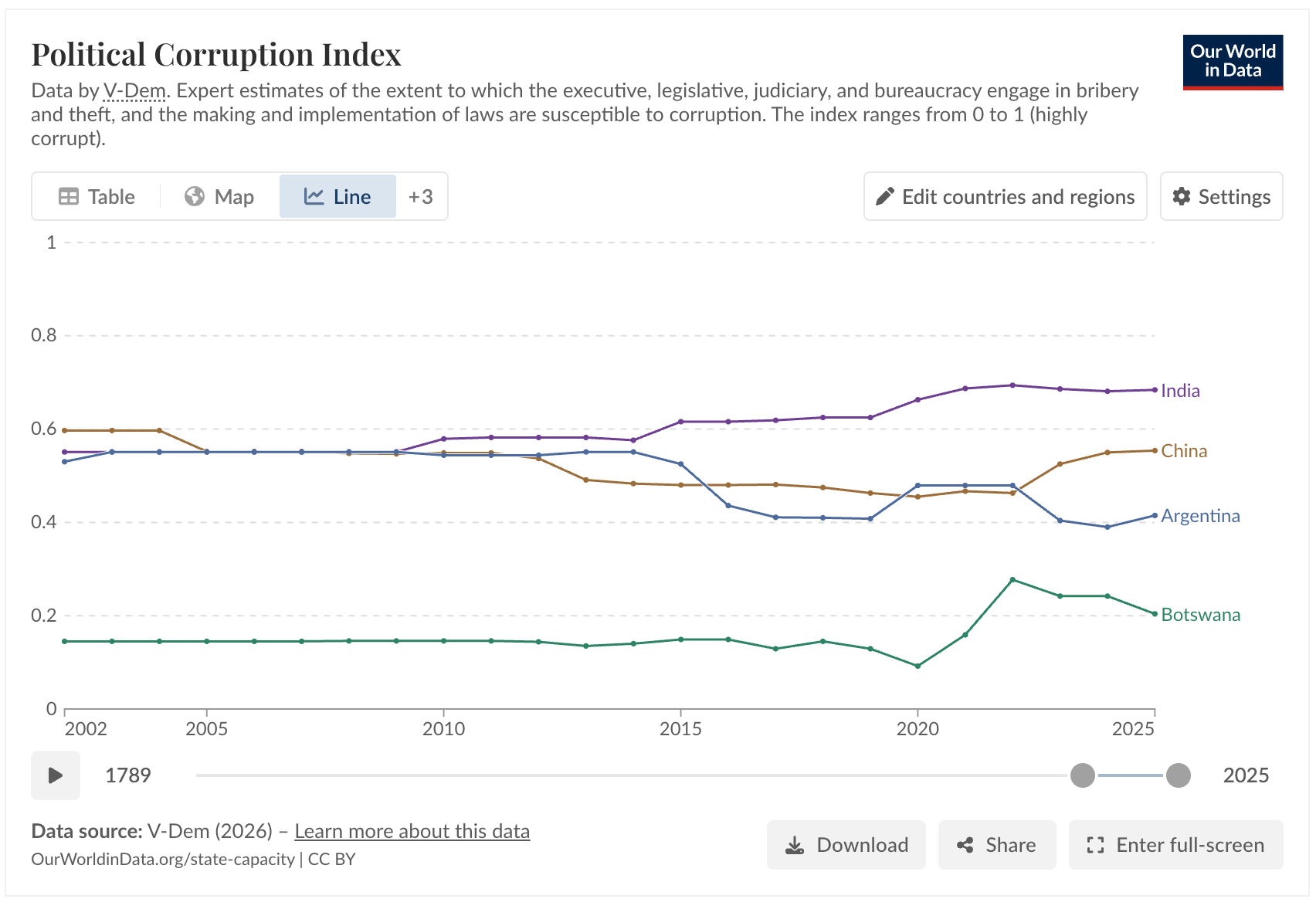
V-Dem’s political corruption index shows that corruption in India has constantly been increasing since 2000 to present. In that period, the UPA got re-elected once. The NDA has been re-elected twice. That lends credence to my view that as long as economic growth has been delivered, voters don’t care much.
By all accounts, the UPA had a stellar first term. Globalization lifted all boats. The global financial crisis in its second term combined with India’s economy landing in the Fragile Five proved hard to overcome. Similarly, the Modi-led government has had issues with crony capitalism. There’s definitely better ways to design industrial policy schemes, but as long as the industrialists chosen execute competently enough, voters see economic growth and are inclined to vote the incumbent back into office.
But there’s well known problems with V-Dem’s indices. Primarily they’re based on the perceptions of a few elites. And their democracy indices are especially problematic5. So let’s take a look at some other ones.
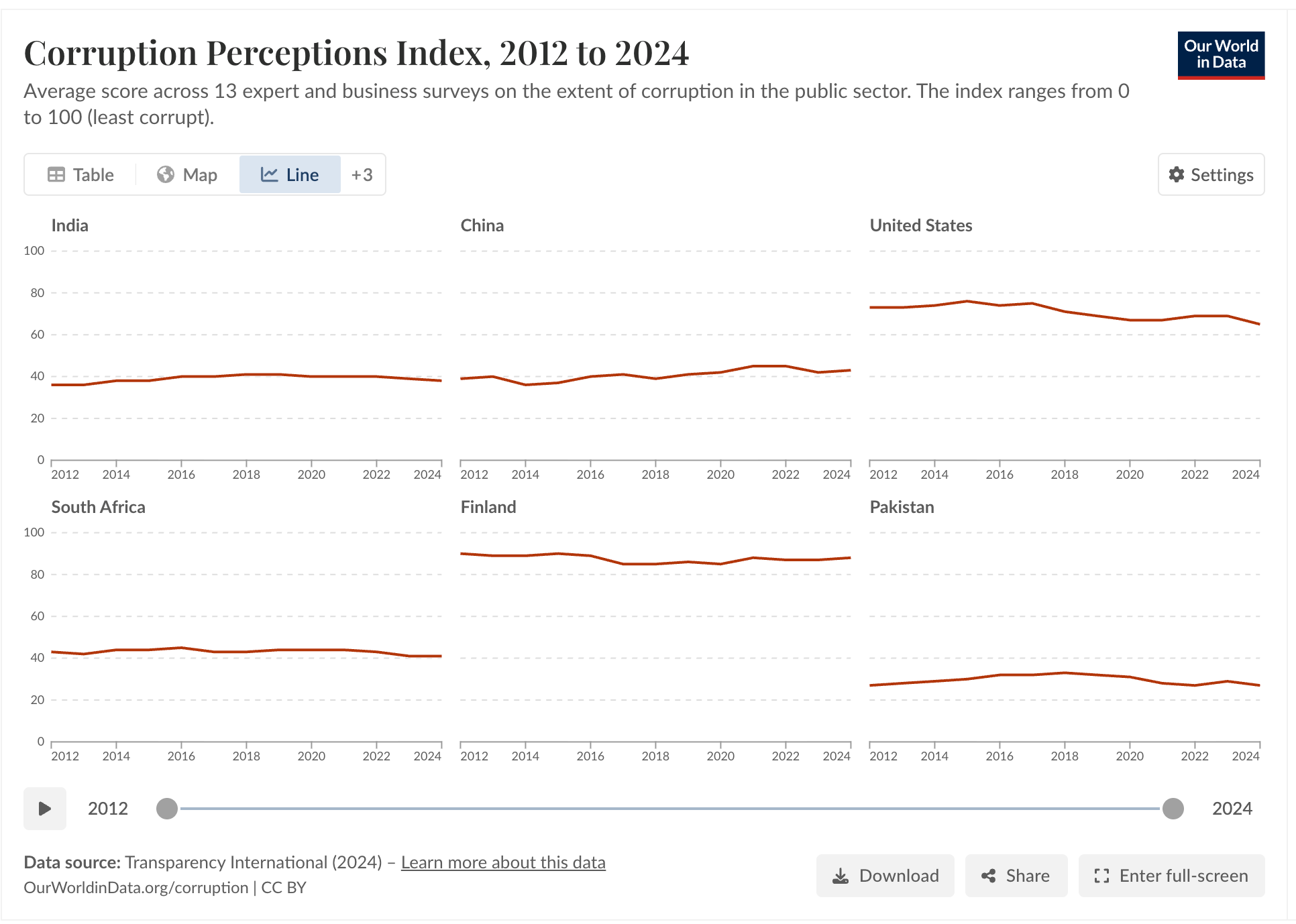
Transparency International publishes the Corruption Perceptions Index (CPI). The methodology has stayed the same since 2012 so scores can be compared over time. CPI is measured through multiple business and personal surveys that measure perceptions of corruption. It is as accurate as a perception-based survey can be.
The results line up with intuition. China, India and South Africa are at mostly the same levels. Pakistan is even more corrupt. The US and Finland are quite less corrupt.
Even though the Modi government got elected after a big anti-corruption movement, there’s been no measurable change in corruption. Or at the very least, there hasn’t been much change in measures of perception of corruption.
There’s not much survey data on the amount of bribes that people have had to pay within the past year. Transparency International only has data for about 4 years.
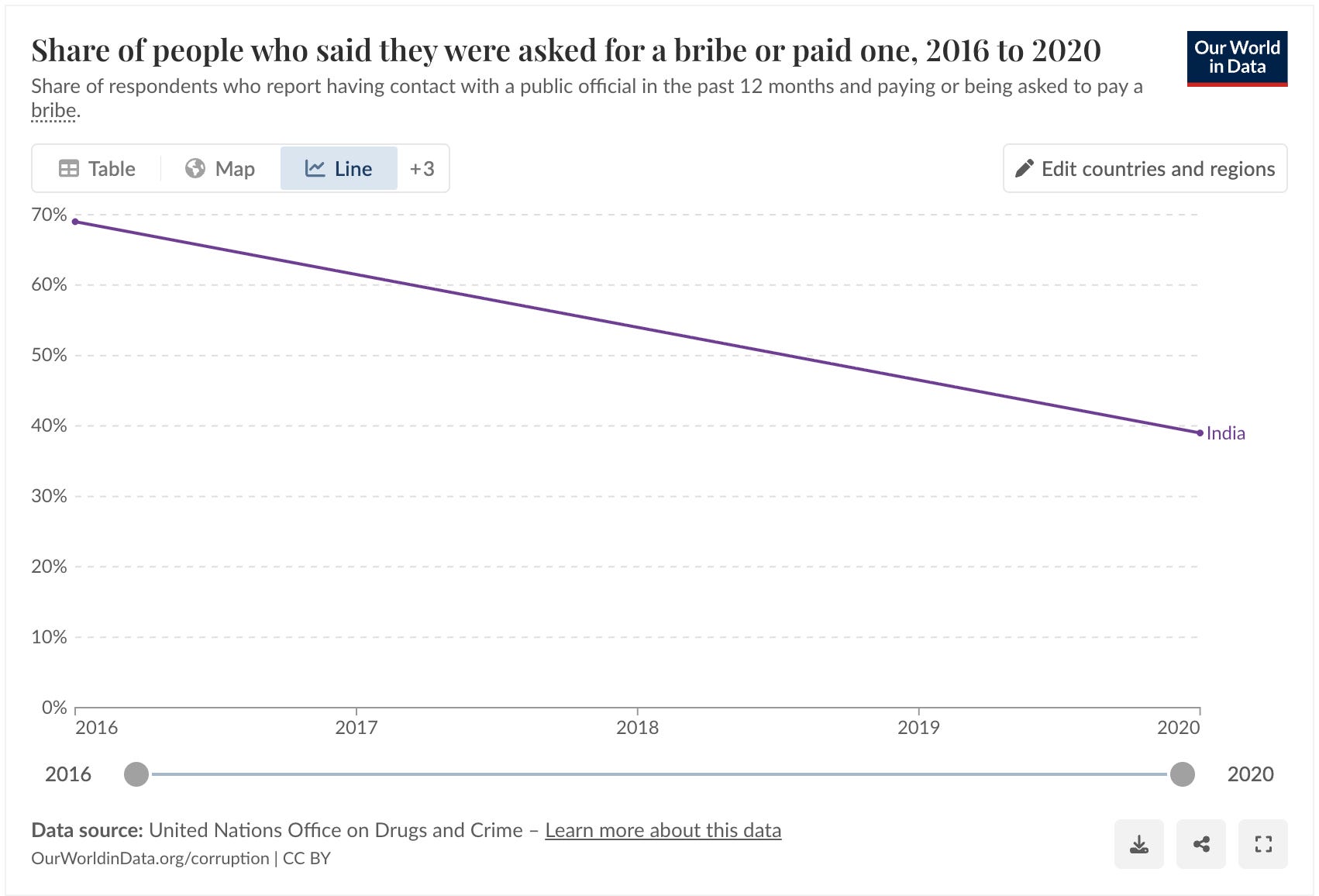
The share of people having to pay a bribe to a public official has sharply declined. And this matters more to economic outcomes than any other type of corruption. The decline correlates to the digitization of various welfare schemes in India along with the Jan Dhan-Aadhar-Mobile trinity. Even with the same financial inputs, this leads to better economic outcomes for the rural poor. Political corruption doesn’t matter.
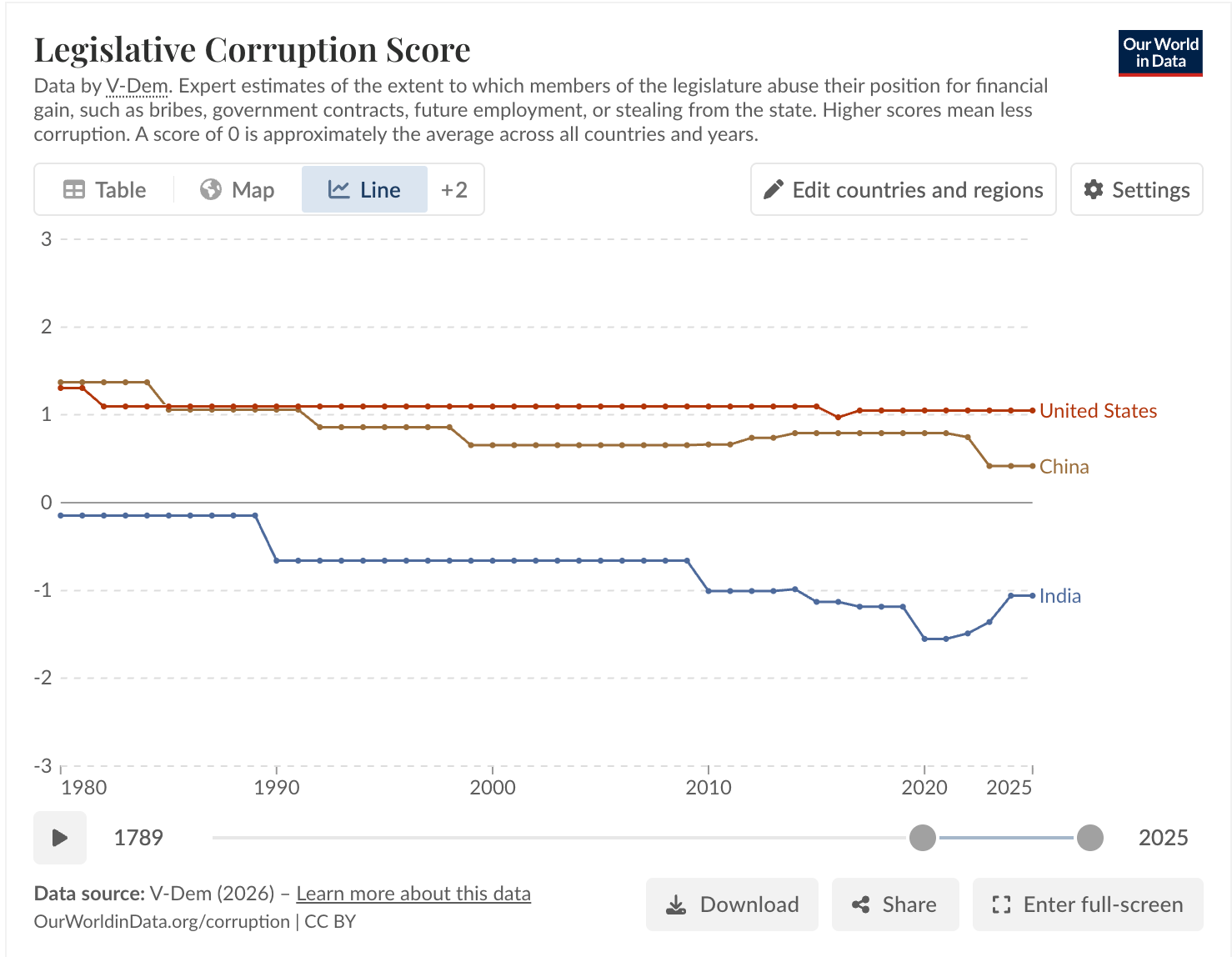
Another indicator of rent seeking is the legislative corruption index. It measures the extent to which legislators use their position for financial gain. In India, as can be seen in the graph above, there’s no correlation between the index and the chance of a government getting re-elected.
While I did say that V-Dem indices have their own problems, the methodology remaining constant across years is important to compare the relative levels of corruption. Any bias will be in one direction only6.
The above evidence is enough to prove empirically that the levels of corruption that citizens face daily has gone down, but political corruption and rent seeking haven’t reduced much.
And as long as voters see that they’re better off than where they were 5 years ago, they are willing to reward incumbents. That’s the case in many countries. Japan’s LDP has ruled continuously since 1955, barring a few years out of power. Sweden’s Swedish Social Democratic Party ruled for 44 years from 1932-76. The Botswana Democratic party also ruled from 1965-2024. All of these countries have thriving democracies, so it isn’t the case that autocrats have had performative elections.
Before ending, I’ll address a few counter-arguments:
The BJP manages to win despite corruption because it manages to polarize elections on religious lines.
Well, for one, the 2024 election proved that the economy matters. Inflation and low economic growth punished the BJP. Secondly, it has become common wisdom and even proven that the BJP benefited from the Balakot strike in 2019, in the face of a sagging economy. So there are more salient concerns than just corruption.Voters care about corruption because it hits economic growth.
Voters would care about corruption that hits them directly. Having to pay to access government benefits directly eats into their disposable income. Anti-incumbency would be high in such scenarios. However, cronyism and access money corruption would slow down growth compared to the counterfactual where such things didn’t happen, but it is much harder to compare these mentally.Lalu went to jail, and Jayalalitha was convicted of corruption
I am not arguing that voters never care about corruption. It is just that as long as the economy is good, and politicians aren’t too on the nose about it, corruption will be given a pass.People care, but there’s no good alternative.
In that case, the incumbent could be thrown out every 5 years. But voters have been rewarding multiple terms to different governments. That wouldn’t be the case if voters cared about corruption as an overarching issue.
If there’s other counter-arguments I have missed, feel free to comment and let me know.
In general, I emphasize vote share more than seat share. Due to the first past the post system, seat shares vary wildly with vote shares such that they are a veyr noisy indicator. Vote share indicates the general level of support that a party has in a society.
Each state had a Hajj quota. Modi claimed that Gujarat had only 4,000 seats allotted but 40,000 Muslims applied while in Bengal that had a quota of 12,000, many seats went empty. This disparity reflected the fact that the Gujarati Muslim was richer than the Bengali Muslim.
Although, in some sense, immigration is also an economic issue. But only if we’re talking about high-skilled immigration. With low-skilled immigration, it becomes a cultural issue.
I don’t say this because they rank India particularly low. I do think that The Economist’s democracy rankings are fair. V-Dem simply rates more dysfunctional and more violent democracies as higher than India’s.
Assuming bias is methodological and not personal.
Comments
Nothing yet. Say the first thing.
Sign in to join the conversation.