

With the rise of Agentic AI, research into AI economics has taken centre-stage. In this post, I want to review the entire literature about the effects of AI on employment. I’ve reached the conclusion that fears of AI taking away jobs are mostly overblown. Such scenarios require assumptions that are corner cases, not to mention understanding how consciousness works1.
There’s a lot of chatter and fear around AI taking away jobs. It’s been more than 3 years since ChatGPT was released and yet, the impact on the job market hasn’t been clear. Anthropic, OpenAI and other AI companies are investing tons of money into data centers. At the same time, many software companies are executing layoffs and laying the blame at the feet of AI. But is it possible that companies are “AI-washing”2 these layoffs?
We’ll come to this question later. The more important question is what is the definition of AI taking away all jobs? The most common doomsday scenario where all returns go to holders of AI models and agents is basically where capital reigns supreme. I define that scenario as the labor’s share of income going to zero. As you can see in the graph below, in the US, labor’s share of income hasn’t fluctuated much from 195o to present. Even if humans remain employed, the main social fear is the concentration of capital in the hands of the few.
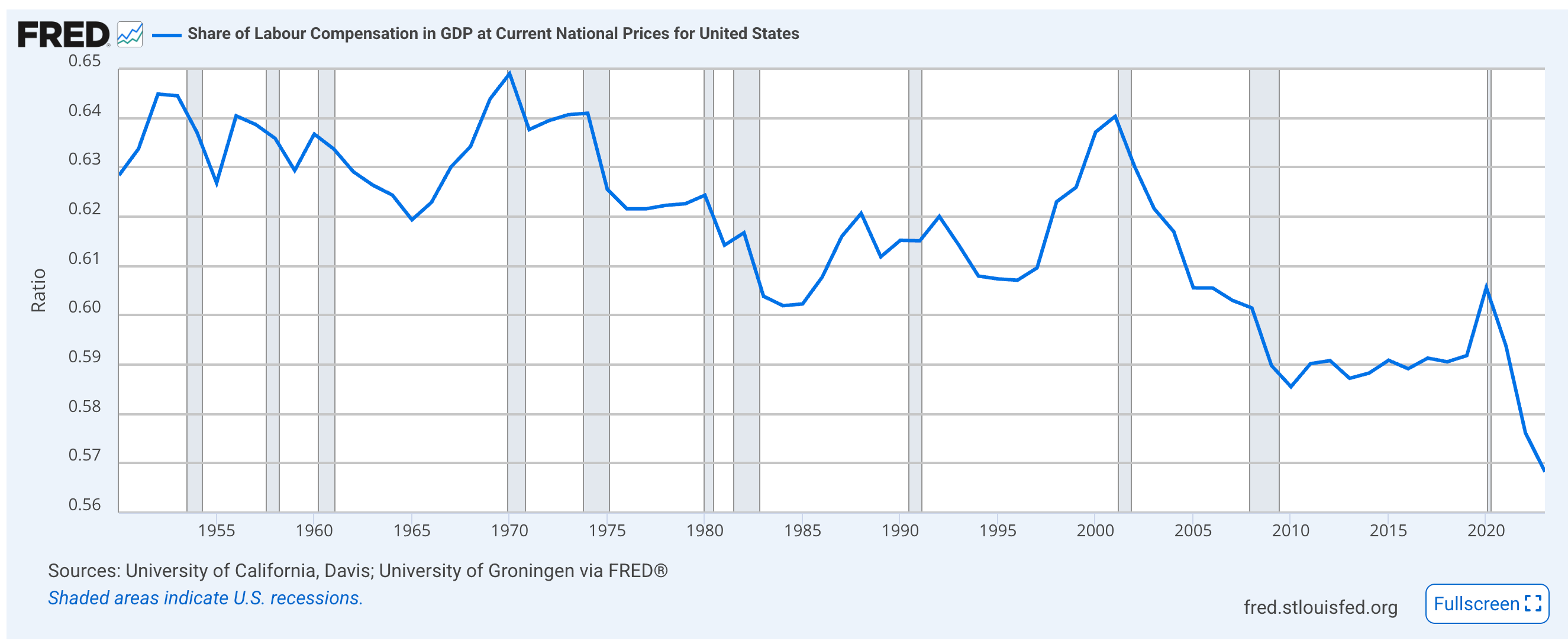
But this phenomenon wouldn’t be unique to AI. Labor’s share of income has been declining for multiple decades in various developed countries. If it is easy to switch between labor and capital, then cheaper capital will result in more capital being used in production.
In other words, when interest rates or price of equipment goes low, then more machinery can be bought to automate tasks. More income goes to purchase capital and less is left over for labor. Some concrete examples:
Wendy’s and McDonald’s are automating their kitchen. With minimum wage rising, capital becomes relatively cheaper to labor and so more is invested in machinery.
Amazon now uses robots for its warehouses almost exclusively. The increasing standardization of tasks along with predictably of robotics, makes it a perfect candidate for deploying capital in automating this.
Call centers now route calls to automatic voice recordings and only use humans for a few complex calls. That’s again an example of income being spent on capital rather than on labor because automated systems are much cheaper and can run 24/7.
Having established that reduction in labor’s share of income can happen with any automation, the rest of this post will do four things:
Go deeper into the “AI takes away all jobs definition”. I want to be as specific here as possible. Fear-mongering headlines obscure underlying economics and conflate together many things.
I want to steelman the doomsday arguments. Lack of counter-arguments to doomsday scenarios simply means acceptance of those scenarios. The declines in labor share are real. But is it a cause for concern?
Go through previous waves of automation and figure out what happens to the mechanics of labor then.
Look at data since the release of ChatGPT and some high frequency economic indicators to figure out what is happening at present.
Okay, so what does “AI taking away jobs” really mean? In my view, it breaks down into four claims:
Some people lose jobs to AI. This is trivially true. Productivity has been increasing for centuries due to automation and various other techniques. Jobs that would have been done by people, have been done by animals or machines. People WILL lose jobs to AI. Waymo will take away cab driver jobs. If increase in software productivity doesn’t translate to increased demands for software, then the number of software engineers will decrease.
The composition of jobs changes. Every wave of automation introduces some amount of chaos leading to winners and losers.
The unemployment rate rises structurally. At present, the US economy is considered at full employment when the unemployment rate is around 4%. A meaningful rise in the floor such that the unemployment rate doesn’t fall below 10% is a moderately likely scenario that I will engage with.
The doomsday scenario in which the labor’s share of income goes to zero. This is the claim that everyone is worried about in the long term.
The last two points are the only interesting ones. Every other claim is either trivially true or uninteresting. So I’ll primarily be addressing those.
Each job can be thought of as a collection of tasks. Automation hits tasks and not jobs. When tasks are loosely bundled, jobs are more fully automated. When tasks are tightly bundled together, it’s harder to automate jobs. For instance, a McDonald’s worker might have to take orders from customers, fry burgers and empty the trash. These tasks aren’t dependent on each other and all can be individually automated. A job that is a loose bundle of such tasks will soon be lost to automation.
On the other hand, some tasks in a software engineering job are: writing code, testing whether it works, reviewing code, planning the roadmap for engineering products, thinking about extensibility, engaging with stakeholders and creating alignment between various factions. Automating one task doesn’t threaten the job. In fact, automating code writing can free up more time to spend on roadmap planning and engaging stakeholders. These tasks can be performed with higher quality. In this case, the tasks in a job are a interdependent and tightly bundled and automating the entire job is mostly unfeasible.
Korinek and Suh (2025) model tasks as either an unbounded distribution or bounded distribution of complexity as shown in the figure above. In the unbounded distribution, there exists a long tail of jobs that keep increasing in complexity. The same doesn’t exist in the bounded distribution. But how do you measure the complexity of a task? They have a simple answer: the more compute a task requires, the more complex it is. As automation progresses, it eventually crosses different complexity thresholds.
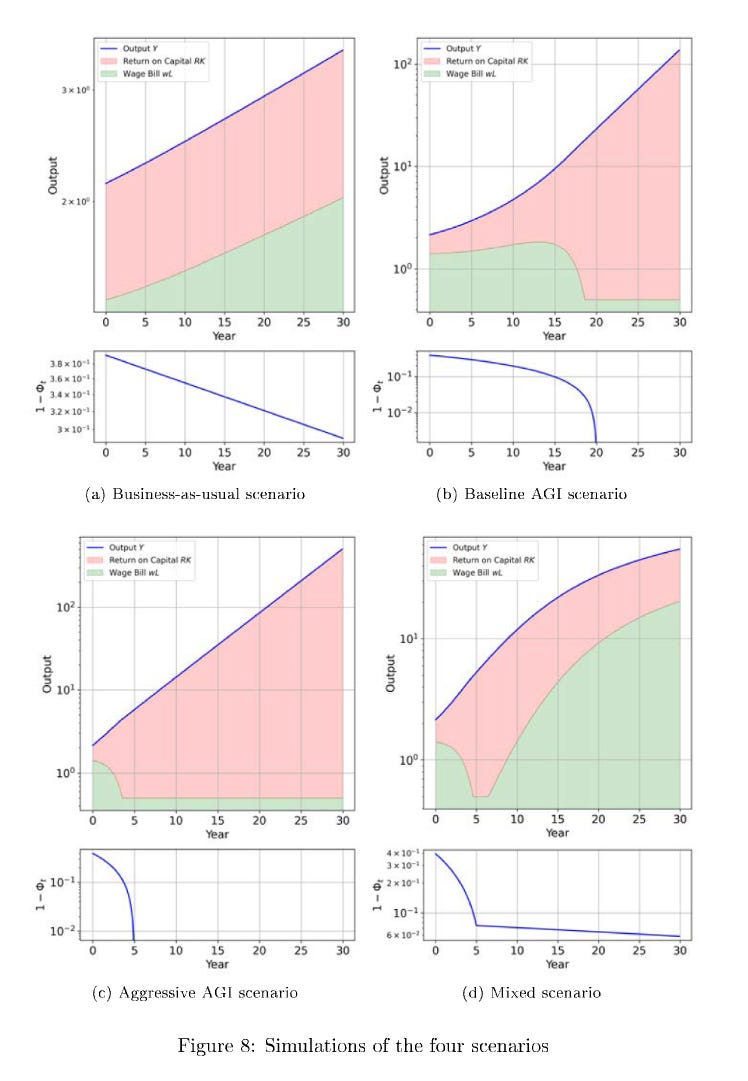
Based on this distribution, the authors propose 4 scenarios:
Business-as-usual happens. A constant fraction of all tasks are being automated. Task complexity is infinite. In this case, wages and output keep rising indefinitely. There are winners and losers. Jobs are reallocated among humans. But there’s no structural collapse.
The baseline AGI scenario where there’s limit to the complexity of tasks. Full automation is reached within 20 years. Output surges, but wage growth collapses.
Aggressive AGI scenarios where full automation is reached within 5 years. Output rises very rapidly, but wages fall even more sharply.
The bout of automation (mixed scenario) where cognitive tasks are rapidly automated followed by the unbounded distribution of tasks which are almost impossible to automate. Output keeps rising, while wages temporarily stagnate and slowly recover.
The graphical outcome is represented in the following graph by the authors.
But which scenario is more likely? This highly depends on your mental model of the world:
If many things are automated, but there are critical bottleneck tasks that only humans can perform, it stands to reason that labor remains scarce and valuable. Productivity gains from AI will increase wages because workers become more efficient at things that machines can’t touch. If you add more capital (or machines), then you need more labor to manage it.
But if there’s no tasks exclusive to humans, that’s when we reach the danger zone. I think that there’s still room for human-written reviews of AI economics. But if that’s not the case, a human worker is directly competing with a piece of capital (data centers, software, etc). In that case, human workers won’t be able to command wages more than what it costs to deploy capital.
To me it seems unlikely that scenario 2 would ever occur. I don’t see society ever automating important job families like police, lawyers, judges and doctors among others. Even more than that, there’s always scarcity. If AI isn’t scarce, then labor involving human services will be scarce as Alex Imas argues.
For example, the purse is a solved design. Michael Kors makes perfectly fine purses from a utility perspective. Yet Louis Vuitton and Gucci still make plenty of profits. Their profits haven’t been competed away. From a technological perspective, the purse has been perfected since at least the 1800s. If these luxury companies can still sell mimetic desires, then I think there does exist a long tail of tasks that cannot be automated primarily through the channel of such desires — if not computational complexity3.
I can anticipate the counter-argument against the above thesis: Unemployment can be high while the labor share is still fine. Basically, the argument goes that as AI automates jobs, the remaining workers will continue to be highly paid. AI researchers will always be handsomely paid in such a world. But if everyone else is unemployed, but the AI researchers are cornering huge salaries, will the labor’s share of income be propped by a small sliver of high-earners?
I have two objections here.
Firstly, to keep labor share of income constant, while halving employment, would require doubling the salaries paid to labor. If unemployment rises even more, the salaries given to the remaining labor needs to be stratospheric. In normal circumstances, I have no idea how such a situation can even arise. But I’ll concede that for the time being. The biggest problem here is how does such a situation arise while the remaining labor has unprecedented bargaining power? That requires different structural assumptions.
Second, there is a structural argument for why labor share of income and unemployment track together.
If technology increases the marginal product of labor, there are new demands for tasks and that restores employment at a new equilibrium. I covered marginal product of labor and other labor economics in the post on Indian labor laws.
Labor markets would not clear with mass unemployment and stable labor share because wages that would maintain the labor share in that scenario would simply not occur if the marginal product of labor isn’t that high. It is a structural contradiction.
I hope this proves that this argument is a weaker form of Korinek’s paper covered above. The strongest form of argument is that unemployment structurally goes up. The doomer scenarios are a collapse in labor share, not a stable share with mass unemployment.
Let me steelman the thesis that labor share goes to zero. I’ll try to argue against myself here.
As documented by Karabarbounis and Neiman (2014), global share of labor income has been dropping for the past few decades4. The decline can mostly be understood as the reallocation of activity towards superstar firms. The S&P500 index is proof of this. 5 companies are responsible for the majority of the index’s gains. These superstar firms have low labor shares of income. So what is likely happening is that superstar firms have better automation and economies of scale and so that’s reducing labor’s share of income.
Acemoglu estimates that automation is responsible for 52% of growth in income inequality from 1980 - 2016. The share of automated tasks has risen since 1980 and is responsible for this fall in labor share of income.
And if Piketty’s thesis proves true that rate of return to capital is greater than the GDP growth rate, then it would mean that capital concentrates in the hands of those that already have capital. This would also mean that those holding capital build up more wealth. Ultimately, this ends up having political and re-distributional consequences.
More fundamentally, all of this assumes that AI cannot be better than human labor. Let’s assume a scenario where AI performs cognitive tasks currently performed by humans. For most of economic history, skilled workers have commanded high wages because of scarcity and rarity. When AI can replace this, and compute becomes cheaper, such that adding a single unit of labor to a process produces much less output than adding single unit of an AI-agent, that’s when the doomsday scenario is hit.
And if AI is cheaper per unit of cognitive output than subsistence wages of humans, no employer would hire any human. If they did, that employer would be competed out of existence. In this scenario, comparative advantage simply vanishes.
Yet another scenario is when AI can recursively self-improve. Reinforcement learning doesn’t yet seem to be at that level. But if it does improve enough, it can produce new tasks that it also can automate. If AI generates tasks fast enough such that humans don’t get time to train into them, then new occupations are filled by AI and not humans.
One thing that often protects labor’s share of income is Baumol’s cost disease. Software engineers are highly productive and their wage rises. Opportunity costs for labor in other sectors rises and so their wages rise. Engineers needs haircuts and to live in the same area as highly productive engineers, barbers need to be paid relatively high wages than those commanded solely due to productivity. This argument depends on sectors remaining immune to the AI onslaught. If AI-resistant sectors shrink, then so does the cost of labor since most humans will probably be likely to be employed in those sectors.
I think these are the strongest versions of the arguments for AGI sending human labor into oblivion. Suffice to say, for now, that I think most of these arguments are flawed and require really strong assumptions that might not bear out.
I’ll conclude this part for now. In the next part, I’ll explain why I don’t think the steelmanned case against labor will hold. We’ll also dive into why I think labor has a structural floor. Then we’ll take a look into previous waves of automation and the mechanics of what happened. I’ll also explain why most of the AI story will likely be explained by boring capital-labor substitution.
Ultimately, I think strong evidence of 3 years of ChatGPT is also indicative of AI economics and the trendline. And finally, I’ll conclude with a philosophical segue into why the problem of AI and consciousness needs to be explored for having any understanding of AGI and ASI.
Ultimately, consciousness is what produces desires in human beings. Mimetic desires are a big part of the human condition. If humans didn’t desire anything more after base desires were satisfied, we would have been out of desires long after food, shelter and clothing were solved. For more on this, I would refer to “The Righteous Mind”.
Basically using AI as an excuse to cut organizational fab.
As always, the Em-dash is my favourite punctuation and this is my attestation that AI hasn’t been used.
Comments
Nothing yet. Say the first thing.
Sign in to join the conversation.