
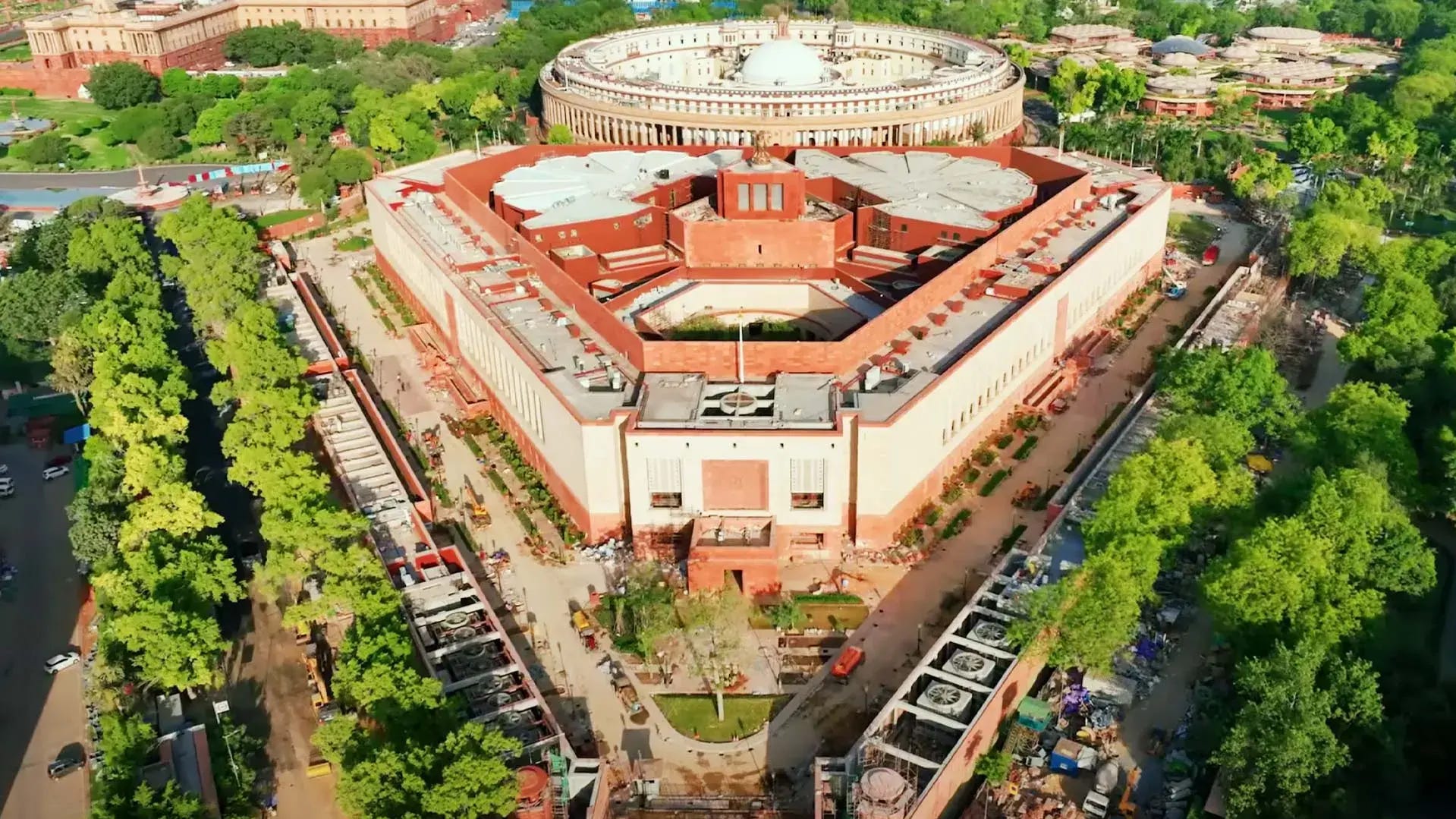
India’s voting has long been lopsided. The first election in the 1951 had 401 constituencies and 489 seats. Some of the constituencies elected multiple members to the Parliament. Over the next few decades, the number of constituencies was gradually increased. The first time that election to 543 seats was held was for the 6th Lok Sabha in 1977. The constituencies for those seats were decided based on the 1971 census. The population in 1971 was approximately 550 million. The population today is estimated to be about 1.5 billion, a 3x increase with the same amount of seats. If seats grew with population, we would be looking at a 1500-strong Lok Sabha and a 600-strong Rajya Sabha.
But there was a principle of “One person, One vote” enshrined into the constitution. Article 326 and Article 81 of the Indian constitution work together to provide that scaffolding. They mandate that all Parliamentary constituencies represent approximately the same amount of population. The population figure would be taken from the most recent census.
Since Sikkim’s accession to the Indian Union in 1975, the number of Parliamentary seats have been frozen at 543. With population and fertility rates growing unevenly across states, the population being represented by one constituency varies wildly.
Leaving out union territories with sparse populations like Ladakh, there’s wide variation in the number of electors from each state. For example, Kerala has about 14 lakh voters per constituency1, while Uttar Pradesh (UP) has about 20 lakh. So one person’s vote in Kerala is worth about 1.4x more than that of a UP voter.
Regardless of your political affiliation and views, that’s a moral and political travesty. The political legitimacy of a republic derives from the equal moral worth of citizens and equal moral worth implies equal political voice. John Rawls said as much in his principle of the fair value of political liberty. He categorically states that citizens should have equal opportunities to influence government and political representation. In my view, that is the fountainhead from which liberalism eventually flows and Rawls does get it right.
Philosophy aside, there’s strong reasons to dislike the current state of affairs in Parliament.
For the democracies that have an Upper and Lower house of Parliament, I plotted the strength of their legislatures2. You can see that India has the lowest absolute number of seats in its Parliament. And that’s considering the fact that India is by far the most populous democracy by a large margin.
Even if India were to maintain the seats-to-population ratio enacted in the 1970s, it should have about 1,650 seats in the Lok Sabha and about 750 in the Rajya Sabha3. Clearly, things need to change and delimitation is the need of the hour4.

If delimitation is necessary, then do seats need to increase proportionally? Or should seats be reapportioned within and across states? In the current political scenario, the overwhelming ask from the southern states is to increase seats allotted to each state by a flat 50%. The logic behind it is straightforward: they have the lowest fertility and the lowest population, so those states shouldn’t be “punished” with loss of political power.
I’ll examine that logic later, but here’s why I don’t agree with it:
No Indian state made any particular efforts to reduce fertility. Fertility collapse is a global issue that’s been in the works for decades. Fertility fall roughly — but not quite exactly — tracks growth in GDP per capita5.
As I said earlier, equal political views is the foundation of democracy. Accident of place of birth shouldn’t determine the value of a vote.
Interests of states should be preserved in the Rajya Sabha. That’s the advantage of a federal bicameral legislature.
India has gone through massive amounts of urbanization since 1971. Rural constituencies have less voters compared to urban ones. And so seats need to be reapportioned such that urban areas are adequately represented again. Incidentally, I think this is one of the many reasons why cities are in such bad shape.
There’s no alternative principle to apportionment. If population doesn’t govern apportionment, what does? GDP contribution is the common answer. But it punishes poor states. The southern states enjoy a coastal advantage. And it is well known that coastal states outperform inland states economically6. If tax contribution is the principle, it just means that richer people can buy more representation and I don’t think that is the road to go.
Does this imply that Southern states are being “punished” for their controlling population growth? I don’t think so.
Reducing fertility is not the virtue it is posited to be. People are not stomachs, but brains. Quoting Alex Tabarrok from Marginal Revolution:
My second Kremer paper is Population Growth and Technological Change: One Million B.C. to 1990. An economist examining one million years of the economy! I like to say that there are two views of humanity, people are stomachs or people are brains. In the people are stomachs view, more people means more eaters, more takers, less for everyone else. In the people are brains view, more people means more brains, more ideas, more for everyone else. The people are brains view is my view and Paul Romer’s view (ideas are nonrivalrous). Kremer tests the two views. He shows that over the long run economic growth increased with population growth. People are brains.
Human capital is required to ensure that the boon of a large population is converted into a concrete advantage. While the Southern states do enjoy a large human capital advantage, without population growth, the human capital will age-out faster and the demographic dividend turns into a drag.
Paul Ehrlich was the one who said that India would face starvation if it didn’t implement any population control. He wrote The Population Bomb which claimed that population growth will surpass agricultural growth unless controlled. India was a “cancerous tumor” of overpopulation. Technology has clearly proven him wrong. I would argue that he was mistaken even in his time. Technological evolution since the dawn of agriculture has consistently been able to increase the amount of mouths that it has been able to feed.
The southern states are clearly parroting his views7. But that doesn’t mean we should lend any credence to those views.
I submit that the reason why this is a political issue is primarily because of Tamil Nadu’s Dravidian Nationalism.
Dravidianism is the root of many bad ideas in Indian politics8.
Tamil Nadu was the first to expand reservations above the 50% mark using the Ninth schedule of the constitution9. The concept of caste-based reservations itself was first implemented by the Justice Party —from which all other Dravidian parties can trace descent — in 1921.
Freebies as a concept were started by MGR’s expansion of midday meals in the early 1980s.
The Aryan Invasion Theory (AIT) has been discredited in favor of the Aryan Migration Theory (AMT). The AMT states that Aryans migrated from the Central Steppes of Asia (somewhere near present-day Ukraine) and gradually merged with the population of the Indus Valley Civilization (IVC). The AIT instead says that the Aryans invaded the IVC and replaced them. The IVC inhabitants are now the non-Brahmin populations in the South. Yet, Dravidians continue to insist that the AIT is true despite mounting evidence to the contrary.
The two-language formula where only English and Tamil would be taught, rejecting Hindi opened up the door to linguistic politics in the rest of the country.
Tamil Nadu was the first state to take control of Hindu Temples under the Hindu Religious and Charitable Endowments (HRCE) Act. Many other states followed suit and now we’re stuck in a place where the State controls only Hindu places of worship.
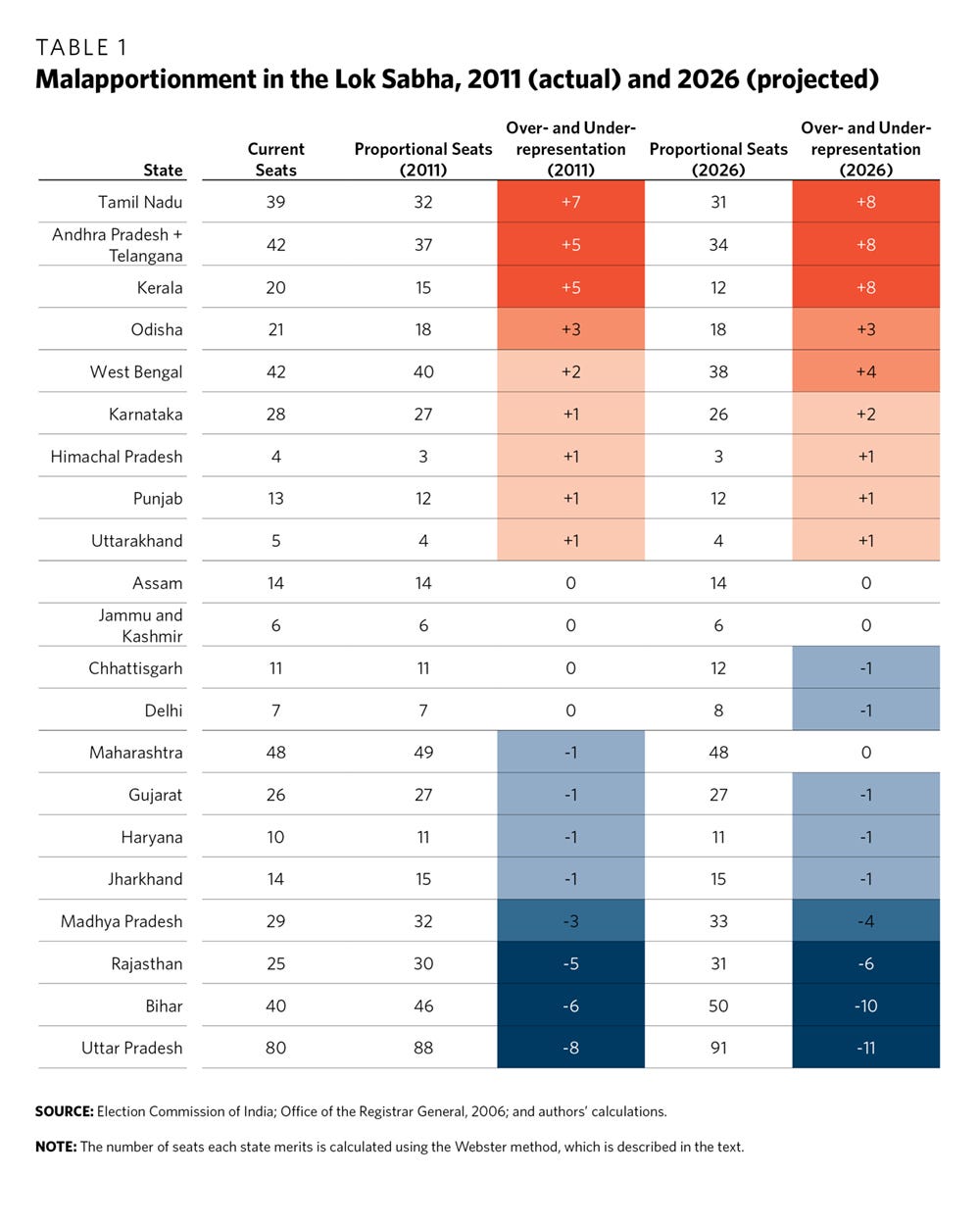
Looking at political opposition to delimitation, Tamil Nadu has been the most vocal. While it does stand to lose 8 seats, proportionally Kerala will be the hardest hit, losing 8 seats out of its present 20. Yet, opposition from Kerala is relatively muted compared to Tamil Nadu. I think it is because of two reasons.
Firstly, Kerala is ruled by national parties. The CPI(M) and the Congress alternate their rule there while the BJP is increasing its presence. Structurally, reapportionment doesn’t hit national parties as much since lost seats could be gained elsewhere. National parties are also hard put to oppose delimitation. The Congress is trying to win elections in Uttar Pradesh as well as Karnataka. It can’t really lead an anti-delimitation campaign without alienating some voters. In contrast, Tamil Nadu politics is dominated by regional parties. The DMK opposed delimitation even back when it was a partner during the NDA government from 1999-2004. Seats that parties lose here will not be made up elsewhere. And it will lead to a loss in influence.
Secondly, Dravidian ideology has a strong component of subnationalism, under the guise of the AIT. Thus, it tends to view any renegotiation of federalism as a threat to its aspiration. And the tendency of Dravidian nationalism to assert itself is particularly strong in such situations. Tamil Nadu’s ideological tradition frames national politics as a centre-vs-region struggle. And that tradition doesn’t exist in states like Kerala.
All of this is directly downstream of regional parties and Dravidian nationalism. Odisha and West Bengal, where regional parties rule, strengthen my thesis. There’s not much opposition there, even though they would lose seats too. Odisha has recently come under BJP rule, but even under Naveen Patnaik’s BJD, there wasn’t much opposition. Mamata Banerjee has aspirations of leading a pan-India coalition and that necessarily involves wooing North Indian voters.
So what does a fair solution look like? I like Shruti Rajagopalan’s ideas mentioned here:
Basically, she proposes that:
The entire federal contract between the Union government and the States be renegotiated.
Lok Sabha seats be perfectly apportioned.
Rajya Sabha seats should be apportioned in proportion to the revenue that each state is able to raise. So richer states would have a higher representation in the Upper House. That’s an incentive to states to increase their sources of revenue.
The Fiscal Commission (FC) devolves more financial resources to the states.
I would only add that the number of seats in Lok Sabha be increased to above 1,000 at least. Common fears of the house becoming unmanageable are unfounded. Most of the work could be done through committees that draft bills and debate internally. That’s how it is done in most mature democracies like the US and the UK.
Finally, getting to the crux of this post: What is the BJP’s angle in all of this? Why did it call a special session to pass this when it didn’t have the numbers to pass the women’s reservation bill with a 2/3rd majority?
The BJP faces tough elections until the 2029 Lok Sabha election. Most of them are crucial. The 2026 elections have West Bengal as the crucial state. The BJP has put forth all the might of its administrative power. It has summoned many central police forces into the state. Not to mention that one of the planks of the election is women empowerment.
Tamil Nadu is also a much needed win to weaken Dravidianism10. Uttar Pradesh goes to elections in 2027 and a third term anti-incumbency is a hard thing to fight against.
The delimitation bill alone would never get passed on its own. So the women’s reservation bill is useful as a trojan horse to get the delimitation bill passed. The failure of the bill would be another plank to fight the election on. And women’s issues are quite sensitive to the electorate.
But then the question goes one level down. Why is the BJP so eager to push through delimitation? Part of the reason is that the BJP is probably preparing the pitch to get delimitation and seat apportionment implemented eventually over the next few years.
But I think the deeper reason is the loss in 2024.
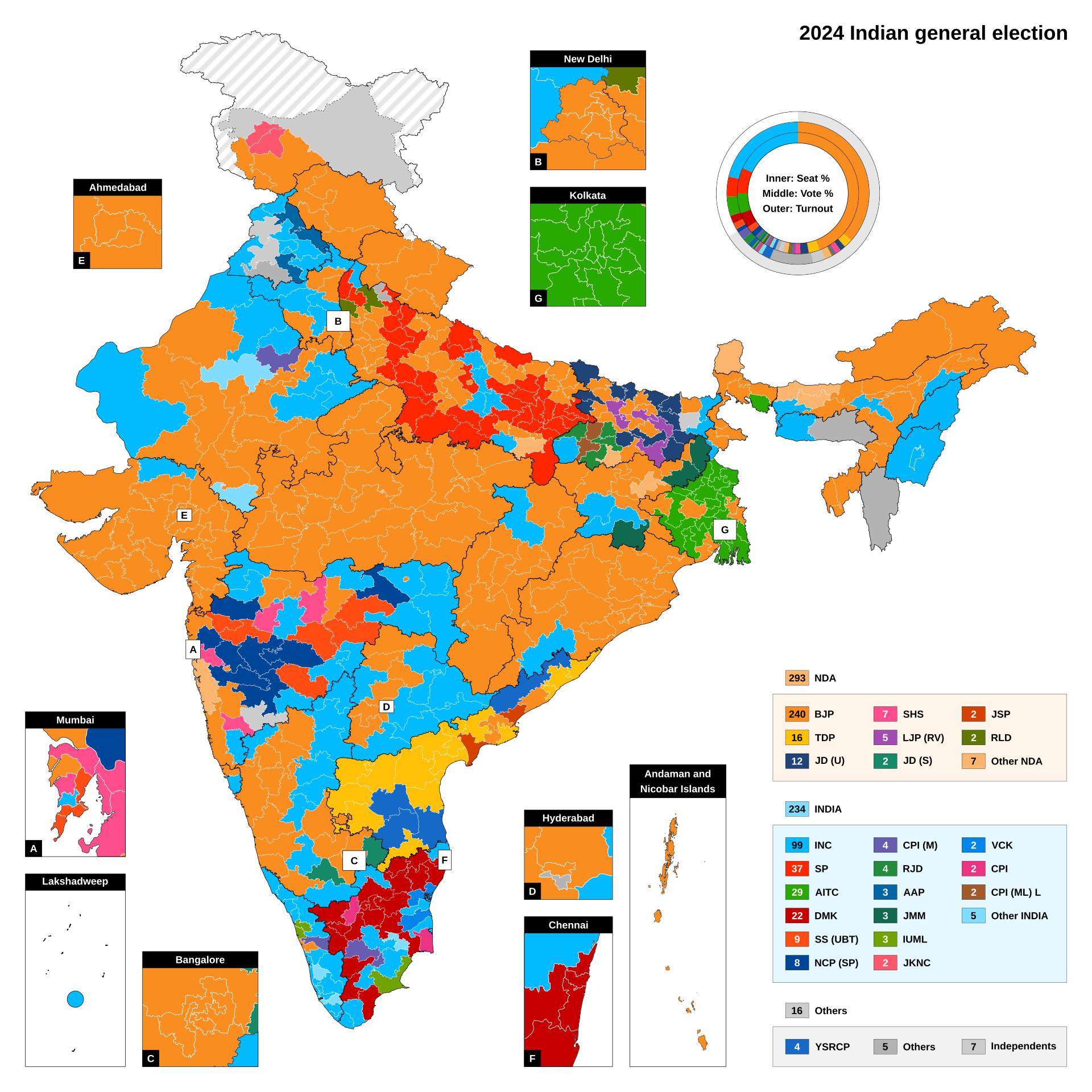
Check out the above map. Even though the BJP had massive losses across the country, it still did well in urban areas like Mumbai, Bangalore, Pune, Hyderabad and New Delhi.
Check out the table below. The rural wage growth is relatively strong from 2010-11 to 2015-16. But from 2015 onwards till 2023, it has stagnated.
There’s a famous result in political science: Most voters care strongly about economic growth. Ideology comes in second. In fact, the best way for an ideology to gain prestige and legitimacy is to deliver economic growth. If you are able to deliver high GDP growth rates while keeping inflation and unemployment low, the incumbent has a strong advantage. Across democracies, 2024 was an election year that many incumbents lost, primarily due to the impact of post-Covid inflation.
Putting this altogether, I think it is evident why the BJP is so desperate for delimitation:
Delimitation and seat apportionment would allocate seats away from rural areas to urban areas because most of the country is urbanizing.
From 2029 onwards, the BJP faces tough elections because it has “maxed out” its gains in its traditional areas and it needs to make inroads into new areas. However, that takes time and is a multi-election process.
Across the world, agricultural income continues to decline. India isn’t any exception. The only real option for rural agricultural labor is to migrate to cities for economic opportunities. Real reforms in agriculture are politically thorny to execute and the BJP has already been burnt once. This economic distress hurts BJP in the rural areas.
Through delimitation, the BJP would be able to squeeze more seats out of its current vote share and geographic distribution of votes. That would probably give it another 5 years of a structural advantage, before needing to make inroads into Punjab, Kerala, Tamil Nadu and Telangana.
Which is why accepting the BJP’s gambit of women’s reservation is a poison pill for the opposition. If women’s reservation goes through, then it makes life difficult for opposition parties.
But if they decline, as they have done so, they open themselves up to political attacks which might shift a couple percentage points of vote share. And small shifts like that can often precipitate a large change in the number of seats.
Thanks for reading The Indic Prism! This post is public so feel free to share it.
Counting all democracies, unicameralism is the majority. But if you restrict yourself to large democracies with a population of at least 50 million, only South Korea is unicameral. Every other democracy has a bicameral legislature.
Population in the 1971 census was approximately 550 million, so just tripling the number of seats here.
There are additional questions regarding how to manage the size of such a large chamber. I believe there are ways around this and the US and the UK offer good practices that can be copied.
This isn’t to say that higher GDP per capita is related to lower fertility rates. Tamil Nadu hit a Total Fertility Rate (TFR) of 1.5 which is lower than 1.6 of the US, despite being substantially poorer than the US. While there’s a correlation, there’s no causation.
With this, we could flip the logic around and say that coastal states should subsidize landlocked states.
It is likely that they’re doing this unintentionally. It is unfortunate that Paul Ehrlich planted such poisonous ideas into our discourse.
Thanks to my friend, Deepak, who introduced me to this idea.
Laws inserted into the 9th Schedule of the Indian constitution cannot be challenged. So Tamil Nadu inserted its reservations laws into the 9th schedule, preventing any legal challenges to it.
Although winning by allying with the AIADMK wouldn’t dent Dravidianism much, it would still hurt it much more than allying with the DMK.
Comments
Nothing yet. Say the first thing.
Sign in to join the conversation.