
Earth Forces Bulletin 26-8
That russia is at war with Europe is the most inconvenient truth that politicians and policymakers are determined to avoid these days. And it is their fear of this truth that is provoking Moscow to inevitably expand and escalate attacks on Europe, not support for Ukraine.
Unfortunately, there’s only one way to stop this from getting worse, and that’s to do the exact opposite of what most foreign policy experts presently advise. Instead of constantly trying not to poke the bear, the time is long past to create and enforce proactive consequences that the thing will actually pay attention to.
It may involve seriously damaging a few russian warships at sea. And/or setting up an air defense zone west of the Dnipro.
Yes, this means risking war. That, sadly, is the price to be paid.
Moscow is only blowing up stuff in NATO countries now because the orcs are pretty certain the chances of meaningful retaliation are zero. Until pain is inflicted, these probing attacks will continue and get worse until somebody dies.
And then what? Will NATO suddenly switch gears and fight back? Doubtful. It’s entire existence is predicated on deterrence, which is another way to say that it simply isn’t built for an actual war.
Zaluzhnyi’s recent statement about Ukraine never joining NATO that made waves is 100% accurate. And it’s probably for the best. NATO is a zombie institution with no remaining purpose but to systematically appease russia in order to avoid an internal crisis that would reveal the bluff at the heart of the thing.
NATO exists to prevent any member from taking action against russia which might expose other members to retaliation. Any attack on NATO constitutes a failure of NATO, so one must never be admitted if there’s any leeway whatsoever.
That’s the harsh political reality of the institution. A legion of experts and professors will go to their graves refusing to admit it, but it’s the simple exceptionally inconvenient truth.
Strike drones have crossed the border to bomb NATO countries like Poland and Romania multiple times. Incidents of drone surveillance of sensitive sites have turned into an outright attempted attack that failed only because the orcs got unlucky.
Moscow hitting Poland with a cruise missile and trying to drone strike a Ukrainian transport jet is all part of a pattern. The incidents will get worse and worse until people start dying and NATO still refuses to adequately respond.
Virtually nobody in a position of authority or influence is going to call these attacks what they are - acts of war - and demand corresponding countermeasures because of the absurd mythology of war that utterly dominates the western mentality. Instead of a scientific process, war is treated as a critical point in a grand narrative, a thing that exists to justify someone’s ideology and indeed the very existence of western civilization.
Down that road lies defeat, always and forevermore. The USA just learned this lesson in Iran, imagining that if you just drop thirteen thousand bombs on designated targets then the enemy is automatically defeated and must surrender. And now Iran controls Hormuz, the mighty United States of America unable to protect shipping through this vital waterway. A world-changing, Earth-shattering event so far as geopolitical history goes.
NATO seems bound and determined to do exactly the same thing as the raging infection that is Putin’s russian world tries to spread. European collective interests are increasingly at odds with NATO’s, the alliance adamantly refusing to perform its sole legitimate function: deterring russia from attacking. Sometimes, that means striking back yourself.
And not with some stupid posturing thing like cyberattacks. Steel must melt. Capabilities must be destroyed. This is the only warning that will stop the slide to worse.
Strangely, Europe is both desperately vulnerable to russian attack - and yet strategically invulnerable on a level that preordains russia’s defeat in any real fight. In the event of an all-out war, russian ballistic missiles and drones would inflict serious damage across Europe, and there just aren’t enough interceptors to stop them. But at the same time, European financial capabilities and standing military power is more than sufficient to destroy the very foundations of Moscow’s missile and drone production lines, which aren’t buried under mountains like so many of Iran’s.
This is why Moscow’s attacks on Europe remain limited and calibrated. Putin can’t win an all-out war against all of Europe, but needs very much for European leaders trained to act like all war is total war to keep pretending that the moment they ever bomb something russian, all hell breaks loose.
The dark heart of Muscovite reflexive control over Europe is the intentional western choice to misunderstand war. If the actuality of it were widely accepted, the basis for western civilization itself crumbles to dust, and for many it’s better to keep zombie institutions alive than accept overdue reform.
War is nothing more than a struggle over resources - there is no morality involved, only survival. Layers of strategy and policy are built up around what reduces down to one group of people’s desire to preserve their existing control over something of material value. Possession of this power creates a material gradient affecting perception and incentives.
Life itself is a form of war, all things in nature struggling against entropy and shortages. This doesn’t mean that all war and warfare must be inherently violent - that’s an assertion adopted by western thinkers because it automatically delegitimizes any struggle against the victors of the last round of power struggles.
In other words, the descendants of the last era’s victors are trying to deny their own successors the tools they used to secure their position. Humanity’s true oldest story.
Use of violence is a tactic employed by people who believe they will get away with it, that things they care about and depend on won’t be harmed too. It is none other than the delusion that violence doesn’t come at a high cost to all involved which makes it inevitable.
Turning the other cheek is all well and good in a group situation where the violent make themselves pariahs by their actions, people generally disliking to encounter violence in their day to day affairs. But when you don’t have a situation where the vast majority of people accept and follow some fundamental rules - like no invading other places and trying to destroy the identity of whole peoples - then turning the other cheek is worse than surrender: it’s enabling behavior that will ultimately make all cooperation impossible.
Then markets, society, and politics all stop working, and you get a self-destructive descent into simple tyranny.
Obviously, you don’t want to fall into the trap of replying to an aggressor in like kind, tit-for-tat, because that gives them another form of control over your behavior. Nor is it appropriate to launch an all-out retaliatory attack.
But a kinetic message must be delivered, one that confirms a willingness to do the one thing the russians are counting on being impossible. This is the only way to call their bluff. This must be done, because any hint of success will breed further tests.
By the way, this is why ultimatums of the sort Trump has constantly issued to Iran are always a mistake. If you threaten something and fail to follow through, the threat becomes hollow. Then you’re in a credibility crisis, where the enemy has every reason to test you further to see what else you’re bluffing about. End result: you lose more, or are forced to make good on your worst threats, which means you are out of room to escalate and can no longer enforce any threats at all.
I felt it necessary to lay this out to start this week’s post, because nobody should have any illusions about where the Ukraine War stands in August of 2026. Putin’s blatant failure to win in Ukraine has put him in a situation where he must bluff readiness for a fight he couldn’t hope to ever survive and so will never begin. His stupid war in Ukraine is only still possible to prosecute at all because senior NATO leaders are all provably careerist cowards who will only ever hold big international exercises and pretend that leaves Muscovites shaking in their boots, duly deterred.
As for accountability, well, they can always point out that World War 3 hasn’t happened yet, so they must be doing something right. Chamberlain would have approved in 1938.
Now: the russians do still have powerful military assets that aren’t involved in Ukraine. They’ve got nuclear powered submarines and plenty of Iskanders, so any full-on war with Europe wouldn’t be bloodless. I’m not saying that Europeans should gird their loins and dig lots of graves. Nobody wants an all-out war, or even a major exchange of fire. Anyone can look at the Gulf States in the Middle East to see how that leaves everyone.
But the final outcome of a NATO-russia war would still be beyond any doubt, even if the USA sat the thing out. It might take a few years to win, but the mathematics of European military potential compared to what Moscow can spare from the fighting in Ukraine at this point are cruel. If russia was truly willing to risk total defeat, NATO hubs supplying Ukraine would have been bombed years ago.
Today, the russians know that on the ground the best they can hope for on the ground is to get maybe twenty kilometers across the border into Latvia or Finland before the advance stalls out and starts to be reversed. A submarine-based campaign against European shipping would last maybe a month before relentless attrition of russian submarines at sea and strikes on their home ports cleared the seas of orc vessels. The Third Battle of the Atlantic would be nothing like the first two.
Moscow would additionally have to decide whether to sling 60 Iskanders a month at Europe or Ukraine, which you can bet would be doing everything it could to take advantage of Moscow’s self-inflicted existential crisis. Germany’s Taurus cruise missile stocks would probably be directed at critical nodes in the Iskander production supply chain, and with Ukrainian Flamingos, strike drones, and other weapons soaking up and scattering enemy air defenses, russia stands little chance of protecting itself.
So any Muscovite threat to fight an all-out war with Europe, short of a literal German-Polish march on Moscow under the shadow of French nuclear mushroom clouds, is simply non-credible. Europe has to prepare for a war with russia, but not limit actions based on the danger of accidentally starting one, because that’s what will provoke further russian aggression. This ain’t opinion here, it’s provable behavioral science.
Just about the only thing that presently keeps Putin’s inner circle from moving speedily to retire him and retreat from Ukraine is the hope of somehow pulling something they can sell as victory from the jaws of defeat. None of them want to die for Putin, but all would prefer to ride with him and maintain the status quo as long as possible. An all-out war with NATO, or even a selection of European countries, slams the door shut on all their hopes and dreams for good.
Which is how you know that it will never come to all-out war, and that Putin’s present campaign of probing attacks only reveals the stark weakness of his real position. It’s such an obvious bluff that it hurts to see nobody call it. I’m no fan of the Israelis, but look at what they’ve long done in the face of any serious provocation from Iran. They hit hard enough to make a point, then pause. Both sides have stopped shooting, while Iran happily toys with Team Trump.
I’ve spent a lot of months writing about how Ukrainian military operations could roll back the occupation and shock Putin’s regime into collapse without direct European involvement. That was intentional. For the past few years, despite taking what many have described as an optimistic position on Ukraine’s chances, I’ve avoided certain policy prescriptions because I know too well how most of the audience that’s into reading longform blogs is trained to reject certain ideas as extreme.
But the Ukraine War has reached a point where the ongoing blood sacrifice of Ukrainians in the killzone and rising loss of civilian life beyond demands a frank assessment of where matters stand and are heading. Europeans are going to start getting killed very soon because NATO refuses to do its job. NATO leaders are doing everything they possibly can to avoid a fight with russia that’s been inevitable since 2022.
Historically, that’s a recipe for a catastrophe that forces uncontrolled escalation - the exact outcome western types are always worrying about!
Say a Ukrainian plane carrying explosives is struck by an orc drone and crashes into a populated area. If NATO doesn’t launch a major military action in response, then when would it ever? Fear of being exposed for what it has long been could easily provoke a panicked reaction from institutional leaders.
Instead, the correct policy response is to take control of the situation: seize the initiative by taking actions which get the point across to Moscow that there are costs for messing with Europe. If NATO won’t do it, then a new European alliance needs to rise fast, Ukraine at its heart. And then spread to Japan, South Korea, Australia, New Zealand, Canada, and a few other sane countries. Everyone threatened by russia.
Europe must begin with a concerted campaign to seize as many shadow fleet vessels as possible, and a russian warship or two escorting them ought to be hit by drones, too. If that fails to get the point across and end these Muscovite attacks on Europe, downing an aircraft that’s shadowing European naval vessels or even dropping a torpedo on any orc submarine caught lurking near undersea cables that fails to immediately surface and depart may be necessary.
Yes, this is escalation. That’s the damned point. To prove lack of fear in no uncertain terms.
This is isn’t an academic question or trivial philosophical debate. It’s a material diagnosis of the present geopolitical condition. Systems are capable of producing a range of outcomes. You get the better ones by becoming wise to the totality of the game and responding appropriately.
I’ve never been one for Roman anything, but the old saying if you want peace, prepare for war, has never been more true in Europe today. The Ukraine War, and with it russia’s entire planned war on Europe to restore the USSR, can end this year if Europe steps up as it should have years ago.
At a bare minimum, European military stocks must be totally opened to Ukraine, especially in the air defense department. Enough with being theoretically prepared for all contingencies - it is a sick kind of irony that European countries are clinging to stocks of Patriot interceptors that are woefully insufficient for an all-out war when Ukrainians are dying today to make that exact war impossible for russia to seriously contemplate.
Not that I really care if anyone thinks that I’m a warmonger, but for the sake of the few who need a disclaimer, here it is: I don’t like the way the world is. I’d very much prefer it to be different. I’m not laying this out because I see this scenario as good, but because I’m pretty sure I can see the least-bad pathway out of the shitshow.
When an enemy is coming at you because they believe you are weak or too hesitant to act, it’s kinder for both sides to disabuse them of the notion as quickly and comprehensively as possible. Now and again, appropriate violence is the best remedy to suffering.
The real war being waged in Ukraine and Europe right now is between a regime that has invested all its power in a certain narrative about itself and the world - and everybody else. The ruscist storyline maintains that russia is the true heart of the christian world, a Third Rome ordained to rule the rest for their own benefit. Hope may always be found in the enemy’s determination to play its role according to script.
Europe, being weakened by all the modern influences russia supposedly stands against, is behind Ukraine’s resistance because it is too weak to ever stand against russian might directly. Petty attacks are launched on a regular basis to provoke elitist twits who see themselves as defenders of western civilization into making russia out to be more dangerous than is actually the case. Their hostility is used in russian propaganda to justify the regime’s claims about being threatened by foreign influences, while lack of apparent progress in subduing russia is portrayed as evidence of russian strength.
A Europe which actually succeeds in hurting russian interests with an overt attack, however, totally flips the script. All of a sudden Putin’s regime is having to explain why it was unable to prevent such a weak and spineless enemy from striking back.
And when it’s all of Europe that’s breaking with the script, not just Ukraine, russian leaders are bound to get scared. Putin, like Trump, only preys on those he thinks are weak.
Whether you smash an ant or a gorilla, down the line people are prone only to recall that you smashed something. Propaganda can handle the job of convincing people that it was actually a gorilla, and the ant is much cheaper to deal with.
Ukraine is a wonderful case in point. So far as russian or US propaganda went back in 2022, Ukraine was definitely a great big ant. Maybe a fire ant, but still an ant.
These days, folks everywhere are slowly waking up to the fact that the country was more like a house cat that has now grown into a leopard. Maybe even a tiger.
So many lessons for the world that I should probably write a book. Instead, I prefer digital simulations and games.
State of the Fronts - Week 32 2026
It’s almost an insult to the Ukrainians working in the killzone to call the fight on the ground a stalemate. The endless skirmishes along the line of contact in Donbas before 2022, sure, stalemate. Neither side had reserves of combat potential it was willing to deploy.
The engine of russia’s war machine is generating punch after punch, thrown at the Ukrainians in a ceaseless stream. The Ukrainians see each one coming, prepare, and shatter it. Only now and again does one do more than get a few orcs into a tree line beyond the last one they’d dug into.
Putin’s orcs are coming at the Ukrainians as intensively now as they have at any point over the past three years, but no longer can they gain the ground they need to in order to achieve any serious operational impacts. Ukraine has been building defensive positions faster than Moscow can take them for some time.
Ten thousand casualties a week, two-thirds fatalities, with the Ukrainians suffering one to two thousand of their own, though “only” one to two hundred fatalities, is hardly a stalemate. Deadlock maybe, and only in the sense that this is taken to imply the Ukrainians identifying and stopping the vast majority of russian attacks before they get going.
The rise of the drone-enforced killzone has made the Eastern Front during the Second World War less useful of a comparison case than it once was. Any more, it’s the amphibious campaigns of the Pacific War that best illustrate the level of planning, coordination, and fire superiority that allows a ground advance to stand any chance of success. This is true both of the later island-hopping campaign the US waged from 1943 to 1945 as well as Japan’s own lightning victories in 1941 and 1942.
On the Eastern Front, the name of the game was maintaining a continuous physical line of firing positions anchored by minefields. Mechanized offensive operations gave each side a chance to breach a thinly held front by surprise and force adjacent enemy units to the ones being victimized to pull back in disarray. That’s what folks call combined arms maneuver warfare. When both sides had mechanized reserves, their relative strength and quality determined who could break the other’s lines.
Done right, in a breakthrough the enemy’s ability to command their units could become so muddled that a whole front would effectively collapse, their original line so broken up that the only option was to reform it further back, using the opportunity provided by the enemy pausing to resupply, as it inevitably had to. This rhythm beats position-based attrition warfare because friendly casualties are naturally lower if the enemy is convinced to prematurely collapse without each element in their order of battle being worn down in turn.
In the Pacific, holding a firm line was impossible, because oceans are big. Island chains hosting fleets of ships and aircraft enable a form of large-scale guerilla-style warfare. Japan established a series of air and naval bases along an arc of island chains to ensure that any force trying to bypass them would have to cope with constant attacks. This was meant to wear down US forces moving west across the Pacific to give Japan’s main fleet something close to a fair fight off Japanese shores.
That plan, a very good one, in fact, was discarded after Japan’s spectacular victories in 1941 and 1942, Japan instead trying to bring US forces to battle in the eastern and then southern Pacific. Didn’t work out as hoped.
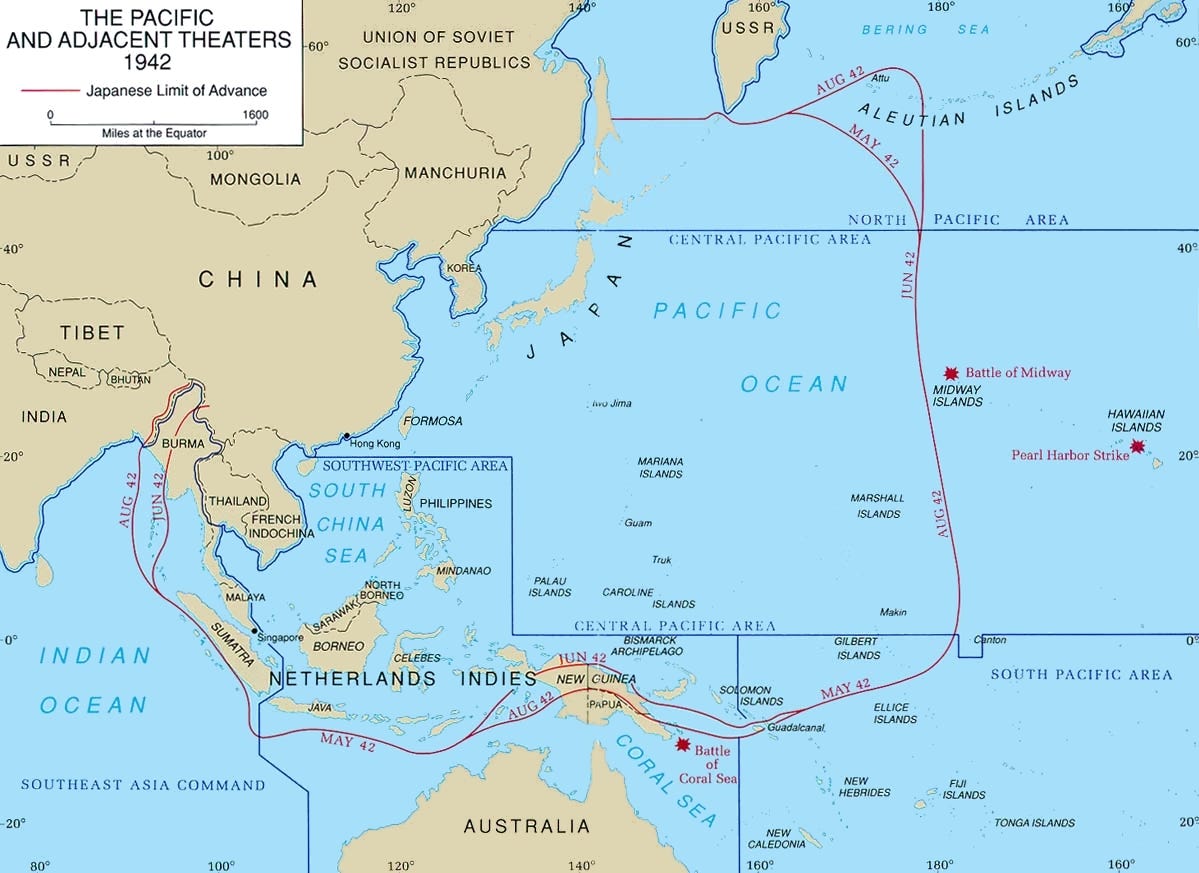
Moscow is doing a fine job of replicating many core Japanese mistakes. The orcs translated a moment of almost total military dominance across multiple core domains at the start of the conflict into the struggle between peers it is today. After this phase comes the inexorable shift to effective inferiority - not in terms of personnel numbers, but lots and lots of machines.
Moscow will eventually have to let robots do most of the fighting, but the lead taken by the Ukrainians over the past couple years won’t be easily lost. Not at the rate they’re developing new solutions to problems Moscow hasn’t even begun to think through. The Muscovite system can evolve, but not quickly, and not completely.
Unlike russia’s army today, the United States Navy of the 1940s was able to completely reboot its operational paradigm while following more or less the same strategy envisioned long before the war. Japan’s navy abandoned its original reasonable plan and instead wasted its strength matching the USA punch for punch in the South Pacific. By 1944 the disparity in effective combat power was too great for Japan to overcome. This was a function both of technology as well as substantial refinement of doctrine and tactics.
Which is just about where the Ukrainians stand today relative to russia. Months of ineffective assaults coupled to the Ukrainians savaging orc logistics from factory to front have left the Ukrainians with the initiative overall. Moscow’s choice to continue its long-since failed effort to encircle urban Donbas at any cost has left the orcs holding the battlefield initiative only in Dobropillya and Kostiantynivka, and on both of these crucial fronts just barely.
Elsewhere, there’s been precious little confirmed change in territorial control for another week, but Ukrainian strike operations continue to gain strength. Muscovite air defenses aren’t out of the fight, but they’re pretty reliably knocked back whenever Ukraine needs them to be. And that’s leading to leakage across pretty much every sector, orcs in the rear feeling the pain.
The setup continues to look exactly right for an intensive Ukrainian counteroffensive effort this September and October. Ongoing counterattacks on the eastern and western edges of the broad Zaporizhzhia sector could be a harbinger, distraction, or simple opportunism. Whatever the case, Moscow’s advance in the Huliaypole area has stalled as Ukrainian attacks on the flanks and to the rear have intensified.
And the deterioration of russian control over occupied Kherson is becoming blatant. A russian rotation into southern Kherson was recently ambushed by Ukrainian aircraft carrier drones. That’s well south of where a drone was recently landed to take out an orc position.
The odds of the Ukrainians working out how to set up remote positions controlled by Starlink are going up by the week. A fully remote-controlled infiltration of orc-held territory might even be possible. If anybody can work out how to use drones to recharge the batteries of other drones, many interesting things become possible without pushing large numbers of people across the Dnipro river or Black Sea in a big amphibious op.
Other carrier-launched drones hunted down a couple S-400 launchers in Crimea. Reports of the orcs secretly preparing to withdraw all command assets from the peninsula look pretty credible right about now.
Smart money likely wouldn’t be on the war ending before 2027. But the possibility is there, and grows into near-certainty if Europe applies real pressure on Putin right now.
Regardless, there appears to be almost no chance of Moscow taking urban Donbas in the next year and a half, which means it almost certainly isn’t happening ever. Throw away a million more bodies or not, it makes no difference: there is absolutely no evidence to suggest that the going will get any easier for Putin’s troops the closer they get to Sloviansk and Kramatorsk. On the contrary, both the intensity of the drone wall and the difficulty just getting bodies to the bleeding edge of the fight will get higher as time goes by.
The map of Ukraine may look like this for a long time to come. Though I’d still put my money on the orcs being forced from occupied Kherson and maybe even Crimea thanks to Ukrainian middle strikes alone.
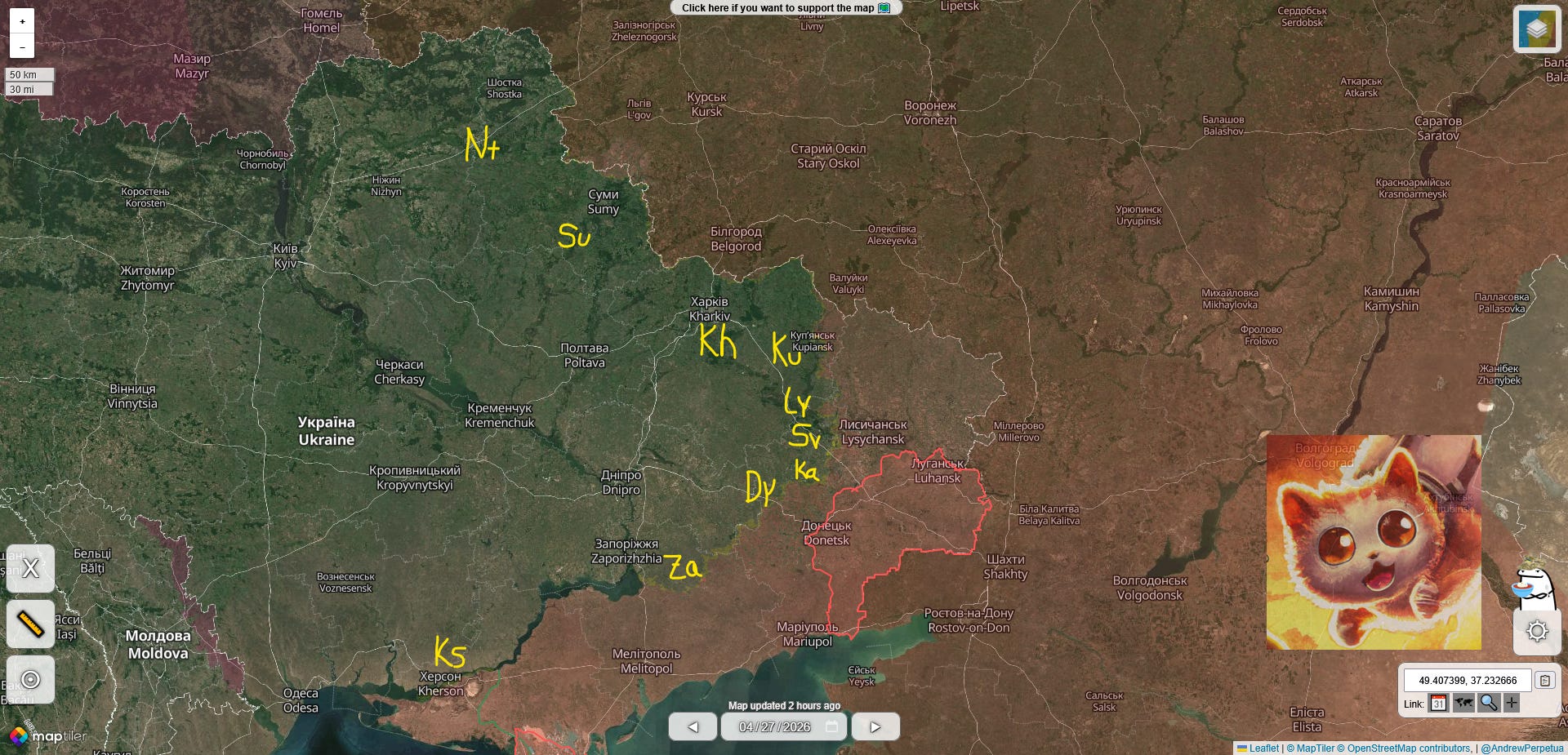
North
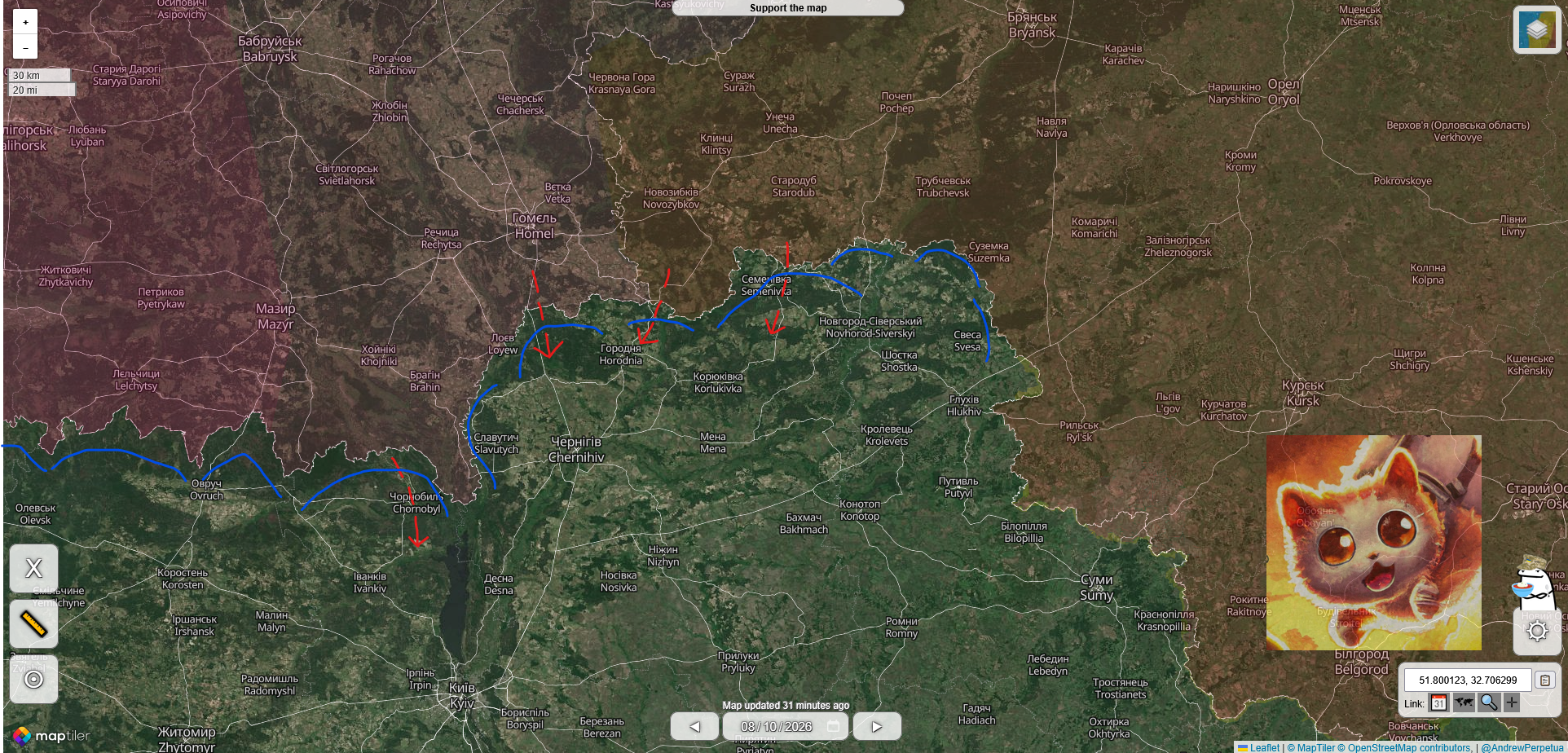
Still chatter about a new front up north, and the Ukrainians are getting ready even if from where I sit it seems unlikely to happen, because it would be very dumb. Might even be more action in Chornobyl, as if that didn’t end in terminal radiation sickness for a bunch of orcs four and a half years ago.
Any attack on Ukraine from the north at this stage of the war faces a nearly insurmountable challenge: any large patch of cover is apt to shelter drone teams who will make any attempt to move through a nightmare. On basically every front, to estimate how quickly the orcs might advance, just compare the distance at any point between their front and areas with lots of cover to a corresponding gap on the Ukrainian side. If it’s similar, advances will be slow if they happen at all.
Guess I’d better finally get around to buying S.T.A.L.K.E.R. 2 so I can familiarize myself with the terrain. And developer. Because my core professional ambition is fast becoming making digital simulations and games, and it’d be real neat to get funding enough to pay Ukrainian developers to build some.
Bottom line for a prospective northern front: it would be a mistake for the orcs to try, and that’s not propaganda. There is a good reason why this area was only actively contested early in the war. As for Moscow trying to march on Kyiv again, that’s just not a serious threat.
Sumy
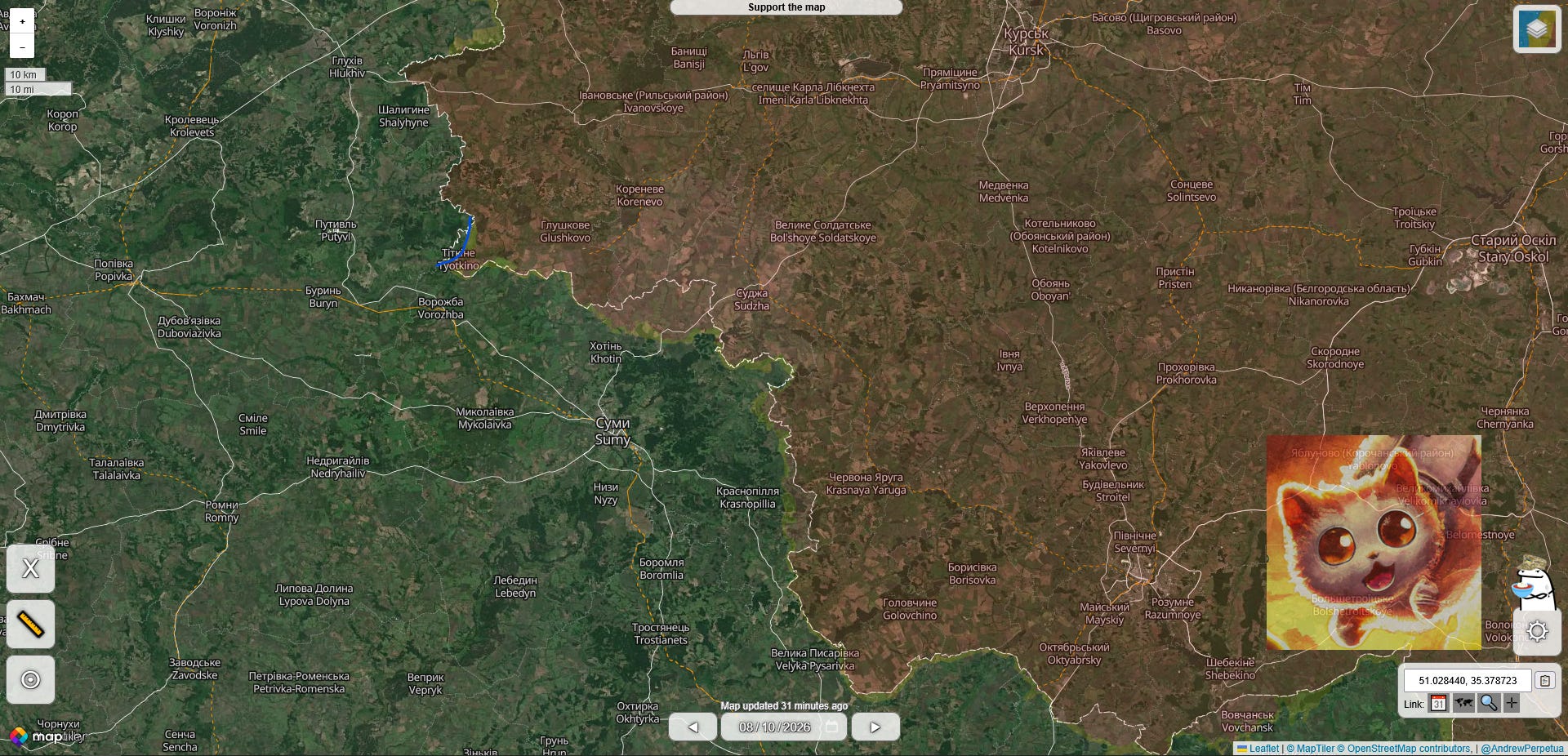
Moscow is still probing in Sumy, and still getting nowhere. Forecast is unlikely to change.
The rule of proximity to cover holds very firm here, with the orcs having to approach a bastion of forest abutting a city over mostly open country. This explains why the sector is now a lower priority for Moscow.
Ukrainian ground forces might not be operating in Kursk any more, save a sliver or two, but the skies over the border are very much still contested. Another reason that it would be pretty dumb for Moscow to attack Ukraine’s north is the relative density of Ukrainian settlements to russian pretty much everywhere from Kharkiv to Kyiv.
Kharkiv
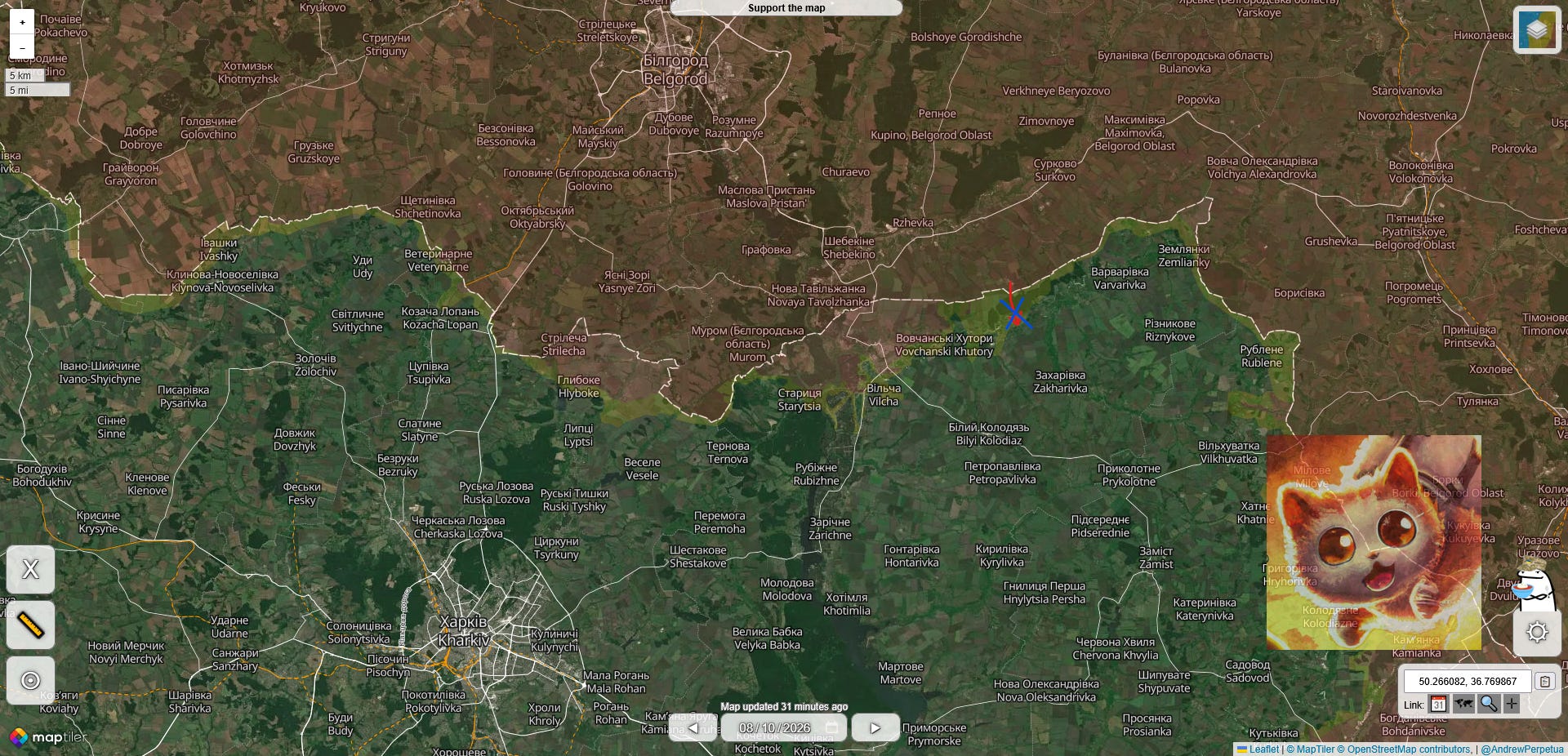
Muscovite operations in Kharkiv continue despite lack of success mainly because Belgorod is close enough to the border to help sustain orc activity. That’s why the place is now getting hit regularly, with the city probably bound to be the first to lose power and heat this winter.
Being able to march soldiers from Belgorod to the killzone northeast of Kharkiv allows Moscow to maintain a regular attack schedule, the tempo rarely changing much, only focal areas shifting with time. Kharkiv is a bigger city, though, so Ukrainian counter-moves always happen fast enough to avert a crisis.
Moscow can be expected to continue on the same path in Kharkiv so long as disposables can be mustered to send to die in some border town. The only real purpose in the blood sacrifice is to prevent a Ukrainian corps from relocating to Donbas.
Kupiansk
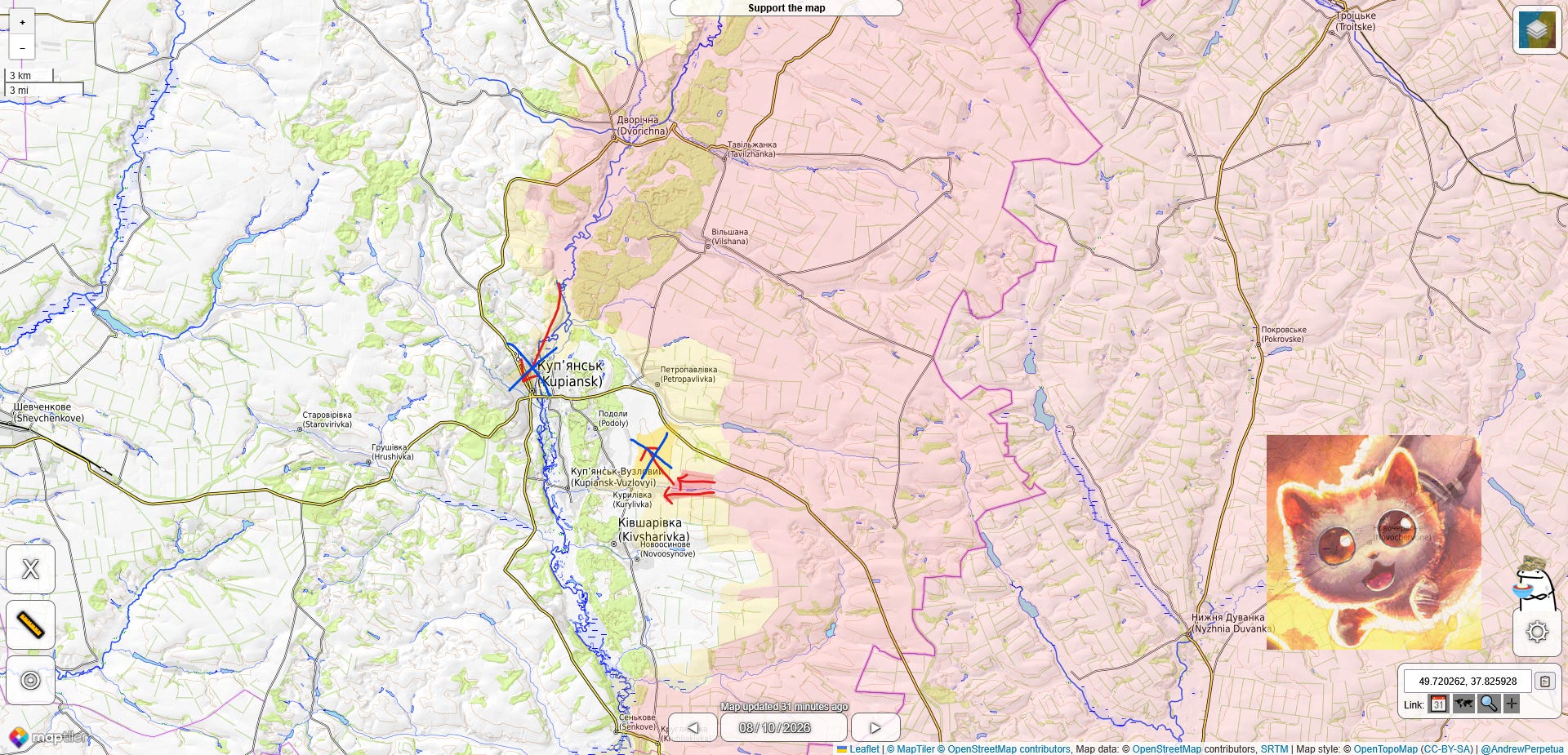
The orcs have finally managed to consolidate control over part of the route from Pischane towards Kupiansk’s industrial and transport center on the Oskil, south of the city proper at Kupiansk-Vuzlovyi. There are also more infiltrators being dealt with in Kupiansk proper.
With a large forest along the Oskil leading back to major base infrastructure near Valuyki in russia to work with, and Kharkiv being the closest major Ukrainian urban center, it’s no wonder that Moscow is able to keep up a steady pace of attacks on Kupiansk, and after many months of trying sometimes achieves a modicum of success. The Ukrainian bridgehead east of the Oskil can’t be easy to sustain, and with the entire thing now well within the Muscovite killzone I suspect that Drapatyi will stop having 10th Corps hold it.
Whatever benefit this small bridgehead offers to adjacent 3rd Corps’ northern flank is probably not worth the sacrifice needed to hold it. Based on the rule of available cover dictating the pace of potential advances, I have to see the Luhansk area as a less-than-ideal spot for a major Ukrainian counteroffensive effort.
I can’t forecast a Ukrainian withdrawal beyond the Oskil in Kupiansk yet. But unless Ukraine is able to eliminate the orc bridgehead on the western bank of the Oskil around Dvorichna, there’s really not much logic in maintaining a mirror bridgehead on the eastern side further south.
Lyman
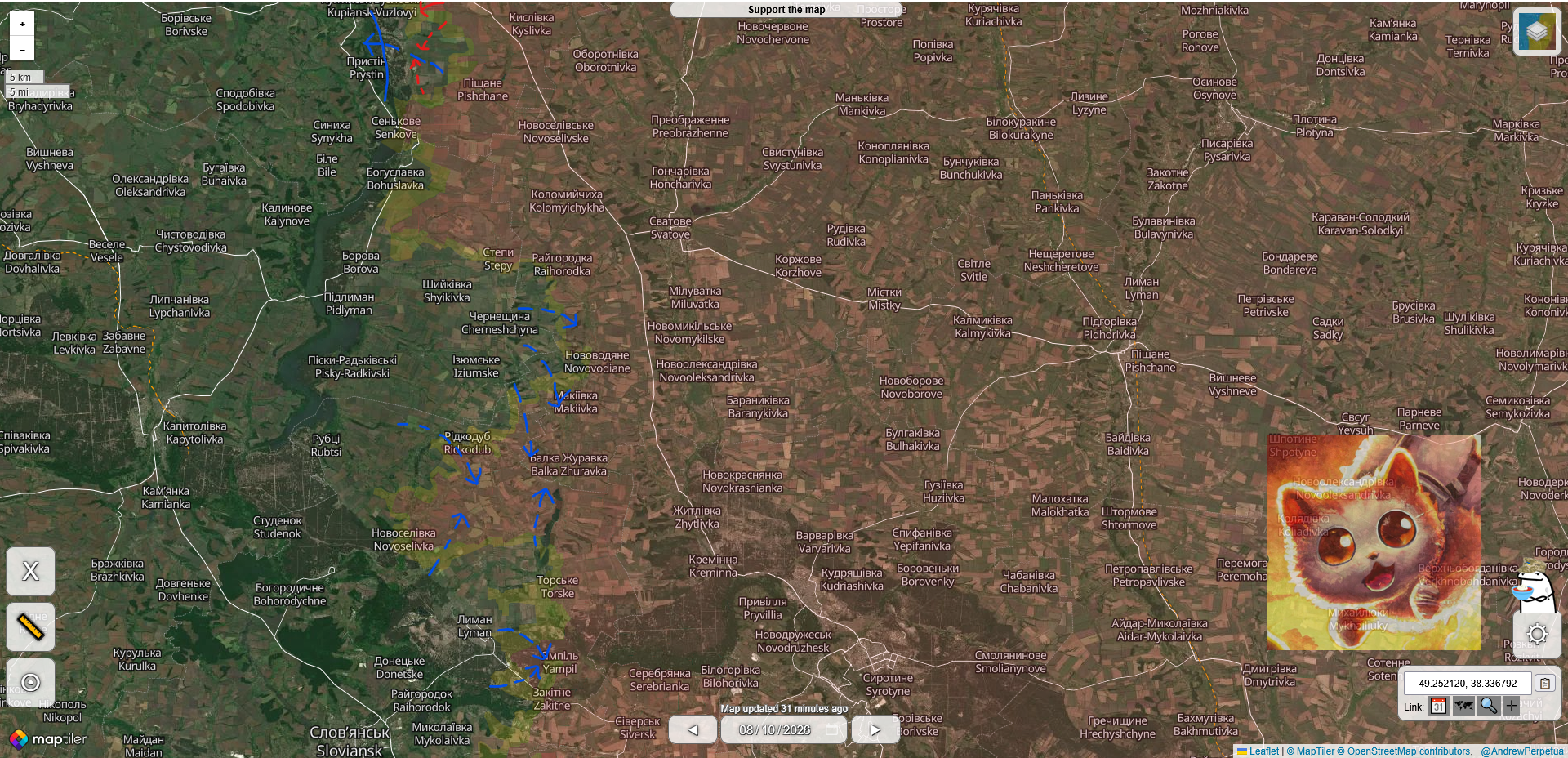
I could be wrong in my evaluation of the Luhansk area’s counteroffensive potential, but more and more I lean towards the view of the northern arc of Ukraine’s defense all the way down to the Siverskyi Donets being a strategic holding action. In the event that Ukrainian forces did advance and secure islands of cover in the forests along the waterway, they’d wind up with pockets of stranded orcs it would take months and too many casualties to root out.
I’ve explored the possibility of Ukraine prioritizing this axis mainly as a thought exercise, but also because it doesn’t hurt to give the orcs things to worry about. The steady expansion of Ukraine’s middle-strike game has, however, rendered obsolete the idea of using Luhansk as a launch pad for strikes on orc logistics routes supplying the occupation.
The shifting geography of this conflict is something few analysts that I’m aware of are addressing in any systematic way. It’s worth thinking about, though, as operational possibilities are constrained by tactical realities more than strategic. In fact, the longer this war continues, the less relevant anything anyone would typically call strategy becomes.
What Ukraine needs to do is not complex at all, but how to achieve the correct symphony of effects to shatter the foundations of Putin’s regime is a much tougher question. Operations are the heart and soul of warfare, and be deeply suspicious of anyone who ever claims otherwise. They are where emergent impacts overwhelm tactics and reset strategy. But their temporal and spatial scope has to be carefully calibrated to get anything done. Timing is everything.
As for the Lyman front more narrowly, there is once more no orc progress to report. Nor is there any Ukrainian, though rumors of secret progress persist. At any point, Moscow’s bridgeheads over the Zherebets between Yampil and Makiivka could vanish from official maps.
My personal strategy for the line of the Oskil would be to pull back in Kupiansk in exchange for leveling the front along the Zherebets. A secure Lyman means that any orc attack on Sloviansk directly is outflanked. Losing Kupiansk only adds pressure to the northern flank of 3rd Corps, which will be tolerable if the approaches to Lyman are safe.
What will Drapatyi choose, I wonder? I will say this much about his time in office so far: Ukraine appears to be giving up more positions that were probably lost anyway. While orc territorial gains might be a bit inflated for a month or two, better to evacuate people who have been stuck in holes for more than two or three months than pretend they’re truly combat-capable. Leave some cameras and explosives behind, then plaster any orcs moving in to dig new positions with drones and artillery.
Sloviansk
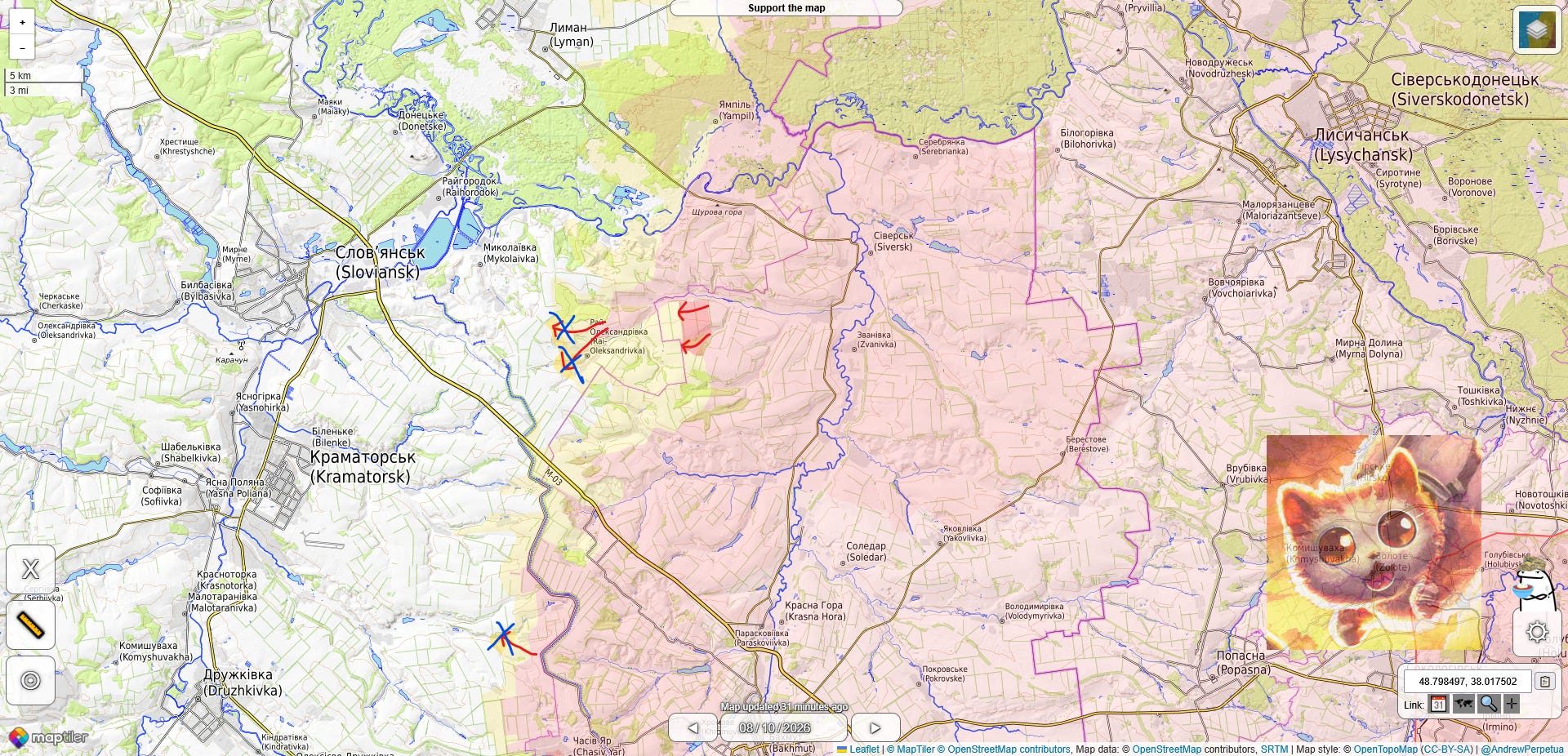
More creeping orc progress in Sloviansk along the same vector as last week, southeast of Mykolaivka, but that’s it for the Sloviansk front. Here, as well as on the Lyman front, the proximity of Sloviansk is making every orc advance tougher than the last. I see the enemy getting stuck by winter not far beyond where their infiltrator suicide squads have been spotted.
Right about the time the enemy’s long advance reached the halfway point between Sloviansk and ruined occupied Siverskodonets, it stalled out. The law of cover continues to hold.
Bastions of cover are a lot like aircraft carrier battle groups. They’re stuck on a fixed position, unlike ships, but also unlike ships (until drones take over more roles) can disperse across the target area to survive. In the net, this means that the side able to concentrate and deploy more firepower in a given node can exert an almost gravitational influence on the enemy, only instead of drawing them in, they’re repelled.
Kostiantynivka
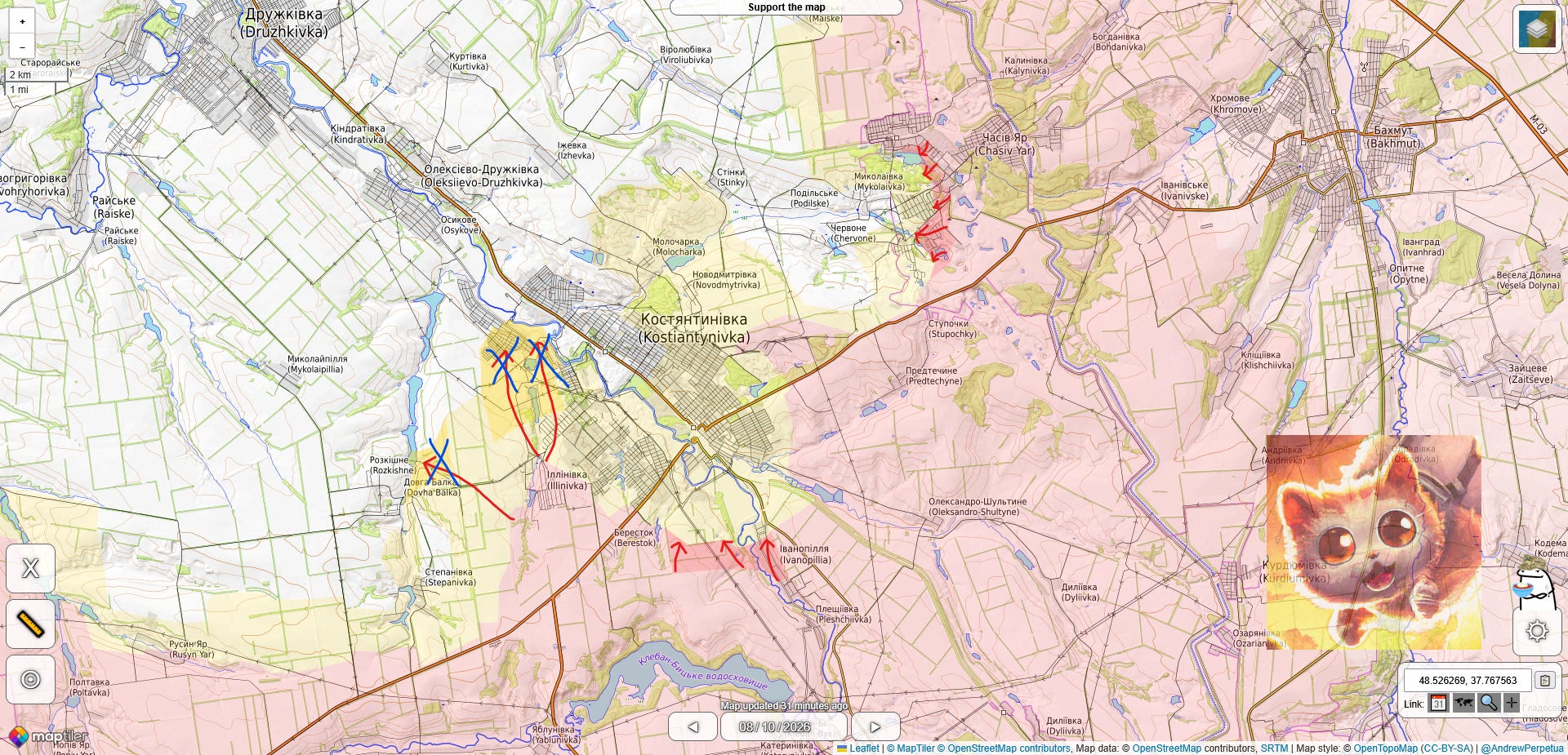
The orcs are pulling out all the stops in their bid to actually secure some of Kostiantynivka, but beyond a shallow if broad advance on the western outskirts of Chasiv Yar and securing some more patches of grey zone to the south, Moscow is still very stuck.
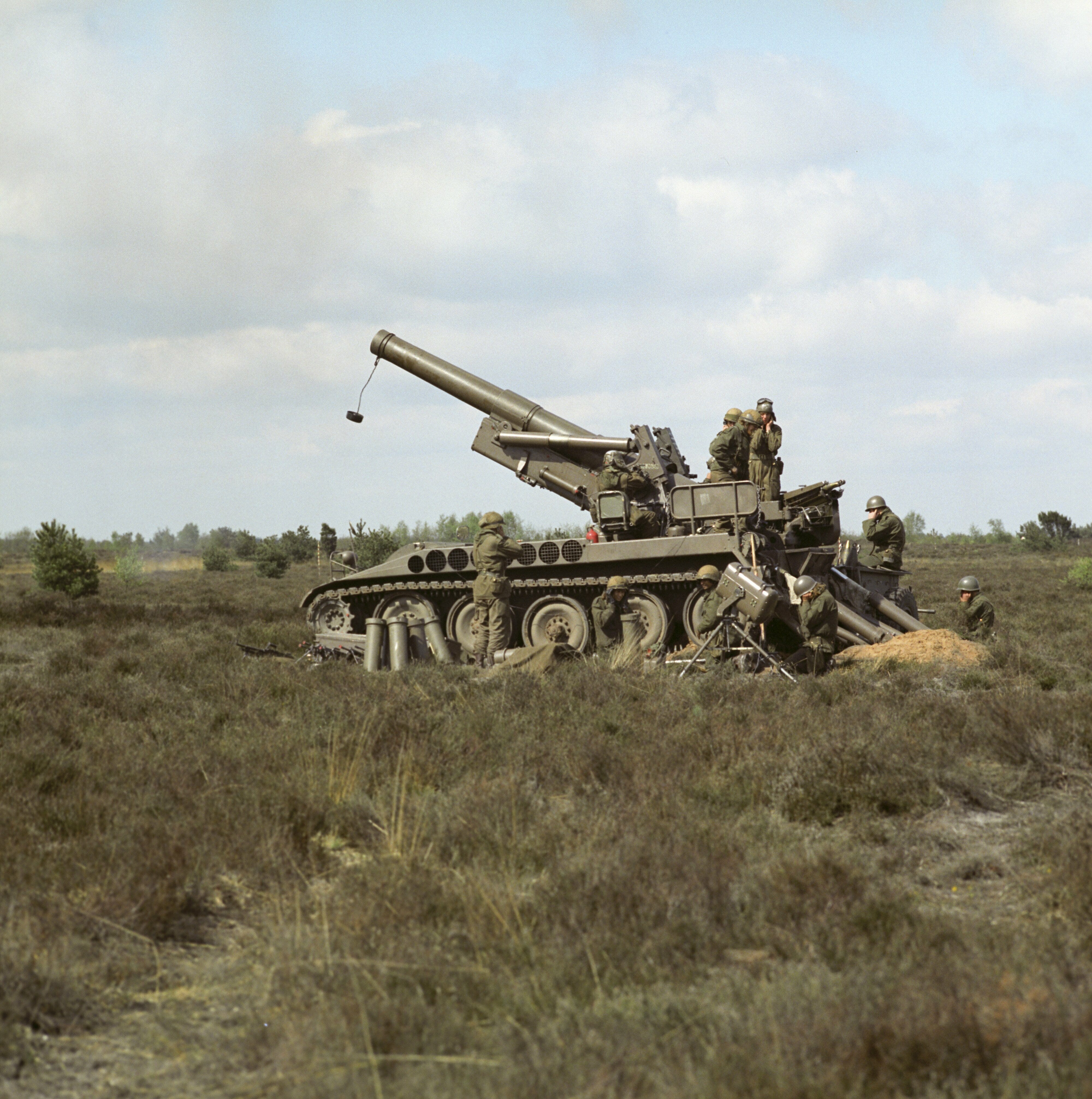
Not a lot of details coming out of 19th Corps, which is pretty standard for them. But hard fighting is definitely ongoing, and the Ukrainians are allocating a lot of heavy fire support, including airstrikes. I suspect that any orcs that do manage to take up residence for a prolonged period of time will learn what those big 203mm shells Ukraine has been getting for old M110 howitzers sourced from Greece can do. Their range is dangerously short for the drone age, but if embedded in heavy fortifications after being snuck into, say, Kramatorsk, they’ve got just enough range to hit Kostiantynivka.
Thing about the fight for Kostiantynivka is that it sits at roughly the midpoint between Sloviansk and occupied Horlivka, a suburb of larger Donetsk. The Donetsk-Horlivka line is occupied Ukraine’s mirror to Ukraine’s Donbas fortress belt.
In the crudest macro sense, you’d actually expect a frontal assault on free Donbas to stall out roughly where it currently is now as a function of the relative density of combat power each side can sustain in the area. That’s why it was so important for the orcs to hold positions across the Siverskyi Donets between Kharkiv and Sloviansk, and why their loss in 2022 was such a strategically vital success for Ukraine. Lack of this northern flank has forced Moscow to focus on the south while trying a frontal assault. The net strategic result is the exact disaster that has unfolded.
This isn’t to take credit from what Ukrainians have achieved through their individual and collective efforts. This was never a strictly even fight, so to draw even at all in a fight like this represents an astounding success.
And for Moscow, a humiliation for the ages. The kind of defeat a power simply cannot live down.
Dobropillya
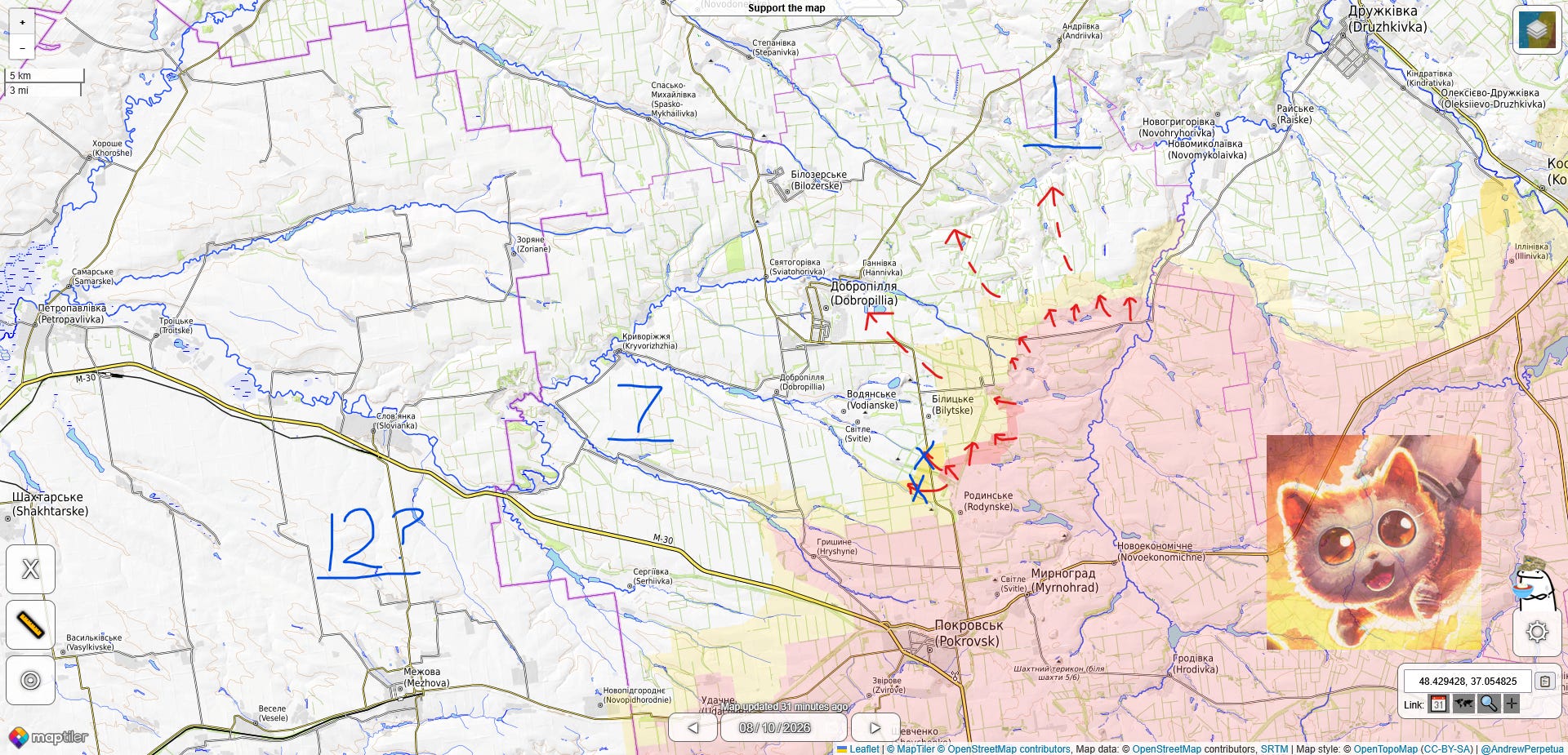
Moscow is presently striving to more or less repeat what a thousand or so infiltrators briefly did last year, pushing between Dobropillya and Druzhkivka. The orcs are determined enough that they’ve been trying out massed attacks, sometimes with dozens of light vehicles.
In theory, with Ukrainian positions now few and far between, more a skirmish line in the traditional military sense, pushing a couple hundred orcs rapidly into the killzone could overwhelm the defense. What actually happens is they all get trapped in a kind of living minefield and wiped out.
Even before they move, their attempts to gather and organize are spotted and draw attacks. In this brave new military world, what is seen gets shot - fast. You survive by keeping movements between points of cover brief and difficult to predict. Very, very different management problem than most professional officers anywhere were trained to handle.
And so the orcs keep throwing blood and sometimes steel at a drone wall. You have to look at their progress over the course of weeks or months to get a sense for what they’ve been trying to accomplish. It’s rarely very clever.
It sure looks as if Moscow will spend the rest of the year bashing at 1st and 7th Corps, trying in vain to open a flank on Sloviansk. But while they’re doing that and grinding into Kostiantynivka, the flank to the south may well crumble.
Zaporizhzhia
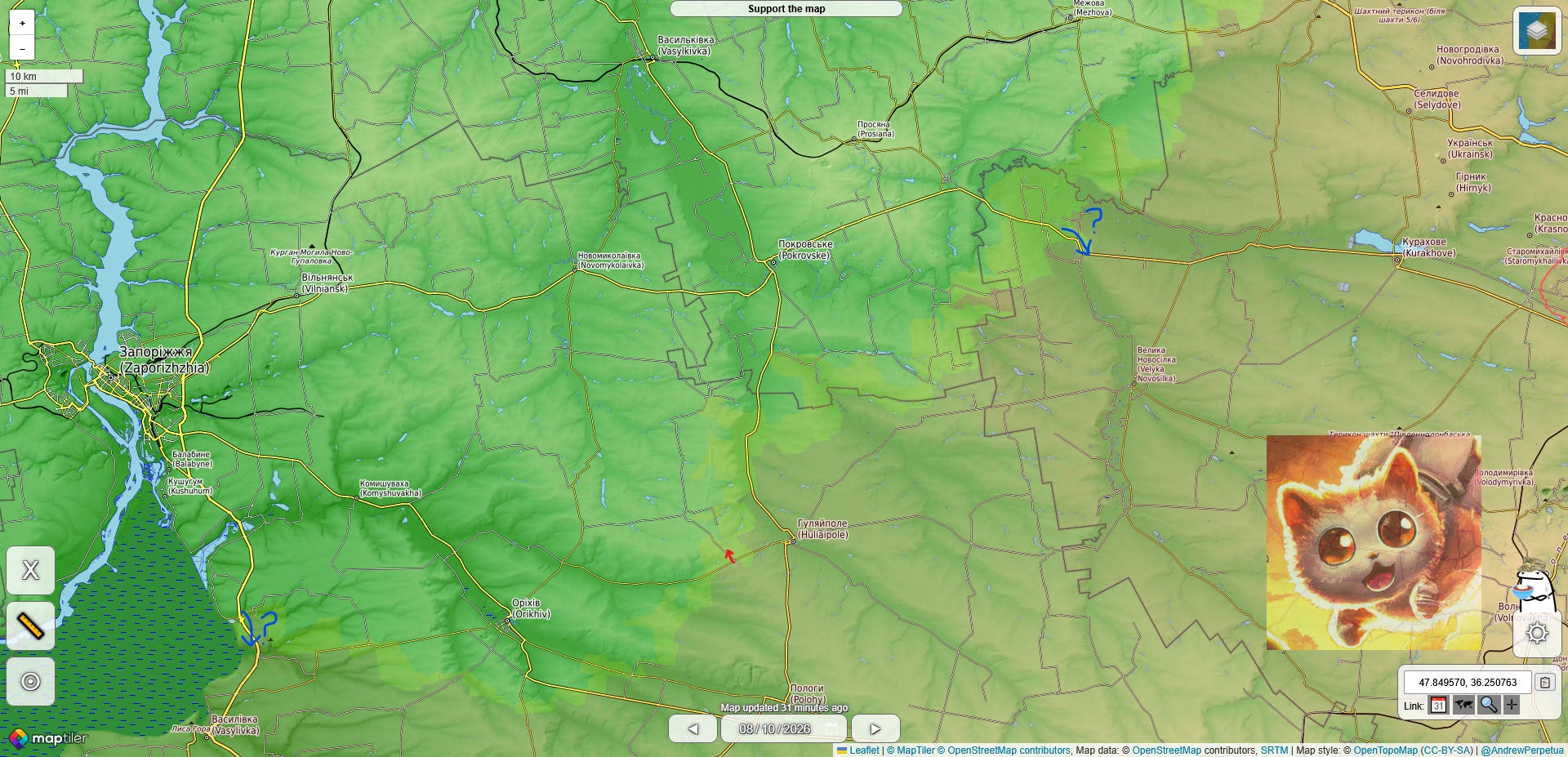
It’s not strictly accurate to refer to the space between the Dobropillya front and the Dnipro river the Zaporizhzhia front, I know. Yet the action along this stretch is so intrinsically bound up with where the orc troops here are supplied from that it functions like a single vast front.
Moscow’s main effort over the past year has been directed at the Huliaypole front, after the push from Velyka Novosilka towards the Vovcha stalled out right when it began to approach a series of forests and towns offering the Ukrainian defenders more cover. The territory around Velyka Novosilka is otherwise very open, which made it tough for Ukraine to defend against Moscow’s meat waves.
But once they pushed too far from their logistics centers in urban Donbas, the meat assaults got weaker and more dispersed. This allowed a series of steady, patient Ukrainian counterattacks to regain ground north of Velyka Novosilka, at the confluence of the Mokri Yali and Vovcha.
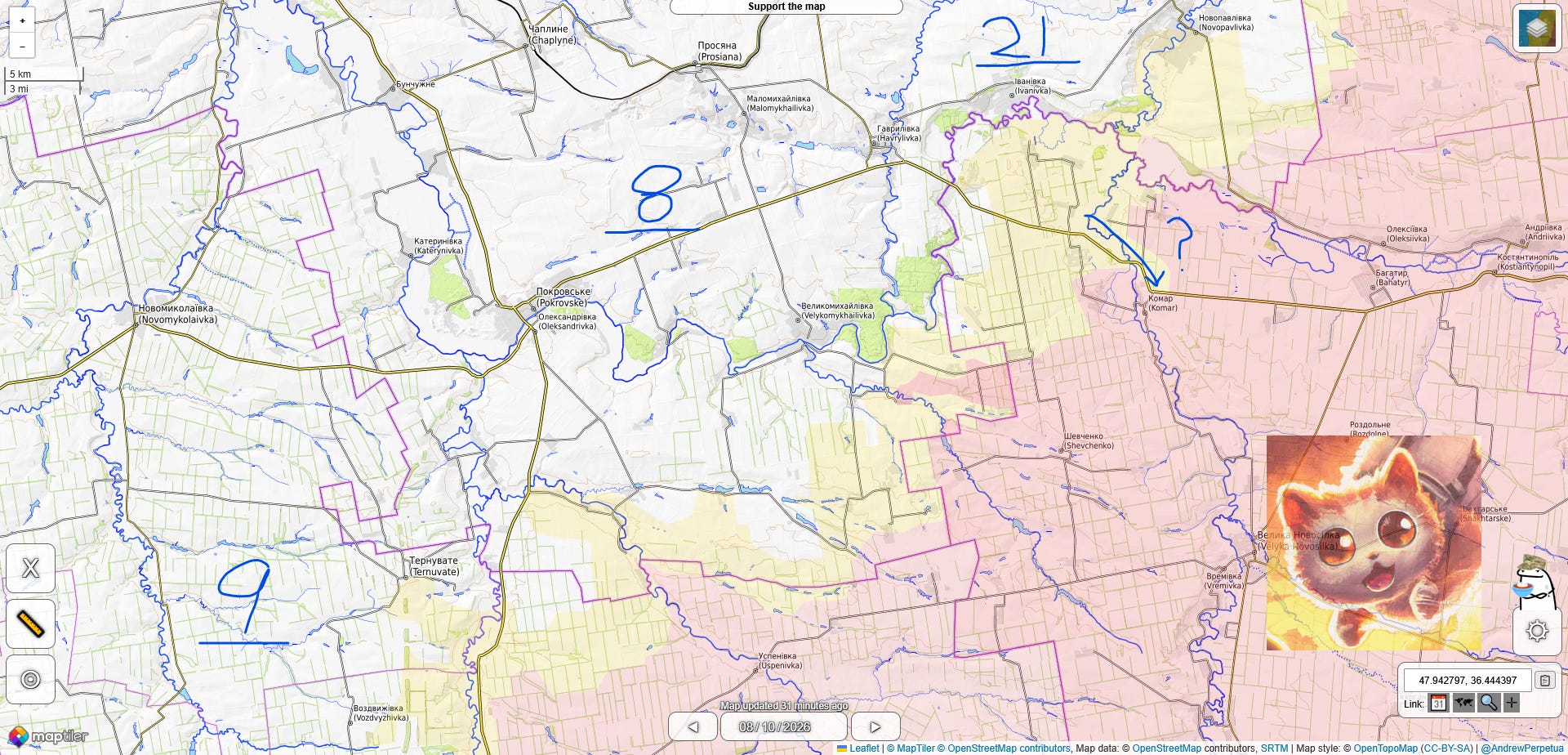
In conjunction with a series of counterattacks launched by 8th Air Assault Corps north of the Huliaypole area, Moscow’s plan to advance through Huliaypole to Orikhiv was outflanked. It’s ground to a near-halt despite the town falling, Ukrainian drone teams able to make the occupation of the place so costly that advancing further just sends more orcs to their death.
Without supporting progress to the east, Moscow’s hopes of finally breaking through Mala Tokmacha to get at Orikhiv were dashed. Without the Ukrainians being tied down protecting Orikhiv, the creep up the Dnipro towards Zaporizhzhia lacked support and failed. There are rumors of a Ukrainian breakthrough near Kamianske that while presently not supported by evidence are no longer totally implausible.
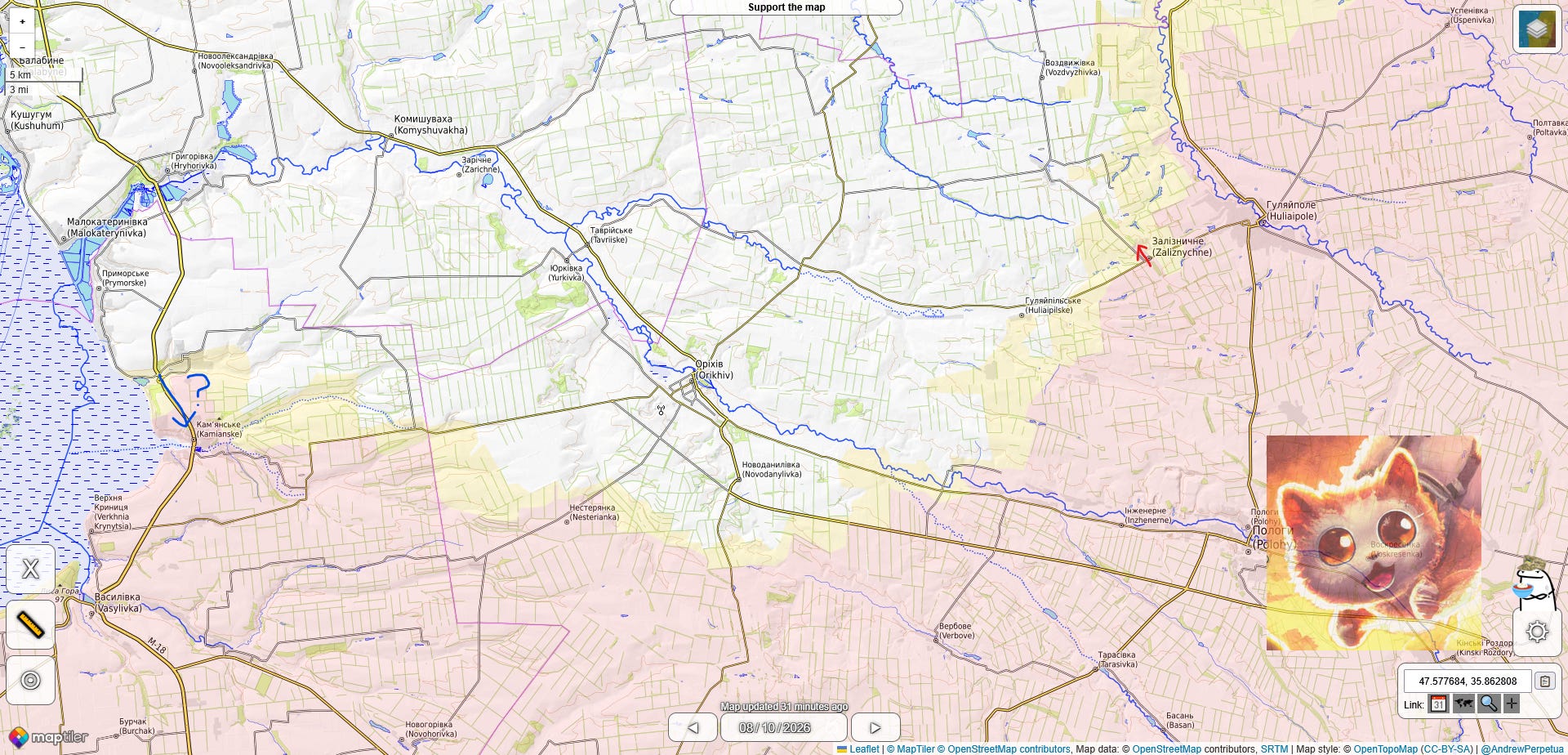
The same factors that make Moscow’s advance over the open steppe so difficult impede Ukrainian counteroffensives, but Ukraine’s growing ability to briefly control the skies over the front thanks to a combination of drones and air defenses creates windows of opportunity. It stands to reason that the Ukrainians will be better able to take advantage of them than the orcs are their own windows of advantage.
I don’t see the orc lines in Zaporizhzhia breaking anywhere except perhaps the Velyka Novosilka area, and at this stage of the war that would have only limited benefits for Ukraine. But it is entirely possible, even probable, that the ongoing strangulation of orc logistics along the Azov Coast will put their grouping in this region on the back foot permanently.
They have a lot of established fortifications to fall back on, and even though seizing parts of these to use as cover might be viable for Ukraine, it’s a risky thing to count on. In many ways, crossing the Dnipro or Black Sea is now easier.
Kherson
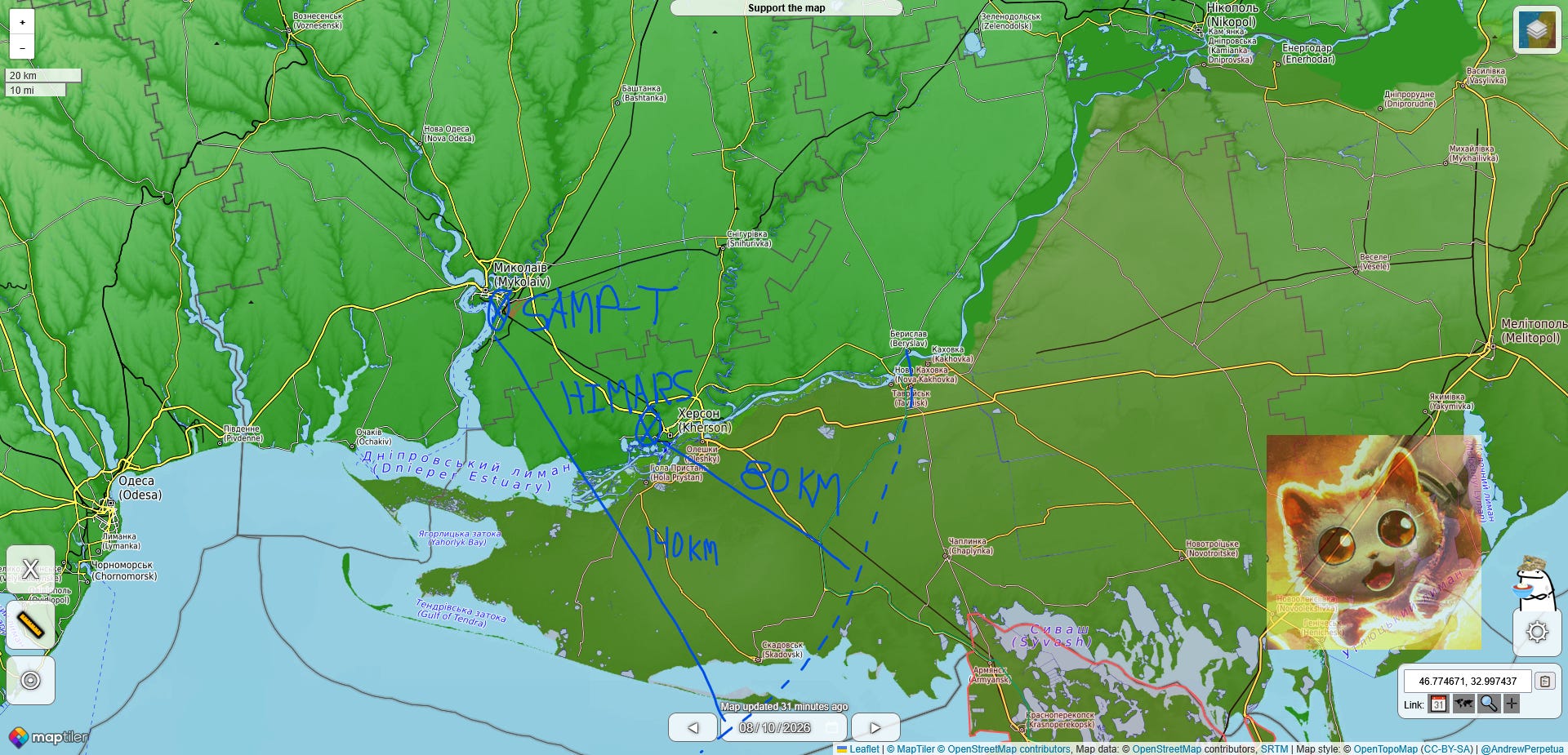
No changes to report in Kherson, nor any I can reasonably forecast until something actually happens. Ukrainian forces, however, continue to shape the landscape as if they’re planning to attack.
The new 34th Marine Brigade recently published footage of an airstrike hitting 15km across the Dnipro. It looks very much as if orc positions west of the defunct Crimea canal are effectively under siege.
It is this part of occupied Ukraine that the orcs should be in the most trouble going forward. It’s also the shortest path to Crimea. This year or next, Ukraine is taking the area back. The occupation may be rolled back from west to east.
Why? In short, because of lack of orc cover, much of it located near Kherson city, and the fact that Ukrainian air defense systems in Mykolaiv and rocket launchers in Kherson can reach all the way to the Crimea canal along most of its length. Ukrainian naval drones can hit anything along the coat with FPVs. These are the essential prerequisites for seizing effective operational control over the entire area.
It is as much an island as Crimea. And sits right off the present Ukrainian mainland, so to speak.
Strike Campaigns
Ukraine’s 40-day Deep Strike campaign has essentially been extended indefinitely, with promises of increased tempo and reach. Nowhere in russia west of Siberia is safe, and the orcs are even covering their nuclear submarines in the North Sea and Pacific Fleets with anti-drone netting.
Good to be prepared, of course, but this is still another cost that the orcs have to eat despite the low probability of Ukraine following through on my scheme for raiding Vladivostok with converted civilian cargo carriers unleashing drones. If the Ukrainians did launch a surprise attack like that, they’d certainly equip their drones with warheads capable of breaching nets.
Many of the refineries the Ukrainians have blasted were covered in them, and some shots of last-minute air defense intercepts (or premature detonations) show a distinct jet of fire along with the initial kaboom. My sense is that Ukrainian strike drones carry shaped charge warheads, possibly with a thermobaric effect.
That is to say, they spread vaporized fuel into the air just before exploding to create extra shockwave. Fun stuff we humans come up with, huh?
The sum total impact of Ukrainian attacks on orc refining and Wildberries logistics centers look to be keeping up to half of the former and most of the latter offline, with there being little the orcs can do about it. Unfortunately for Ukraine, there are Wildberries competitors, and they apparently prefer smaller warehouses. Unfortunately for Moscow, the more targets there are to defend, the leakier the overall air defense system gets. And it keeps coming under attack itself.
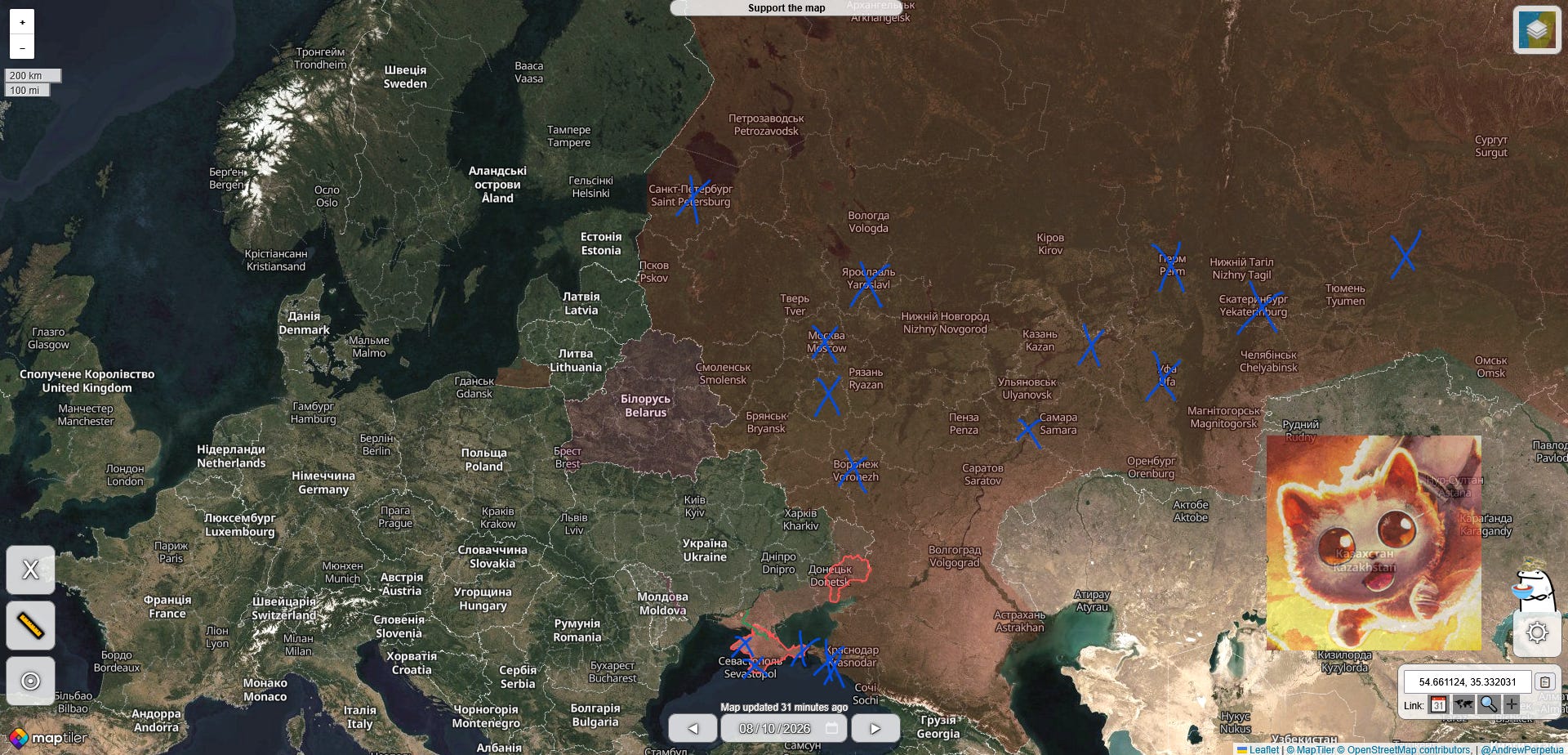
For Ukraine, the lodestone of the entire strategic strike campaign is getting at Moscow’s missile production system. Whether through subcomponent denial or finding ways to get at a complex built to physically survive a nuclear attack, there’s no better solution to the ballistic missile problem than preventing the production of missiles in the first place.
Trying to kill launchers is a fool’s game: if you’ve got the resources to spare, great: the Scud Hunts during the Gulf War hardly detracted from the obliteration of Iraq’s ground forces, even if they weren’t very successful. Nobody is saying that Israel and the USA were dumb to try and suppress Iranian launches during the Iran War, only that the success rate was bound to be lower than boosters said would prove the case (looking at you, Fabian Hoffman).
But launchers look a lot like semi trucks from the air or space, and like Iran, russia has lots of places to hide launchers. Hunting them will never protect Ukraine the same way going after production supply chains and boosting interceptor inventories can. Good news on that second front is that this should be the last winter when Ukrainians will have to endure mass attacks on infrastructure without most inbound shots being knocked down: the Freyja project is humming along, first widespread use expected in under a year.
That should obviate the need for Ukraine to produce Patriots, which may never actually happen given US politics. It’s been said that US makers are reluctant to give Ukraine a chance to make Patriots at a lower cost, but this misses the real issue. They’d just agree to buy from Ukraine, slap on Raytheon or Lockheed brand stickers, and charge Uncle Sam full price, pocketing a hefty profit, just like they already do.
Funny how everybody seems so determined to pretend not to know how big military contractors work pretty much everywhere. If they can make the military give them sole-source contracts under the logic that involving foreign suppliers might expose US intellectual property, they can set profits as they please thanks to the government-sanctioned monopoly. Once that door is closed and they have to compete on the open market, they’ll just lower costs by outsourcing production and still over-charge the military even as top line costs come down.
They win either way. So just do whatever is necessary to help supply meet demand.
Moscow’s own missile monopoly is unfortunately chugging along at full speed, churning out sixty Iskanders plus forty S-400 missiles in ground attack mode every month. The latter look to be used as semi-decoys, launched with Iskanders to make picking out the heavier weapons tougher for Ukrainian air defenders. Only they aren’t true decoys, as they pack a hefty fragmentation warhead lethal to civilians.
If the orcs were able to knock out Ukrainian production lines entirely, they would, but Ukraine has decentralized so much that there’s no chance of a knockout blow, only delays. And it’s looking like Ukrainian missile production rates will be in the double digits by the end of this year, so Ukrainian Iskander clones will begin hitting russian targets in a matter of months. Even if this domain is Moscow’s best, it’s still losing ground.
Plus the Turks have agreed to send Ukraine 70 more ATACMS shots. Apparently that new security pact between them, the Saudis, and Pakistanis is freeing up resources. Hooray for that. Can’t help but enjoy seeing both Iran and Israel discomfited by a new Sunni Islamic alliance. Be neat if Egypt and Syria joined too. Gulf States, except probably the UAE, are likely going to jump on the opportunity.
The USA can leave the Middle East forever now. Everyone will be better off for it. Even Ukraine - if everyone accepts that the era of Middle East wars must come to an end lest vital global infrastructure be badly impacted until alternative logistics routes to Hormuz are built up, then surviving Patriot stocks can go to Ukraine. Maybe before winter. Wouldn’t hurt the global food supply to have grain shipments through the Black Sea restored.
Moscow’s own deep strike campaign is mostly about hurting civilians for the sake of it, and also proving to russia’s elites that Moscow has a chance of winning the war yet. Extinguish this hope by shielding Ukraine, and the end of Putin’s long war on Ukraine can rebound onto the Middle East, further boosting security across the region as Iran’s patron is forced to turn inward. There’s only wins to be had here.
Like, how stupid does a world leader have to be right now to not see the global benefits in backing Ukraine? The USA and russia are both in full-on collapse. Ending their proxy wars in the Middle East can bring a period of peace and reconstruction to that tormented region, just as beating russia back from Ukraine will kick Europe into the same mode.
This stands to totally reorganize the world system for the better. All it takes to make it real is embracing Ukraine’s right to defend its people.
Prudence and pragmatism also favor supporting Ukraine, because the Ukrainians are on track to win. With far more pain and misery than need be, but victory is coming all the same. The ongoing Middle Strike campaign is even more directly responsible than all the damage being done to russia at the strategic level.
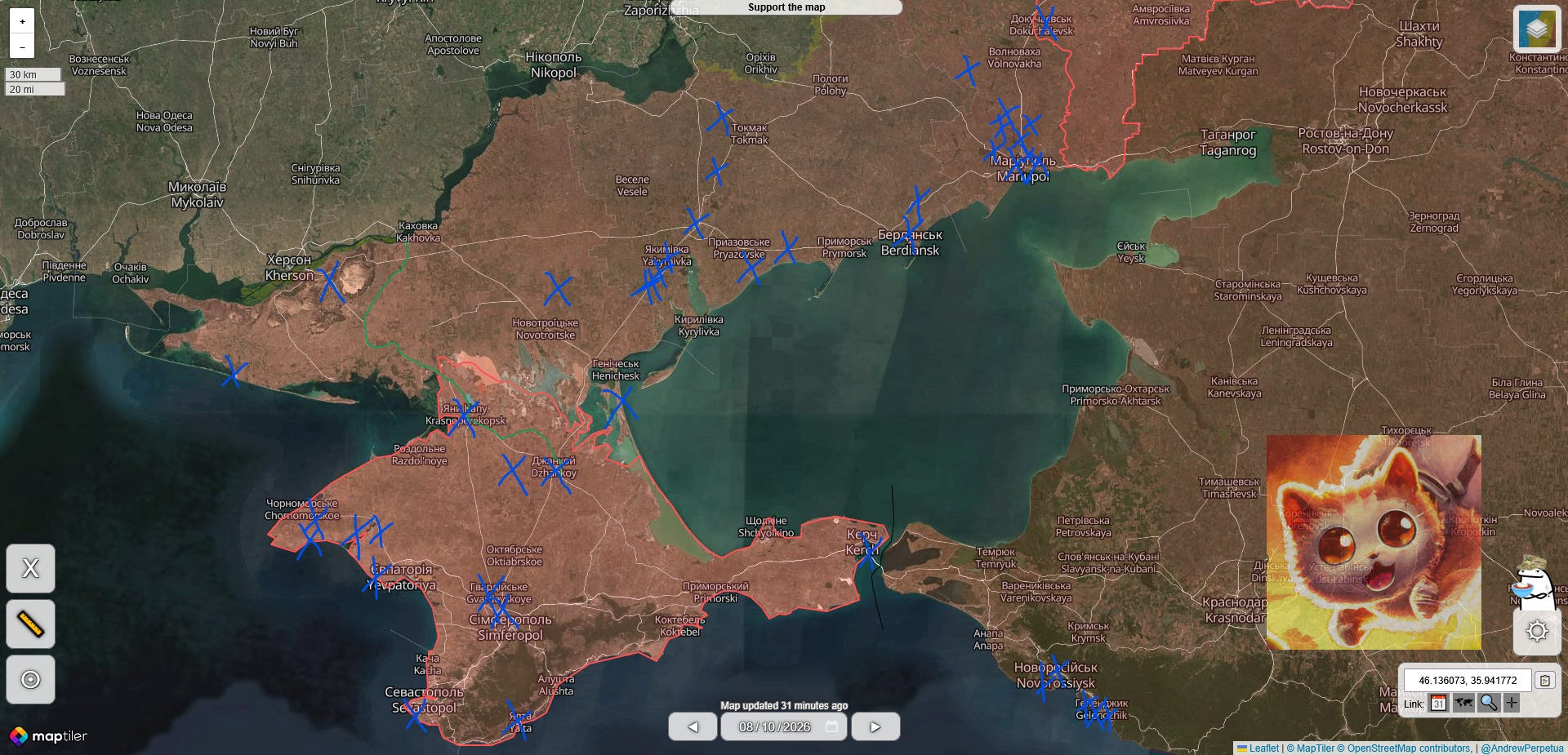
Crimea’s isolation is deepening, occupied Kherson is in trouble, and orc activity across Zaporizhzhia and even southern Donetsk, which are supplied from Mariupol, is showing signs of supply chain issues. The orc war machine is being cut apart to its full depth, and the consequences will compound as time goes by.
It’s only early August. In September there tends to be a bit more weather to work with. And my expectation is that offensives will be timed and located to ensure maximal control while leaving some space for covert movement. Because drone superiority is never liable to be complete or lasting, but very temporary. Time it with effectively planned and supported ground movements, and what looks like a stalemated front may shift fast.
Air, Sea & Signals
Air
A Ukrainian MiG-29 went down after a missile malfunction, but the pilot is alright. Combat-related losses like this are going to happen. The orcs lose jets to stuff like this all the time, including friendly fire. Not seeing anything in the rate of Ukrainian losses to suggest a systemic problem.
Haven’t brought up Gripens in a while (really ought to give Saab more free advertising space), so figured it’s worth mentioning that we’re roughly four to six months out from Ukraine having an answer to glide bomb strikes. These usually miss Ukrainian positions, but dozens of times every month they don’t, and a significant fraction of Ukrainian losses are down to these. Civilian deaths, too, with the orcs happily throwing a dozen one-ton bombs at a residential area on a whim.
So the moment Meteor missiles whack a few Su-34s, driving them further from their targets, Ukrainians will breathe a sigh of relief. Drone attacks on airfields are also on the rise as orc air defenses are strained.
Air bases pretty much have to have multiple radars to function, so aren’t easy targets to get at undetected. They are typically guarded by effective air defenses, too, leading to few drones or missiles getting through. But as with the case of Moscow, where sometimes only one drone out of hundreds pierces all three defense rings specifically guarding the capitol, even that one pays for all the others. Hundreds of SAMs were expended, and to fill gaps in their coverage the orcs have to pay for hundreds of teams driving around in gun trucks.
Not all russian air defense operators are well trained. In at least one incident recorded this week, shells from a gun-based system fell onto a bunch of parked cars, very nearly killing several civilians.
Muscovite air defenses are now responsible for a fair number of civilian deaths across several incidents, including one where the idiots took down a Ukrainian drone right over a crowded beach, leading to six deaths. It isn’t at all out of the question that orc gunners have ordered to disregard civilians, Moscow fully intending to capitalize on any deaths.
Oddly enough, russian commenters have apparently mostly been scorning their own side, not the Ukrainians. But they’ve got to be pretty enraged seeing footage of Ukrainian drones lazily winging their way over russian cities.
Ideally, most of Moscow’s air power will be redirected to hunting drones. A-50 AWACS have been spotted on multiple occasions working well inside the russian interior. So few remain in service that this probably leaves russian jets working near Ukraine without support most of the time. When Gripens arrive, this will cost them dearly.
Sea
The breakdown in the truce that kept shipping in the Black Sea safe has created another global logistics headache, especially for countries that buy grain from Ukraine or russia. It was probably inevitable that Moscow would retaliate against the grain corridor after Ukraine began its drone blockade of the Kerch Strait.
Here the salient point is that NATO should be covering the western half of the Black Sea at this point to keep Romania and Bulgaria safe. The Turks have the southern side well covered, I expect, but if NATO countries are willing to contemplate escorting ships through Hormuz after a ceasefire, then establishing a secure maritime corridor a hundred kilometers from literal NATO shores ought to be worthy of consideration.
The other naval news out of the Ukraine War is that the Ukrainians sent some drones off Crimea in broad daylight. At least one got shot up, but others either survived or went after their targets, it seems. The regularity of Ukrainian drones approaching Crimea has to alarm Moscow.
Signals
The orcs are busy trying to establish a Starlink-type comms constellation of their own, and making fairly rapid progress, unfortunately. But aside from daily windows that Ukraine can predict, coverage will be very incomplete until 2028. Muscovite efforts to jam Starlink are ongoing, but the facilities they’re building for it are highly vulnerable, some already winding up destroyed.
In the short run, it looks like mesh networks running a fairly simple AI to coordinate groups of drones is the hazard that Ukraine should really be racing to prepare for. Only hard-kill solutions will do, so developing remotely controlled turrets optimized to shoot down drones has got to be a priority, plus more automation for interceptors. Shaheds are starting to carry jammers.
An increasing proportion of orc drones being jet-propelled is another problem, as reaction times go way down and fewer interceptors can catch them. Hunting jet-powered drones is inevitably going to be a job for crewed combat jets for some time to come, because they can generally catch up to them and jet engines are more susceptible to infrared tracking used by cheap and plentiful short-range air-to-air missiles. Short-range ground-based SAM systems are another option, with interceptor stocks plentiful still, as are higher-end drone interceptors.
Overall, air defense work is trending towards ever-increasing complexity, with accurate forecasting of enemy moves a vital part of the process. As it has been in naval warfare for at least eighty years now.
Media coverage doesn’t do justice to the amount of planning that goes into positioning an aircraft carrier battle group and its escorts. Same is now true of air defense, which makes the effective participation of so many private individuals in Ukraine so incredible.
Staff Affairs
Federov still hasn’t returned, but this may not mean much. If his initiatives are moving forward under Khmara, an interregnum is no big deal.
High-level changes are ongoing in the military. Drapatyi is actively cleaning house and investigating many of the things that need looking into, like the assault forces. They’ve stopped being given new recruits, which given how many were apparently not really physically or mentally suited for service is probably for the best.
Too many details about many of the assault regiments suggest dysfunctional commanders unable to cope with modern warfare to ignore. A culture seems to have grown up that isn’t ideal. Unlike the Air Assault Forces, which have maintained the spirit of aggression needed for their role without sacrificing their humanity, at least a couple of the assault regiments went full-on Neo-Soviet, treating people as disposable. These formations need to be assigned one to each corps and fully integrated there.
It’s not like they’ve performed any better than Air Assault Forces or marine brigades in the field. Though very possibly many of their personnel couldn’t meet the requisite standard, so can’t be simply allocated to a different brigade. Different raw material would itself do much to explain higher casualty rates.
Top performing people cluster for a reason. This isn’t always a good thing, because elite cultures are a problem too. Still, it’s usually better to err on the side of keeping high performers doing what they do and remediating those that fail.
Something everybody who publishes Ukraine-focused content should be keeping at the forefront right now is the radical difference between how basic military actions looked a few years ago and today. It isn’t easy to update core assumptions about how things are supposed to work, but it’s necessary when a war this savage has been underway for so long.
The world is going to really regret letting it continue, because the evolution of warfare over the past few years has been rapid and increasingly total. Mental models deeply ingrained into professionals around the world are obsolete. Following them will get good people killed.
As is apparently fated to be the case when two countries with deep reserves of potential engage in a fight to the death, all manner of innovations have emerged. And the longer the fight continues, the more its trajectory and possible outcomes are governed by pure economics.
This is what makes it impossible for Putin to stop his war on Ukraine or prevent him from expanding it as far into Europe as he thinks he can get away with. He’s committed to an all-in position: he will never accept he was wrong and will only fade away if forced to. The Muscovites can entertain his grandfatherly delusions until they’re both globally despised and too poor to bother with, if they really want to surrender to fate.
But it’s a fair bet that they won’t. Making them choose to move on him is a function of demonstrating that the road has only one end. Either get off the wagon or plummet into the abyss.
Concluding Remarks
And that’s it for Earth Forces Bulletin 26-8! I had intended to publish it later in August, but recent events made the timing right. Apologies for not breaking out geopolitical developments by region, but the main ones were covered well enough, I think.
tl;dr - Europe has to choose to stand up, and the Middle East is actually starting to trend in a saner direction. Putin’s empire, meanwhile, is still burning down. And the USA is, well…
But August is historically a rough month in geopolitics, so we’ll see where matters stand in September. By the end of that month, it should be clear whether my theories about Ukraine’s counteroffensive plans for 2026 are right.
Comments
Nothing yet. Say the first thing.
Sign in to join the conversation.