
Even though russian attacks remain intense on the most hotly contested fronts, an increasing desperation marks their character.
The assault rate overall remains at record levels, and casualties have spiked to match. However, Moscow’s territorial gains are, in either gross or net terms, utterly pitiful.
Maybe two or three square kilometers a day, at a price of around six hundred dead and as many seriously wounded. A year ago, everyone sane saw one hundred casualties per square kilometer as a sign of a military system in terminal decline. Throwing more orcs into uniform will not reverse this harsh trajectory.
The russian empire is apparently bound and determined to kill itself trying to murder Ukraine. Neat! Those few outside of Ukraine who still pay attention to the conflict are bearing witness to a historic process which will be analyzed and argued about for a thousand years or more, as it is laying foundations so thick the future will wonder why anyone cared about what happened before.
A true transformation of warfare has been kicked off by this atrocious conflict, and though the nature of war will not change, methods will. Are, rather. Starkly, and quickly, with those who fall behind paying in blood. American soldiers already are in the Middle East, and it stands to get much, much worse for the poor bloody infantry.
Civilians aren’t getting off easily either, though. Footage of outright evil, like a drone hunting some civilian dude selling vegetables in Kherson, will spare no one forever, even if they choose to look away today.
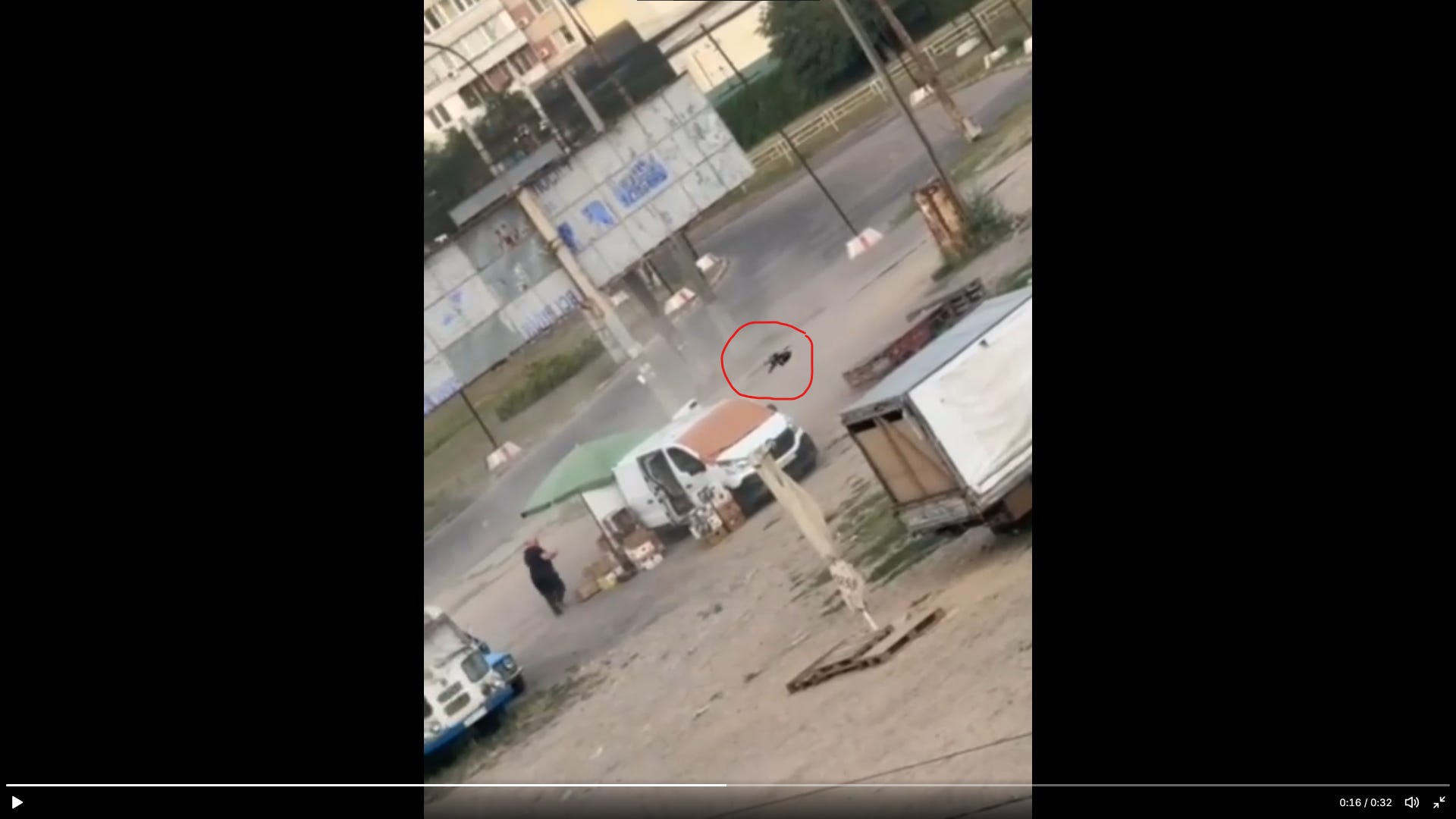
Welcome to the future, on display today in Ukraine. Rare to get such a clear glimpse of what-is-to-be.
Suddenly years of duck hunting as a kid just became a plausibly useful survival skill. Yay.
Why go to the latest boring history-twisting Hollywood blockbuster by whatever director is in vogue when you’ve got the most gripping drama of all time playing out unscripted in Ukraine? But then, a body might learn something about the human species, for better and for worse.
Guy made it through, thankfully. But he was lucky. I’ve seen footage from the Kherson area showing a dead lady next to her dead dog, drone bombed on a walk, as well as a murdered grandmother next to her murdered goats, also drone bombed on a walk. Because orcs will be orcs.
In the russian way of waging war, brutality is the point, which is, incidentally, why Pete Hegseth is probably secretly a russian agent, compromised after his habit of submitting to male sex workers became known to Moscow’s agents. Prove to me that isn’t true, anyone who dares. Best possible cover for a russian saboteur is a twit who wraps himself in the American flag while defying the basic principles Americans in uniform fight for.
Anyway, russia makes a point of being vicious because this makes polite eyes look away. Many simply won’t believe that humans are capable of this. So much better to live in a world where this couldn’t actually happen, or was somehow justified.
To each their own delusions.
Me, I’ll always feel proud to have been even an infinitesimal part of the right side. I’ve donated enough money that, statistically speaking, I’m theoretically responsible for the removal of at least one orc from the battlefield. Only wish I could fly drones (preferably interceptors) from the other side of the world. Be happy to train and take on regular remote shifts, but the operational security side is still an unresolved issue, I expect.
I do see the idea of russians somehow being forced to atone for what’s happened as a fever dream, though. Best that can be hoped for is the collapse of the existing russian state and emergence of a new and truly federal russia where Moscow’s power over other regions is legally restricted. Everybody likes to pretend that Germany was denazified because everyone said this was so, but where did the AfD come from then?
Regardless of how the war ends or exactly when - end of this year being a very real plausibility - right now the tide is against Putin in every domain of the fight but mass use of ballistic missiles. And by next year Ukraine looks set to draw even there too, as well as begin erecting a shield of its own that doesn’t rely solely on Patriot interceptors. Since two-thirds of global stocks are gone. And Iran still has lots of missiles.
The Ukraine war could, I have to admit, drag on for years more, if two conditions are met. First, Ukrainian forces are unable take advantage of the current moment of orc weakness on the fronts to carry off an effective large-scale counteroffensive. Second, Moscow pretty radically reorganizes the way it fights, relying on networks and autonomy instead of Soviet ways.
I really doubt that the orcs can flex in time, but in theory there is an orc pathway to effective adaptation and stopping the Ukrainians from running away with the technology race. This is what makes Ukrainian counteroffensive work this late summer and fall so strategically vital. And I expect why Zelensky, now that the initial forty-day strategic strike campaign has concluded, will order a smooth shift to an even more extensive assault on russian logistics.
On the ground, really the only positive news for Putin this summer is that Kostiantynivka is well infiltrated, with chances high that Ukraine will lose any semblance of control by the end of the year. The less so good news for the old murderer is that the result looks set to turn out about as well as it did down in Pokrovsk.
After finally taking control earlier this year, the orcs have been too exhausted to capitalize on what was already a classic Pyrrhic victory. They’re stuck on the road to adjacent Dobropillya, even though the fighting there is Moscow’s current main effort.
Moscow’s never-ending series of offensives represents a strategic error of the highest order. One of the most classic of all time, warned against in just about every book on strategy. Trying to maintain a constant, machine-like pace is the very antithesis of how you wage war if you actually aim to win. This is what bureaucracies do when they’ve lost the plot. Action substitutes for effect.
The ending of this story is all but written.
But until the Ukrainians can break the enemy front somewhere and begin rolling orc control over occupied Ukraine in a big way, the people enabling Putin’s failed war may not feel compelled to accept the price Ukraine must demand for it to really end. To do this requires that a new doctrine guides the use of military force across the board.
Ukraine’s new military leadership seems to understand this. Zelensky seems aware that Ukraine has a window lasting no more than another three to four months to deliver a decisive result. Wiping out Ukraine’s energy infrastructure this fall is likely within russia’s capabilities thanks to the global depletion of Patriot interceptor stocks in the Iran War. Ukraine will win despite this, but it would be better for all involved if the Ukrainians didn’t have to. As tens of millions of russians can say goodbye to electricity and heat too.
If 140 million people are all so gutless that at least some can’t figure out how to get rid of their wannabe Tsar, then I guess we’ll see how they handle grandfather winter. In a record-setting El Nino year, which will do who knows what to the climate in eastern Europe. If it’s a harsh winter, then Ukrainians and russians will suffer alike. If it isn’t, then one of Putin’s last areas of domain superiority is all for nothing.
And mobilization or not, Ukraine’s drone forces are on track to become so powerful by 2027 relative to the defense the orcs are still able to put up that the line will start creeping back. Occupied Kherson will eventually turn into an orc trap, the entire space between the Dnipro and Crimea part of the new tactical zone. Crimea will be under constant attack.
I just don’t see how Putin endures the pressure he’ll be under for much more than another year or so. Lines for fuel and fights over spots continue across russia. Wildberries warehouses continue to burn.
It’s honestly gotten to the point that weekly updates are almost too frequent to capture the natural rhythm of the new balance in Ukraine. Though behind the lack of territorial changes, there sits the harsh truth of Moscow trying harder to advance now than at any time in the past three years.
A record number of engagements is only leading to record casualties - over 40,000 in July. Nearly a quarter of a million this year already. And according to Zelensky, Moscow’s losses are past 1.6 million in total, with 700,000 fatalities.
Some russian world you orcs have there.
Ukrainian fatalities are probably well over 100,000 by now, though half are classified as missing, probably inappropriately at this point. But in terms of raw population potential, Moscow’s military power has substantially shrunk thanks to the insane assault on Ukraine. A country with 3.5 times as many people cannot lose fully seven times as many dead and not be weaker on the other side of the bloodletting.
Sadly, the human cost probably matters less in the final reckoning than the visible collapse of russian air defenses over the past few months. Ukrainian deep and middle strikes savage the enemy every single day. Not all strikes succeed, but enough do.
Soon, the average russian can anticipate going without enough fuel to fill up their car or be able to receive online orders. Refineries keep burning, with close to half of total and a third of operational production offline. Wildberries has lost three-quarters of its space at the largest two-dozen or so fulfillment centers that comprise the bulk of its capacity. Ukrainian attacks are also breaking down Moscow’s electronics supply chain, jeopardizing the entire war effort at scale.
What more is there to say than what Ukrainian fighters do with every assault repelled and every drone strike that succeeds? Moscow’s strategy in the war is endless pressure at the front, which is scientifically ridiculous, and harming Ukrainian civilians until they demand surrender from Kyiv, which is equally ludicrous a proposition.
The Ukrainians have no shortage of troubles of their own. However, the core loops that cause them their own share of grief are not as pervasive or severe as the ones afflicting Moscow’s system.
And whatever capacity to adapt the Muscovites still have left in them, it’s damn hard to argue with the threat posed by a couple hundred thousand long-range strike drones backed by several thousand cruise and ballistic missiles. Which is what the Ukrainians will produce in 2027.
Moscow lacks the missiles to cope. There already aren’t enough systems to adequately cover all of the territory under threat, and their count is shrinking Drone interceptor team numbers are not liable to grow fast enough to fill the gap the way they have in Ukraine.
Usable metaphor: Ukraine is in the position of a fighter locked in a grapple who is slowly, carefully, and with extreme patience working themselves into just the right position to squeeze off their opponent’s carotid arteries.
Nighty night time is coming, Putin.
State of the Fronts - Week 31 2026
This week’s update will be brief, because I’m switching to a new and more concise publishing model. Most weeks I’ll track and evaluate battlefield changes, but once a month I’ll do a deeper dive in Earth Forces Bulletin. Which will also shift a bit more towards operational as opposed to theoretical matters.
More on that in a few weeks. Here’s the strategic map for reference:
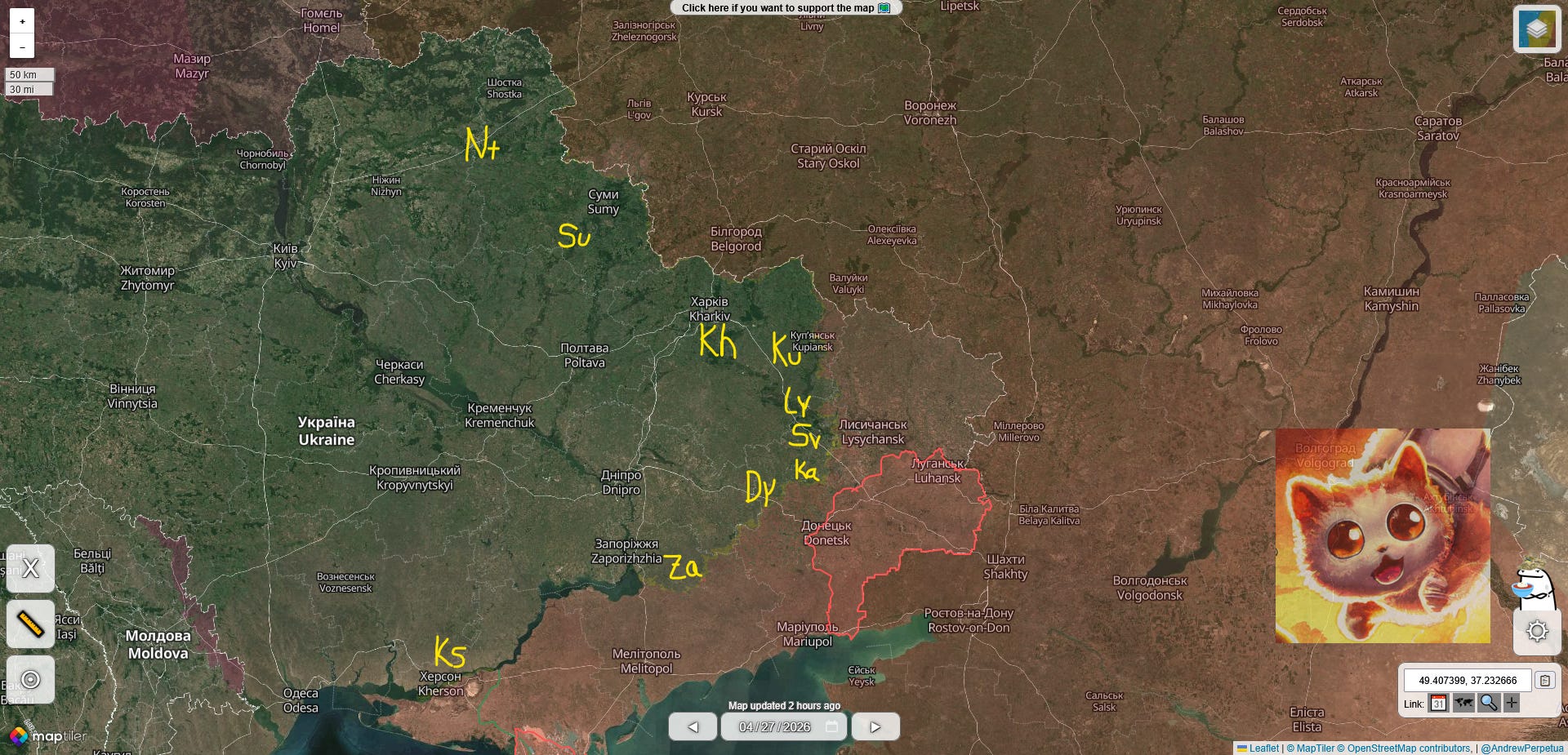
Instead of concentrating forces, Moscow’s operational plan for this summer is still all about trying to outflank Ukraine’s toughest defenses in Donbas. Hasn’t worked so far, and is unlikely to now.
I’ll give the orcs credit for this much: they’re concentrating on one flank, not two at once. Moscow’s immediate goal is to overwhelm Ukrainian forces between Kostiantynivka and Dobropillya. The arc through Lyman further north is a supporting effort, as it isn’t really a proper flanking strike, but a frontal assault up the Siverskyi Donets river valley.
Moscow would very much like to get the Kharkiv and Kupiansk fronts going as a coordinated northern jaw, but so far all attempts have failed. Like Sumy and the prospective push in Chernihiv, north of Kyiv, the main goal is to stretch Ukrainian forces, keeping them thinner on the ground in Donbas.
Trouble both sides are facing in figuring out how to fight effectively in the Network Age is working out how wide of a corridor you need through the killzone to sustain operations at a tempo which exceeds the enemy’s ability to react. This has always been the entire point of maneuver warfare: not so much surprising the enemy about where you are attacking, but by how quickly you can dismantle their defenses and do things which discomfit their internal structure.
Drones in and of themselves are not war or even battle winners. Their vital function is to reduce the space the enemy has to operate unseen and unchallenged. Armored vehicles shrug off multiple drone hits all the time. But lots of little attacks eventually cause serious enough damage to render a vehicle unusable. Once damaged, other stuff can kill it. But in the short term, it stops posing a threat.
So it’s the density of drone support that really counts. The fewer enemy drones that reach your people, the happier they’re liable to be, too, and at the moment density of drone interceptors controls that factor.
This suggests that attempts to comprehensively breach a drone killzone should aim to do so across a wide enough area that a corridor forms, a strip down the center buffered by twenty to even thirty kilometers on either side by protective cordons too hazardous for enemy drone operators to work. This area has to be isolated from virtually all logistics to a depth of around thirty kilometers as well. Beyond, intense middle strikes have to sever tactical and operational echelons.
An illustration of how this would look in a Dnipro crossing op:
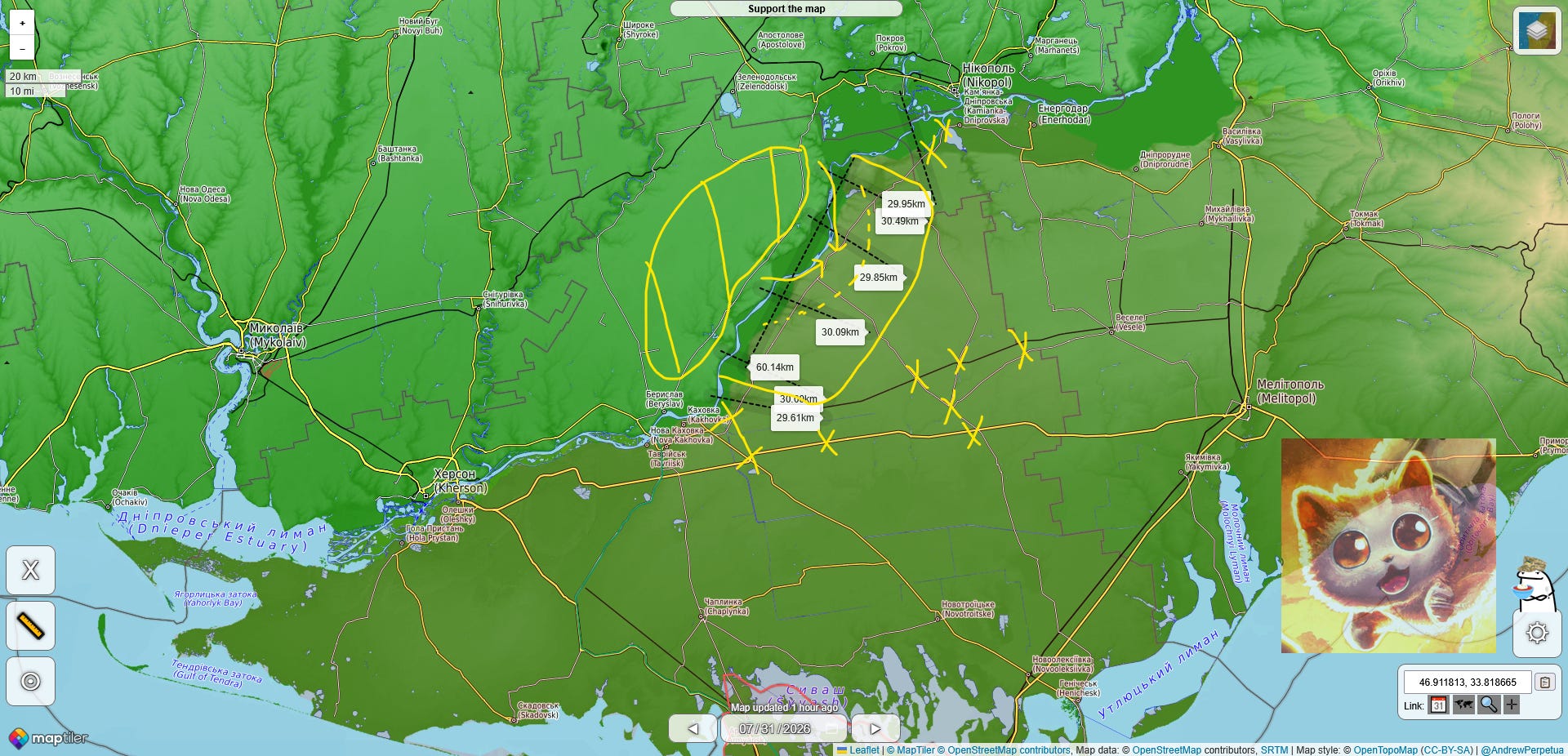
Whether this is possible in a given sector can only be known after a series of focused, intensive probes across the full scope of the target area. When friendly forces move in, it’s got to happen during a narrow window, and the enemy presence has to be almost immediately reduced to scattered teams trapped in hides. Full drone superiority has to be achieved to prevent enemy troops from receiving supplies and fire support.
Very tough to amass the necessary numbers to pull this off without the enemy noticing and getting prepared. But it’s probably the sole workable alternative to a slow process of drone-based infiltration and clearing of isolated enemy positions. Which will work in time, but leaved the enemy room to adapt.
I forecast that the Ukrainians will absolutely try something big, though. The authorities are even telegraphing it, in their own way.
You don’t typically announce serious operations intended to break enemy logistics across a broad area unless you are also planning supporting actions at scale on the ground. And are confident that even if the enemy knows a punch is coming, understanding of the actual state of the fronts is so poor that confusion will ensue as soon as the liberation of significant territory is announced.
Kyiv Post journalist Stefan Korshak has been reporting rumors about secret Ukrainian advances in Lyman and Zaporizhzhia lately. Could well be something to them. Deception efforts are likely, though.
I’m afraid that the days of usable open-source intelligence and analysis are probably numbered. Governments are figuring out how to influence them effectively. Was probably inevitable, but still kinda sad to see it play out.
North
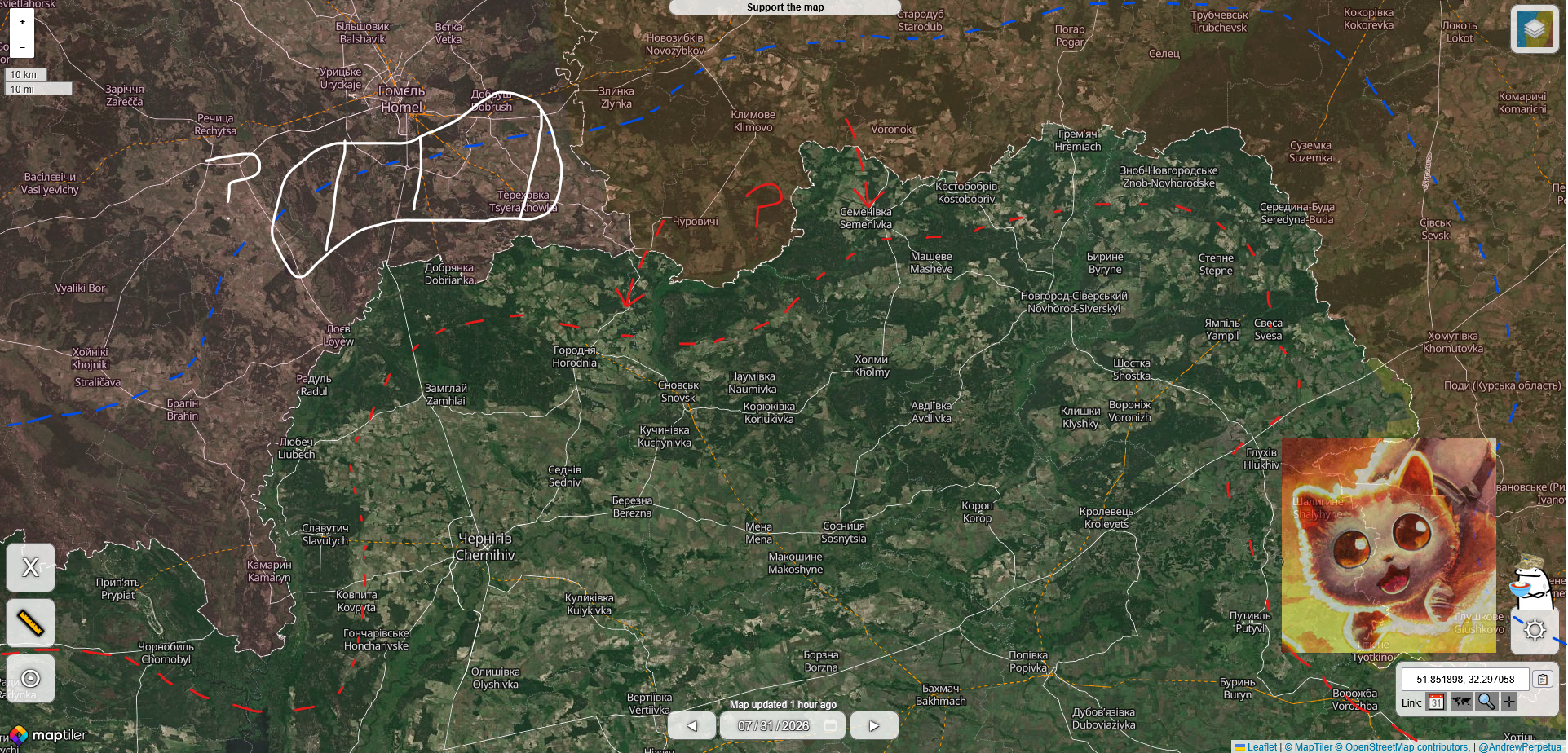
Belarus this week announced the creation of a new airborne division in the country’s southeast, right where it would need to go to support a russian effort north of Chernihiv. But announcing a new formation could mean years before it’s ready to fight, and could well be an attempt by Belarus to placate Moscow, which badly needs allied support about now.
Gestures are one thing, launching an invasion another. My read on the situation up north is that it’s an attempt at distraction. And whatever brigades Ukraine has (should have) resting in the corps assigned to the north are likely still more than capable of maintaining the drone wall.
Moscow’s buffer zone strategy will, upon historical reflection, likely be deemed a political effort damaging to military operations elsewhere. Ukraine’s attitude towards the risk seems to be some flavor of bring it on.
Sumy
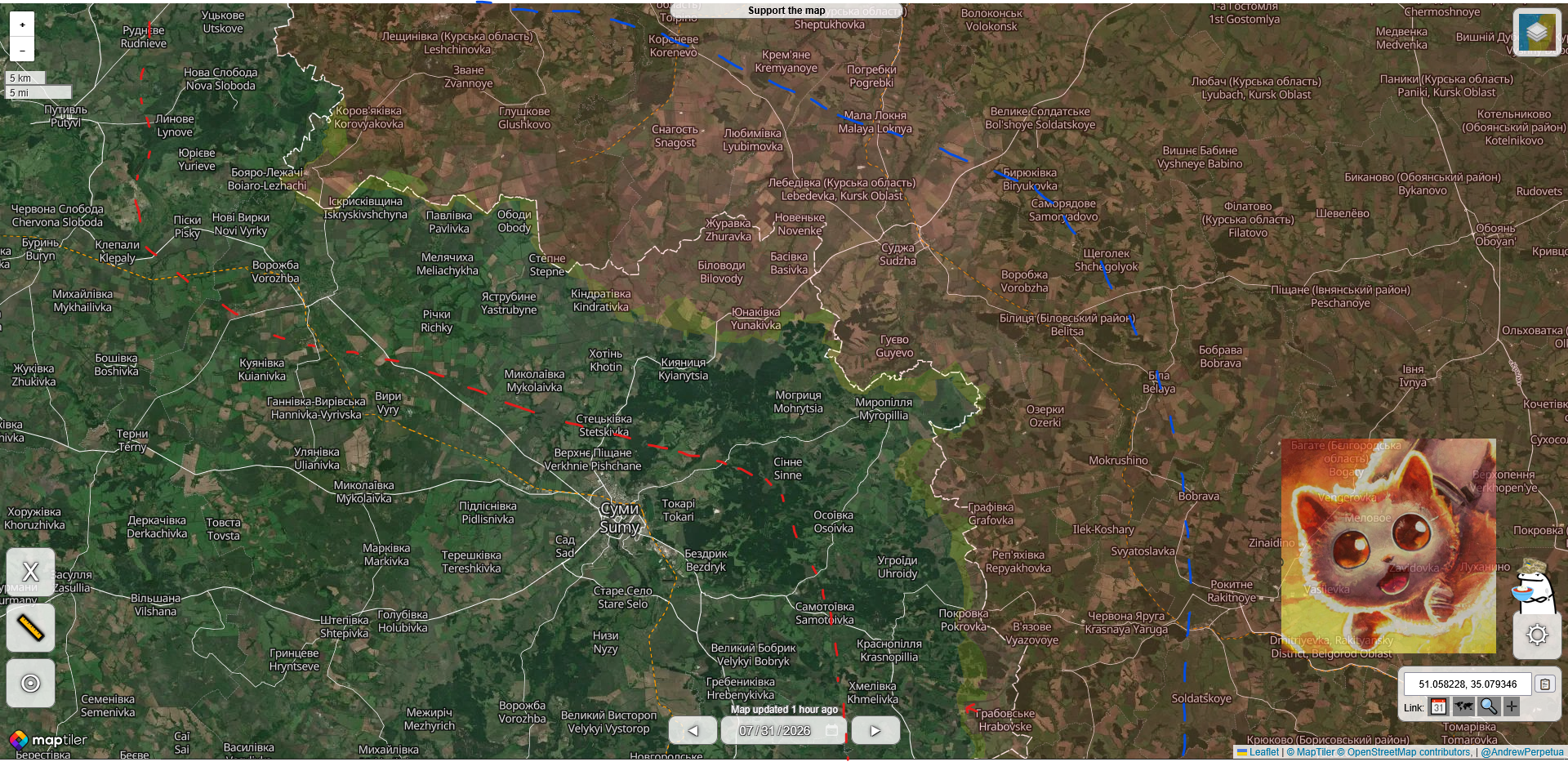
Tiny orc advance noted on the southern edge of the Sumy front, and that’s all for the past week. Nothing more substantial than that likely long into the future.
I’m trying to get better about showing a rough estimate of where the killzone for each side extends, because you really need that these days to get a sense of just how little Moscow accomplishes.
Right now, Ukrainian forces within 20km of the front have to consider themselves observed at all times. Movement must be brief and covered by friendly support, with minimal use of vehicles. Most logistics are done by drone, and fighters often walk to rotate out of positions.
For the orcs, the killzone begins more like 30km from the front. Ukraine holds a slight qualitative edge thanks to more reliable communications and better artillery. A Bohdana howitzer dug in 10km behind outlying Ukrainian hides can drop a shell on any target spotted in the killzone.
Oh, and for an excellent participatory view from a journalist with the guts to spend a few days on the front line, check out this Kyiv Post piece. War just isn’t for humans any more. Infantry are like rowboats caught between battleships and aircraft carriers.
Kharkiv
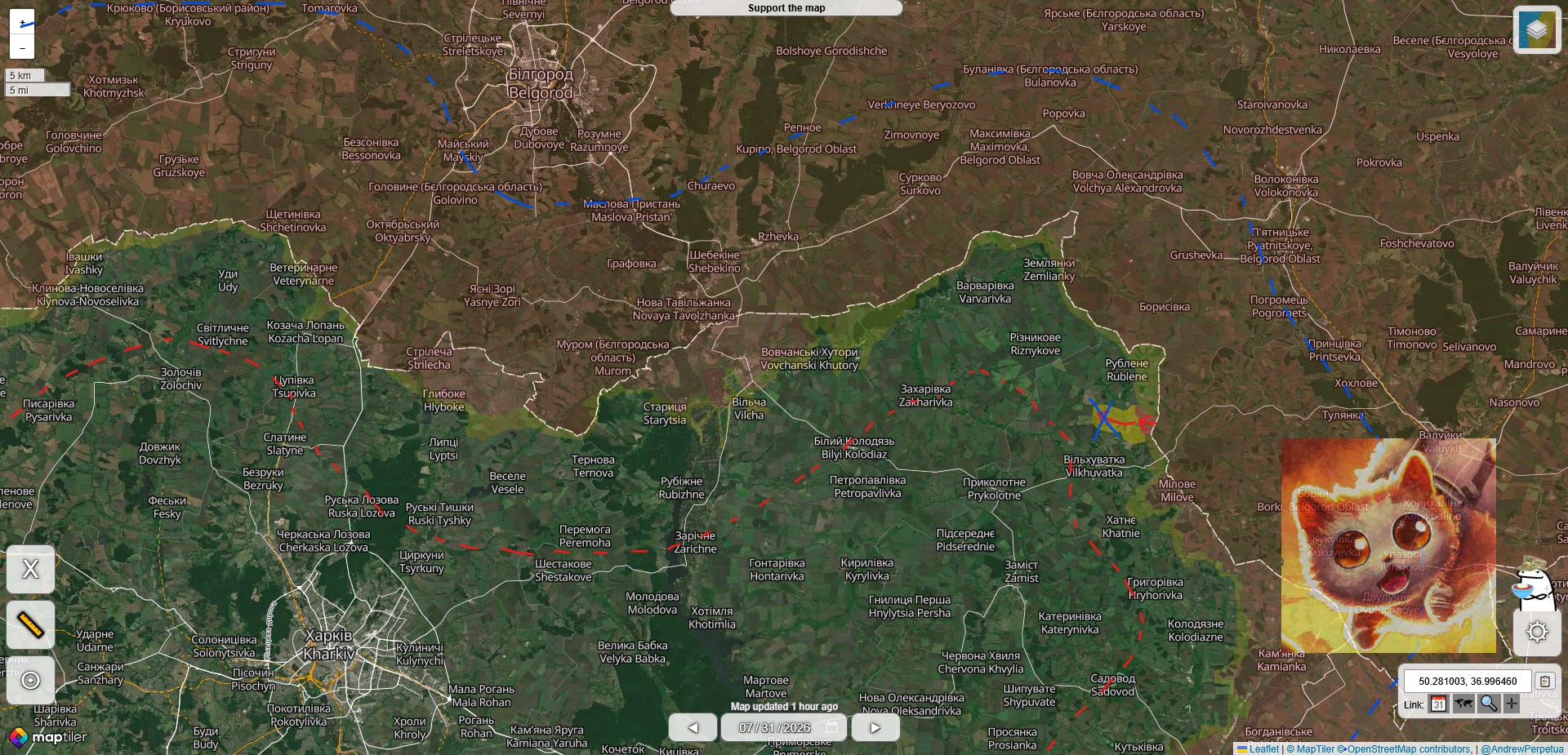
Muscovite efforts to keep Ukraine worrying about Kharkiv are ongoing, and another orc border breach in the east was spotted. All the enemy actually did was put a few people deep in the killzone, though.
Getting infiltrators three or five kilometers beyond enemy-held positions is not as damaging as it once was thanks to drone resupply. They wind up trapped in holes, surrounded by Ukrainian hides, at least some of which usually receive enough supplies to make rooting them out difficult or even impossible in the short run.
And so they sit until hunted down, because until enough orc drone operators appear to interfere with Ukrainian logistics, the Ukrainians stand a better chance of staying alive while the orcs are starved out. This style of warfare is exceedingly cruel. It has already consumed more people than a limited nuclear exchange targeting military sites likely would.
Hence my general lack of concern for the Ukrainians giving up positions. Most of the time, the orcs are destroying themselves for nothing. If you wanted to kill russia for good at the lowest possible cost, you’d somehow convince the russians to do exactly what they’re doing now on the ground in Ukraine.
Kupiansk
The fronts all the way down to the Siversky Donets are pretty stuck right now, unless Ukraine is keeping some kind of big victory under wraps. Moscow is still trying to infest Kupiansk again, and some infiltrators make it through now and again. But the place is a no-go zone for both sides, mostly.
Who owns it or doesn’t isn’t that relevant any more. Just being able to get to it is more than half the battle.
Lyman
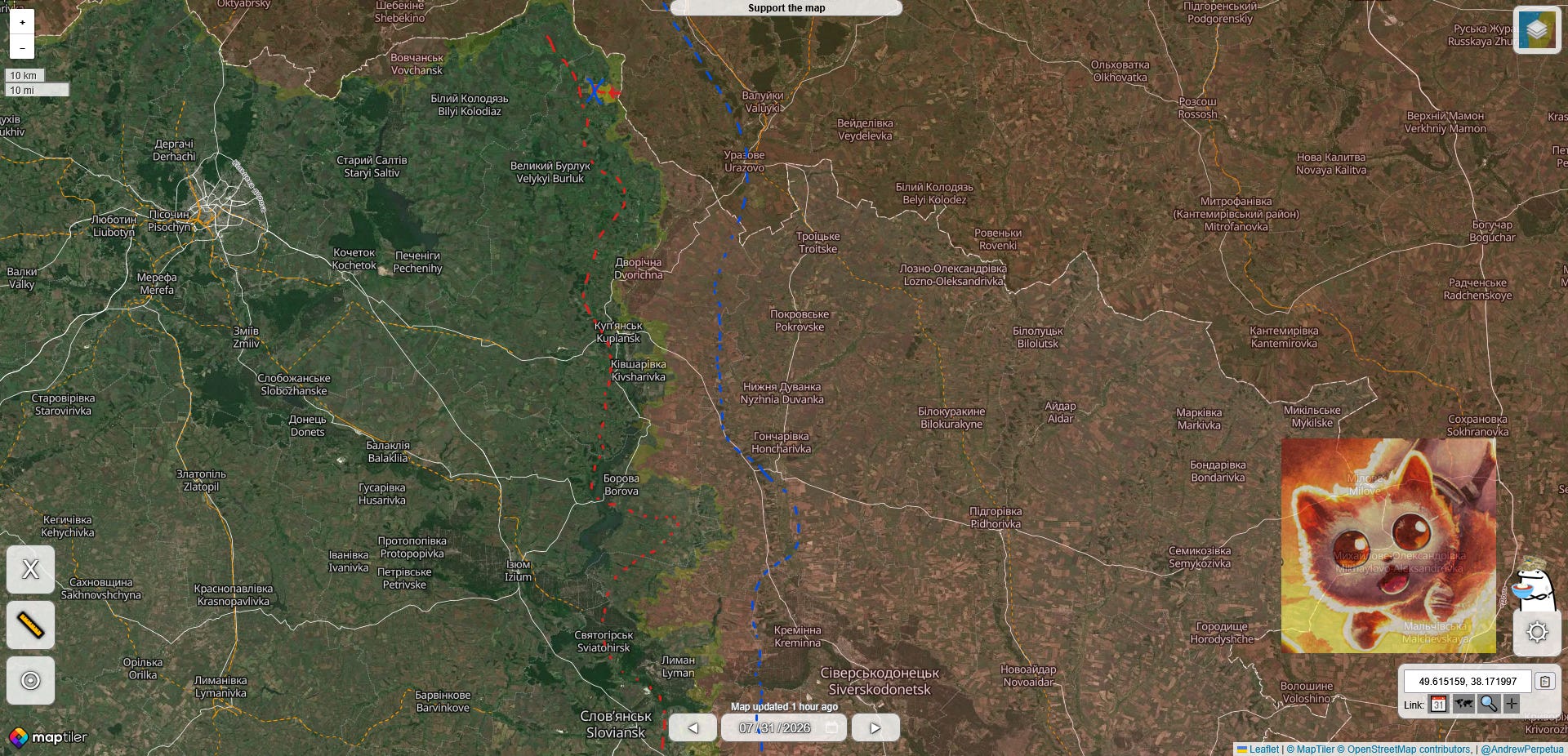
Unlike the Kupiansk bridgehead over the Oskil, which is so small that I increasingly question the wisdom of holding it, Third Army Corps’ has a sufficiently large hold over its own bridgehead that there seems to be little risk of Lyman falling. Possibly ever.
As for counterattacks here that are being kept secret, they could refer to a campaign that aims to throw the orcs across the Zherebets. Perhaps more likely is an advance in the forests between Lyman and Yampil. Easier to keep details of that under wraps.
Securing the Yampil-Zarichne line would go a long way towards keeping Lyman free, and possibly unlock reserves for a bigger effort further north. If the orc hold here stops being such a useful attrition trap.
Sloviansk
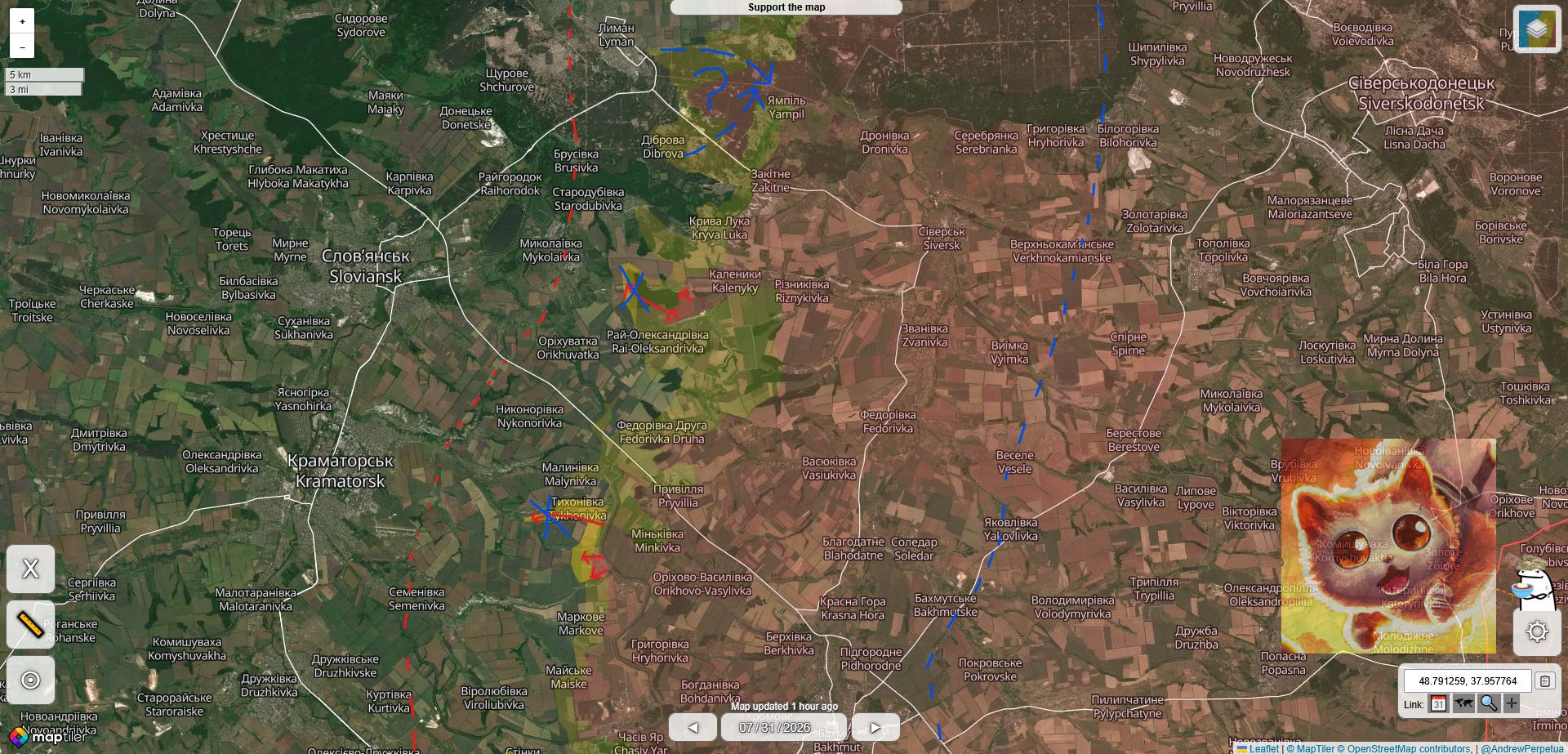
The russian frontal advance towards Sloviansk is still probing westward while wedging Ukrainian forces off the ridge east of the Siverskyi Donets-Donbas Canal. Pushing slowly up the Sukha river valley, they’re working hard to envelop the Ukrainian defenses in several forest tracts.
These have anchored Ukraine’s positions since Siversk fell, but their own loss in turn was a matter of time. That it’s only set to happen over the course of August and September is a defensive victory in its own right.
Another reason to suspect that further north Ukrainian forces may be conducting secret counterattacks near Yampil is to prevent the loss of positions south of the Siverskyi Donets leaving Ukrainian fighters just north of it threatened from two sides. If successful, and Lyman holds, Moscow’s advance should run into a tough barrier when it hits a series of lagoons and wetlands near Mykolaivka.
Further south, a small enemy advance towards Kramatorsk, in conjunction with a likely Ukrainian pullback from Chasic Yar, could lead to some outwardly concerning gains over the canal that almost certainly factors into Ukrainian plans. I don’t see much hope for the orcs in advancing directly towards Kramatorsk, though. Terrain is not favorable, the enemy forced to choose between a push through a ravine flanked by heights or pushing Ukraine off said heights directly. All within easy drone range of Kramatorsk.
Kostiantynivka
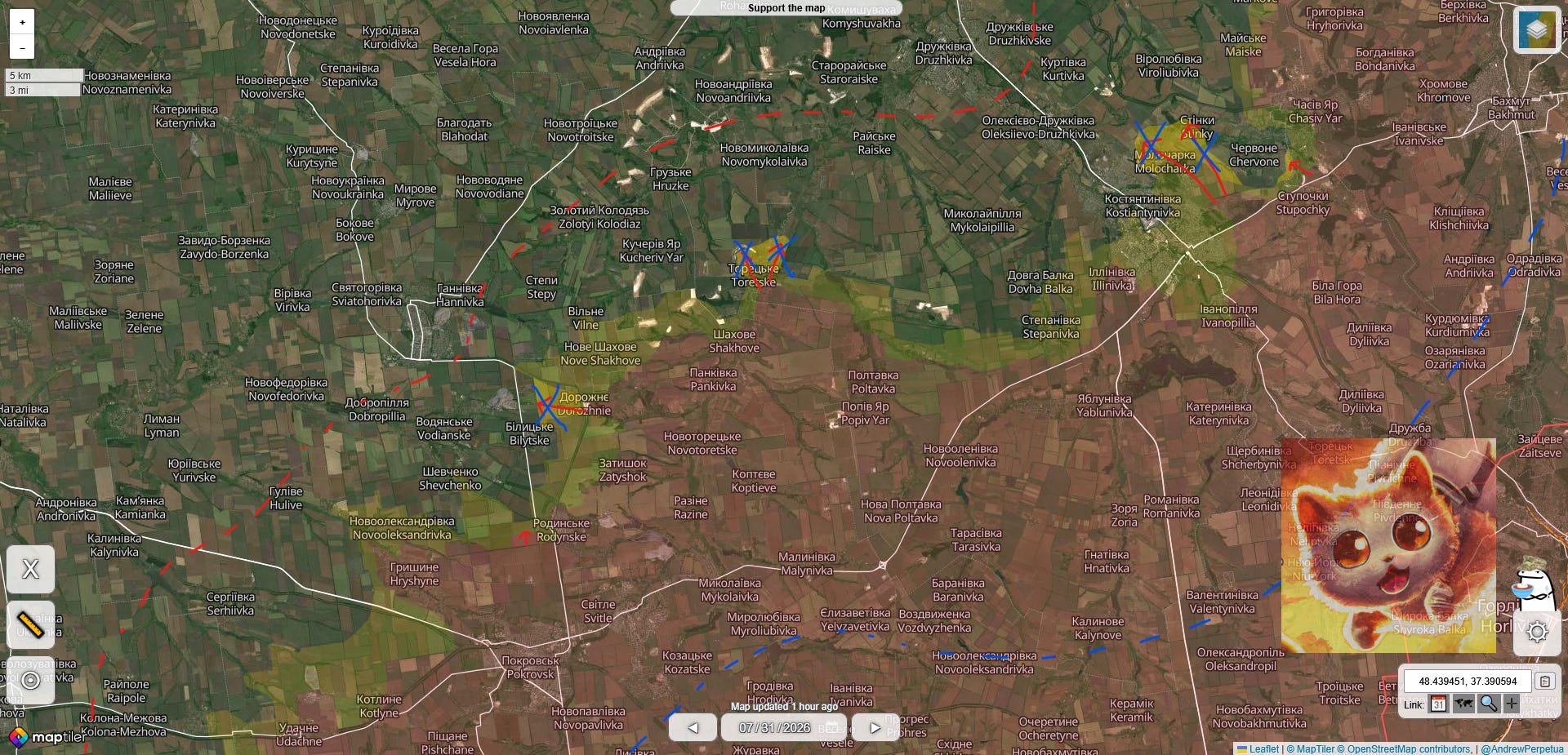
While the fighting in Kostiantynivka has seen few observable changes over the past week, the Chasiv Yar flank is under increasing pressure. Could be that the orcs trying to breach the city from the south are low on power, so Moscow is shifting the weight of the effort towards Chasiv Yar in hopes of catching Ukraine off guard.
Given the Reuters piece from a week ago that detailed the living hell of spending a full year in a hide outside of Chasiv Yar, I have to see Ukrainian resilience here as partially ephemeral. While the enemy can’t kick the Ukrainians out of their hides, Ukraine doesn’t have true control either.
So there appears to be a danger of Ukrainian forces stuck on the western side of Chasiv Yar being surrounded, or at least having their logistics threatened by infiltrators. Enough orcs have made it into Kostiantynivka that the Ukrainians are too busy hunting them down to quickly respond to a shift in their emphasis.
Now that the orcs are in the Deep, so to speak, it’s probably past time to get any Ukrainian defenders on the outlying walls extracted. At best, each side is at parity when it comes to flying drones over Chasiv Yar. That means Ukraine is sitting at a disadvantage and should plan to pull back to the next set of prepared defensive lines.
A consequence will be increased infiltration pressure on Kostiantynivka, but this is inescapable. Ukraine will, barring a counteroffensive between Kostiantynivka and Pokrovsk, only be able to maintain a defense on the western edge by winter.
This isn’t a big deal so long as the outcome is planned for. The reality is that all of Kostiantynivka is in the orc killzone. Druzhkivka and Dobropillya are both already on the outer fringe, as Kramatorsk and Sloviansk will soon be.
The purpose of the killzone is to maximize the number of enemy casualties inflicted for every friendly they get to. Control over it is predominantly a function of drone team density, provided effective coordination.
So the intensity of a killzone will generally correlate to the amount of cover available. It becomes quadratically, maybe exponentially more deadly the farther in you get.
In urban Donbas, Ukraine will have endless warrens to use for cover as the enemy struggles to approach over blasted countryside. Just getting to Pokrovsk, Myrnohdrad, Kostiantynivka, and Siversk was the easy part of Putin’s mad campaign. And it began before drones had so radically altered the geography of the fronts.
Moscow has a lot and uses them unsparingly. But Ukraine’s do more effective damage. All factors point to Putin’s war crashing headlong into a wall.
Dobropillya
A few more minor advances in the area to record this week. The orcs are trying with all their might to get close to Dobropillya, with less than spectacular results. Their focal point looks to be drifting northward, into territory covered by First Corps near Shakhove. But there’s still a frontal attack axis going near Bilytske.
When Moscow decides on something, the orcs generally keep at it. Last year, that big infiltration wave which the Ukrainians defeated east of Dobropillya aimed to take control of an important stretch of high ground from which attacks on Druzhkivka could be launched. The Dobropillya Counteroffensive ended that danger - for a while.
Moscow’s next attempt seems to be underway, and thus far it’s not going any better than the first. But it’s notable that the enemy is still so obsessed with this line of attack. They’re really not keen on bashing frontally into Sloviansk.
Just to the west of Pokrovsk Ukrainian forces lurk, making Moscow’s halting progress further north even more interesting. If the orcs commit too much here, a counterattack from the west could conceivably liberate Pokrovsk. No doubt the Ukrainians much enjoy being able to hit supply lines coming into Pokrovsk from launch positions near Udachne.
Zaporizhzhia
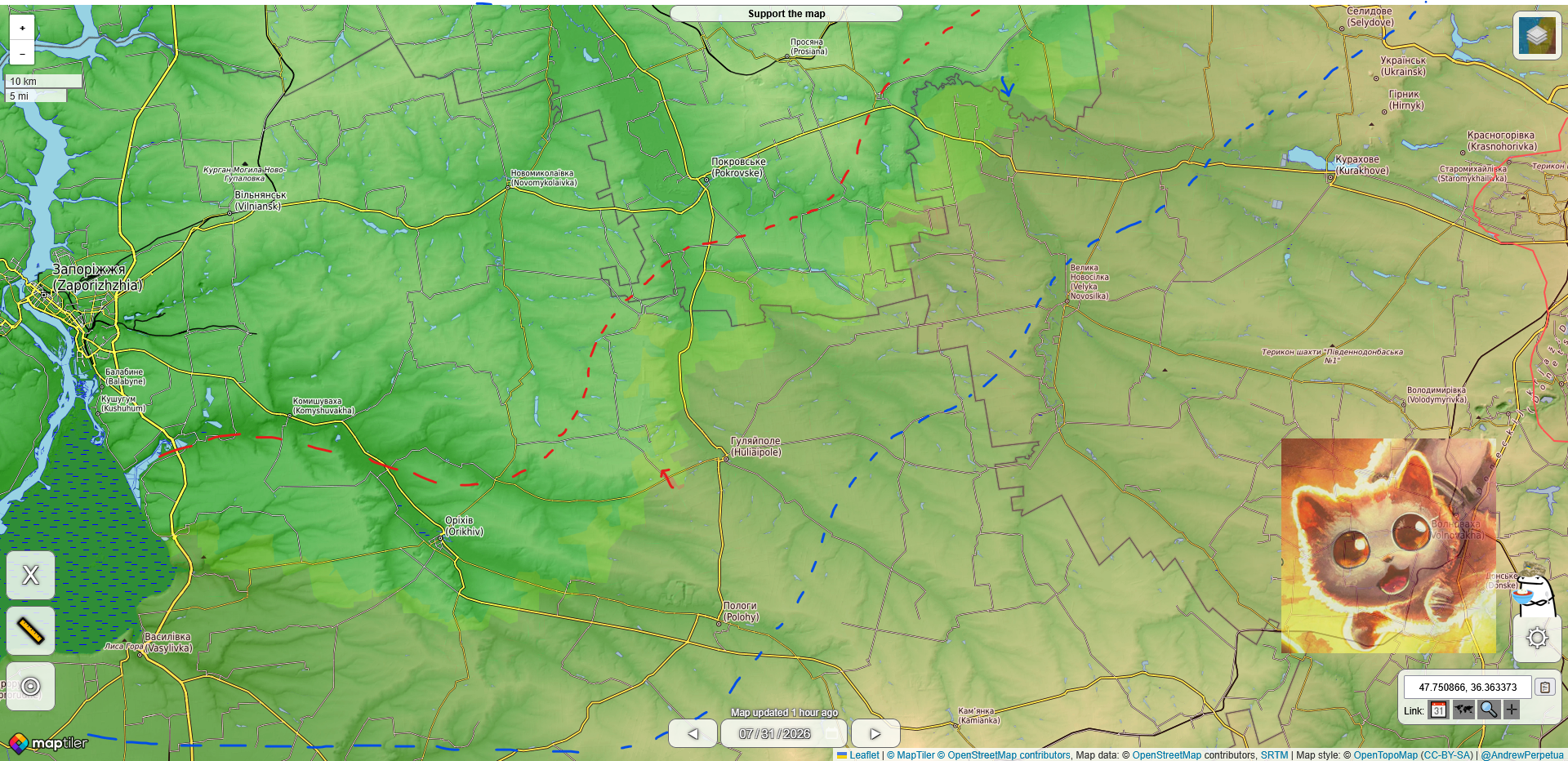
Not much news out of Zaporizhzhia this week, just an incremental enemy advance west of Huliaypole. But nothing that risks a broader upset of Ukraine’s front. And Ukrainian counteroffensive pressure is still ongoing where the Mokri Yali meets the Vovcha. No news on that lately, though some orcs started waving flags a good bit east of where they should have been on at least one occasion.
The heat and limited cover available on Ukraine’s southern steppe would seem to demand some pretty strict conditions for any movement in or near the killzone. I’m still undecided on whether this makes counteroffensive work more or less dangerous on the whole.
Until the enemy’s glide bombs are reliably neutralized, I have to see limited cover as more of a liability for Ukraine in most circumstances. Fewer places to hide positions, whether filled with people or armored vehicles, means fewer spots for the orcs to try and bomb.
Once Gripens arrive next year, even if only a few are ever available the risk calculus for orc glide bomb attacks shifts for good. The danger of concentration is what makes me wonder if, despite the threat of russia adapting well enough to cope with Ukrainian developments and resetting the balance of power again, Kyiv won’t wait until 2027 to go big. Unless something that starts out small, speculative, and highly reversible succeeds and attracts serious resources prepared in advance for this eventuality.
Kherson
No ground changes in Kherson. Just more orc drone safaris going after civilians, as laid out above.
This is russia, always and forevermore: butchery and murder on a continental scale. Any defender of russia or anything russian, literature included, is complicit now. Only the language is exempt. In fact, the more dialects and variants of Russian that are spoken, the better.
Deep down, Muscovites know that people who speak with an accent not of Moscow or St. Petersburg aren’t true russians, and can never be. That’s the pyramid con of the russian world in a nutshell: one rule for you, another for we.
Strike Campaigns
The vaunted russian air defense system is collapsing. Yes, it’s still fighting back, and not every Ukrainian raid succeeds. But there’s no other way to accurately depict what’s happening out there.
Moscow, for all its hundreds of air defense systems and tens of thousands of missiles in the inventory, is unable to effectively monitor its entire airspace and stop flocks of drones. Ukraine sends several hundred every day, exceeding Moscow’s typical total. Ordinary russians are seeing drones buzz overhead to blow up stuff all the time, Moscow’s social media bans and laws against filming attacks be damned.
What Ukraine is accomplishing through repeated, now daily deep strikes against russia is difficult to adequately describe. It’s monumental, a shift in the perceived balance of power of the same order as the one underway in the Middle East thanks to the failed US war on Iran.
There is almost no potential Muscovite adaptation that can possibly prevent Ukraine from destroying the majority of russia’s refining capacity and major logistics centers by the end of the year. Power plants will be next in line if Moscow goes through with bombing Ukraine’s energy systems again.
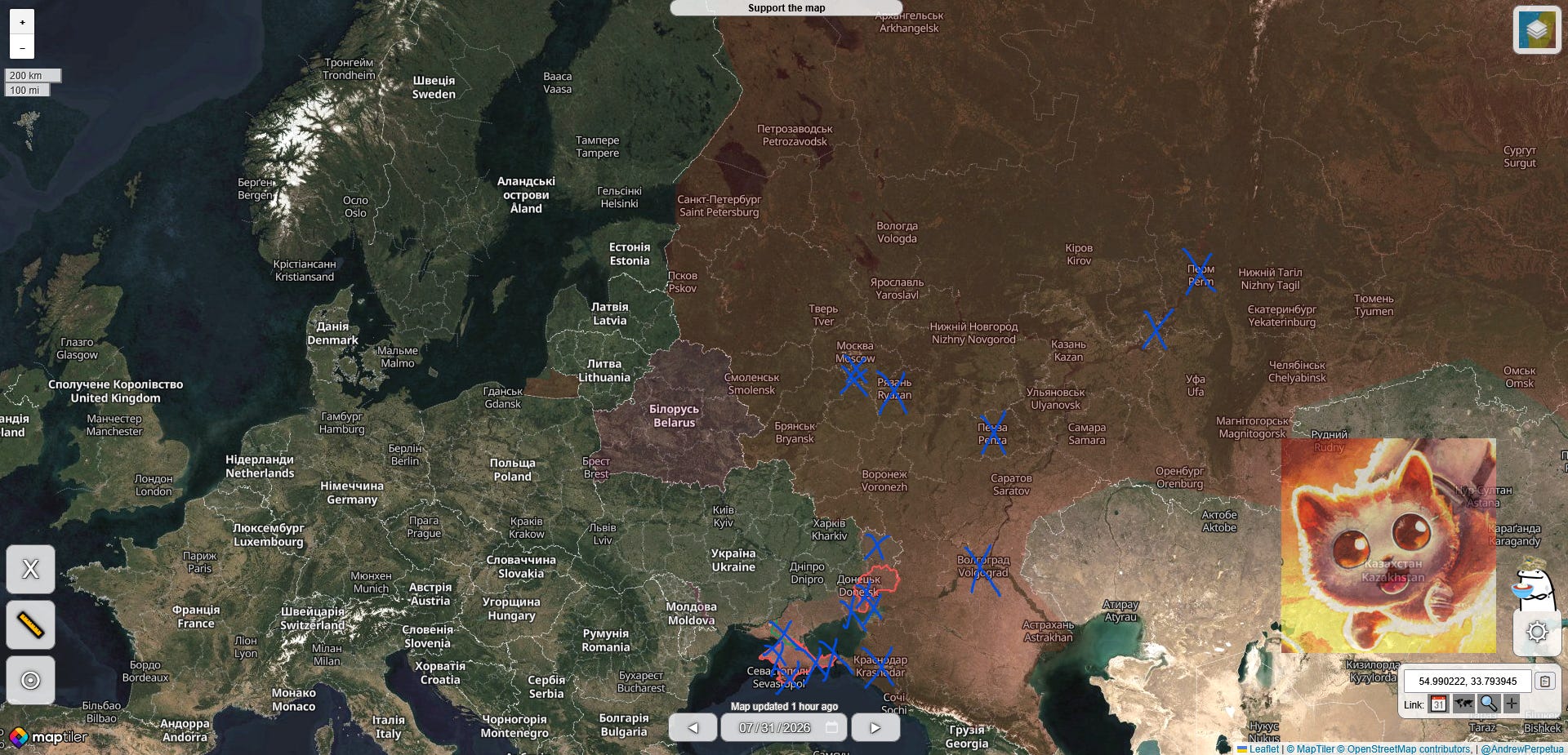
Middle Strike work also continues unabated. Ships have been largely driven from the Azov and Black Seas, trucks and trains are hunted from Mariupol to Crimea. And Crimea… wow is the place getting smashed up. Ukraine is switching off the power locally, which will make the orcs even more dependent on scarce fuel to power the generators that make stuff like radars go.
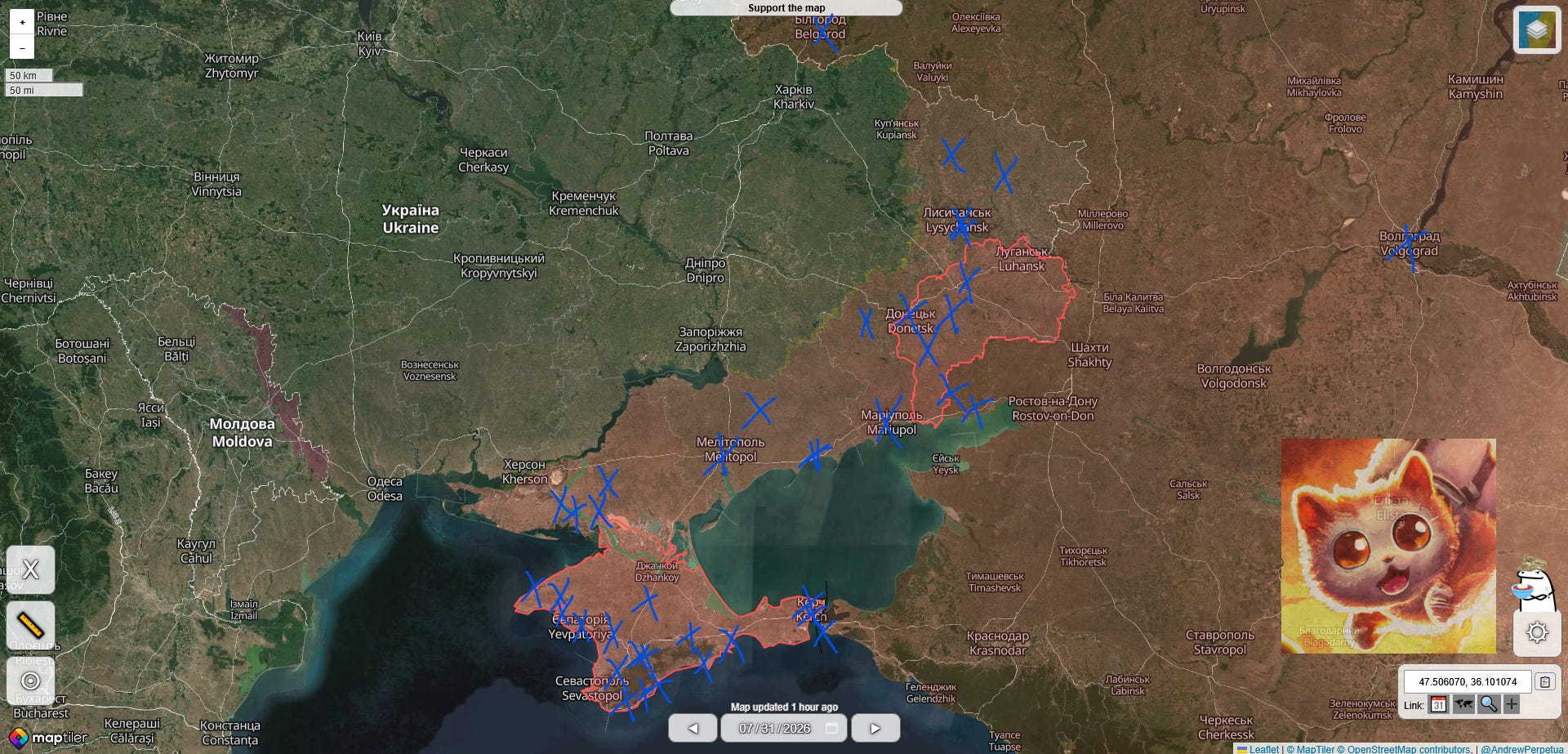
Moscow’s tactic of using mobile antiaircraft teams to protect truck convoys is having decidedly mixed results. Maybe they do some good, but plenty are on video missing or ignoring incoming drones, many teams abandon their vehicle, and some get blown up in it.
Summer is just over halfway through, and the impacts are already being felt in less effective orc assaults. The grounds for a cascade failure in one or more orc fronts are being prepared.
And Moscow? Throwing record numbers of ballistic missiles at Ukraine, mostly hitting civilians. A whole family got wiped out in Dnipro, parents and a bunch of kids, by a North Korean missile.
Not sure whether to be grateful for the lack of impact on Ukrainian war production, or just bitter at the fact this is still happening almost five years into the war. Ukrainian shortages of Patriot interceptors belie how ridiculous the USA and all of NATO have been for far too long. Nobody was ever going to fight a real war. The entire Cold War security architecture was a gigantic, costly bluff.
Unfortunately there’s no good long-term solution to ballistic missiles and strike drones working in tandem. Neither offensive strikes - unless the enemy is very stupid or has no better terrain to work with than flat desert - nor Golden Dome defensive systems will suffice.
Funny enough, it’s looking like a world system where everyone can hurt everyone else’s money could turn out more peaceful than anything the planet has seen before. Nuclear weapons show that if leaders face personal consequences for a war, they won’t fight it. Only when other people can die without leaders being held accountable do they engage in stupid wars. Same is true even of the not so stupid ones, like you get when some foreign country decides you or your lands belong to it.
That should mean any world where drones can always come for any world leader, even the USA’s, automatically sees less large-scale warfare. Can’t even stop humans from waging war, but can absolutely put some safety glass around the ring.
Hell, drones make it so we can actually practice war without getting anyone hurt. One more reason I’m getting into digital simulation. Because if the sim matches reality, something way more possible with robots than people, it has the ability to convince even very dumb people like politicians to not try a particularly stupid thing.
Air, Sea & Signals
Air
Both sides have suffered some aviation losses this week, Ukraine to either an accident or drone gun run gone wrong that claimed an F-16 (pilot is okay, so all is well) and russia to Ukrainian drones paying visits to airfields. The number of incidents where Ukrainian drones managed to take out enemy aircraft on the ground is rising fast. If that becomes a regular event, Moscow’s aviation is in dire straits.
One thing the Muscovites do well, historically, is deploy aircraft with a lot of range. Still, having to fly from bases another hour or so further from the front adds wear and tear and pilot fatigue to every mission. In systems warfare, every channel of influence you have over the enemy or your own capabilities must be optimized.
Sea
The truce that once held at sea is definitely gone. Moscow is killing foreign sailors traveling to Odesa to pick up grain in revenge for Ukrainian attacks on cargo vessels that frequent russian ports.
Ukraine’s attacks at least offer the crews a reasonable chance of escaping unscathed. See a drone coming for the bridge or hull, best evacuate in the seconds you have. Luckily Ukrainian warheads these days are calibrated to start fires, looks like, more than produce shrapnel.
Contrast that with Moscow’s use of air-launched anti-ship missiles to destroy whole ships. Incidentally, it’ll be kinda comical if the US were ever to actually fight China and did okay in the shooting part but lost round two because China can repair battle damage to ships caused by drone hits, but the USA runs into a backlog.
Signals
Moscow’s comms satellite system, its answer to Starlink, has now managed to loft enough satellites into orbit to sustain 1-2 hours of daily communications over Ukraine. Not a good development, and neither is the appearance of facilities near the front in multiple locations that appear designed to support Starlink jamming efforts.
Starlink constellation is too large to consistently block in its entirety, but can be degraded. Basically, you beam so much of the exact signal type it’s looking for at it that the receiver is overwhelmed and unusable.
Like, imagine your favorite music, but the volume amped up beyond the level of a jet engine. I enjoy Swedish death metal very much, and it would be very metal to dissolve one’s eardrums in a blaze of glory, but I value the opportunity to appreciate sounds well into the future.
But here’s the major difference between Starlink and Moscow’s rival: the orcs have between one and two dozen satellites up, hence the limited coverage. Much, much easier to jam a smaller number of satellites too. I expect the Ukrainians will work tirelessly to disrupt it, and also bomb orc jamming installations. Excellent job for the small cruise missiles Ukraine has been receiving, I expect.
Staff Affairs
No Federov return yet, but Khmara looks solid enough. Could be the plan is to keep him as an interim through the year, bring Federov back when it doesn’t look like Zelensky is giving in to protests.
Hard to be sure about another country’s politics. Federov is showing signs of having ambitions, so Zelensky might not want to be seen to give in to his demands for that reason too.
Me, I’m mostly concerned about how effectively Drapatyi can get people out of the exposed hides they’re stuck in for months on end. It is disconcerting to think that those spots where the open source maps haven’t shown any changes for a year could actually represent several Ukrainian teams of three, two, or even one last survivor stuck living on whatever food and water they can scrounge from the dead.
And people complain about not enough Ukrainians wanting to be infantry. Who ever would, given the new reality? Practically no twenty-something soldier I ever knew would have tolerated the conditions Ukrainians in their forties and fifties endure.
Boy are these people owed. And first payment ought to be getting them the hell out intact. If you can’t supply a position, you don’t hold it. An infantry’s boot no longer determines where control runs. It’s just one factor. Anybody in a command position who doesn’t get this needs to be made infantry themselves.
Concluding Remarks
And that’s it for this week. Given how repetitive these posts have become, I think it best to avoid unnecessary explanation going forward. Better to be succinct, as the way the war has changed, in six months a whole new paradigm might have to be described anyway.
But I sure hope this thing ends sooner. I strongly suspect Ukraine will do everything possible to make 2026 a lot like 2022 was.
Putin’s regime is teetering on the edge of a knife. May the cowards fall and cut themselves open on the way down.
The last thing the world needs right now is more war. A major economic reckoning, after all these years of AI megahype and now the fact of demonstrated Iranian control over Hormuz, seems inevitable. We’ll see.
Comments
Nothing yet. Say the first thing.
Sign in to join the conversation.