
Climate change is caused by increasing amounts of heat-trapping greenhouse gases, which trap more heat in the atmosphere. Governments are failing to reduce the snorting and exhalations of our iron beasts. Our constructions are heating up the land, while property owners profit at our expense.
By restoring local water cycles, we can green our heat islands with more vegetation and soil, better enjoy our constructions, experience natural cycles more comfortably, and help restore the global climate by releasing less heat into the atmosphere.
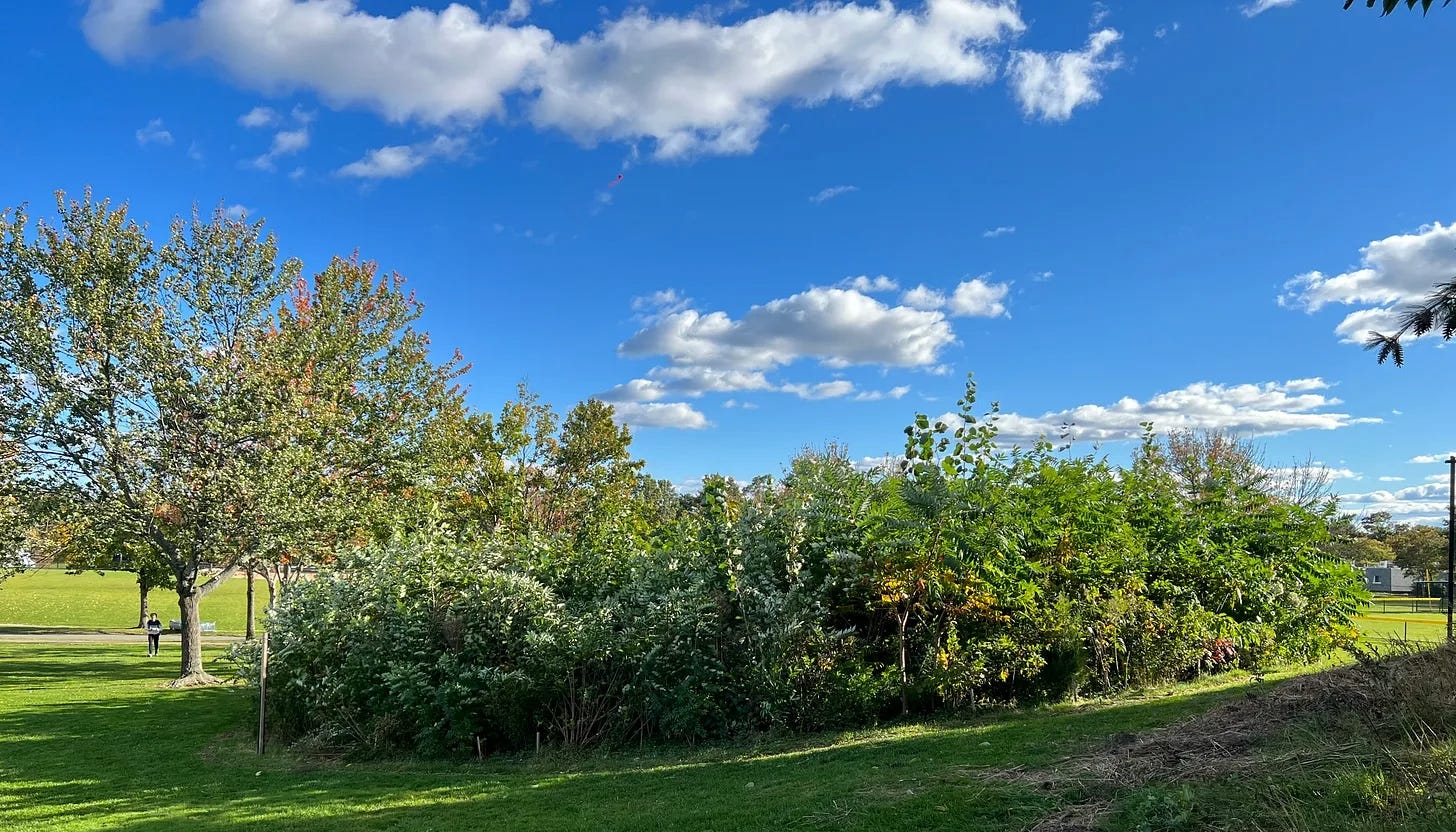
It’s complicated, as a small forest just below the hill’s crest in Cambridge’s Danehy Park shows. From a distance, it looks like Alexander was having a very bad hair day, with sumac trees going every which way and poplars reaching for the sky. The approximately 4,000-square-foot microforest was planted based on principles developed by the botanist Akira Miyawaki. He noticed that trees near places of worship were healthier and grew faster than trees in regular forests. This was due to greater species diversity, more shared resources, and communication via roots connected to the mycorrhizal network. Organisms that collaborate tend to thrive better than those that go it alone.
The Miyawaki Forest in Danehy Park features approximately 1,400 trees and 32 different native tree and shrub species. Each tree and shrub type has its own assemblage of associated bacteria and fungi. Microbes in tree bark eat methane and carbon dioxide. In the Amazon, about a third of the methane emanating from the ground was taken up by bacteria in tree bark.
Good holistic design amplifies the benefits of species diversity, leading to faster growth, increased carbon sequestration, and deeper soils that retain more water. Plants are spaced about 18 inches apart, forming an impenetrable tangle of sapling stems and leaves. Canopy trees such as oaks, maples, and ashes are mixed with understory species such as dogwoods, witch hazel, and viburnums. Others include spicebush, winterberry shrubs, and ground cover such as New Jersey tea and lowbush blueberry, totaling 32 species.
The wisdom of a Miyawaki forest begins with its canopy, which absorbs sunlight and reflects latent heat back into the atmosphere. The forest experiences a temperature inversion, with warm air on top and cool air below, which intensifies as moisture nears the ground. The dense thicket of native trees prevents the winds from drying out the forest.
Trees transpire six molecules of water for every molecule of glucose they photosynthesize. More water is released as carbohydrates are produced to build the plant’s biomass, with one-third of it returning to the soil as root exudates. In the stillness, moist air remains within the forest. Leaves fall to nourish and enrich the moist forest soil, and the water cycle turns within the forest, driven by the sunlit leaves above.
Trees control the release of water vapor by opening stomata on leaves and needles when it is hot. The water evaporates, and the change of state from liquid to gas cools the air. During the coldest hour before dawn, trees release water vapor that condenses to form the morning dew. This exothermic reaction warms the microclimate above the soil. This only works when sheltered from dissipating winds. During winter, a breeze of just two miles an hour will prevent evergreen needles from warming sufficiently in sunlight to photosynthesize.
Trees release the most bacteria and fungi into the air. Water molecules nucleate around organic aerosols and condense to form water that becomes cumulus clouds. Water in the atmosphere retains heat. Water vapor is a greenhouse gas. White cumulus clouds, however, reflect more heat than they absorb, resulting in a net cooling effect on the planet. Clouds high above have an advantage because the density of greenhouse gases is greatest near the ground and decreases with altitude.
In the atmosphere, when water vapor condenses into liquid (volume from vapor to liquid shrinks by a factor of about a thousand) and raindrops fall (removing mass), there is a decrease in air pressure that draws moist air from above the water. This is why the Amazon forest has the world’s largest river. As each diverse, high-density forest matures, ships at sea experience a bit less stormy weather as more energy is drawn inland.
We have suffered enough from climate change. Time for a bifurcated strategy. Let’s reduce greenhouse gas emissions and the amount of heat entering the atmosphere in the first place, with more natural ecosystems carpeting the land. Clothe our constructions with nature, and more forests that look like they are having a bad hair day.
Comments
Nothing yet. Say the first thing.
Sign in to join the conversation.