
Tuesday night, council picked $0.19310 as next year's proposed tax rate, turned down a motion to raise it a penny, and sent staff home with homework. Here’s the math behind each option, the argument over one word, and what you can still change before September 1.
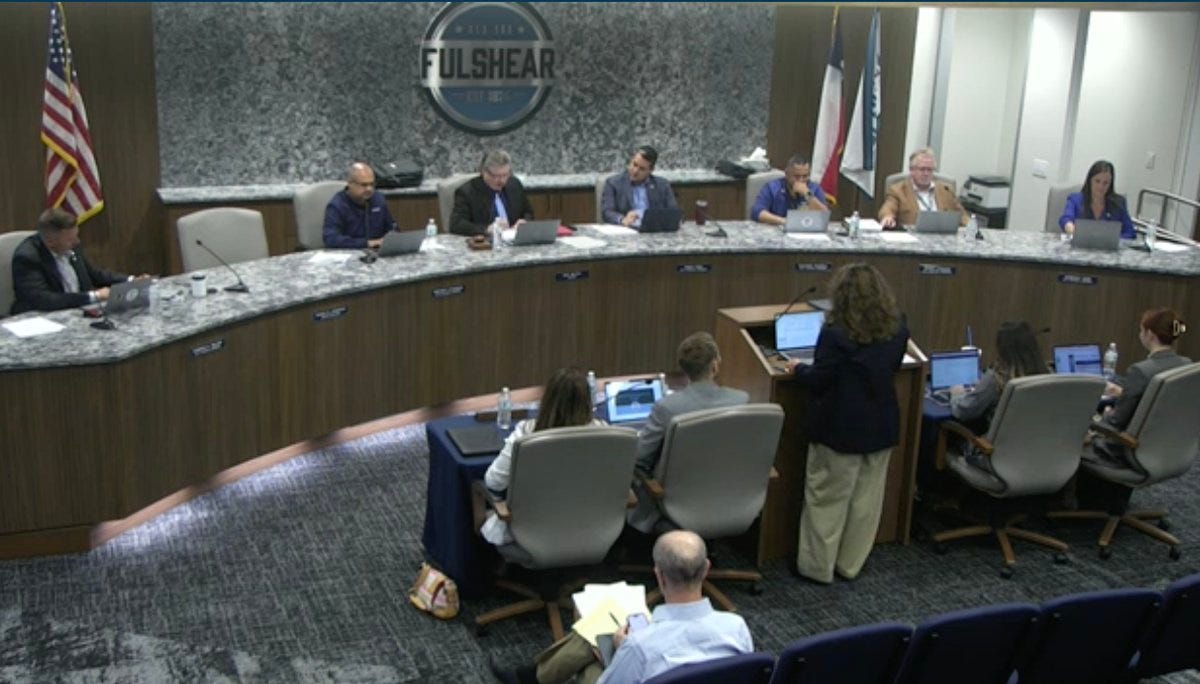
Two weeks ago I told you the number on council’s desk would be $0.19310 per $100 of value. On Tuesday, August 18, council made it official, but not before a two-hour discussion that was the most candid look yet at where Fulshear’s money comes from, where it’s going, and why the easy years are ending.
If you’ve followed this series, you know the premise: the budget is the one document where every other decision the city makes becomes real. Tuesday was the night it started becoming real for your tax bill. This is the installment I promised on the tax rate, the M&O-versus-I&S story, and it turns out the vote was only half of it.
Before anyone talked rates, Finance Director Angela Alvarado walked council through Fort Bend County's certified appraisal roll. The city’s total taxable value is now roughly $5.55 billion, up about 6.2 percent from last year. A year ago, the increase was closer to 12 percent.
The more telling figure is new construction. Last year, new property added about $375 million to the tax roll. This year it added about $180 million, less than half. Council Member Udakar did the division out loud: new growth is only about 3.25 percent of the existing base.
“We are kind of reaching that point of maturation,” Alvarado said. City Manager Zach Goodlander added that the slowdown shows up twice, once in property value and again in development revenue, the permits, inspections, and licenses that new construction pays for.
Mayor McCoy asked the question everyone was thinking: does this mean we’ll soon stop being the fastest-growing city in America? “Probably so,” Goodlander said.
That single slide reframes the whole budget. For years, Fulshear has held its tax rate nearly flat while the city grew underneath it, because new rooftops paid for new services. Council Member Pena put it plainly: “We’ve been fortunate the last few years that we’ve been able to grow to kind of sustain our current government.” That cushion, to borrow a word that would get argued about later, is shrinking.
Fulshear’s rate has two halves, and they behave very differently.
The I&S half, for interest and sinking, is debt service. It covers the MUD reimbursements the city owes under its development agreements, the interlocal agreements with the county for road projects, and starting this year, the payments on the $13.5 million parks bond voters approved in May 2025. The city has to pay its debts, so this half is essentially fixed. It comes off the top.
The M&O half, for maintenance and operations, is everything else: police, streets, parks mowing, staff. Whatever total rate council picks, the debt gets subtracted first, and M&O is what’s left.
Here is the part that surprised me. Since 2020, Fulshear’s M&O rate has been compressing, from roughly 16 cents to about 11 cents today. That isn’t because the city got dramatically leaner. It’s because the debt half kept growing, and council kept choosing to hold the total rate down. M&O absorbed the squeeze.
The state sets two goalposts each year. The no-new-revenue rate is the rate that would raise the same dollars from the same properties as last year, a benchmark for comparison. The voter-approval rate is the ceiling: the no-new-revenue M&O rate plus 3.5 percent, plus the debt rate, plus any “unused increment.” That last term matters. When a city adopts a rate below its ceiling, it can bank the difference and use it within three years. Fulshear adopted $0.167903 last year against a ceiling near 19 cents, so it carried an increment into this year. If it goes above the ceiling, the rate goes to an election.
Alvarado laid out four rates against the current $0.167903. All of them share the same debt half, which rises from about 5.14 cents to about 6.83 cents. Udakar noted that over 90 percent of that 1.7-cent jump is the parks bond arriving on the books for the first time. Because the city sold those bonds at a true interest cost of about 4.3 percent instead of the 4.83 percent assumed on the ballot, the bond’s cost to a $400,000 home comes in at around $64 a year rather than the advertised $74.69.
The differences between the four options are all on the M&O side.
The no-new-revenue rate, $0.159522, would actually be lower than the current rate. It would leave the general fund roughly $1.7 million short of the budget council has been building since spring. Staff’s illustrative list of what that would take included not mowing the new parks, cutting street maintenance, and dropping every new position except police. Nobody on the dais entertained it. “I don’t think anybody up here is gonna vote for the no new revenue thing,” Council Member Miller said.
The “basic” voter-approval rate, about 18.4 cents, takes the 3.5 percent but leaves the banked increment untouched for a future year. It costs a $400,000 home about $65 more a year, and it leaves the budget about $275,000 short, which staff said would come out of the $400,000 in “strategic projects” already in the plan: $150,000 for parks, $100,000 for drainage, $100,000 for building repairs, and $50,000 for landscaping along the Westpark Tollway.
Staff recommended a rate of $0.19310 to support the preliminary budget. It uses about 43 percent of the banked increment, funds everything in the budget, and leaves roughly $235,000 of additional capacity on top of the $342,000 operating surplus. Staff estimates a $400,000 home costs about $100 more per year. The packet’s required taxpayer impact statement puts the median homestead’s increase at $139.81, or 17 percent, but that figure also reflects this year’s rise in appraised value; staff’s number holds the home’s value constant to isolate the rate.
The maximum voter-approval rate, $0.204901, uses the full increment. About $147 more on a $400,000 home, and about $912,000 in additional capacity, with reserves at 29 percent instead of the 25 percent target.
Two rules of thumb from Tuesday worth keeping: every penny on the rate is worth about $573,000 to the city and about $40 a year to a $400,000 home. And the break-even rate, the one that funds the budget as written with zero extra, is about 18.9 cents. The proposed rate sits four-tenths of a cent above that.
Miller asked Alvarado to explain, for the audience, why staff keeps anchoring on a 25 percent fund balance. The answer is three months of operating expenses in the bank: if revenue stopped tomorrow, the city could keep the lights on for a quarter. It is a best-practice number, not a law, but it feeds directly into the city’s credit rating, currently AA+. Udakar drew the line to the capital plan this series has been following: drop the reserve, lose the rating, and the city pays more interest on the roughly $332 million in bonds and loans it will need for wastewater, water, and streets over the next five years. Cutting the reserve to save money would cost money.
The most interesting stretch of the night wasn’t about numbers. It was about vocabulary.
Staff had described the $235,000 above break-even as a “cushion.” Miller objected. “I just don’t like the word cushion. I don’t think that should be the goal,” he said. “There needs to be a strategic plan that lists projects that can justify what we’re doing.” Goodlander conceded the point, “that was our fault,” and offered “strategic priorities” instead. Council Member Bow agreed the messaging should be project-first: let the need drive the number, not the number drive the shopping list.
Meanwhile, the mayor made the case for more, not less. The difference between $0.1931 and the 20-cent ceiling, he said, is one penny, and the difference between a quarter-million dollars and nearly a million in the bank, at a cost of about $48 a year on a $400,000 home. His reasoning had two parts. First, downtown: invest now in the curb cuts, drainage, and infrastructure that attract commercial development, and the sales tax that follows can pay for beautification later. Second, Austin: the next legislative session is expected to target the 3.5 percent cap, possibly dropping it to 1 percent, which would leave next year’s council with far less room.
Udakar offered the honest counterweight. A 1 percent cap isn’t a red line, he said; it’s a yellow one; it would force the city to justify a larger increase to voters in an election rather than to itself at the dais. And the city hasn’t gone to its ceiling in years, so its own history doesn’t show it needing the room.
Pena framed the $100 figure differently: roughly $64 of it is the parks bond voters already approved, so the operations increase council is actually deciding is closer to $36 on that same $400,000 home.
To be fair to every side of this, none of them was arguing for a lean city. Bow said no resident has ever asked her for fewer services. Pena called the current operation “pretty lean” already. The disagreement was about how much room to take and how to explain it, not whether to take any.
Goodlander put a list on the screen. None of it is a major capital project; he called them “minor wins, getting things done that we can’t otherwise fund.” Shade structures at Eagle Landing Park, which has no trees. Drainage on Walker Lane, which $100,000 could probably finish, or a first phase of the Leah and Penn Lane outfall, which it could only start. Repairs to the water-intrusion problems in the police building. Spare generators, pumps, and well components at water plants, because, as Bow noted from the council’s tours, much of that equipment is the only one the city owns, and the Cross Creek reserve fund that has been paying for emergency repairs ends this year at zero. Land downtown, before it’s gone. And the comprehensive plan update, which just landed a matching General Land Office grant that the city could choose to leverage harder.
Udakar’s priority order: critical infrastructure first, then maintenance of what the city already owns, then beautification, and weigh each by how many people it helps and whether it’s shovel-ready. Council Member Johnson added downtown stormwater and the long-deferred Redbird Lane drainage. Alvarado committed to bringing back a ranked list with costs, timelines, and who benefits, and to separate true recurring expenses from one-time ones.
Pena moved to propose the maximum voter-approval rate. It died for lack of a second.
Mayor Pro Tem Johnson then moved to propose $0.19310 with a public hearing on September 1. Council Member Russell seconded. On a roll call, it passed 6–1, with Pena voting no.
One procedural point makes that vote less final than it sounds, and it’s the reason the hearing matters. A proposed rate is a ceiling, not a commitment. Council can adopt anything at or below $0.19310 in September. It cannot go higher without restarting the notice process. So the debate between 18.9 and 19.3 cents is still live; only the debate above 19.3 is closed.
Pena, who wanted the maximum, asked whether proposing it would have preserved flexibility to come down later. It would have. Council chose not to keep that door open.
Three things I’d flag before September 1
First, the tradeoff is narrower than the headline. Between the break-even rate and the proposed rate sits about $235,000 and about $16 a year on a $400,000 home. The honest question for the hearing is whether the project list staff brings back is worth that, not whether Fulshear should raise taxes.
Second, the parks bond is the increase you already voted for. It accounts for most of the debt-side jump, it’s coming in cheaper than advertised, and it’s arriving on your bill this year because the city waited to sell bonds until Primrose Park Phase 3 was ready to build. That’s the right sequence, but it means the bill and the park show up in the same year.
Third, watch the word “cushion.” If the September presentation can name the projects, price them, and rank them, the 19.31-cent rate has a case. If it can’t, council has already said, on the record, that it doesn’t want to buy headroom for its own sake.
The public hearing on the proposed tax rate is Tuesday, September 1, at 6 p.m. at City Hall. Council can adopt the budget and the rate that night or wait until September 15; staff noted there are reasons to adopt early, including police positions that can’t be posted until the budget is final. To speak, sign in before the meeting starts; you get three minutes.
If you go, the most useful thing you can do is react to the project list. Tell council which of those minor wins matters on your street, or which one doesn’t. That is exactly the input they asked for Tuesday night, and it's still the highest-leverage fifteen minutes of civic participation available to you.
Next in the series: what actually gets adopted, and what changed in the room between now and then.
Sources: Fulshear City Council regular meeting, August 18, 2026 (video and agenda packet, including the certified 2026 appraisal roll, the taxpayer impact statement, and the tax-rate options on packet page 338); earlier installments in this series, “Following the $332 Million: A Budget Series” and “The Number Is $0.19310: What’s on Council’s Desk Tuesday Night.”

Supporting Our Local History. All proceeds from “About Fulshear, Texas” sponsorships go directly to the Fulshear Historical Association, a registered 501(c)(3) nonprofit dedicated to preserving and celebrating the rich heritage of our community.
About Fulshear, Texas, is the area’s authoritative hyper-local media ecosystem. Our Substack newsletter achieves a 60%+ open rate, our Facebook presence (@About Fulshear Texas) generates over 35,000 monthly views, and we have launched a community podcast. We reach more than 8,000 unique individuals monthly, with 53.5% residing directly in Fulshear. The core demographic is affluent homeowners aged 35 to 54—representing peak household earning years, established homeownership, and the population most likely to refinance, purchase investment properties, or refer neighbors and colleagues to a trusted lender.
How this post was made: drafted with AI assistance, then researched, edited, sourced, and fact-checked by me. Errors are mine — reply, and I’ll correct them. For more details, click here.
No posts
Comments
Nothing yet. Say the first thing.
Sign in to join the conversation.