
Thousands of planned homes, a boutique hotel, a Home Depot, and miles of new pipe are converging on the ground between FM 1093 and I-10. Here’s what’s actually being built out there — and why the money arrived years before the rooftops.
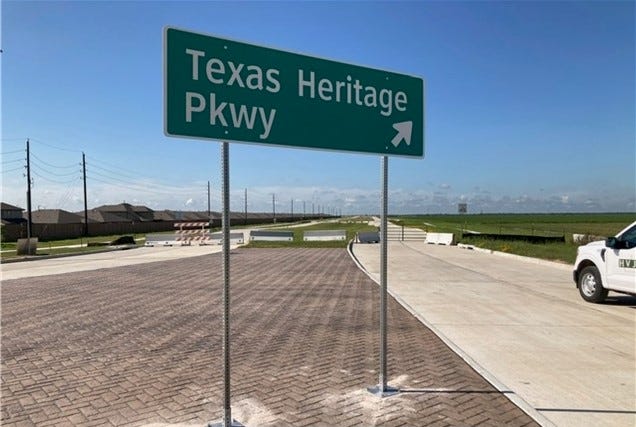
Texas Heritage Parkway is a 6.4-mile, four-lane boulevard running from I-10 down to just south of FM 1093, threaded with roundabouts instead of traffic signals. For most of its short life, it has felt like a road built for a city that didn’t exist yet — a wide, landscaped corridor through land that still reads, in places, as pasture. If you’ve driven it and wondered who exactly it was for, the answer is now arriving, all at once.
Covering Katy News recently published a useful survey of the corridor, and the individual items will sound familiar to regular readers: Heritage Bend, Fulshear Central, Belmont Estates, the Home Depot at FM 1093 and FM 1463. What the piece captures — and what I want to unpack here — is that these are not four separate stories. They are one story, and it’s the same story I told in “The Financialization of Dirt”: capital commits to land years before anyone lives on it, infrastructure follows the capital, and rooftops come last. The corridor is where that sequence is now playing out in public, project by project.
Start with the biggest number. Heritage Bend is nearly 3,000 acres in unincorporated Fort Bend County, announced by Hines in January 2025, planned for more than 7,000 homes with eight builders signed on. The first neighborhood—an 188-acre Highland Homes section with 554 homes planned—broke ground on July 9. Infrastructure is expected to wrap by the end of this year, with the first homesites ready and sales anticipated in early 2027. The master plan also includes the corridor’s next road move: Hines will push the parkway farther south through the property, carrying it beyond the Westpark Tollway toward Winner-Foster Road as the community builds out.
Fulshear Central, the mixed-use project under construction on the south side of FM 1093 between Bois d’Arc Lane and Texas Heritage Parkway, is now underway. At roughly 125,000 square feet, it is the corridor’s commercial down payment: shops and offices, the boutique hotel, and a new connector street tying FM 1093 through to McKinnon Road.
Belmont Estates, a large-lot residential development, got an amended plat for its 109-acre first section approved by City Council on July 21 (6-0, with one abstention). The plat anticipates a future road extending east toward the parkway.
And then there’s the Home Depot — a big-box store of roughly 134,000 square feet planned near FM 1093 and FM 1463, representing more than $38 million in land and construction. On August 4, council voted 5-2 to reject the Chapter 380 incentive agreement — a sales-tax rebate that would have returned 25% of the city’s 1% sales tax for up to five years, capped at $2 million and estimated by staff at roughly $500,000. I wrote about that deal at length before the vote; what matters for this piece is what didn’t change with the rejection. The store site’s water, wastewater, and drainage infrastructure had already been built — by the municipal utility district — before council ever weighed in. As Mayor Pro Tem Sarah Johnson put it that night: “We do want Home Depot in Fulshear.”
Homes, shops, a hotel, a big-box anchor.
The corridor is no longer a road in search of a city.
Here is the pattern worth noticing across all four projects, because it’s the same one I described in “The Financialization of Dirt” and in the Heritage Bend series: by the time you see construction equipment, the important decisions are years old.
Heritage Bend is the cleanest example. Eight builders will sell the homes, but the builders are, in a real sense, customers — Hines assembled and entitled the land, and a municipal utility district finances the pipes and pavement, including the $129 million bond authorization I covered in “Heritage Bend’s $129M MUD Bond — and Who Pays for It.” The parkway extension through the property isn’t a public works afterthought; it’s part of what makes 3,000 acres of dirt worth developing. The road creates the land value, the MUD monetizes it, and future homeowners’ tax bills service the debt.
You can see the same machinery at a smaller scale in the Covering Katy piece if you know where to look. Belmont Estates’ amended plat came with utility strings attached — terms formalized last December in an amended utility agreement among the city, Fulshear Municipal Utility District No. 4, and the developer. The city secured a 12-inch water line — bigger than the subdivision alone requires, sized for firefighting flow and the long-term health of the water system — running up from Fulshear Lake Trace to Belmont’s southern entrance at Bois d’Arc, and it must be in the ground no later than Phase II. Engineers also redrew the sewer plan after finding a shorter, more direct path into the city’s system. The Home Depot site, as noted, had its utilities built by a MUD before the incentive debate even started.
None of this is a scandal. It is simply how master-planned Texas gets built, and it has one important implication for how residents should think about the corridor: most of what will happen along Texas Heritage Parkway was decided in capital structures years ago — what the city still controls is the terms on which that growth connects to Fulshear’s systems.
If the corridor is the powder, the Westpark Tollway extension is the fuse. The first two miles opened on February 28 — well ahead of the contractual completion date of November 3 — and the remaining stretch of the four-mile, nearly $72 million extension to Charger Way is expected to open this month, adding two toll lanes in each direction along FM 1093 and letting through traffic bypass the signals at the major cross streets.
I made the argument in “The August Inflection Point” that the full opening moves neighborhoods along this corridor across the commute-time threshold that changes who shops for a house here, so I won’t repeat it. The short version: the tollway doesn’t just relieve congestion for the people already here. It enlarges the pool of people who will consider moving here — and every project in this piece was underwritten on that assumption. Heritage Bend’s groundbreaking on July 9 and the tollway’s completion in August landing within weeks of each other is not a coincidence. It’s a schedule.
The reasonable reaction to “7,000 more homes” is some version of: can the roads, schools, and pipes handle it? That concern is legitimate, and I’d point anyone asking it to the budget series running in this newsletter now — the city’s proposed five-year capital plan runs roughly $332 million, and its single largest slice, about $126 million, is wastewater, including a South FM 1093 gravity line that serves precisely this part of the map. Sewer capacity, as I argued in that installment, is the real ceiling on growth. The corridor is why.
But there’s a framing trap here, and it’s the same one from the Home Depot debate. The relevant question is never whether Fulshear can stop the corridor from growing. It can’t — Heritage Bend sits in unincorporated Fort Bend County, outside the city’s limits and largely outside its authority, and the tollway is a county project. The relevant question is whether growth happens on terms the city helps write: utility agreements with conditions like Belmont’s water line, plats that reserve road connections to the parkway, capital plans that put the pipes where the people are coming. That’s the leverage Fulshear actually holds, and to be fair to council and staff, the record in this piece — the plat conditions, the utility amendments, the capital plan — shows them using it.
Three things will tell you how fast this corridor matures. First, the tollway’s full opening and what happens to FM 1093 traffic counts afterward. Second, Heritage Bend’s cadence: model homes and first sales in early 2027 will mark the moment the corridor’s financing thesis meets actual buyers. Third — and this is the one you can influence — the budget hearings running through September, where the $332 million capital plan that has to keep pace with all of this gets adopted. The budget is a standing item at regular council meetings until then. If you’ve ever wanted to understand where the next Fulshear is coming from, the corridor is the map, and the budget is the price tag.
Go look at both. And if you know a neighbor wondering what all those roundabouts are for, share this with them.
Sources: Covering Katy, “Fulshear’s next growth corridor takes shape around Texas Heritage Parkway”; Covering Katy, “Westpark Tollway Extension Opens First Segment Saturday in Fulshear”; Covering Katy, “Heritage Bend takes shape as first neighborhood construction begins”; and prior About Fulshear, Texas coverage: “The Financialization of Dirt”, “Heritage Bend: Eight Builders, One Developer, One Financial Sponsor”, “Heritage Bend’s $129M MUD Bond — and Who Pays for It”, “The August Inflection Point”, and the “Following the $332 Million” budget series.

Supporting Our Local History. All proceeds from “About Fulshear, Texas” sponsorships go directly to the Fulshear Historical Association, a registered 501(c)(3) nonprofit dedicated to preserving and celebrating the rich heritage of our community.
About Fulshear, Texas, is the area’s authoritative hyper-local media ecosystem. Our Substack newsletter achieves a 60%+ open rate, our Facebook presence (@About Fulshear Texas) generates over 35,000 monthly views, and we have launched a community podcast. We reach more than 8,000 unique individuals monthly, with 53.5% residing directly in Fulshear. The core demographic is affluent homeowners aged 35 to 54—representing peak household earning years, established homeownership, and the population most likely to refinance, purchase investment properties, or refer neighbors and colleagues to a trusted lender.
How this post was made: drafted with AI assistance, then researched, edited, sourced, and fact-checked by me. Errors are mine — reply, and I’ll correct them. For more details, click here.
No posts
Comments
Nothing yet. Say the first thing.
Sign in to join the conversation.