
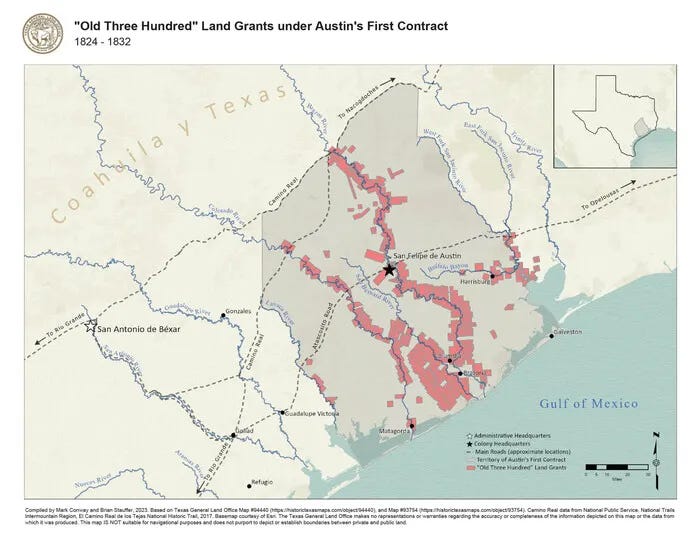
Fulshear, Texas – The modern-day city of Fulshear, a thriving community in north Fort Bend County, owes its very existence to a foundational land grant issued nearly two centuries ago. On July 16, 1824, Churchill Fulshear Sr., a prominent member of Stephen F. Austin's "Old Three Hundred" colonists, received a substantial land parcel—a "sitio" or "league"—from the Mexican government. This 4,428-acre grant, officially designated as the Churchill Fulshear League, Abstract 29, along the Brazos River, laid the groundwork for a rich and enduring legacy.
While the general size and location of this significant grant are well documented, the complete, original "metes and bounds" (precise boundary descriptions using directions and distances) for the entire 4,428-acre league are not readily available in general historical summaries. This common challenge in historical land research stems from evolving land records and the centuries-long subdivision of large grants.
However, detailed boundary descriptions exist for smaller tracts later carved out of the original Fulshear League. A prime example is the historically significant 1.988-acre "Negro School Tract," conveyed in 1890 by Churchill Fulshear Jr. (Churchill Sr.'s son) to establish a school. Its boundaries were meticulously defined, starting at a "large post oak post" near the Fulshear race track gate and extending with precise measurements in "varas" (an old Spanish unit of measurement). These detailed descriptions offer invaluable insights into 19th-century surveying methods, showing reliance on both natural and artificial markers.
The Churchill Fulshear League, Abstract 29, remains a fundamental legal reference for property records in the region today. Even contemporary legal documents for small subdivisions within the area consistently trace their lineage back to this original grant, underscoring its profound and enduring cadastral importance.
The evolution of the Fulshear land holdings reflects the foresight and strategic decisions of the Fulshear family. After Churchill Fulshear Sr.'s early passing, his son, Churchill Fulshear Jr., took the reins, expanding the family's estate and developing the property into a self-sufficient agricultural hub complete with a cotton gin, flour mill, and even a racetrack known as "Churchill Downs."
A pivotal moment came in 1888 when Churchill Fulshear Jr. made the strategic decision to grant the San Antonio and Aransas Pass (SA&AP) Railway a right-of-way through his land. This choice, in contrast to the nearby community of Pittsville, which declined railroad access and subsequently declined, proved transformative. It directly led to the formal platting of the town of Fulshear in 1890, attracting settlers and fundamentally shaping the region's economic and demographic landscape.
Although direct family stewardship of the land ended around 1937, the Fulshear family's legacy remains deeply ingrained in the area's identity. The journey from a vast Mexican land grant and agricultural plantation to a formally platted town named after its original grantee highlights how foundational land grants are dynamic entities that underpin centuries of development and continue to shape the modern geography of places like Fulshear, Texas.
For those seeking a comprehensive and precise delineation of the original Churchill Fulshear League's full boundaries, direct consultation of primary source documents is essential. The Texas General Land Office (GLO) archives are the definitive repository for land grant patents, original field notes (which contain precise metes-and-bounds descriptions), and historical survey maps. Additionally, the Fort Bend County Clerk's Office provides access to deed records that detail subsequent subdivisions. These resources, many of which are increasingly available through digital platforms like the GLO's online databases and "The Portal to Texas History," offer the most authoritative avenues for unearthing the precise historical boundaries of this significant Texas land grant.
[NOTE: This article was originally published on July 27, 2025.]

Supporting Our Local History. All proceeds from “About Fulshear, Texas” sponsorships go directly to the Fulshear Historical Association, a registered 501(c)(3) nonprofit dedicated to preserving and celebrating the rich heritage of our community.
About Fulshear, Texas, is the area’s authoritative hyper-local media ecosystem. Our Substack newsletter achieves a 60%+ open rate, our Facebook presence (@About Fulshear Texas) generates over 35,000 monthly views, and we have launched a community podcast. We reach more than 8,000 unique individuals monthly, with 53.5% residing directly in Fulshear. The core demographic is affluent homeowners aged 35 to 54—representing peak household earning years, established homeownership, and the population most likely to refinance, purchase investment properties, or refer neighbors and colleagues to a trusted lender.
How this post was made: drafted with AI assistance, then researched, edited, sourced, and fact-checked by me. Errors are mine — reply, and I’ll correct them. For more details, click here.
No posts
Comments
Nothing yet. Say the first thing.
Sign in to join the conversation.