
Piper is not an energetic dog.
Most afternoons, she barely lifts her head when I step out onto the patio in our Fulshear backyard. So when I noticed her frozen—completely locked in on something under the patio furniture—I knew something was off.
She wasn’t barking. She wasn’t wagging. Just staring.
I followed her gaze and took a few careful steps closer, trying to see what had her so focused. At first, I didn’t notice anything—just shadows and the legs of the furniture.
And then it moved.
A slow, unmistakable shift beneath the chair.
Now, I’m Australian. I grew up around snakes, and one thing you learn pretty quickly is this: you treat every snake with caution.
But standing there in my backyard in Fulshear, that experience didn’t give me answers—it just made me more aware of what I didn’t know. Texas snakes aren’t the ones I grew up with.
My mind immediately started racing. Is it dangerous? How close is too close? What am I actually supposed to do here?
If you live around here, there’s a good chance you’ll have a moment like this at some point. And what I’ve realized is: knowing what to do doesn’t come naturally, but it can be simple. And it definitely doesn’t have to start with panic.
1. Pause and create distance
Stop moving toward it
Slowly back up to at least 6–10 feet away
Keep your movements calm and predictable
Most snakes aren’t interested in you—they just don’t want to feel threatened.
2. Get pets and kids out of the area
Call your dog back (this was my first priority with Piper)
Bring pets and children indoors right away
Don’t let curiosity turn into a closer encounter
3. Do not try to handle or kill it
This is where a lot of trouble happens.
Most snake bites occur when people try to interact with or kill the snake
Even a harmless snake can bite if it feels cornered
The safest interaction is no interaction.
4. Watch the snake’s behavior (not just how it looks)
You don’t need to be an expert in identification.
Instead, notice:
Is it moving away? → Great, let it go
Is it coiled or staying put? → Give it space and time
Is it near a hiding spot (bushes, fence line, furniture)? → It’s likely passing through
5. Give it time to leave
Most snakes will move on within minutes to a few hours
Your yard is usually just part of their route—not their destination
6. Call for help if something feels off
It’s completely okay to ask for help.
Consider calling local animal services if:
The snake is inside your home or garage
It hasn’t moved on after a while
You feel unsure or uncomfortable handling the situation
7. Take a breath—seriously
This part matters more than it sounds.
That initial adrenaline spike? Totally normal.
But once you pause, create space, and think through your steps, the situation becomes much more manageable.
One thing that helped me feel calmer afterward was understanding what’s actually out there.
In Texas, there are four venomous snakes you might hear people mention: copperheads, cottonmouths (water moccasins), rattlesnakes, and coral snakes. All of them exist in the broader region, and a couple—like copperheads—are more commonly talked about around areas like Fulshear.
But here’s the part I didn’t fully appreciate at first: most snakes you’ll come across are harmless.
Rat snakes, water snakes, and garter snakes are far more likely visitors in a backyard setting, and they’re not interested in anything other than finding food and moving on.
The tricky part is that if you’re not used to identifying them (and I definitely wasn’t with Texas species), it’s not always obvious what you’re looking at in the moment.
And that’s exactly why the best approach isn’t to rely on quick identification—but to treat every snake encounter with the same calm caution. Give it space, avoid interaction, and let it move on.
Once I stopped feeling like I needed to instantly “figure it out,” the whole situation got a lot less stressful.
After that experience, I found myself thinking less about “how do I avoid snakes entirely?” and more about something a little more realistic: how do I make encounters like that less likely—and a lot less stressful when they do happen?
Because the truth is, living in Fulshear, you’re never completely separate from wildlife. Neighborhoods back up to open land, ponds, and green spaces. Snakes are just part of that ecosystem.
What is in your control, though, is how inviting your space is to them.
I started to notice the little things, like how easy it is for a yard to become a perfect resting spot without you realizing it. Longer grass, overgrown edges, or shaded areas under furniture can create exactly the kind of cover a snake is looking for. Keeping things trimmed back and visible doesn’t eliminate the possibility, but it does make your yard far less appealing as a place to stop and linger.
The same goes for clutter. Piles of wood, unused materials, or tucked-away corners can feel harmless, but they double as shelter for all kinds of wildlife. That moment with Piper happened under patio furniture is a reminder that even ordinary spaces can become hiding spots.
Another thing I hadn’t really thought about before is how indirect the attraction can be. Snakes aren’t showing up because of anything you’re doing—they’re following food. If your yard attracts rodents, it can quietly become part of that food chain. Simple things like securing trash, avoiding pet food left outside, and keeping things tidy can make a difference over time.
It also changed how I think about pest control. Some methods, like glue traps, can seem convenient—but they’re often unnecessarily cruel and can harm more than just the intended target. Taking a more thoughtful approach to managing pests not only feels better, it also supports a healthier, more balanced environment overall.
I also took a closer look at the house itself, especially around the garage and fence lines. Not in an obsessive way, just noticing where there might be small gaps or easy entry points. It doesn’t take much space for something to get through, and sealing obvious openings adds a little extra peace of mind.
But the biggest shift for me wasn’t anything physical, it was mindset.
You can do everything “right” and still see a snake occasionally. And that’s not a sign something is wrong—it’s just part of living in this environment.
What changed for me is that it stopped feeling like a crisis waiting to happen, and more like something I understood how to handle.
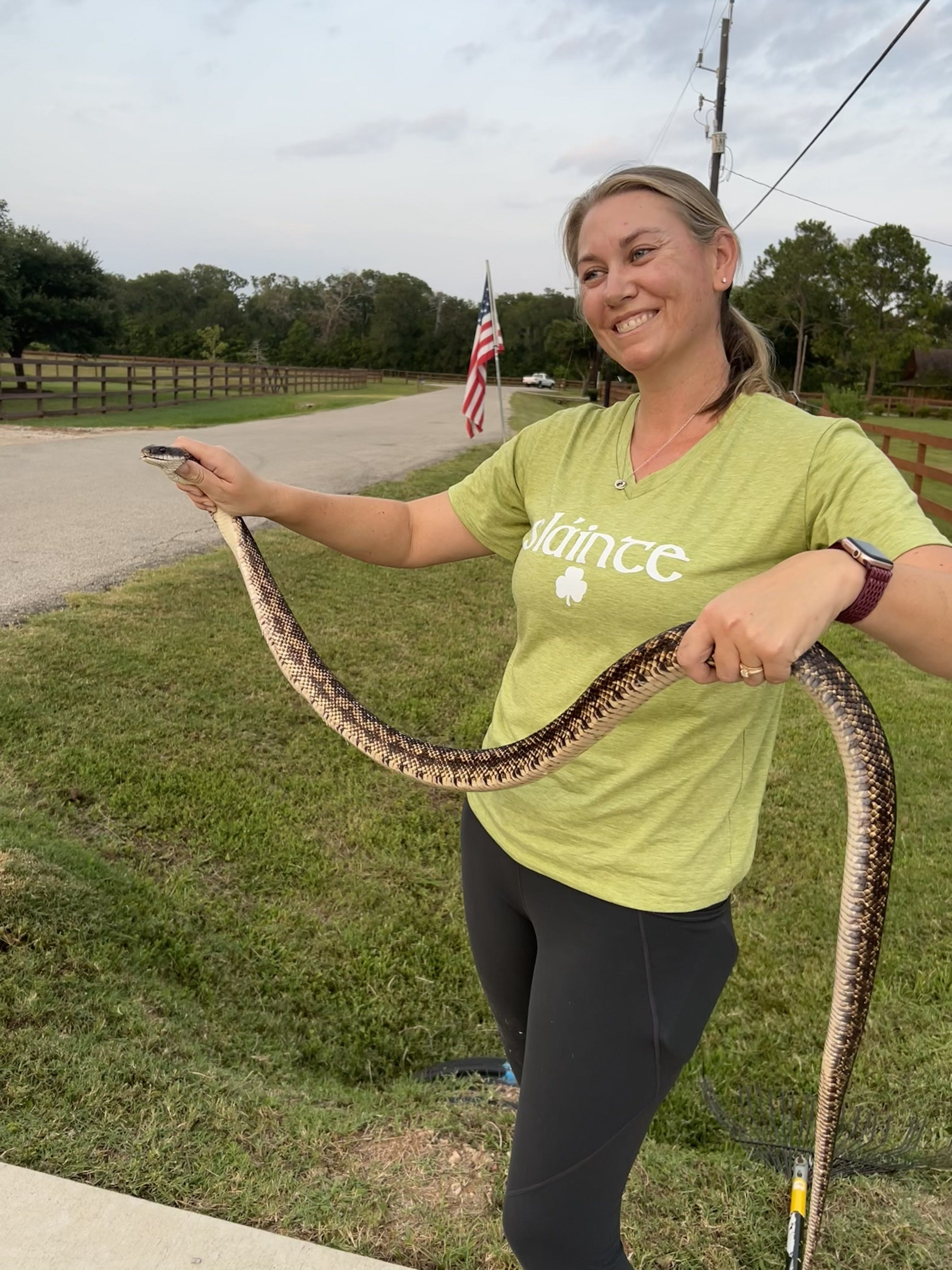
For the snake on my back patio, a non-venomous western rate snake, I gently relocated it to grassy area along the Brazos River.
Later that evening, Piper got a little extra meat in her dinner—part reward, part thank you for paying attention when it mattered.
By the next day, she was back to her usual self: stretched out in the backyard, conserving energy, only occasionally springing into action if a squirrel made a questionable decision.
And honestly, that’s how I want to feel about snakes here, too. Not constantly on edge, not overreacting, just aware enough to notice when something’s off, and calm enough to handle it when it is.
Because in a place like Fulshear, these moments are going to happen. But they don’t have to turn into panic. With a little awareness and a simple plan, they can just become part of the rhythm of living here, something you notice, handle, and then get on with your day.
About the Author: Sarah Johnson is a longtime Fulshear resident and currently serves as Mayor Pro Tem and District 1 Council Member for the City of Fulshear. An Australian native, Sarah has called Fulshear home for more than 13 years and became involved in local government through issues affecting her own neighborhood. When she isn't tackling city business, apparently she can also be found negotiating unexpected backyard encounters with Texas wildlife, with a little help from Piper.
No posts
Comments
Nothing yet. Say the first thing.
Sign in to join the conversation.