
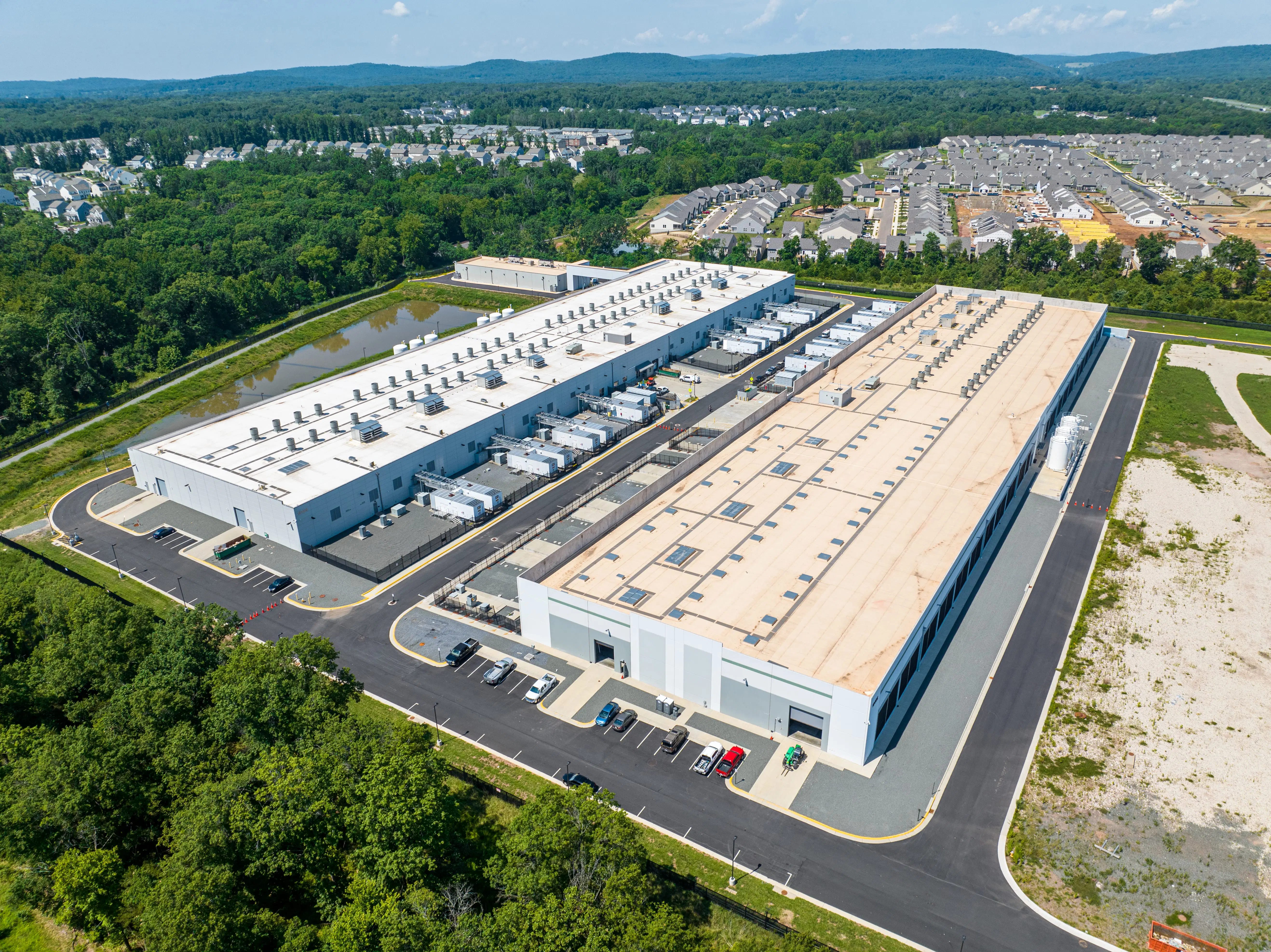
The short answer is that nobody has proposed one here. The longer answer is about power, water, and who gets to say no — and on all three, Fulshear is in a better position than most Texas towns. For now.
Every so often a reader asks me a question I can’t answer in a sentence. This month it came three different ways — at a Rotary lunch, in a reply to the water restrictions post, and in a text with a screenshot of a Granbury news story attached. All three amounted to the same thing: Are they going to put one of those AI data centers out here?
It’s a fair question, and it’s being asked in a lot of small Texas towns right now for good reason.
So I went looking.
As of this writing, no data center has been proposed inside the City of Fulshear, and none has surfaced publicly in our stretch of northwest Fort Bend County. Nothing on a Planning and Zoning agenda. Nothing on a Council agenda. Nothing in the Texas Comptroller’s registry of certified data centers. Nothing plotted near us on either of the two statewide trackers that journalists are using — the Texas Tribune’s and the Houston Chronicle’s.
Now let me tell you why that answer is weaker than it sounds.
Texas has no state database of data centers. None. The Tribune has said so plainly, and the Comptroller’s list only captures projects that applied for a specific sales-tax exemption — a subset, not a census. Developers routinely assemble land under LLC names and run projects under code names; in Hood County, the eight proposals that landed on the commissioners’ desks arrived with names like “Fort Spunky” and “Project Panther.” A tract can be optioned, surveyed, and quietly rezoned somewhere else in Texas before anyone at the coffee shop hears the word “data center.”
So the honest version is this: nothing is public here, and “nothing is public” is not the same as “nothing is happening.”It’s simply the best answer available, and it’s the one I’d bet on.
The scale of what’s happening statewide is genuinely hard to hold in your head.
ERCOT — the grid operator — was tracking roughly 474 gigawatts of large-load interconnection requests as of June, spread across more than 1,800 projects. About 90 percent of that is data centers. For comparison, the all-time record for actual electricity demand on the Texas grid is 91,089 megawatts, set on July 22 of this year. The queue is more than five times the largest hour Texas has ever had.
Not all of it is real. Developers file speculative requests in multiple locations and abandon most of them. But the number was large enough that on August 3, Governor Abbott directed the Public Utility Commission and ERCOT to conduct a comprehensive verification and audit of every data center moving through the interconnection process, and said projects that don’t comply with state requirements must be denied grid access. ERCOT responded the same day by suspending its “Batch Zero” study process — the pipeline it had built specifically to handle this wave. At the PUC’s August 14 open meeting, ERCOT said the verification would take several months, though less than nine, and that up to roughly 300 projects fall under it.
In plain terms: the front door to the Texas grid is closed to new data centers until the state finishes counting.
Closer to home, land-use consultants cited in Missouri City’s own agenda materials this spring counted roughly 400 data centers in Texas, with about 55 in the Greater Houston region. The Chronicle’s tracker puts the statewide count at 335 operating, with another 225 planned. Houston is not the epicenter — Dallas–Fort Worth is, by a wide margin — but Fort Bend County has been named repeatedly as a place developers are looking, because of land, existing electric infrastructure, and Houston’s fiber network.
Strip away the mystique and one of these facilities needs three things.
Power at transmission scale. Not a big commercial service — a substation. Senate Bill 6, signed in June 2025, created a whole new regulatory category for “large loads” of 75 megawatts or more, with disclosure and curtailment obligations attached. Seventy-five megawatts is roughly what fifteen thousand homes pull. The projects generating headlines are ten and twenty times that.
Water, or a very expensive alternative. Roughly 30 percent of the energy a data center consumes goes to keeping the chips from cooking themselves. The Houston Advanced Research Center estimated in January that a mid-sized facility uses about 300,000 gallons a day; a University of Houston engineering professor put hyperscale campuses at up to five million gallons a day. Closed-loop and air-cooled designs cut that dramatically, and the industry points that out fairly. But they cost more and use more electricity, which is its own tradeoff.
A large, flat, cheap tract with fiber nearby. Hundreds of acres, ideally, and ideally not next to houses.
Now hold each of those up against Fulshear.
On power: CenterPoint Energy is the transmission and distribution utility here, and the system that serves us was built for rooftops, schools, and retail centers. A single 300-megawatt customer doesn’t plug into that; it follows high-voltage transmission, and it brings a substation with it. Right now, the interconnection queue it would need to enter is frozen.
On water: Fulshear is a member of the North Fort Bend Water Authority, an entity that exists for one reason — to move this area off the aquifer and onto surface water under Fort Bend Subsidence District mandates. The District adopted an amended regulatory plan in December 2025 that steps those limits down over the coming decade. I wrote about all this in the spring, in the infrastructure piece. We are a community actively rationing and re-plumbing its own water supply. A new industrial customer asking for 300,000 gallons a day is not a routine service request here. It’s a policy decision.
On land: this is the part people underestimate. Fulshear doesn’t look like Hood County because our big flat tracts already have a higher bidder. Land that pencils out at master-planned-community prices does not pencil out for a warehouse full of servers. Our best protection against a data center, right now, is a housing developer.
It would be dishonest to pretend any of that is permanent. Closed-loop cooling solves the water objection. Developers routinely pay for their own transmission and increasingly build their own on-site gas generation. And rooftop economics change. These are frictions, not walls.
Here is the part I most want you to understand, because it’s the difference between reading about Granbury and having a say in Fulshear.
Inside the city limits, Fulshear has zoning. Our Coordinated Development Ordinance — Chapter 28 of the city code, adopted in 2020 and amended several times since — divides the city into districts and lists, district by district, exactly which uses are allowed.
Search that ordinance for “data center,” and you will not find it. Not once.
That sounds like a loophole. It is close to the opposite. Section 28-2-20, titled New, unlisted, and prohibited land uses, handles exactly this situation. When someone proposes a use that isn’t on the list, the city administrator must determine whether it is “a subcategory or functionally similar to a specifically identified use,” weighing fifteen criteria — among them trip generation, impervious surface, regulated air or water emissions, noise, lighting, use and storage of hazardous materials, character of buildings and structures, nature and impacts of operation, and hours of operation. The administrator may refer that call to the Planning and Zoning Commission.
And then this sentence, which is the whole ballgame: if the administrator determines the proposed use is not functionally similar to a listed use, the use is prohibited.
So what would a data center be “functionally similar” to? The only district where it plausibly lands is Industrial (IN), and there are three candidates on that list:
Warehousing and Storage — permitted by right. A building permit, and that’s the process.
Manufacturing, Light — permitted by right. Same.
Power Generation, Transmission, and Distribution — requires a specific use permit, which means a public hearing, a Planning and Zoning recommendation, and a City Council vote.
That single classification decision determines whether your neighbors get a microphone or a notification. It is the most consequential land-use question nobody in Fulshear has had to answer yet.
A few other things worth knowing about the IN district: buildings top out at 45 feet, a Type C bufferyard is required where industrial abuts residential, and the specific-use-permit criteria in Section 28-2-17 require that adequate public services — explicitly including water, sewer, and electricity — be available “without the reduction of services to any existing uses.” That last clause is the sharpest tool in the drawer, and it was written for exactly this kind of question, even though nobody was thinking about AI when they wrote it.
I should be straight about one gap: I don’t have a figure for how many acres inside Fulshear are currently zoned IN. It isn’t much, and any tract not already zoned Industrial would need a zoning map amendment first — again, a public hearing and a Council vote. But I’d like the actual number, and I’ve requested it.
Outside the city limits, the picture inverts. Fort Bend County has not adopted zoning ordinances and does not issue certificates of occupancy. The county’s real levers are subdivision platting, drainage, road design, on-site sewage, and utility connections — process, not use. It can make a project engineer its stormwater properly. It cannot tell a landowner that servers don’t belong there.
That is not a Fort Bend failing; it’s Texas law, and it applies to nearly every county in the state. It also explains the single most important statistic in the Tribune’s reporting: of the 248-plus data centers planned in Texas, nearly half are headed for unincorporated areas — up from about 12 percent of existing facilities. Developers have noticed where the hearings aren’t.
Fulshear’s extraterritorial jurisdiction sits in the middle. The city can apply subdivision regulations out there. It cannot zone.
Which brings me to the reframe. The question isn’t really whether Fulshear could stop a data center. Inside the city limits, with a rezoning and possibly a specific use permit in play, the answer is plainly yes. The question is whether the decision would ever reach Fulshear at all — or whether it would land two miles outside the line, on a county plat, where the only public meeting is the one where somebody reads the drainage calculations aloud.
Same county. Similar growth pressure. No data center anywhere in the city.
In May, Missouri City amended its zoning ordinance anyway. The package defines data centers as a distinct use, routes them through a special use permit requiring public hearings before both the Planning and Zoning Commission and the City Council, and — the piece I find most useful — requires an applicant to disclose projected energy and water usage before a building permit can be issued. The city’s materials also describe a minimum separation from residentially zoned property, a height cap on the principal structure, screening of equipment, and submittals covering noise, generator inventory and emissions, hazardous materials, traffic, grid coordination, and decommissioning.
Development Services Director Jennifer Thomas Gomez told the council the amendment doesn’t prohibit data centers. It sets standards.
That’s the point. Missouri City wrote its rules with zero applications pending, which is the only time you can write them calmly, cheaply, and without a lawyer for a landowner sitting in the third row. Fort Worth is now doing the other version — a moratorium adopted this month under public pressure, with litigation risk baked in and a ninety-day clock. Both cities will end up with an ordinance. One of them will have paid much more for it.
To be fair to the other side: Dan Diorio of the Data Center Coalition argues that communities perceived as unwelcoming lose more than data centers, and that the industry has generated over $3 billion in state and local tax revenue in Texas in three years. He’s not wrong about the money. The property tax base a facility like this throws off is enormous relative to its footprint, and it doesn’t send children to school or drive on the roads at rush hour.
But the jobs are the honest weak spot, and the state’s own tax code proves it. To claim the sales tax exemption under Section 151.359, a “qualifying data center” must be at least 100,000 square feet, invest $200 million within five years — and create twenty qualifying jobs. The “large” version, at 250,000 square feet and roughly half a billion dollars, requires forty.
Big tax base, tiny payroll, large appetite for two utilities we’re already managing carefully. That’s the actual trade. It may still be worth making. It should be made with the numbers in front of you.
If you want to track this yourself, these are the places a project shows up before it shows up:
City Planning and Zoning and City Council agendas, for either a zoning text amendment addressing data centers or a rezoning of a large tract to Industrial.
Fort Bend County Commissioners Court agendas, for a Chapter 381 economic development agreement — the county’s cousin of the Chapter 380 agreement we spent so much time on with Home Depot. A tax deal is often the first public trace of a private project.
Lamar CISD board agendas, for any school district value-limitation application.
The Comptroller’s registered data center list, which is updated periodically and is genuinely public.
Large land assemblies filed under LLC names with no announced use, particularly near existing transmission corridors.
The ERCOT and PUC dockets, for the outcome of the Abbott audit. That’s a matter of months, not years.
I’ll keep an eye on all of it, and I’ll tell you the moment something appears.
Nobody is building a data center in Fulshear. But Missouri City wasn’t building one either when it sat down in May and wrote the rules — and that is precisely why it could.
Fulshear has something most of the Texas towns in these news stories never had: zoning, a Planning and Zoning Commission, an unlisted-use provision that turns a novel proposal into a public decision rather than a permit clerk’s judgment call, and a Council that answers to people who show up. Those tools are worth exactly as much as we’re willing to use them before we need them.
The Council meets on the third Tuesday of the month, and the Planning and Zoning Commission meets ahead of it. If you want to know what Fulshear thinks about data centers, the useful thing to do is not to wait for a sign to go up on a fence line. It’s to ask the question while the answer is still cheap.
Sources: Office of the Governor, Aug. 3, 2026 directive; ERCOT Market Notice M-A080326-01 and Aug. 14 PUC open meeting; The Texas Tribune (June 2, June 8, Aug. 3, Aug. 14, 2026); Houston Chronicle Texas data center tracker; Houston Public Media / Texas Standard, June 8, 2026; Houston Advanced Research Center, “Thirsty Data,” January 2026; City of Fulshear Coordinated Development Ordinance, Chapter 28; Fort Bend County Engineering; Fort Bend Subsidence District 2025 Regulatory Plan; Texas Tax Code §§ 151.359 and 151.3595; Texas Comptroller of Public Accounts.
If a neighbor has asked you this question, forward them this post. And if you hear something before I do — reply to this email. That’s how half of what I write gets started.

Supporting Our Local History. All proceeds from “About Fulshear, Texas” sponsorships go directly to the Fulshear Historical Association, a registered 501(c)(3) nonprofit dedicated to preserving and celebrating the rich heritage of our community.
About Fulshear, Texas, is the area’s authoritative hyper-local media ecosystem. Our Substack newsletter achieves a 60%+ open rate, our Facebook presence (@About Fulshear Texas) generates over 35,000 monthly views, and we have launched a community podcast. We reach more than 8,000 unique individuals monthly, with 53.5% residing directly in Fulshear. The core demographic is affluent homeowners aged 35 to 54—representing peak household earning years, established homeownership, and the population most likely to refinance, purchase investment properties, or refer neighbors and colleagues to a trusted lender.
How this post was made: drafted with AI assistance, then researched, edited, sourced, and fact-checked by me. Errors are mine — reply, and I’ll correct them. For more details, click here.
No posts
Comments
Nothing yet. Say the first thing.
Sign in to join the conversation.