
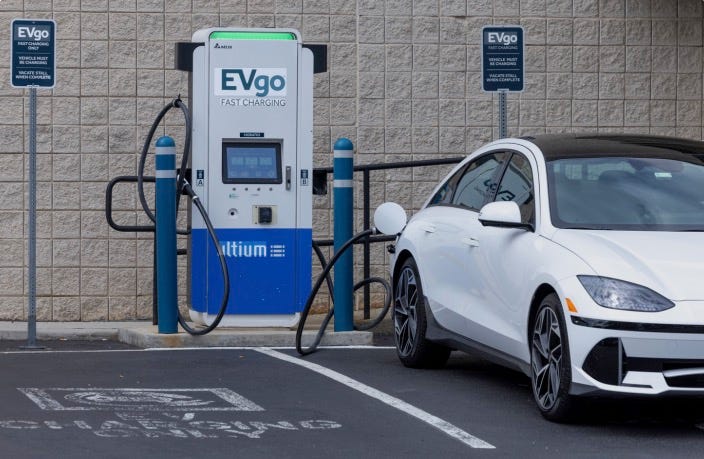
A reader says our commute is built for electric cars, and that free-night electricity makes the fuel cost “a nothing burger.” He’s mostly right. But the free part is doing less work than the advertising suggests — and one of the most heavily marketed plans in Texas won’t let EV owners in the door.
Every so often a reader hands me a good question dressed up as a casual suggestion.
This one came from Mitch Winkler, who noted that a Fulshear-to-downtown or Medical Center commute looks close to ideal for an electric vehicle. With so many Texas plans offering free nights, he wrote, the energy cost can be a nothing burger — and EVs excel in stop-and-go traffic besides. Maybe a future topic, he said.
So I spent a few days on it. The short version: the fuel savings are real and larger than most people assume. The mechanism that delivers them is not the one on the billboard.
From Fulshear to downtown Houston is about 34 miles by road, depending on where you start and whether you take the Westpark or I-10. The Medical Center is a bit farther. Call it 68 to 75 miles round trip.
Five days a week, forty-eight weeks a year, that’s roughly 16,000 miles of commuting alone — before groceries, church, or a grandchild’s ballgame in Katy.
At the AAA Texas statewide average of about $3.63 a gallon in mid-August — up roughly 85 cents from a year ago — that commute costs a 28-mpg crossover somewhere around $2,100 a year in gasoline. A thirstier vehicle gets you closer to $2,400. A frugal sedan, maybe $1,850.
An efficient EV covers the same 16,000 miles on roughly 4,800 kilowatt-hours drawn from the wall. At the Houston area’s typical all-in residential rate of about 14 to 15 cents, that’s around $700.
So before we discuss a single word of fine print: the fuel side of this comparison isn’t close. Mitch is right about the direction and roughly right about the size.
This is the part that surprises people. Gasoline cars do their best work on the open highway and their worst in stop-and-go. EVs are the reverse. Regenerative braking recovers energy every time you slow down, and lower speeds mean less air to push. The EPA’s own city ratings for electric vehicles typically run 15 to 25 percent better than their highway ratings.
To be fair, that cuts against the Fulshear commuter in one respect. A good deal of our drive isn’t stop-and-go at all — it’s sustained 70-plus running on the Westpark or I-10, which is exactly where an EV gives back its efficiency advantage. The 8 a.m. crawl east of Beltway 8 helps you. The tollway sprint does not.
Here is where the marketing and the arithmetic part company.
Your electric bill has two halves. One is the energy charge — what your retail provider sells you. The other is the delivery charge — what CenterPoint bills for the poles, wires, and meter, at a rate the Public Utility Commission sets and every provider passes through at cost. Nobody in Fulshear can shop that half. CenterPoint is our wires company because of where our houses sit, full stop.
Delivery currently runs around a nickel per kilowatt-hour plus about $5 a month. The exact figure moves; the PUC resets it each March and September, and the next adjustment lands September 1.
Now apply that to the commute. Most free-nights plans waive only the energy charge during the free window. Delivery keeps ticking. Charge 4,800 kilowatt-hours overnight at a nickel of delivery, and you have paid about $240 for a year of “free” electricity.
That is still a bargain against $2,100 of gasoline. It is not a nothing burger.
Two more things worth knowing before anyone signs a twelve-month contract:
The daytime rate pays for the free window. Providers don’t give away power; they price the free hours into a higher rate for every other hour. Independent analysts generally put the break-even between 30 and 40 percent of your monthly usage falling inside the free window. Most Texas households don’t get there, because most usage is daytime air conditioning.
“Many plans” is generous. As of mid-August, one Houston plan-shopping site counted just four time-of-use plans from two providers in our market. The category is smaller than the ad spend implies.
I looked at TXU’s Free Nights & Cool Summer plan — currently the most visible free-nights offer in Texas — and found this in its footnotes: customer exclusions include homes with rooftop solar panels, electric vehicles, or batteries.
Read that twice. The plan, built around shifting load to night hours, will not enroll the households best equipped to do it.
It would be dishonest to stop there, though, because it makes TXU look like it’s hiding from EV owners when in fact it’s routing them somewhere else. The same company sells EV-specific plans. Its Free EV Miles plan credits back 100 percent of both the energy charge and the CenterPoint delivery charge for vehicle charging done at home between 10 p.m. and 1 p.m. — fifteen hours a day, every day. Verification runs through your car’s telematics, which you have to authorize; TXU says the platform covers more than 90 percent of EVs on the road.
Waiving delivery is the unusual part, and it’s the part that makes Mitch’s phrase nearly literal. That $240 I calculated above goes away.
TXU’s own savings claim is “more than $500 a year,” built on an assumed 3,550 kilowatt-hours of annual home charging. A Fulshear commuter running 16,000 miles to downtown would use meaningfully more than that.
So: is the energy cost a nothing burger? On the right plan, close to it. But you get there through a door marked “EV plan,” not the one marked “free nights” — and if you walk through the wrong one you may be told you’re ineligible.
Fuel is where EVs win. The rest of the ledger deserves the same honesty.
The federal tax credit is gone. The $7,500 new-vehicle credit and the $4,000 used-vehicle credit both ended for vehicles acquired after September 30, 2025. There is no federal purchase incentive in 2026. Anyone quoting you an EV price net of $7,500 is working from an outdated script.
So is the charger credit. The 30 percent federal credit for home charging equipment expired for property placed in service after June 30, 2026. A Level 2 installation in a Weston Lakes garage is now entirely out of pocket — and if your panel is full or the run is long, an electrician’s quote can surprise you.
Texas charges EVs $200 a year. New registrations pay $400 up front, covering two years. That reads as a penalty, and I’ve seen it argued that way. But run the numbers: our 16,000-mile commuter burning 583 gallons pays about $224 a year in state and federal fuel taxes at 38.4 cents a gallon. For a heavy commuter, the EV fee is close to a wash. For someone driving 8,000 miles a year, it isn’t — that driver pays roughly double what the gas tax would have collected. The fee is flat; road use isn’t.
Public charging here is thin. Fulshear has a Shell Recharge site on FM 1463 and a handful of stations along FM 359 and at Cross Creek. The nearest Tesla Superchargers are in Katy, at the Buc-ee’s on the Katy Freeway and near the H-E-B off Nelson Way, with a fast-charging site up in Brookshire. That’s adequate for a household that charges at home and workable for an occasional top-off. It is not adequate as a primary fueling strategy.
Which brings me to the condition the whole argument rests on. If you cannot charge where you sleep, none of the above applies to you. Every dollar of savings in this piece assumes a garage, a 240-volt circuit, and a car sitting still from 10 p.m. to 6 a.m.
It isn’t whether electricity is cheaper than gasoline in Fort Bend County. It is, by something like two-to-one or better, and rising pump prices are widening the gap.
The relevant question is whether your household can put the load where the discount is — and whether the plan you sign will let an EV owner participate at all.
On that test, Fulshear scores unusually well. We are a city of single-family homes with garages, long outbound commutes, and driveways that sit occupied overnight. That is close to the ideal profile, and Mitch identified it correctly.
Two pieces of homework if you’re considering this. Pull your actual hourly usage from Smart Meter Texas before you shop; it will tell you in an afternoon whether a time-of-use plan fits your household or fights it. And read the Electricity Facts Label — the one-page disclosure every Texas plan must publish — specifically for two things: whether delivery charges are included in the free window, and whether EV households are excluded. Both answers are in there. Neither is in the commercial.
If you drive an EV out of Fulshear every morning, I’d like to hear your real numbers — what you pay, which plan you’re on, and whether the math has held up. Same if you tried a free-nights plan and it went sideways. Reply to this email; I’ll follow up with what readers report.
And thank you, Mitch. That was a better question than it looked.
Figures in this piece reflect rates and rules in effect in mid-August 2026. Gasoline prices are AAA Texas statewide averages; electricity delivery rates are set by the Public Utility Commission of Texas and reset March 1 and September 1. Plan terms change frequently — verify against the current Electricity Facts Label before enrolling.

Supporting Our Local History. All proceeds from “About Fulshear, Texas” sponsorships go directly to the Fulshear Historical Association, a registered 501(c)(3) nonprofit dedicated to preserving and celebrating the rich heritage of our community.
About Fulshear, Texas, is the area’s authoritative hyper-local media ecosystem. Our Substack newsletter achieves a 60%+ open rate, our Facebook presence (@About Fulshear Texas) generates over 35,000 monthly views, and we have launched a community podcast. We reach more than 8,000 unique individuals monthly, with 53.5% residing directly in Fulshear. The core demographic is affluent homeowners aged 35 to 54—representing peak household earning years, established homeownership, and the population most likely to refinance, purchase investment properties, or refer neighbors and colleagues to a trusted lender.
How this post was made: drafted with AI assistance, then researched, edited, sourced, and fact-checked by me. Errors are mine — reply, and I’ll correct them. For more details, click here.
No posts
Comments
Nothing yet. Say the first thing.
Sign in to join the conversation.