
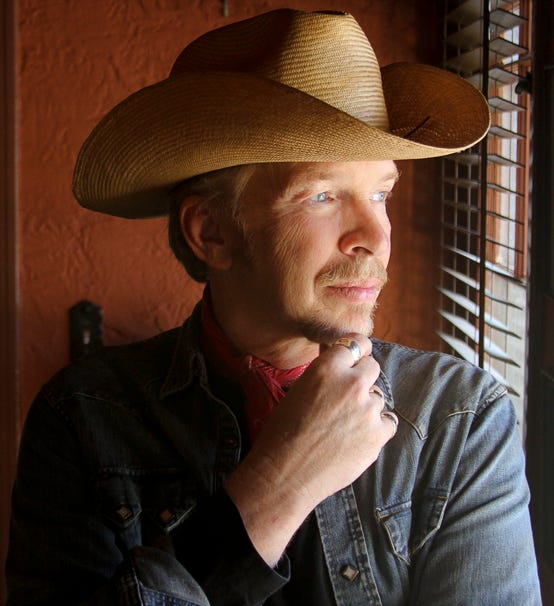
Sometime back in the late Seventies, I heard the Blasters blow the roof off at Madame Wong’s West in Santa Monica. No other band on the West Coast was doing quite what these guys were doing, which was to singe the carcass of what we would later call roots music with the heat of punk. Their guitarist, Dave Alvin, wrung out some mean licks that night. There was rockabilly in his sound, and more than a little blues, as well as a lot of raw noise. It was L.A., it was hardcore and it riveted me all night long.
No one in that sweaty venue could have predicted his path in the years to come. After a short stint with the literate punk ensemble X, he would drift through a slow-motion sequence of albums, each one worth the wait. From his 1987 release Romeo’s Escape, with its mix of new material and second takes on Blasters songs, to 1998’s magnificent Blackjack David, which remains one of my top ten favorite albums of all time, Alvin charted an intriguing course toward maturity, in which the flash and flail of his early efforts deepened into an idiosyncratic, folk-based style. Words like “poetic” are overplayed in the propaganda of pop music publicity, but they’re appropriate, if not inadequate, in Alvin’s case.
When I met Alvin at a run-down Mexican diner on the outskirts of Hollywood, he proved an engaging presence though somewhat shy, unburdened by bravado or false modesty, a musician at peace with his history, his goals and himself.
(Much of this interview focused on Blackjack David; I’ll post that deep-dive part of our conversation shortly.)
Your upbringing in Downey was so untypical for what people consider normal in L.A.
Well, my dad was an organizer for the steelworkers’ union, which in the Western United States meant there were not only steelworkers but mineworkers and people like that. So when we were growing up, my dad was traveling a lot. I won’t say I spent as much time in motel rooms then as I do now, but it was close.
Your dad would take the whole family as we went off to organize workers?
Yeah, who would just take my brother and me. There were times when he’d take us out of school, just to go with him. So we traveled all over the Southwest and the West as young kids. My brother Phil and I saw things that I didn’t realize until later in life other kids didn’t see: mining towns in the Rockies, Indian reservations, border towns, things like that.
Did you see it all just as scenery at the time, or were you picking up on broader lessons that would affect you later as a songwriter?
Certainly it affected me later as a songwriter, there’s no doubt about it. But it was both. Some of it was just like, “Everybody does this.” Then there were other times when you realized that everybody doesn’t do this. I remember a lot of stuff from that era. I remember a fight one time at a diner, out in the middle of nowhere, and a hasty exit.
What was it about?
It was over political issues, let’s put it that way.
And your dad was involved in it?
Oh, yeah. I believe it was down in Arizona. There’s always been weird, strange labor history down there. One of my most vivid memories is of a little town in the Rockies called Red Cliff. You could only get to it on a one-lane road that went down into this canyon. If you were coming down and another car was coming up, you had to back all the way back up. I remember it was a miner’s town. It’s probably a ski resort now. So there’s all these images like that, which were given to me as a kid, and they’ve just stuck with me. In some ways, the images you see early on are the ones you carry with you through most of your life.
You must have seen extremely polarized reactions to your father. Some people probably considered him a hero and others saw him as a villain.
Yeah. I tended to view him as a hero; I still do. Unions were a prickly issue in America; they still are. I mean, there were times around the dinner table when my dad had had one too many, and “The Union Maid” would get sung: “There once was a union maid, who never was afraid.” Or other organizing songs would get sung around the table. That was a big influence.
The other big influence was that I had cousins, much older cousins, who were listening to a variety of music. My cousin Donna was in some ways maybe the premiere influence. She was into hard R&B and rock & roll. She would give us her records when she would get tired of them or they’d scratch. She turned us on at a very early age to everything from Big Joe Turner to Carl Perkins to Ray Charles, a lot of West Coast doo-wop stuff – the Medallions, the Penguins, the Meadowlarks, groups like that. Then I had another cousin: Mike. This was a few years later, but he listened to Ramblin’ Jack Elliott and Bob Dylan and Dave Van Ronk and Sonny Terry and Brownie McGhee, people like that. At family gatherings, there was my cousin Mike, who was the folkie guy; he’d always bring his guitar and banjo, and everybody would sit around and sing songs. Those two cousins were my mom’s side of the family. On my dad’s side was my cousin J.J. My uncle had a ranch out in what was then the rural San Fernando Valley, and J.J. was into George Jones, Stonewall Jackson, people like that. The closest he and my other cousins met was around Roy Orbison.
The most important lesson here is that you learned to hear the similarities between different types of music rather than be raised within only one tradition.
Yeah. My brother Phil explained it to me once, when we were real young. We’re going way back in the mists of time in my brain here, but I remember him saying, “It’s all blues! Listen, it’s all the same three chords!” For example, my cousin Donna had given us an Atlantic anthology; it was called The Greatest Rock & Roll. I still have it. It was from, like ’58 or so. It was Big Joe Turner, Ray Charles, LaVern Baker, Ruth Brown, the Coasters and all that. My cousin Mike had this record, Dave Van Ronk Sings the Blues, and I could figure out what the blues progression was. You could hear the same thing going on in the Dave Van Ronk record as you could on “Mary Ann,” the Ray Charles song that was on this anthology, along with “Steamboat” by the Coasters, which is also a blues. And of course, the Big Joe stuff. So it was pretty obvious to me that this stuff was pretty similar.
Aside from the more technical elements of blues structure, was there something more ephemeral, something more along the lines of blues spirit, that you saw these styles share?
Yeah, though I still can’t put my finger on it. My favorite song as a kid was “El Paso” by Marty Robbins. I could spend hours with that record back then, and other things like “Memphis,” the Chuck Berry song. Anything that painted pictures in my brain was what I loved. But if we’re discussing hard blues or straight blues, when we started getting Sonny Boy Williamson records and things like that – I guess it was when we were eleven or twelve – I became a bit of a blues Nazi for a couple of years, from thirteen to fourteen, I’d say. There was a store, like a supermarket, that was selling cutout records. I still have a lot of the LPs I got there, stuff like weird Ace knockouts, where there would be Earl King, Sonny Boy Williamson, Frankie Lee Sims, people like that, on a collection for 59 cents. But the real revelation was when they started having a lot of the ABC/Paramount Ray Charles records for, like, 99 cents. Once a week I’d go and buy two of them until, at one point, I think I had every Ray Charles ABC/Paramount LP. That’s when I started intellectually noticing all the connections. It was like, here’s Ray Charles, and yeah, he’s a blues guy – but wait a second! He’s doing this Buck Owens song! And he’s doing kind of a jazz thing over here. That’s when I started seeing that, yeah, all this stuff is connected.
Did you see a lot of live music in those days?
Oh, yeah. We started seeing bands at rock shows, with my mother warning us, “Don’t eat anything! Don’t drink anything!” I think I was thirteen when I saw my first real blues show, which was Big Joe Turner, T-Bone Walker and Eddie “Cleanhead” Vinson with the Johnny Otis Orchestra at the Ash Grove. Forget it, I was hooked. Everybody was still in great shape, still in their prime. That sold me. It was one of the greatest things I ever saw, or ever will see. I remember that first night, we stayed as the band was loading up. I have this very vivid memory of the backdoor of the Ash Grove being opened and the equipment being loaded out, and T-Bone Walker was sitting at the piano on the stage, playing and singing to nobody. We went up and I don’t think I said anything, but Phil was like, “Mr. Walker!” That led to an addiction. We started, by any means possible, to get to the Ash Grove or any other place where people like this were playing.
Was it hard to get into clubs as underage kids?
In general, no. About a year later, when I was fourteen, we really started serious about getting into bars. For example, Lloyd Glenn played for almost three years at a prime rib joint that was, like, three blocks from our house in Downey. There used to be this whole circuit that’s no longer there anymore, where a lot of these session guys from the L.A. blues and the R&B scene worked. They could work these lounges, doing standards and whatever. So we discovered Lloyd Glenn, and they had a little lounge where you’d wait before you’d go in to be seated. He’d be in there, doing whatever the standardswere. They had chairs right up at the piano, and we’d sit there. By thi time, we already had some records he was on, on Swingtime and some of the other small West Coast labels. But he’d also produced Ray Charles’ first records, and he’d been on T-Bone’s records for Capitol and Black & White. He’d been on Lowell Fulsom’s records; he was with Lowell for a long time. So we’d sit there and say, “Play some blues! Play some boogie-woogie!” And he’d be like, “Yeah, kids, in a minute.” He’d finish “Stardust” and then he’d play one of his songs. He gave me a sheet music of one of this songs, with an 8-by-10 glossy from him in the late Forties, and I still have that.
Where else were you hanging out then?
There was a Denny’s, which was open twenty-four hours, kind of catty-corner from the prime rib joint. When I was fourteen or fifteen, I would crawl out of my bedroom window at two o’clock in the morning and go down to the Denny’s, because Lee Allen and these guys who’d get off their gigs at these lounges, they’d be in there, eating. You could just sit there at the counter and stare at them. They’d have their girlfriends of the night or whatever with them. By this time, I knew Lee, and he would be, “What are you doin’ out of bed [laughs]?” Then there were the hard-core, chitlin kind of bars. We’d sneak into those; there’d be no problem. It was a different world then.
Were those bars around Downey too?
You had to travel a little bit, but it wasn’t that far. It was nothing to get to Compton or to South Central. There was the York Club, there were clubs like the Parisian Grove and they’d bring in everybody, from Freddie King to Johnny Shines to J.B. Hutto and of course Muddy and Lightnin’ [Muddy Waters and Lightnin’ Hopkins]. I mean, we saw Lightnin’ somewhere between thirty to forty times. Fairly early on, we got to be friends with Big Joe and Lee Allen and Eddie Vinson. Big Joe became a family friend, and we had T-Bone over to dinner once. These guys were always heroes and always on a plane above us, but they became people we knew.
There was one night, I think I was seventeen, when I was Big Joe’s manager for the night. I got him a gig with some friends of mine at this high school. We borrowed somebody’s car, because my brother could drive. Phil had a Chicago blues band, and they backed up Joe. Then we drove him home. He made us go down Central Avenue and, at whatever it was, three o’clock in the morning, he gave us the tour, pointing to all the boarded-up storefronts and telling us what each one was: the names of the clubs that used to be there, who played where … you know, “Duke Ellington would play here.” He’d take us by the Dunbar Hotel and say, “This is where you had to stay in those days if you were black.” You soak that stuff up when you’re so young. I still have the romance for all of that.
“I’m a blues guy who likes country music.”
This was obviously during your “blues Nazi” period.
Oh, yeah. That’s really what I am still, to this day. The best definition I’ve come up with for what I do is, I’m a blues guy who likes country music. I always liked country music. When we started collecting blues records, I was also collecting Western Swing stuff: old Bob Wills 78s, things like that. I tended to prefer the songs that were bluesier, but at the same time we had old 1920s mountain music records, like Gid Tanner, Riley Puckett, Charlie Poole. I always liked that, because that kind of stuff was, to me, as close as white people could get to sounding like Robert Johnson, even though it didn’t sound anything like him.
When you say “blues” to contemporary listeners, they often think of specific rather than broad images: Texas-style electric guitar, for instance. Not many would think of your work on Blackjack David as an example of a blues artist at work.
Well, if you put an electric guitar on me and I sit in with somebody, I’m basically doing Johnny “Guitar” Watson. My guitar playing is getting more rounded, but I really just want to be Johnny “Guitar” Watson [laughs]. One of the great realizations of my life, which came early on due to these experiences, was that there’s no way I could be any of these guys that I’d love to be. If I could be Lightnin’ Hopkins right now, and you could guarantee it, I would probably take you up on it. It’d be like, “I can be Lightnin’ Hopkins? You got it!”
When did you realize that you were going to be a full-time musician?
It wasn’t until fairly recently, really. Well, you know, you have dreams when you’re a kid. I know I did, my brother did, my friends all did. But it wasn’t until we were making money with the Blasters that it was like, “Hey, maybe we could do this for a real living!” We put the band together just because the whole punk rock thing was going on. That was really an influence on us, that whole do-it-yourself thing and it doesn’t matter how good you are. That helped me a lot. My brother was already a great singer and a great musician; I was still figuring it out. We were all working day jobs. I was a fry cook. And I saw a thing on late-night TV on the Sex Pistols and the Clash; it was the first murmurings of punk. They hadn’t put the albums out; these were the early days of the 45s. I went out the next day and bought “God Save the Queen” and the first Clash single at an English import shop in Long Beach. I was just blown away. These guys were the same as me. It was like, “Goddamn, if they could do it …” That’s when me and Bill [drummer Bill Bateman] and Johnny [bassist John Bazz] started going up to the punk rock shows in L.A. We knew that we couldn’t become pure punk-rockers, just because Big Joe Turner drove me down Central Avenue [laughs], but we figured that we could take that frustration and anger and excitement and joy that punk rock was all about and bring it to the kind of music that we were brought up on.
You didn’t sense any cultural barrier between your American references and the British working-class issues that early punk addressed?
Well, you know, the thing about kinds of music that aren’t popular, like blues or punk or avant-garde jazz … Whatever music you find on your own, even if it belongs to another world, it becomes really personal.
I had dinner once with Robben Ford, the guitar player. We had the same manager for a while, and we hung out and had a great time. We didn’t have a lot to talk about at first, but then we figured out that there was one record that was a huge influence on both of us: It was the three-LP box set that Verve Folkways put out, called The Blues Box. One LP was, like, Sonny Terry and Brownie McGhee, one was Lightnin’ Hopkins and Big Joe Williams, and the other one was Jimmy Witherspoon backed up by jazz guys like Richard “Groove” Holmes. We dug the whole thing, but his favorite record was the Jimmy Witherspoon, and ours was the Lightnin’ and Big Joe Williams and the Sonny Terry stuff. I realized that blues is this type of music that’s so personal that you can transform it into anything. I think that’s one of the reasons why it’s so resilient as a form. Blues can be anything from a bar band in Austin doing “Wang-Dang Doodle” to Miles Davis doing Kind of Blue to Jimmie Rodgers, the “blue yodeler,” to Bob Dylan’s Time Out of Mind. It’s everything from rockabilly to Duke Ellington. That’s why it’s such a great form. But because it’s so personal, you get blues people who are like, “That ain’t blues.” They do that because everybody has a personal definition of what blues is.
It was the same with punk rock. To me, punk rock was such an individual thing. It started out in England as a working-class-rebellion music. At the same time, it was Patti Smith. I’d seen her Horses tour, when she came out and did a gig at the Golden Bear in Huntington Beach. I went down there because I’d seen [Charles] Bukowski read there: I was reciting poetry, so I was more hip on that, but the music was like, “Wow!” By the time the punk rock thing had gotten to L.A., it had already splintered into many other things. It could be the loud thrash-guitar approach of bands like the Weirdos, or it could be keyboard-techno stuff of bands like the Screamers, or it could be the heavy poetry thing, like the early X stuff. Punk was already a myriad of choices, and we thought that we could fit into it.
“In the cloistered L.A. rock scene at the time, nobody was doing what we were doing.”
The interesting thing is that the Blasters were already not thinking imitatively. It wasn’t about how you could copy this or that punk band; it was about how you could fit your unique sound under this umbrella.
Well, we knew that what we were doing was oddball. Rockabilly was on people’s lips, but there wasn’t a rockabilly scene, like there is today. When we did the Ronny Weiser thing [i.e., American Music, the first Blasters album, recorded in Weiser’s living room], we hadn’t ever played in Hollywood. We were strictly playing at biker bars and some rundown country bars. W were on our own, in a way. The only other people who were similar at the time were … We knew that Mink DeVille had some bluesy R&B stuff going on. I think the Fabulous Thunderbirds had put out their first record. But especially in the cloistered L.A. rock scene at the time, nobody was doing what we were doing.
Was it a tough sell to play music that weird at biker bars?
Oh, hell, no! That was an easy sell. I don’t know about nowadays, but in those days biker bars were always a place where you could go and play Jimmy Reed or John Lee Hooker. The hard sell was when we started playing the L.A. rock clubs. We were doing anything for a gig. We did some gigs opening for Redondo Beach types of cover bands; we’d go up there and play for half an hour or forty-five minutes before they did their three sets a night. They were good bands, but they were doing Cheap Trick and things like that. We’d get a six-pack of beer; that would be our pay.
I actually got one of my greatest pieces of career advice from some guy at one of these gigs at the Sweetwater in Redondo Beach. He said, “You guys aren’t gonna get anywhere playing this kind of music. You gotta play what’s happening. You gotta do the Cheap Trick.” I have nothing against Cheap Trick; I think they’re great. But it just wasn’t what I was brought up to play. That’s been my motto ever since [laughs].
How did you get started as a songwriter?
I’d been studying poetry. I had great teachers who made us write in all the poetic forms. They were great writers themselves, so you couldn’t do it awkwardly. You had to rhyme so it sounded smooth. Or at least you had to attempt it, whether you accomplished it or not. But when I started writing songs, it was because Ronny Weiser said, “We need originals for your record.” Everybody was supposed to go write something, and at the next band rehearsal I was the only guy who showed up with any songs [laughs]. That really started it.
What was your approach in your earliest attempts at writing?
Well, I was trying to write songs that would fit in somehow with the covers, with the Junior Parker songs or the Howlin’ Wolf stuff or the rockabilly stuff, so it would be kind of seamless. Yet at the same time I was trying to use the rule that I had learned earlier, that I can’t write about things that aren’t a part of my world.
Was it kind of a revelation to find out that you had a talent for this sort of thing?
Oh, yeah. I mean, the third song that I wrote was “Marie, Marie.”
Did you know that you could write before that?
Oh, hell,no. I don’t know about other songwriters, but I still don’t know. To me, they were just kind of flukes; I didn’t know how they happened. It’s not like you go down to the store and get a kit. I mean, there’s all these books now that you can buy – How to Write Songs and all that – although I’ve never looked at them. But it’s not like there’s a blueprint. Of all the great songwriters I’ve known over the years, nobody does it the same. It’s not like “put slot A into joint B.” I know that some songs need a verse, a chorus and a bridge. Some songs don’t. Like on Blackjack David, there’s a song called “Tall Trees,” which is just a one-chord blues. It’s always been a goal of mine to write a one-chord blues and make it work. But it wasn’t until the second album that the Blasters did for Warner Bros., Non Fiction, that I started thinking, “I think I’m a songwriter. I think I can do this.”
Why did that realization come with this project?
Because I had to actually shut myself out from the world and write it – stuff like “Runaway Cadillac” – whereas the stuff I had done before then just came to me. I’d be walking down the street and this song would pop into my head, so I’d go and write it down. But then you get the sophomore record, and you gotta come up with more songs, and I don’t want to say gotta force it, but you gotta make it happenl I was real disappointed with how we recorded that album and how it came out, but I’m real proud of the songs because of the way I worked them. I mean, I didn’t drink or go out at night, and every morning at nine I got up and went to work on all these yellow legal pads covered with lyrics.
If there is one rule that might apply to all songwriters, it might be to not be afraid to write things as a starting point that seem stupid.
I still have that problem. There’s a very large board of censors in my brain. One of the reasons why I’m not more prolific is that I’m battling those guys all the time. They say everything from “this sucks” to “this isn’t as good as what you wrote five years ago.” That’s a difficult thing. I mean, I got a board of censors for everything, down to the guitar solo. There’s always a nagging voice. When I wrote “Fourth of July,” I knew it was a pretty good song, and that scared me too. I didn’t know why it was a pretty good song. I was like, “This doesn’t sound like anything I’ve ever written before.” Now, I know this is true for a lot of songwriters: As you get ten or twenty years into it, you’re up against yourself. That’s a real pain in the ass.
In another interview, you shared some thoughts about the changing temper of society, noting that America is becoming “less of a republic. A lot of people don’t have faith in political parties.” Do these changes affect your creative process as a songwriter?
Well, I think a lot of the characters in my songs are people who live outside the gated communities. There’s a certain constancy in every songwriter’s work. I don’t want to get too far into it, because I don’t want to jinx myself – that’s another censor – but there are themes of alienation and displacement in mine. I spend most of my time traveling in America. That’s where I live and I come back to visit my things occasionally. I get to see the country a lot. We’re in a friggin’ van, not in a tour bus, and we’re staying at Red Roofs and Motel 6s. That could have an influence, in that the people I see around me tend to be the alienated and the displaced. I think there’s a sense of loss in my songs.
I’ll give you an example. Just five months ago we stayed in a Red Roof in Charlotte, North Carolina, right next door to a McDonald’s. The McDonald’s was completely surrounded by a fence with barbed wire on top. As you would pull out of the McDonald’s, there would be guys standing there, selling drugs. We were at that Red Roof for two nights, and on the morning of one day a guy died there for some mysterious reason – they wouldn’t say. But the cops were there, and they’re pulling the body out, and I’m standing out there. Those scenes are there, you know? You just have to open your eyes.
When I get home, if I’m not writing and I’m just running errands, I’m living my life with blinders: “I gotta get to the store. I gotta go pay this bill.” But when you’re traveling and you’re getting into the writing thing, you open your eyes and you start looking around. There’s vivid imagery everywhere. I don’t think the country’s imagery is getting less vivid. I mean, that guy Buford Furrow just shot up a daycare center; that’s pretty vivid imagery.
“People pretend that they don’t realize that this is a class society.”
A lot of that stuff might be happening as a rebellion against pressures to conform, though. Earlier American archetypes may have just been individual by nature, in some less psychotic way.
Well, I think a lot of that stuff goes back to these issues of displacement and alienation. I don’t think it’s time to turn out the lights, lock the door and throw away the key on representative democracy. But these are strange times. There are issues that we don’t confront because we don’t know how to, whether it’s racial or economic. People pretend that they don’t realize that this is a class society. It’s not the sort of entrenched, easy-to-delineate class society like you have in Britain, but it’s a class society. We live according to our classes. Whether it’s white anger, black anger, brown anger, yellow anger, red anger, whatever, a lot of that comes from this sense of displacement and powerlessness. Getting back to this idea that we don’t live in a republic anymore, the problem is that a lot of people don’t believe in it, and that sense of republic was supposed to make us all feel like we’re a part of this thing. There’s a consumer conformity that’s going on these days – “buy this and you will be like everyone else” – where maybe it used to be, “believe this. We believe these truths to be self-evident.” That has a familiar ring to it. That could come back. Who knows? But for now, a lot of people are just lost.
Do you bring these issues to the table in a conscious way as you begin writing?
I’ve written a couple of overt things, but I prefer making things more subtle. Last year, I was really pissed off, along with everybody else, about this whole Monica Lewinsky thing. Now, if I’d written a Monica Lewinsky song, it’d be out of date now. Why waste the time, when there are certain things that are of constance, you know what I mean?
“The key to survival is to find your own voice and try to make it timeless.”
One good thing about folk songs like “Blackjack David” is that it’s at least three hundred years old and it’s still relevant. It tells what could be a modern story: just replace the horse with a car. So [with] a thing like “Mary Brown,””King of California” and “Andersonville,” I try to write something that sounds like folk or blues or mountain blues tradition and yet put some kind of contemporary spin on it. The older you get, you see so many things come and go, so many scenes and fads and friends, that the key to survival is, one, to find your own voice and, two, try to make it timeless. That’s the hard part, and it’s intentional.
But songwriters like Woody Guthrie could write “Pastures of Plenty” and other very time-specific songs, and they still resonate today.
Well, that’s a great song, but there are other Woody Guthrie songs that don’t. It might be the blues influence in me. There are some political blues songs, but most blues songs were couched in subtlety and double-entendre. I mean, “I’m a Man” and “Mannish Boy”? There’s a very loud but very subtle affirmation.
Can we say that on your solo albums the other musicians play a supporting part, while on band records the approach is more collective?
That’s true. When I started writing songs with the Blastgers, and I brought the songs to the band, they were gonna sound however the band makes them sound. Like, one of the few times I would bring a country song to the Blasters, we would do it sort of country but it would be based in R&B. Say the bass player or somebody wouldn’t feel comfortable playing a straight country pattern; it wasn’t within their repertoire of tricks. So the song would disarm them more than something you might not have originally heard for the song. There’s a point where, as a songwriter, your song has to take priority over everything. The only thing it doesn’t take priority over is my voice … unfortunately.
Your singing is very expressive, though.
It’s getting better. Over the past couple of records, it’s been getting clear to me how to interpret my own stuff. Starting on the first couple of solo records on Hightone, there’d be more songs where I’d get it right, in the sense that the song is more important than who’s playing drums. With my own records, Greg has so many acoustic gigs with me [Leisz, multi-instrumentalist] that he knew where my strengths lie, which is when I’m just playing me, and the song and the lyrics are stripped down.
With most bands, the material isn’t quite as important as the band itself. With solo artists, the songs have to come first.
Well, first of all, every band has its own rules: “We do not do Al Jolson songs in this band.” Then you have everybody’s level of musicianship. I don’t want to pick on the Blasters, because I would bring in one or two songs that I couldn’t play even though I’d written them. So you do songs, and if the band is capable of playing them, you do them that way. If they’re not, you morph them into something else that the band is capable of playing and the singer is capable of playing and the singer is capable of singing.
Does the kind of work you did with the Blasters, X and the Knitters affect how you work today?
That’s all there, especially in live shows with the band; it gets pretty loud and Blasterish. That’s just because I still love playing those songs in that way. So I don’t try to disown it. You know, I would love to go back and do an album of cover songs with the Blasters, spend a week drinking beer and doing that. But to write songs for my brother or John Doe to sing, I don’t think I could do it. They’re more than welcome to take anything I’ve written and sing ’em [laughs]. See, what I brought to the Blasters is the same thing I bring to my stuff now; there’s no difference. They could have gotten a great guitar player in there when I left … Actually, they did. When I left the band, my brother got Hollywood Fats, one of the greatest white blues guitar players I’ve ever heard. What I brought to the Blasters, though, besides a kind of youthful abandon, was that I was a songwriter. That changed it from being a roots cover band to something else, since most bands that go in that direction don’t have songs. You see people trying to do it now, but in those days there was no emphasis put on songs; it was how many licks you could play, or could you sound like Little Walter or B.B. King? It wasn’t like, can you write like Percy Mayfield, you know?
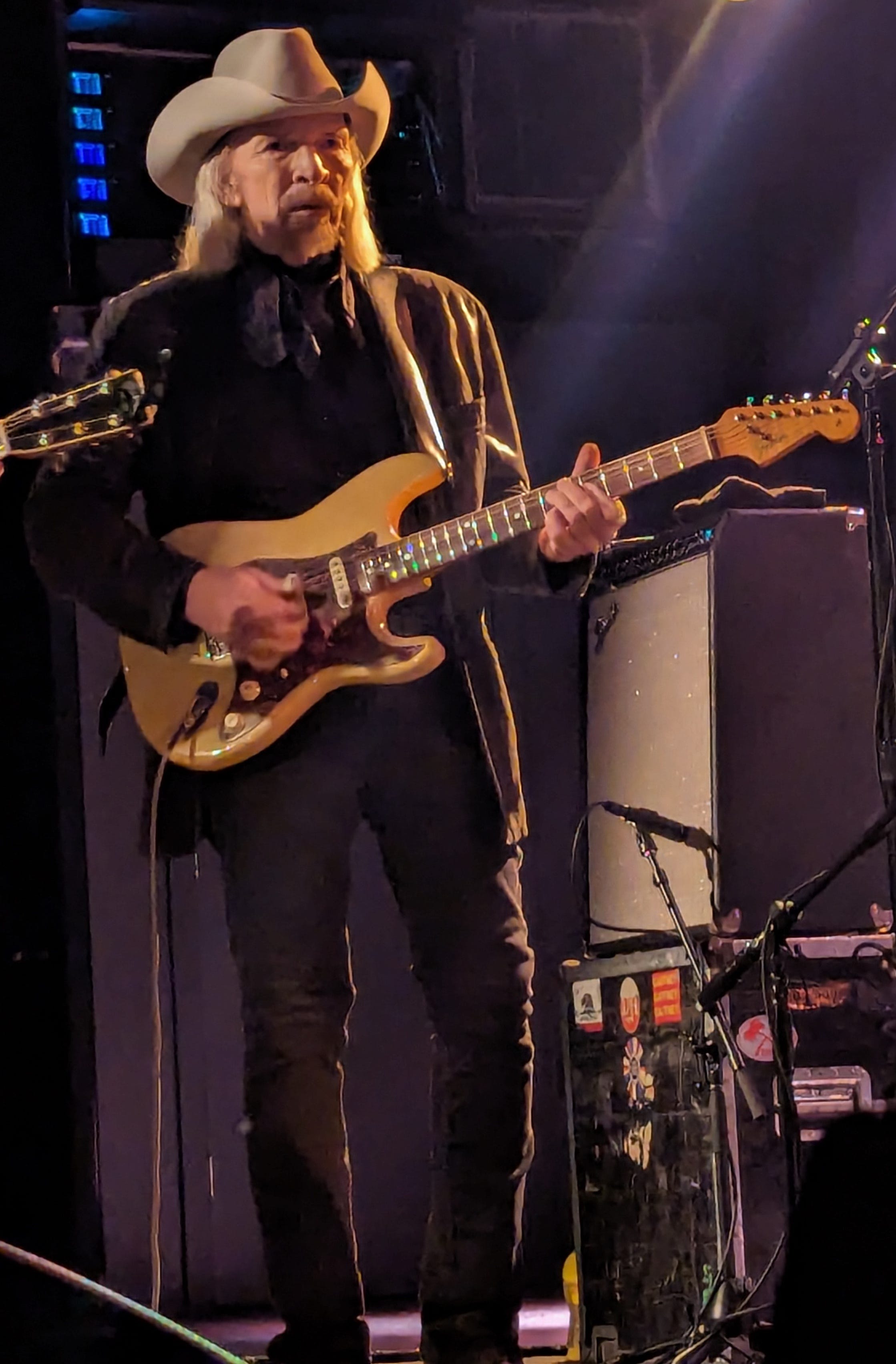
You’re supposed to play a Knitters reunion gig at Slim’s in San Francisco. Is this a nostalgic kind of thing, or are you trying to do something viable at this point in time?
I say that it’s sort of stepping into the past, but once you’re onstage it becomes the present. See, if any band breaks up and then gets back together, it’s like friends. Everybody in the Blasters grew up together, from my brother and me to the other three guys. Even Lee Allen we knew since we were twelve. With old friends like that, you may not talk to them for a year or two. Then when you get together, it’s like nothing has changed, either for good or for bad. Not always but a lot of the time, you can make something valuable, if that’s what you want to do. You have to start spending a lot of time together and figure out if your similarities are the same as when you were kids, and work off of those. If it was like, “gee, nobody’s career is doing anything, so let’s see what happens here,” that would be pretty pathetic.
It’s hard to think of any band that splits up and regroups later with as much energy and validity as it originally had.
Well, I think it could be done. The Knitters, for example. The punk rock/alternative connection to country is now so established that it would be difficult to say what would happen if we got back together. When we did our Knitters gigs, especially the first few, we were talking about mouths on the floor: People were like, “What is this? What is John Doe doing, singing ‘Silver Wings’?” But that opened some people up to that kind of music. A lot of kids never had a good experience with country music. They’d never seen Ralph Stanley – and if they had, they’d been drug to see him in some sort of sterile environment. It’s the same with blues, but especially because country is so shoved down your throat with the massive Nashville thing, most kids look at country music and they don’t see anything … dangerous about it. When I think of country music, I think of certain people who were definitely living and performing and creating on the edge. The Knitters tried to bring that edge to it again and make it clear to the previous generation of punk rockers that there was this other music here that was an outsider music.
Given the corporate domination of music these days, do you feel almost forced into a position of going beyond just playing music, to make a point about the kind of music you love?
Oh, yeah. That was the whole Blasters thing. You gotta remember, when we got together, it was March of ’79. We came up with the name by July or August of that year. This type of music was dead. You didn’t hear blues on car commercials. There weren’t Sunday afternoon NPR blues shows. There weren’t alternative country fanzines. There wasn’t an Americana chart. There wasn’t a House of Blues chain. There was nothing. This music was forgotten. You had disco, you had sensitive singer/songwriter, you had punk rock …
And arena bands.
Right,and that was it. But we loved this music. We knew guys who showed us how great this stuff is. Our thought was that we should do the same – and not work day jobs [laughs]. One of the most moving memories I have of the whole Blasters period came at a gig in Seattle. It was the same place where the Sonics played and the Kingsmen played. We played this gig with the full band, with Lee Allen. We came back for one of the encores, and we did the Little Richard song, “Keep A-Knockin’.” This was an all-ages show, and there was a kid, about twelve years old, smashed up against the stage, just crying his eyes out. I leaned down and I said, “Do you want to get pulled out?” He was like, “No!” I said, “What’s the matter? What are you crying about?” He goes, “I’ve never heard music like this before.” That stuck with me. For all the bullshit we went through as the Blasters, that was like, okay we’ve completely screwed up some kid’s life now [laughs]. He’ll never fit in! But it was so moving.
How are you getting along with your brother Phil?
Well, if I saw him getting run over in the street, I’d go out and help him [laughs].
Phil always had an outstanding talent for mathematics. In fact, he has a master’s degree in the subject. Do you have any similarly hidden talents?
[Laughs] No, none at all. What you see is what you get.
What about during your days as a fry cook? Did you have a specialty?
Actually, the one thing I got really good at was to distinguish Middle eastern accents. The bulk of our customers were everything from Moroccan to Armenian to Persian. I can still do it sometimes, but in those days I was really good at tellin an Egyptian accent from a Syrian accent. My forte was falafel. I made pretty good humus too.
Are you and Phil ever going to work together again?
Nah. He has his opinions and I have mine. We started with the same records and went different directions. That’s really what it boils down to. Writing songs for someone else to sing is like being a speechwriter, you know? You have to share certain views. Now, my brother and I do share a lot of views, but you get to a point where that isn’t enough. I would love to be able to write a song like “American Music” again, but I’ve written it. I can’t write it again. So what do I write next? Well, I’ve got to go more personal and less grand, or let’s say less anthemic. And the more personal you get, the more difficult it is to go to your brother and say, “Will you sing this? It’s a song about a girl who completely smashed my heart.” It’s just really hard, you know? Basically, I got to the point where I’d written all the songs I could write for my brother. I know that there’s a couple of songs I’ve written since that he’s done. Like, I know he was doing “Dry River” for a while with the Blasters.
But that wasn’t written specifically for him?
Right. But to write twelve songs that we still share the view of would be real difficult. And our working methods are different too. Phil doesn’t believe in record producers, and I’m a record producer sometimes [laughs]. It’s just something we disagree on.
At least you’ve earned a place with him in that rock pantheon of warring brothers: the Davies boys, the Gallaghers …
Exactly [laughs]. Somebody wrote a book about the greatest rock & roll stories, and we had a paragraph or two and a photo of us in the “battling brothers” chapter.
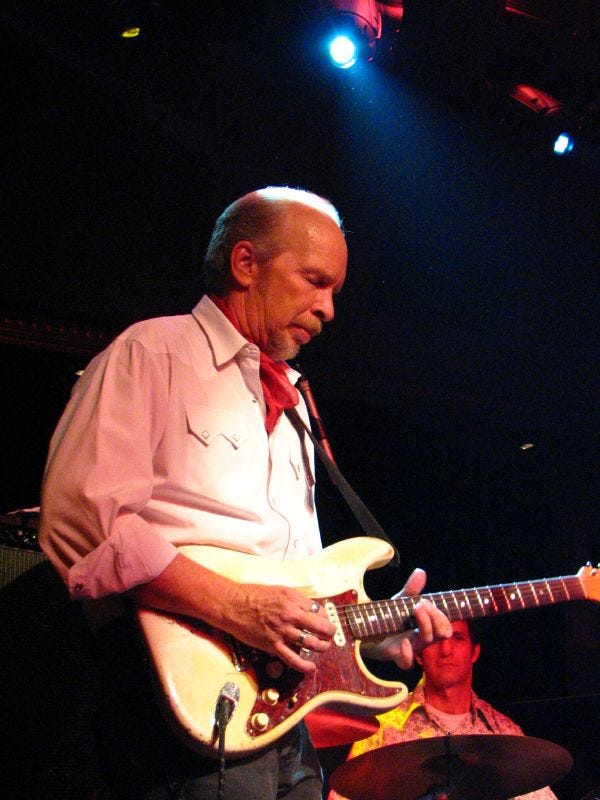
I heard that your manager actually ordered you and Phil not to do interviews together at one point.
Yeah. There was an experience on The Today Show, and it was pretty ugly [laughs]. It was just stupid brother shit. If he says the sky is clear, you’ve gotta say it’s cloudy. You can’t let him get away with saying it’s clear, like, who the hell does he think he is?
But last November, I finished six months of solid touring, and I ended up with my band doing two nights in this blues bar. One night, Gene Taylor was in town because he was rehearsing with the Fabulous Thunderbirds, and John Bazz lives down in Long Beach. So the encore of my show was Bobby Hicks, my drummer, playing, because Bill [Bateman] was in Alaska. But other than that, it was the Blasters! Bazz was playing bass, Gene got up and played the piano, my brother sang and I played guitar. We started pullin’ out everything from “I’ll Be Glad When You’re Dead, You Rascal You” to whatever. If you can get together, doing that kind of stuff is easy, because that’s where your roots are. But to then say, “It’s 1999 and I wrote this song”? Forget it.
####
No posts
Comments
Nothing yet. Say the first thing.
Sign in to join the conversation.