
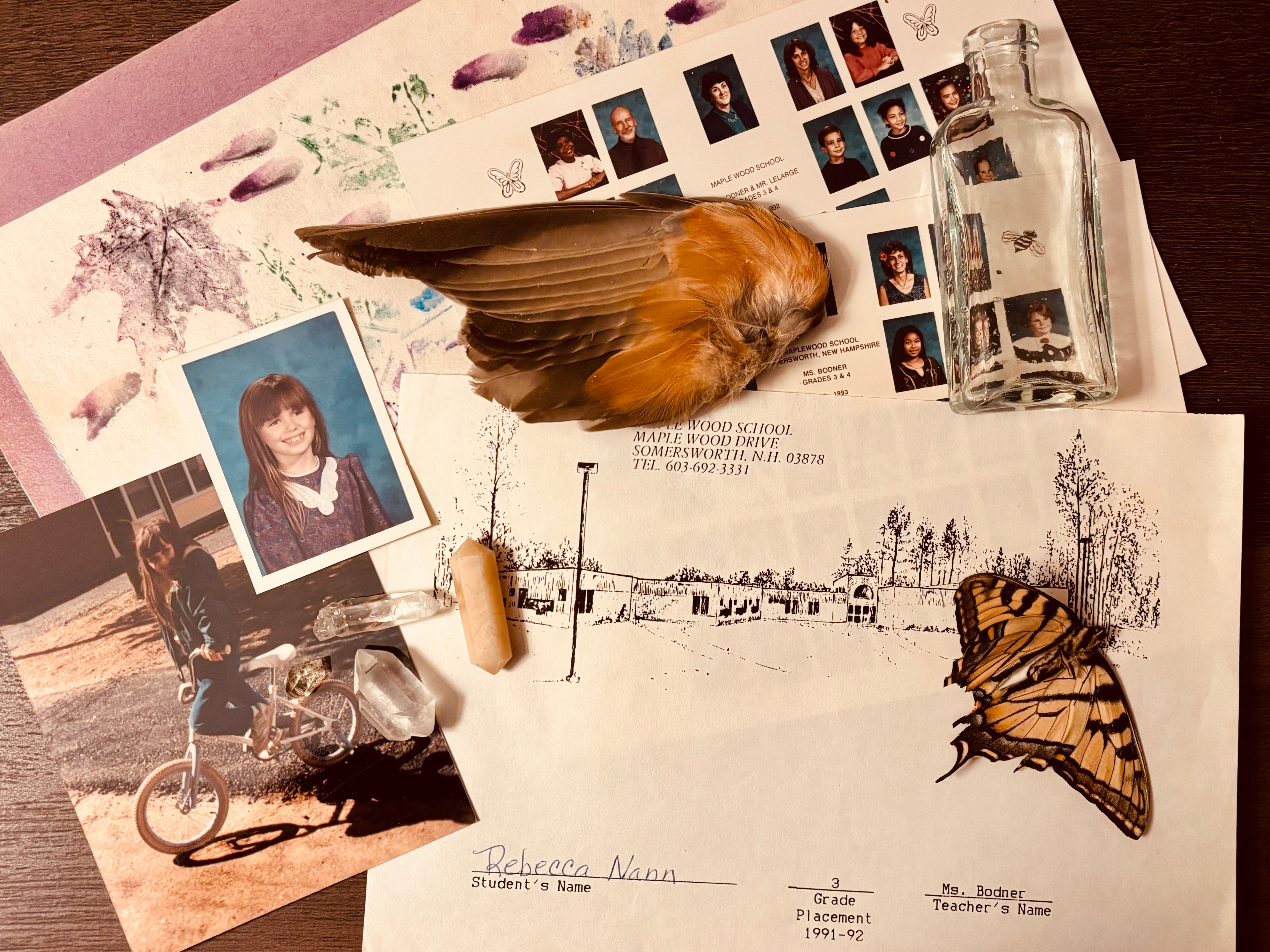
Dear Ms. Bodner,
I long to return to the region we lived when I was a young girl, when you were my teacher. Affordable housing is hard to come by, always, but more so these days, and especially the nearer one gets to the sea. In fifth grade, the year that followed the two I spent in your classroom, my mother could briefly afford to buy me flute lessons. I had to surrender the rented flute just as I was learning to make my instrument produce sounds that more closely resembled music than the honking of a duckling finding its voice for the first time. One day soon after, we came home to find my mother’s belongings tossed onto the sidewalk by her third husband. The memory is a blur of police officers and accusations, followed by hurriedly packing our belongings.
I attended three schools that year. After Somersworth, we spent a brief stint tucked away at a women’s shelter in Rochester. The school there smelled of peanut butter and armpits, mingled with that old building scent— the way I remember most of my schools smelling. There was a faded foursquare and a lone basketball hoop in the back of the school grounds where we would take recess. Nothing like the sprawling playground at Maplewood. It’s funny how both poverty and growing up are marked by the disappearance of apparatuses for play. Anyway, I remember borrowing two books from their school library, both biographies. One about Harriet Tubman, the other about Martin Luther King, Jr. We left the shelter before I could return those books. I think I secretly wanted it to be that way. There was something in their struggle that felt familiar to me, though I didn’t quite have the words for it at that age.
From there we landed in Northwood. Our apartment was roughly the size of a shoebox. The town referred to the property as The Chicken Coops. I sang along to Abba and Tears for Fears while fashioning drawers for my clothes out of moving boxes and duct tape. The woods that surrounded our home were a sanctuary where I dug for old glass bottles by the brook. I foraged for discarded cigarette butts along the dirt driveway, which I smoked behind the trees. The cockroaches my new babysitter introduced to the building upon the beginning of her tenancy weren’t like the ones you kept as class pets. Mostly they hid behind the mountain of filthy cookie sheets and used dinner plates that had become semi-permanent fixtures on her kitchen countertops. She healed her ringworm with a salve my mother made.
This was a two-year pitstop on our slow migration to Concord, where I lived out the remainder of my childhood— what wasn’t spent in group homes, anyway.
Now I live in a town that seems overrun with political yard signs and flags, that reflect a set of values I do not share. Because of this, the tenants of the Monadnock region overwhelmingly appear to subscribe to an ideology that would obliterate the existence of people like me and my daughter, who reject the ideals of normativity, as well as our neighbors, whose ethnicities are often described in our society as “exotic," at best.
There is something in the air these days…I am reminded of a poster that hung in your classroom. You know the one. I think it was black, maybe brown, with white text, which read:
Text within this block will maintain its original spacing when published
First they came for the Communists
And I did not speak out
Because I was not a Communist
Then they came for the Socialists
And I did not speak out
Because I was not a Socialist
Then they came for the trade unionists
And I did not speak out
Because I was not a trade unionist
Then they came for the Jews
And I did not speak out
Because I was not a Jew
Then they came for me
And there was no one left
To speak out for me
by Pastor Martin Niemöller
Lately, the words of this famous poem frequently come to mind. Those of us who are afraid of what is to come have taken down our rainbow flags and Black Lives Matter yard signs, the ones that haven’t been taken down on our behalves by those who fancy themselves soldiers defending a new order. A few brave residents replace their stolen or destroyed symbols of resistance as needed; beacons in a long, dark night.
For much of my life, home was a four letter word much the way hell is. It was school where I found respite; though, I did spend more time skipping class than attending it— that is, when I wasn’t slumped over my desk or getting kicked out of the room for one disruption or another. It is perhaps my greatest regret that I did not discover my love of learning until after it was too late to receive a free education. In truth, I was too exhausted by trauma and undiagnosed disabilities to even begin to access it.
In your class, school was refuge. It was the place I went while the bruises healed. The place where fallen leaves were paint brushes, and a thousand sheets of paper could be folded into a wish. It was a place where cockroaches weren’t reviled vermin, but adored classroom pets that lived alongside a friendly tarantula, a wiley chinchilla, and two white doves that punctuated the cacophony of children with their sweet, trilling songs.
You are the reason I collect specimens in glass jars, and dream of living in a solar powered cottage with a down feather bed for slumbering, and a hammock for lazing. You are the reason porcupine quills, marbled paper, and painted eggs stir a flutter of happiness inside of me. You are the reason why I do not want to die before feeling the damp kiss of the Maya Rainforest on my skin. You may have only known me for those two school years but I have carried you with me these three decades since.
It is the strangest sensation— how viewing the photos you have shared with me can elicit a tearful response. I am not being hyperbolic when I say being your student is among the most influential and cherished experiences of my life. Through your teachings and the simple act of introducing young minds to multicultural art and stories, I learned that difference is not something to merely tolerate but that it is the very richness of life, and we must savor it. I remain a fairly sheltered white woman of quite modest means, who’s still yet to see much of the world. It would be all too easy, and I dare say by design, to have cultivated in my worldview a hatred and disdain for that which I do not recognize in myself. We have read in the history books what that outlook has to offer humanity, should it be paired with unchecked power and greed.
Perhaps the tears are for more than nostalgia and fondness alone, but for knowing who I might be without those two precious years I spent as your student. After all, children are born with all the necessary ingredients of their becoming but it is the many hands of our caregivers and our teachers which do the baking.
Sincerely,
Rebecca Nann
As creator of Missives from the Margins, Rebecca Nann aims to amplify and celebrate cross-disability perspectives while exploring the historical roots of the contemporary issues faced by people with disabilities. In addition to completing several research internships with the Community College System of New Hampshire (CCSNH) and the Global, Racial, and Social Inequality Lab (GRSIL), Rebecca is a scholar, artist, essayist, and provocateur for social justice.
Identifying as a person with disabilities who has experience with poverty and trauma, Rebecca has provided valuable insight as a former member of the Boards of Directors for New Hampshire Legal Assistance (NHLA), the Legal Advice and Referral Center (LARC), and 603 Legal Aid. She completed her associate degree in General Studies with High Honors from NHTI in 2023 and studied Sociology at Keene State College.
Follow Rebecca’s creative work on social media and by subscribing to her substack RNann.Substack.com
Comments
Nothing yet. Say the first thing.
Sign in to join the conversation.