

I am beside myself with excitement and pride to announce that my first piece was published for Missives from the Margins and to share my first companion post here in (The Margins). If you have not done so already, please read Missive No. 1: The Unseen on the Disability Rights Center - New Hampshire website. In both Missive’s and Margin’s No. 1, I lay a foundation. Each Missive published on DRC’s website will focus on storytelling, while each corresponding Margin published here on my Substack will provide definitions, history, and sources that bring deeper meaning and historical context to the stories.
It would be disingenuous to say “happy reading” or “I hope you enjoy,” as this material will not be all sunshine and rainbows; disability history is mostly pretty bleak. Instead, I will leave you to read the first of many posts by saying that I hope you get something meaningful from these histories, that it lights something resembling a fire inside of you. I want this history to never again repeat itself, which feels more and more like a possibility these days.
Sincerely,
Rebecca
The margins are more than just blank space surrounding text in a book, waiting to be colonized by a reader’s thoughts— they are the Land of Forgotten Things, an oubliette for the unwanted, the dirt under society’s fingernails. We who occupy the majority get reduced to the minority, and though we have existed throughout time, the inconvenient details of our making are all too often cast aside.
As the editors of A New Disability History pointed out, we have become accustomed to our “cultural devaluation and socially imposed restriction… [our] personal and collective struggles for self-definition and self-determination.” (Longmore and Umansky, p4) A narrative about the slightness of our abilities and the enormity of our burdens on society has been handcrafted over centuries to reinforce our place in society. Prior to the Enlightenment disability was considered divine punishment for one’s sins— and often, for the sins of one’s mother. Societal attitudes and treatment of disability worsened with substantially higher rates of bodily maiming, caused by rising post-industrial workplace injuries and upon the conclusion of the United States’ bloodiest war, the Civil War. With this increase, and the advent of government assistance programs, more and more people with disabilities were pushed out of the workforce. (Patterson 2011; Handley-Cousins 2019; Egner and Geiss 2021) Evolutionary theory birthed the medical model of disability, informing pervasive ideas that disability could and should be eradicated by eugenic sterilization. These measures were incentivized for economic reasons, as people with disabilities were increasingly viewed as financial burdens and an invasive weed to pluck from human existence. (Gamble 1951)
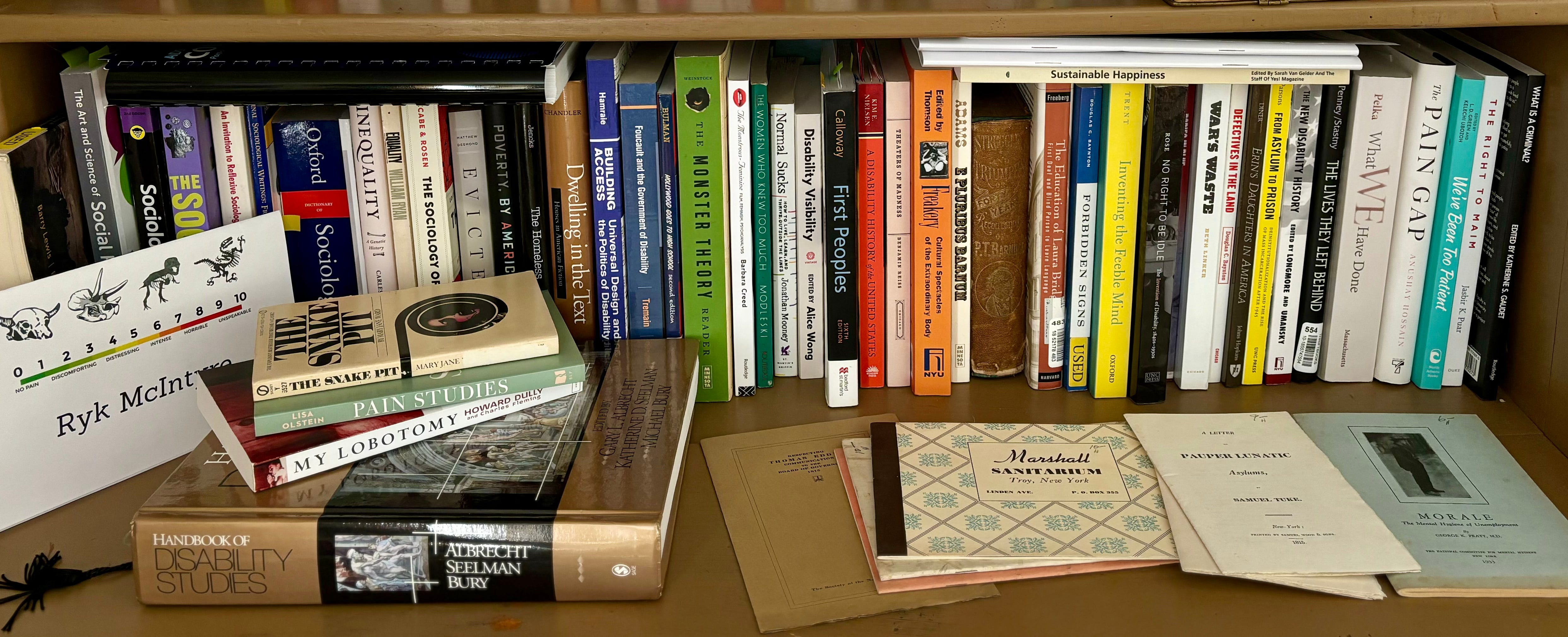
The nineteenth and twentieth centuries were the most gruesome periods in American disability history, with the advent of freak shows, asylums, and the rising popularity of eugenics and lobotomies. (Gamble 1951; Longmore and Umansky 2001; Rogers 2010; Patterson 2011; Mooney 2019) Parents submitted their disabled children for medical experimentation or institutionalization, and in some cases, willingly sold their disfigured children to freak shows. (Freeberg 2002; Rogers 2010; Patterson 2011; Mooney 2019)
Throughout history, people with disabilities have been treated with fear, suspicion, malice, disgust, and morbid fascination. (Gamble 1951; Connor and Bejoian 2006; Esmail et al. 2010; Rogers 2010; Patterson 2011; Mooney 2019; Runcan 2022) We have been shoehorned by society into stereotypes that people with disabilities are helpless, monstrous, pitiful, and sexless burdens who threaten American ideals and drain resources with our dependency. But the margins do not have to be a desolate place, a boneyard for our dreams to languish, where our existence is rendered mere spectacle in a sideshow or pathology awaiting a cure— we are not bound to the uninspired destinies laid out for us. We are too big and too complex for such archaic presuppositions.
It is time for a new narrative. One that is by and for the central characters of our stories— us. Just as the margins have been used as a dumping ground for society’s refuse, they have become a place where we can let our bellies softly hang over our belts. Our stories make this the place for gathering our sorrows and celebrations. The place where our cups run over with the stuff of our collective rage and revolutionary spirits.
Welcome to this place where you can receive our stories, the ordinary and the extraordinary, unneutered by eugenic thought, and undiluted by the sensational and the super.
Welcome to the margins.

Disability has several definitions, depending on who is doing the defining and for what purposes, and how it is defined can reveal hidden attitudes towards people with disabilities. In early U.S. history, a moral model represented the most widely accepted attitude about the origin of disability: a punishment for a moral failing or sin committed by the person or their family (usually the mother). Within this model, disability might also be considered the will of the Christian god. With advances in Western thought and medical knowledge, there was a shift from the moral model to the medical model. The medical model espouses degrading, ableist views of people with disabilities and fails to address “the social marginalization and economic deprivation of many people with disabilities.” (Longmore and Umansky, p12)
“The medical model makes variability synonymous with sickness and puts the social ‘problem’ to be solved in the person, not the environment around the person.” (Mooney, p55)
Medical definitions of disability are based on pathology, comparing the so-called normal mind and body to an abnormal mind and body, and they focus on a curative approach. Legal definitions determine eligibility for government assistance based on a pathology that limits a person’s ability to earn wages through paid labor. Federal disability benefits programs, such as Social Security, tend to use legal definitions based on the medical model.
As a person with disabilities, I favor the social model, which acknowledges the role of attitudinal and structural barriers as being just as disabling, if not more than, the disability itself. The Social Model of Disability from the National Disability Arts Collection and Archive (NDACA) is a short animated video that explains the difference between the medical and social models of disability in an easy to understand and visually interesting way.
As explained in Normal Sucks (2019) by Jonathan Mooney, harmful attitudes about disability have become interwoven with notions of normalcy. Part historical analysis and part memoir, I highly recommend this as both an introduction to disability history and as a first-person disability story exploring ableism in the educational setting. As Mooney says in the video below, “normal hasn’t always been normal; it has a history not of discovery but of invention.”
Under the moral and medical models, disability is treated as “bad.” Whether as a divine punishment and test of character, or a pathology needing a cure, disability is pitiable, burdensome, loathsome, or tragic. It is also under these models that it became easier to justify inhumane treatment of marginalized people, and to hide or eradicate disability, be it through forced assimilation into the mainstream or total annihilation. As Mooney points out in Normal Sucks:
“Beginning in the early 1950’s, a doctor named Walter J. Freeman would travel from state to state performing lobotomies in people’s homes…Freeman performed 3,439 lobotomies in twenty-three states, despite the fact that he had no formal surgical training. Of these, 60 percent were performed on people with diagnoses of mental differences and 40 percent on people considered homosexual. There was a 14 percent fatality rate.” (Mooney, p67)
Lost in Laconia (1L Media, 2010) is documentary film about the Laconia State School, formerly known as The New Hampshire School for Feeble-Minded Children. Viewers should be prepared, as this film deals with themes of abuse and subhuman living conditions. It is difficult to watch but captures a significant part of NH’s not-too-distant disability history— a history we must not forget. As the documentary reveals through first-person accounts, historical footage, articles, photographs, and public court documents, “best practices” in this setting included isolation, neglect, physical abuse, sexual assault, and numerous other human rights violations, including forced sterilization. This film also details a turning point in the treatment of people with disabilities in NH, as well as how the changes transformed the lives of former “inmates.”
The following quote from the film captures pervasive historical attitudes about people with disabilities and is in reference to another famous quote, “three generations of imbeciles is enough.”
“Unfit human traits: feeblemindedness, epilepsy, criminality, insanity, alcoholism, pauperism, and many others run in families and are inherited in exactly the same way as color in guinea pigs. If all marriages were eugenic, we could breed out most of this unfitness in three generations.” (1L Media, 2010)
Ableism- discrimination and prejudice against people with disabilities. Ableism assumes that people with disabilities are inferior to those without disabilities and it is especially prevalent in medical, educational, and workplace communities. Examples of ableism include assuming a person is not disabled based on how they appear, believing that disabilities need to be cured or that people with disabilities are better off dead, and thinking that accomodations for people with disabilities are special treatment. Internalized ableism occurs when people with disabilities develop negative feelings about themselves and other people with their disability as a result of internalizing harmful ableist messages from external sources.
Assimilation- taking in and understanding information, or the process of becoming more like something— which sounds rather benign. Though assimilation can be naturally occuring, historically it has been forced on many minoritized groups in this country. For example, Native Americans and people with disabilities are two minoritized groups who have been subjected to forced assimilation through violent means. This topic will be covered in greater depth in future posts. For now you can learn more about its use in boarding schools for indigenous children here and in schools for the deaf and blind here.
Cross-disability- an inclusive term for all disabilities, whether they are acquired, congenital, intellectual, neurologic, or related to mobility, chronic illness, or mental health conditions. It is a way of indicating that multiple disabilities are being included or considered.
Deserving Poor- an old-fashioned phrase used to describe people who are considered poor “through no fault of their own,” and therefore, are deemed worthy of assistance, especially financial. This term has been used to justify dehumanizing poor people or depriving poor people and their families of the means to be fed, sheltered, clothed, and cared for. Future posts will dive into this term and the history surrounding it. Learn more about historical attitudes about poverty and disability here and here.
Disability- the expression of a physical or mental condition that limits a person’s mobility, senses, or activities within a social context. There are several definitions and models of disability. More on that below.
Disproportionate- refers to when the size or amount of something is too large or too small in comparison to another thing, the difference being surprising or unreasonable. For example, incarcerated people are disproportionately low-income and people of color. This does not mean that more poor people and people of color are committing crimes; rather, what this reflects is that law enforcement is more likely to target these communities and that individuals from these communities have fewer resources to adequately defend themselves in the justice system. Additionally, half of the people killed by police are individuals with disabilities. Read more here.
Eugenics- based on the belief theory that characteristics related to health and disease, as well as social and intellectual capacity are inherited, and that genetic purity would lead to a utopian society, eugenics is the selection of desired heritable traits. Some examples of eugenics include marriage restrictions, segregation, compulsory (forced) sterilization, forced abortion or pregnancy, and more. This practice has been used in the U.S. in an attempt to eradicate people with certain disabilities, health conditions, socioeconomic status, and of a certain race or ethnicity. Compulsory sterilization of people with disabilities is still legal in several states. Learn more here.
Federal Poverty Line- a flawed system used by the federal government to decide how poor you are and if you are poor enough to be considered impoverished or eligible for assistance programs. Many needy families are disqualified from government welfare programs based on this system. Read an article on the topic from the Institute for Research on Poverty here.
Malingerer- another old-fashioned term coined to describe people who “fake” having disabilities so they do not have to work. This accusation has been weaponized and used to justify discrimination or the refusal to support people with disabilities in a number of ways, especially financially. Learn more about the birth of this word in the context of the American Civil War here.
No Child Left Behind (NCLB)- a piece of educational reform legislation passed by Congress in December 2001 and then signed into law by President George W. Bush. It has been criticized for using standardized tests to measure the success of schools with teaching children how to read and do math, while punishing schools who “fail” instead of addressing structural causes such as ableism, poverty, and racism. NCLB was replaced by the Every Student Succeeds Act (ESSA), which took effect during the 2017-18 school year and has also been criticized for masking and failing to address root causes of inequality.
Normal- average or to be expected. Originally, normal was a mathematical term for describing right angles. During the nineteenth century, what was once known as the word for perpendicular was adopted by the medical community to describe human bodies and minds as being in a normal state. More on that below.
Supercrip- refers to a person with disabilities who achieves something exceptional despite their disability. The supercrip trope serves as an inspiration for non-disabled people. However, it often becomes a mechanism of internalized ableism for people with disabilities, causing them to compare and harshly judge themselves. Often the accomplishment depicted within a story utilizing this trope is considered exceptional because of the disability. The assumption being people with disabilities are not as capable of doing what may be considered more ordinary for people without disabilities.
This is but a drop in the ocean. If I thought it would be reasonable, this first companion post would be much longer. If I had the space, right now I would be reframing our colonial history as disability history and providing a list of books, films, and videos on the topic of assimilation and segregation. Alas, Substack has length limits, as I am sure your attention spans and schedules do, too. But since I need to pace myself, this is where I leave you, dear readers. Please subscribe and stay tuned for the next Missive, where I share a conversation with a disabled NH artist and plant enthusiast. We get into topics of community and loneliness, trying to forge a career, and the ways service providers can either provide vital support or cause extreme harm to people with disabilities.
(The Margins) is the companion publication to Missives from the Margins, which is available on the New Hampshire Disability Rights Center (DRC) website. DRC provides information, referral, advice, legal representation, and advocacy to individuals with disabilities on a wide range of disability-related problems including education, accessibility, employment discrimination, home and community-based services and Medicaid.
No posts
Comments
Nothing yet. Say the first thing.
Sign in to join the conversation.