
Hello and welcome to the December issue of the Peripatetic Historian. I’m your host, Richard J. Goodrich, and once again we gather around the loom to weave history, travel, and photography into a coat of many colors.
This Month:
Peripatetic Field Report: H. R. Giger’s Treehouse
Arctic Cold Sweeps Taiwan
Ready? Let’s dive in:
Anping is a historic district of Tainan, a southwestern Taiwan city. Here the indigenous and Chinese residents of the island made first contact with Europeans—the Dutch who arrived in 1624. The Dutch gained a temporary toehold and built a fort to secure their trading outpost (Fort Zeelandia) but ultimately were expelled in 1661.
Although failed colonization attempts are fascinating, it was natural history that captured my imagination during a November visit to Anping. The ruins of the old Dutch fort could not compete with the rundown building that stood a couple of blocks north.
I speak of the old Tait & Co. warehouse, a stone and brick structure erected in 1867. After China’s defeat in the Second Opium War, the emperor named Anping as one of the ports that Europeans could use for their trading enterprises. Tait & Co., a Scottish firm that traded opium for Taiwan’s sugar and camphor, moved right in. The company prospered until 1895, when the Japanese took over the island and nationalized international trade. They pushed the European traders out and confiscated the buildings for Japanese enterprises.
The Japanese Salt Company took over the warehouse and stored—unsurprisingly—salt. Fifty years later, after the end of World War II, the Japanese left and the warehouse was abandoned.
When I first heard the name “Anping Treehouse,” I envisioned a massive structure lodged in a tree—sort of a Swiss Family Robinson edifice. Reverse the image: the treehouse is a tree that took over a (ware)house. In a scene that could be slotted into a movie about an apocalyptic, post-human world, we are confronted with a giant banyan tree that has reclaimed the land, overrunning and enfolding the Tait & Co. warehouse into its root structure.
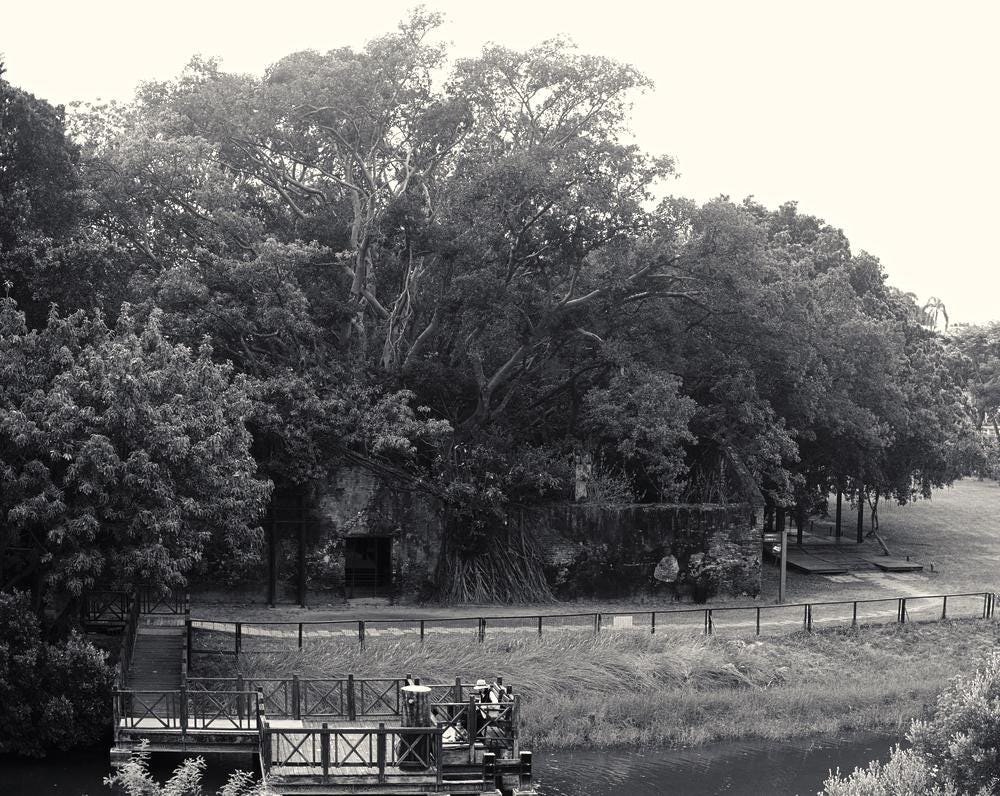
Now, full disclosure as the financial journalists say: I have been fascinated with banyan trees since I first arrived in this verdant land. It is my favorite Taiwanese plant, a communal, parasitic organism.
Wikipedia describes the tree as “epiphytic, lithophytic, and terrestrial.” What this means is that the seeds of the banyan tree are incredibly versatile. If a bird deposits one in a limb notch of another tree, it will sprout and send vines spreading around the the trunk and limbs of its host. The banyan will use the host tree in the same way a young tomato plant climbs a stake.
Should a seed fall on stone or concrete, the plant will anchor itself and spread like ivy across the hard surface. Lacking the first two options, a seed can also take root in the earth and grow in a normal manner.
No matter how the seed starts, one of the distinctive characteristics of the banyan is its aerial roots. As limbs grow laterally, the tree drops long tangled threads toward the ground. When these touch the earth, they root and and develop into secondary trunks that support the expanding tree. Left unchecked, a banyan tree will spread in all directions, covering acres of land in a dense, woody thicket.
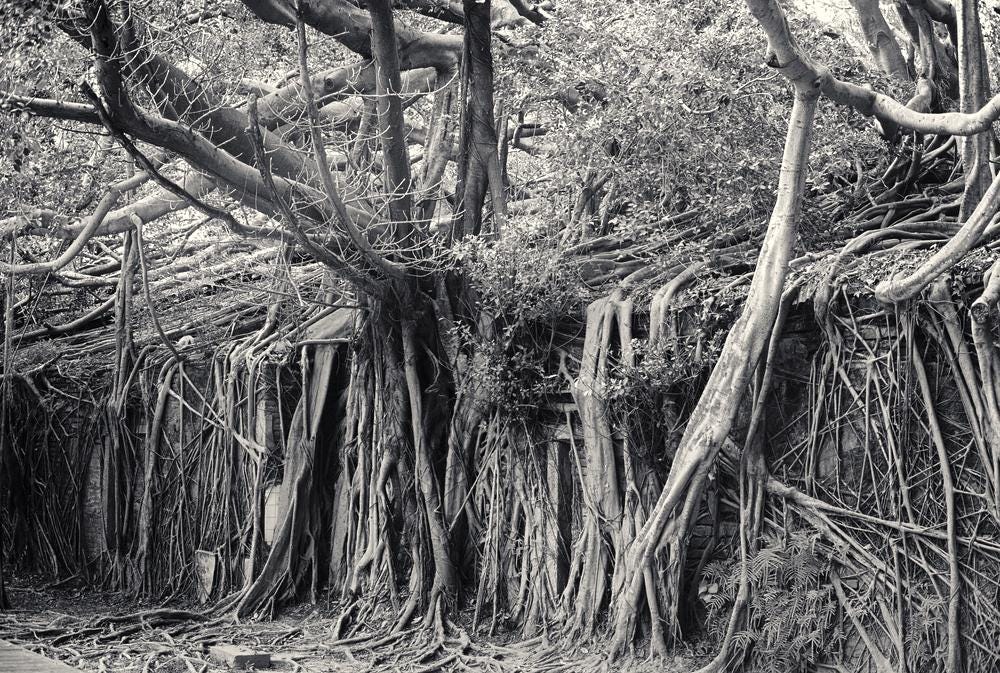
Or, as in the case of the Anping Treehouse, an entire building. Lacking dedicated gardeners to keep the aerial roots in check, the tree overwhelmed the walls of the building, covering it in a dense weave of roots, trunks, and limbs.
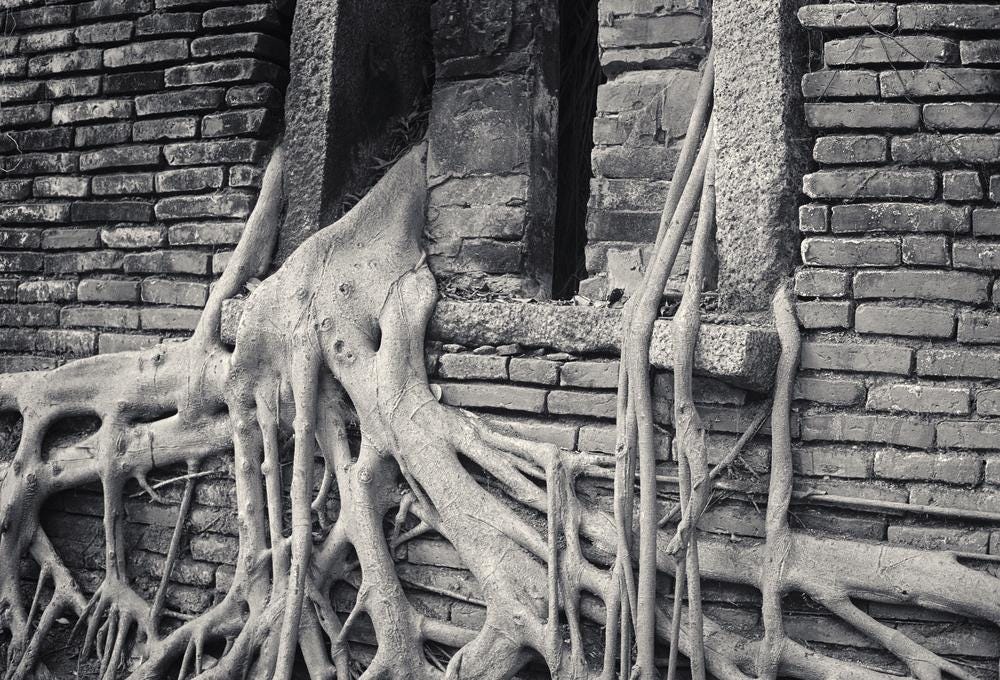
Absolutely fascinating. I was reminded of the “biomechanical” art of Swiss painter H. R. Giger, whose chilling fusion of machine and organic material heightened the tension in the movie Alien.
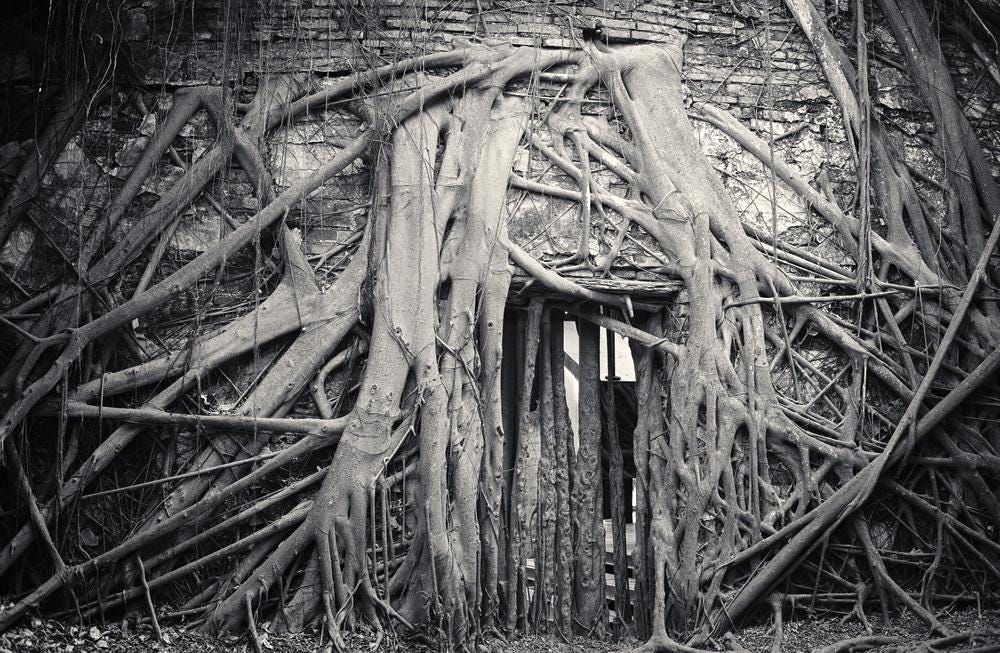
The banyan tree has completely overwhelmed the Tait & Co. warehouse, integrating the stone and brick into its own structure. The building has been assimilated, folded into a greater biological complex. Should humans end up destroying themselves, it is easy to imagine the banyan trees spreading across Taiwan.
Resistance is futile.
The season of arctic cold is upon us, suggested this headline, plucked off the Nov. 15, 2025 front page of the Taipei Times. Taiwan’s Central Weather Authority warned that the island might experience temperatures as low as 16-17 C (61-63 F) before the month drew to a close. A climactic crisis to be certain.
As someone who spent 14 years enduring the winters of Spokane, Washington—where entire months passed in which the temperature did not rise above 0 C—I have a different scale of cold. Nevertheless, I am anticipating an outbreak of puffy jackets, stocking hats, gloves, and woolly scarves as the environment again tests Taiwanese pluckiness and fortitude with temperatures that might plunge as low as 10 C / 50 F before this misery abates.
Pity us as we prepare for another horrific chill in Taiwan.
And, of course, winter’s approach inaugurates the holiday season. Shopkeepers in Taipei have had their Christmas decorations up since Halloween. I anticipate much yuletide cheer to come this month. Wherever you are, enjoy the season, and I will see you back here as the new year begins.
Until then, be safe, be sensible.

Know someone interested in history, travel, or photography? Hit the share button and send them a copy of the Peripatetic Historian.
Thoughts? Comments? I have a button for that as well:
No posts
Comments
Nothing yet. Say the first thing.
Sign in to join the conversation.