
Hello and welcome to the November issue of the Peripatetic Historian. I’m your host, Richard J. Goodrich, and once again we gather around the loom to weave history, travel, and photography into a coat of many colors.
This Month:
Peripatetic Field Report: The Bubonic Plague Issue
Ready? Let’s dive in:
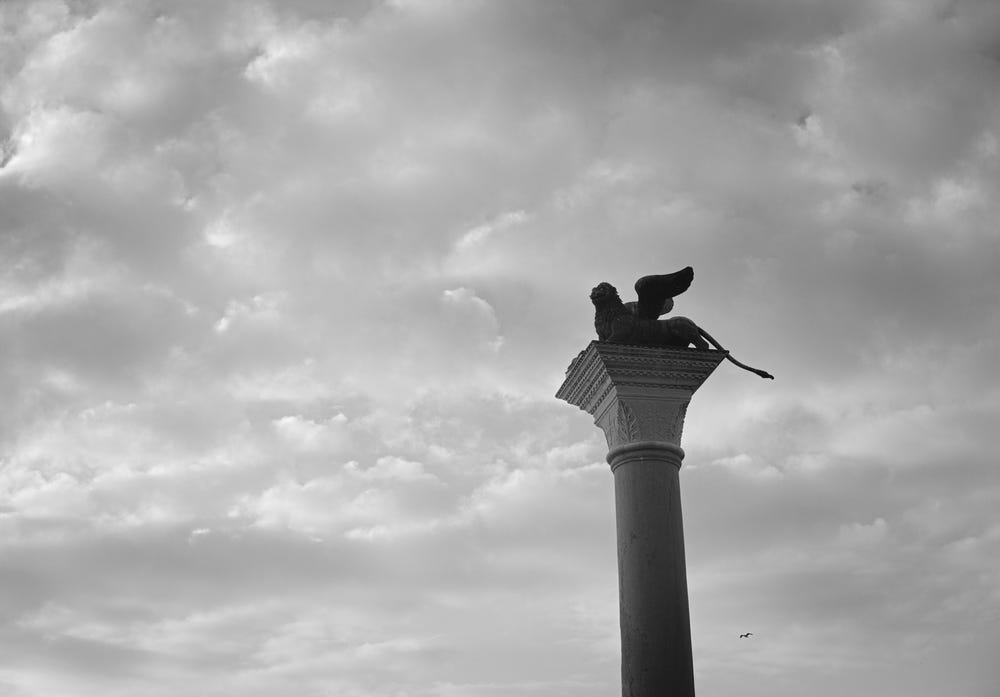
So let us imagine that we are living in a pre-scientific age, a time before modern medicine or, in fact, even a primitive understanding of the root causes of illness. It was a golden era, a time that would delight US Secretary of Health and Human Services, Robert F. Kennedy Jr. Natural remedies—bloodletting, animal dung (ingested or applied topically)—stood prominent among treatment possibilities. Life expectancy was low, mortality high, and there were none of those nasty vaccines to stoke controversy.
Which left Venice (and the rest of Europe) in a a poor position when the first wave of Bubonic Plague reached the Mediterranean in 1347/8. Venice, possessor of a huge merchant fleet engaged in regular traffic with the East, was one of the first European cities to feel the blow. Over the next five years, the Black Death mowed like a scythe through the heart of the city.
As the recent Covid outbreak reminded us, pandemics are a frightening thing. This is true even when we understand the underlying science of a disease. But imagine the terror of our ancestors who lacked an intellectual framework to explain what was happening around them. Today everyone appeared hale and hearty; tomorrow family, neighbors, and friends were suddenly sick and dying.
Faced with what appeared to be a distressing and inexplicable judgment from heaven, the Venetians pioneered an innovative approach to tackling the disease.
Although centuries passed before Europeans discovered the plague’s cause (the bacillus Yersina pestis, identified by Swiss microbiologist Alexandre Yersin in 1894) people noticed that the disease developed in clusters: let one person show symptoms and soon family members and neighbors were likely to become infected. Proximity appeared to matter. This observation served as the basis for the miasma—bad air—theory. Doctors believed that the plague was produced by poisonous air, gases that concentrated in pockets and killed those who lived in the area. This miasma clung to infected individuals or objects, and seeded new pockets as people moved around.
Building on this explanation, Venetian doctors began to wear masks during outbreaks:
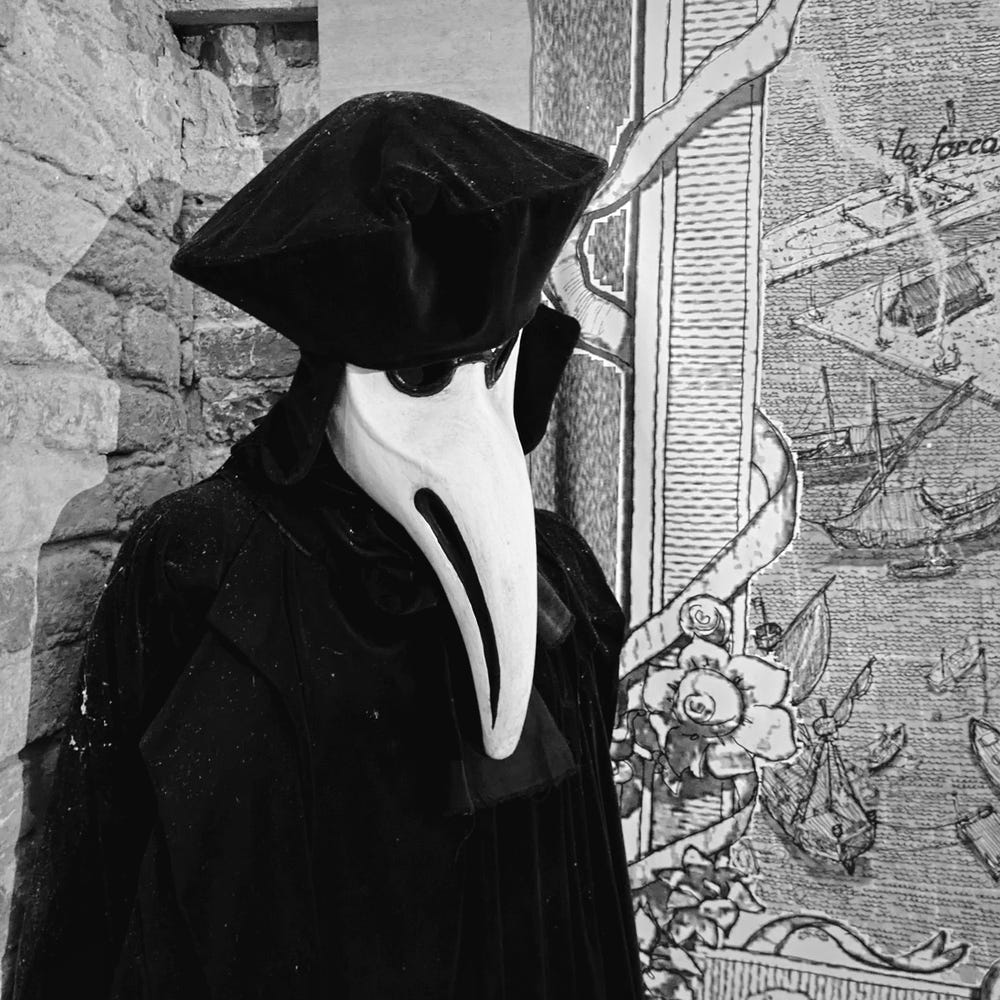
They stuffed efficacious herbs into the overgrown proboscis, a precaution intended to filter the miasma. Although stylish and comforting, the mask offered no protection against the biting fleas that actually transmitted the bacillus.
Although the miasma theory fell short of true understanding, it did suggest a solution that did prove useful: the separation of the infected from the healthy population.
Although the first stroke ran from 1347 to 1351, a series of aftershocks rattled the city over the following century. The plague receded and then mysteriously returned. In 1423 the Venetian Senate voted to establish a “hospital” for plague victims on a nearby island. This facility, Lazzaretto Vecchio, (the ‘old’ isolation hospital) was less concerned with treatment than sequestration. Officers of the Magistrato alla Sanità snatched individuals displaying plague symptoms in the city and transported them to Lazzaretto Vecchio. Those who survived a 40 day trial (our English word “quarantine” has its roots in the Italian quaranta-forty) were allowed to return home. The majority of internees did not survive the experience—their bodies were stacked in mass graves in the island’s cemetery.
Like recent Covid measures, the government lockdown and restrictions on movement were unpopular, but logic suggests it must have saved many lives. The isolation of plague victims slowed the disease’s spread. It was only a matter of time before the practice was extended to deal with the threat of international trade.
On an October Saturday afternoon, I hopped off the number 13 vaporetto and climbed a short gangplank to the gates of Lazzaretto Nuovo (the ‘new’ isolation hospital). It is a small island, sitting three kilometers northeast of Venice. Uninhabited today, this low-lying rectangle of earth, rising out of the tidal marsh, was the site of Venice’s second innovative response to the Black Death.
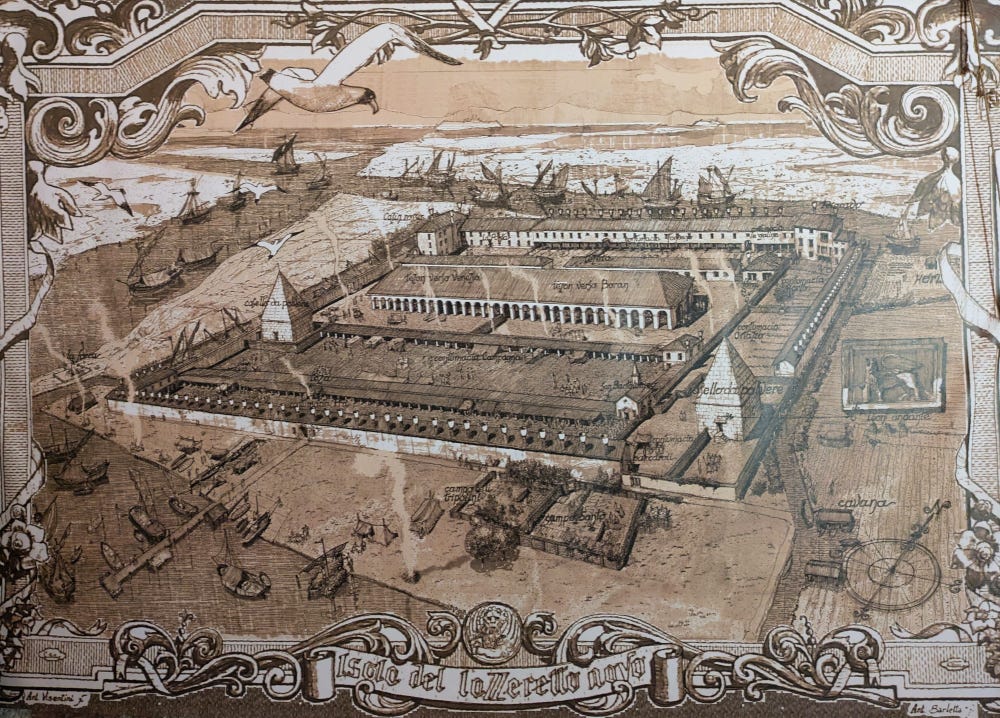
The Lazzaretto Vecchio had demonstrated its value in reducing the impact of plague in the city. Unfortunately, Venice, at the hub of international trade, remained vulnerable to the contagion carried on arriving ships.
Lazzaretto Nuovo, was intended to blunt the danger. In 1468, the city took over an island previously owned by the Benedictine monks of San Giorgio Maggiore, and built a massive cargo and lodging complex on the site. Each ship arriving in the lagoon was inspected by a Venetian doctor. If he discovered signs of the disease aboard (or if the ship came from an afflicted city) he ordered the ship to Lazzaretto Nuovo. There longshoremen unloaded the cargo and subjected it to disinfection procedures to drive off the miasma (exposure to fresh air and sunshine; washing durable goods in vinegar; fumigation with juniper and rosemary). The crew and passengers were assigned lodging and confined for forty days. Unlike its sister facility, people were expected to survive their internment and eventually reach the city. It was a nuisance, but a creative response to this mysterious ailment.
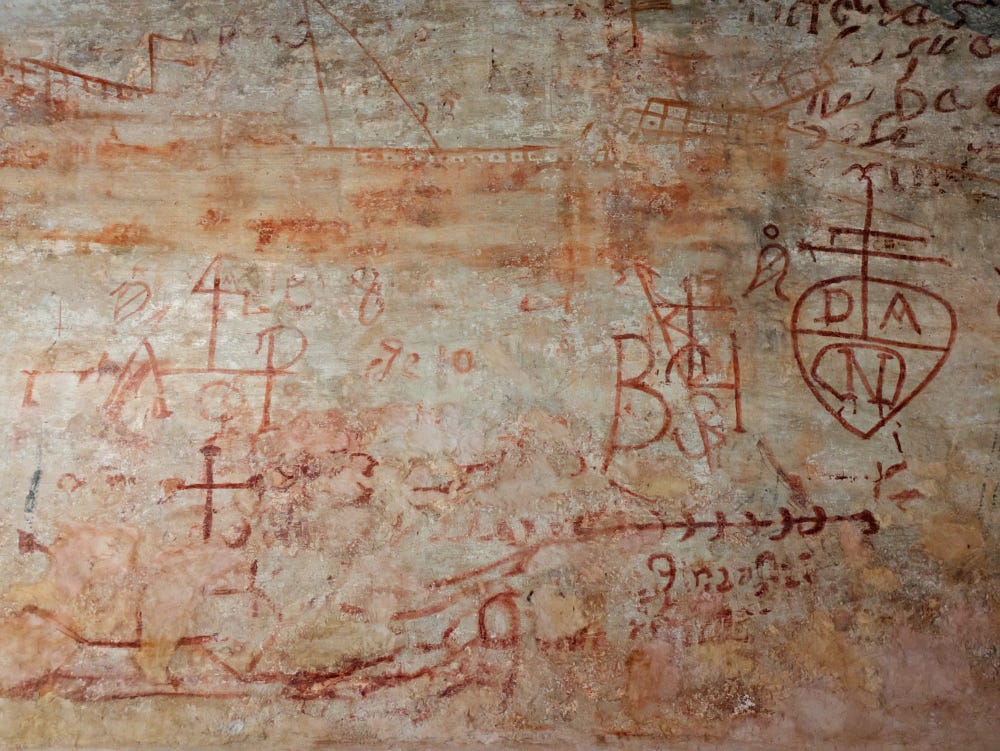
Today, most of the buildings have been dismantled, but the tall brick wall that prevented pilferage and escape still rings the site. Inside, guarded by swarms of mosquitoes, stands the Tezon Grande (“Large warehouse” in the Venetian dialect). This structure—a long, 100 meter brick structure—is the second largest building remaining from the heyday of the Venetian Republic.
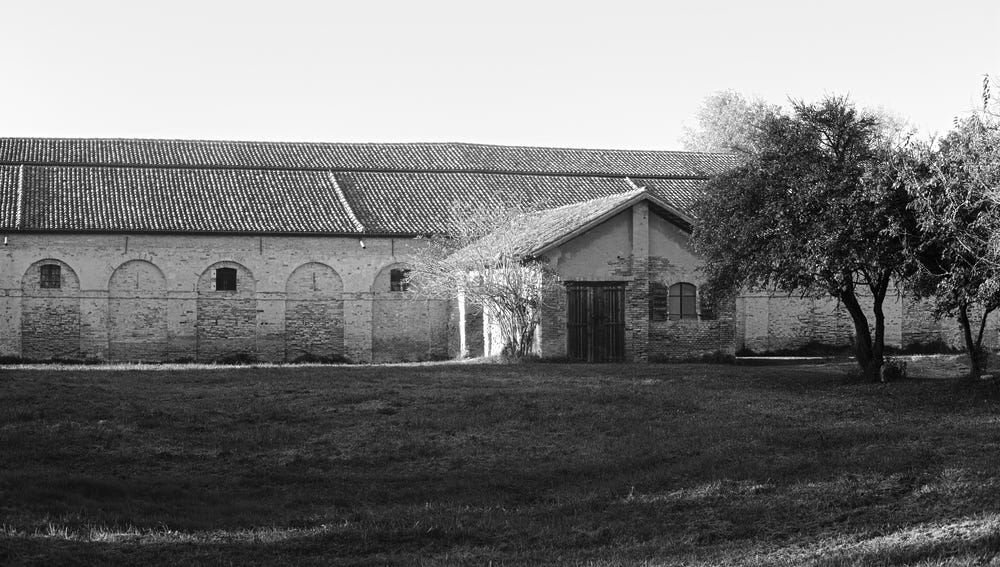
Sixteenth century graffiti decorates the interior, a testament to the boredom of the workers and the sailors restricted to the island.
The 1630-31 outbreak of plague tested the Venetian quarantine system. Plague again swept the city and there were so many victims that Lazzaretto Vecchio was overrun. The overflow was diverted to Lazzaretto Nuovo. When the second site ran out of beds the government chartered hundreds of boats to create a floating hospital that encircled Lazzaretto Nuovo.
In two years, nearly 100,000 residents of Venice and the nearby islands died. It was a frightening death toll. Many historians believe that political cowardice amplified the casualty rate. The city’s leaders knew how to check an outbreak, but in seventeenth century Venice, as in the modern world, citizens resented restrictions on their freedoms. The politicians were slow to implement full quarantine procedures and the disease exploded.
Fortunately, this was the city’s last great outbreak. Proactive quarantine practices shielded the city from further episodes and by 1750 the threat of plague had receded. The two large plague islands were mothballed and a smaller facility, Lazzaretto Novissimo (the ‘newest’ hospital), was established on Proveglio.
Today Lazzaretto Nuovo is only a shell of its former self. The harbor, once filled with merchant ships from across the Mediterranean, has silted up and turned to a marshy tideland. Apart from swarms of mosquitoes, the island has no permanent residents. The raw, ragged bricks stand in silent testament to the hundreds of thousands of people who suffered the ravages of the great pandemic. They are also a memorial to the ingenuity of a people who, faced with an inexplicable catastrophe, exercised their minds and found a creative way to face the horror of the unknown.
I had hoped to write something about Venice’s spiritual response to the Black Death, but the Substack editor is already complaining about the length of this month’s installment. Deo volente, I will return to the topic next month—unless some other shiny object captures my attention. One never knows.
Until then, be safe, be sensible.

Know someone interested in history, travel, or photography? Hit the share button and send them a copy of the Peripatetic Historian.
Thoughts? Comments? I have a button for that as well:
No posts
Comments
Nothing yet. Say the first thing.
Sign in to join the conversation.