
Hello and welcome to the January issue of the Peripatetic Historian. I’m your host, Richard J. Goodrich, and once again we gather around the loom to weave history, travel, and photography into a coat of many colors.
This Month:
Oh the Weather Outside is Frightful…
Peripatetic Field Report: Tales from the Grand Hotel
Mosquito Mayhem
Ready? Let’s dive in:
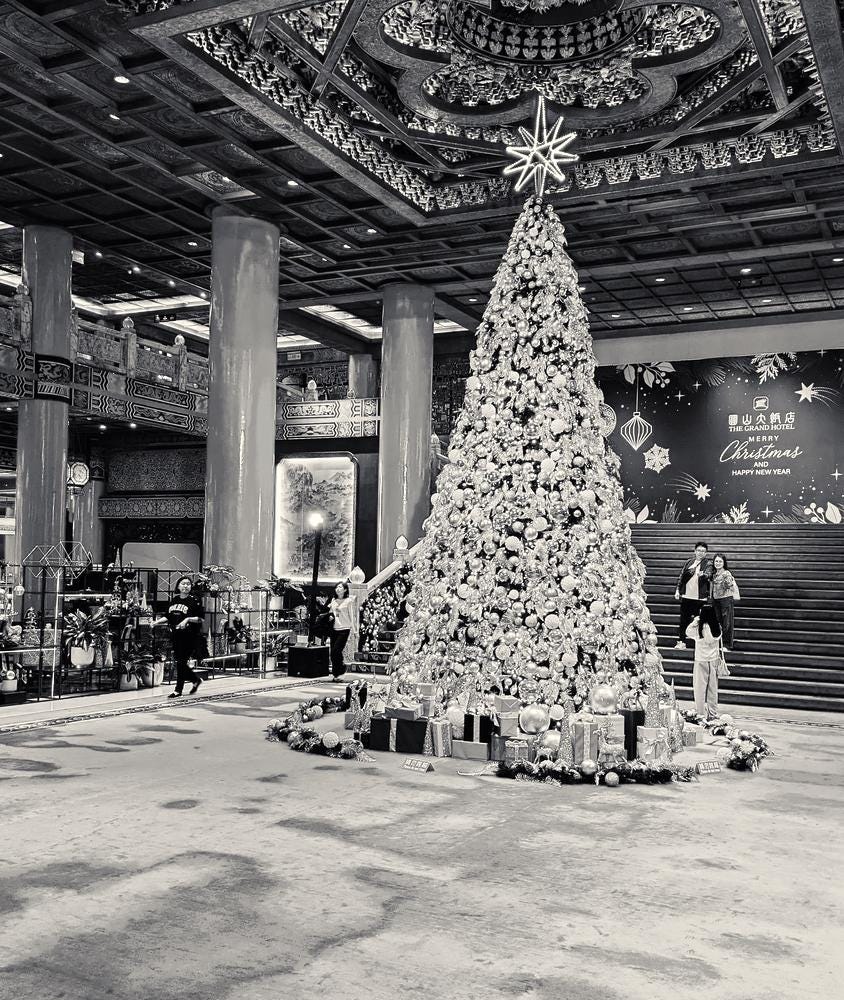
You will recall that last month’s Peripatetic Historian ended with a cliffhanger. As we went to press, Taiwan’s Central Weather Authority had just issued a frigid weather warning and residents faced the horror of a plunging column of mercury. Temperatures were forecast to drop into the 50s (teens for those of you reading along in Celsius).
The situation was grim. I immediately implemented contingency plan "Old Jack Frost,” verifying that my closet still contained my small collection of long-sleeved shirts and shaking out the folds in my light blanket. One doesn’t mess around when these warnings arrive from the CWA. I had no doubt that a winter blast, fresh from the Siberian steppes, was about to scour our fair city.
Or not.
The prediction proved a false alarm. Our daytime high on Christmas Eve was 84 (29C). Today, with the new year only two days away, the temperature is 78. Our endless summer clings with the tenacity of a waterlogged rat balancing on an old ship’s timber.
Life in the semi-tropics.
The Grand Hotel, Taiwan’s first guesthouse to attain a five star rating, attests to a love of dragons and the paranoia of the country’s first president.
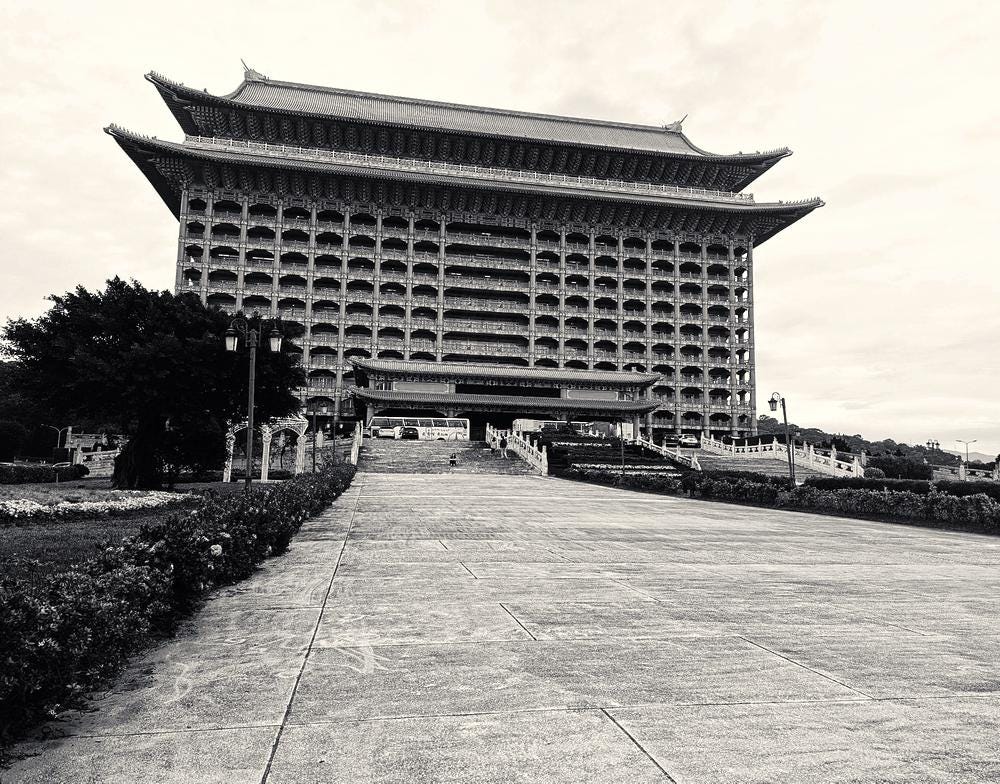
It is a building designed to impress and overwhelm visiting dignitaries. Resembling a squat pagoda, the hotel stands fourteen floors high and shelters more than 500 rooms beneath its gold tile roof. Guests in the outer rooms enjoy private patios, from which they can gaze across the Keelung River and admire views of downtown Taipei and Songshan airport.
And then there are the dragons. Wherever you look, wherever a flat surface presents itself, you find a hand-carved dragon. According to Feng Shui masters, the hotel squats on a local dragon. I have no way to verify that claim, but even if it is untrue there are more than enough dragons in the hotel to compensate.
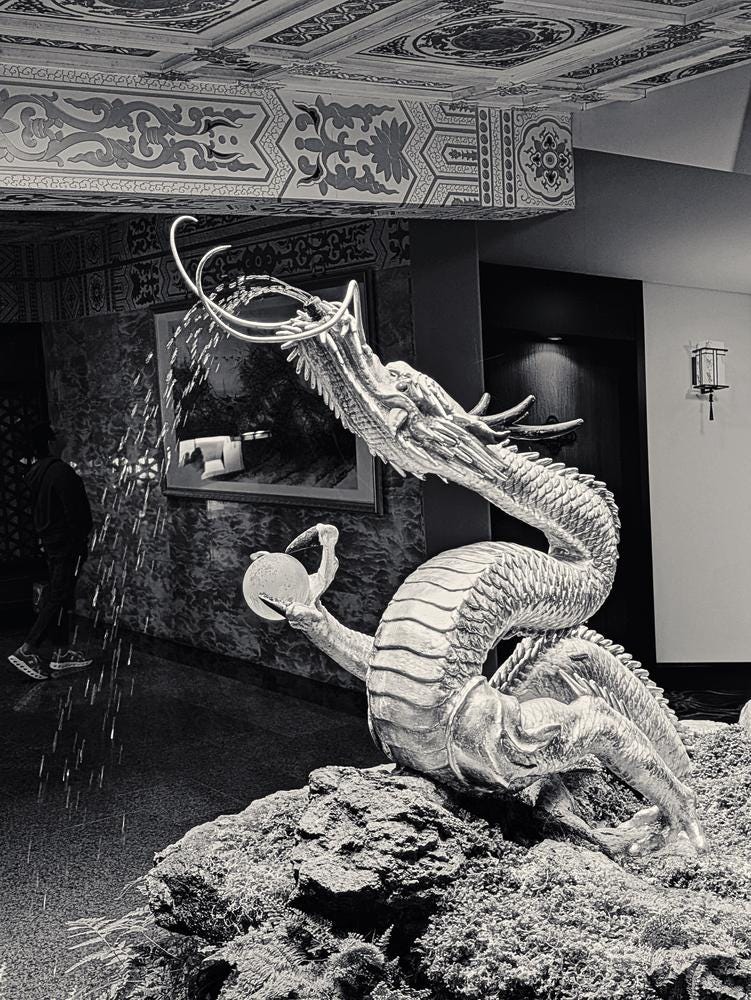
According to local tradition, an Australian visitor set himself the challenge of counting every dragon in the hotel. After three days—the length he had specified in his original room reservation—his task remained unfinished. He was forced to add another three days of residency. After six days of neck strain and finger cramps, he had counted more than 220,000 dragon images in the building.
Is this story true? As a professional skeptic I am dubious. A back-of-the-jotter calculation reveals that, assuming he tallied dragons for twelve hours a day, he would have been required to average 3,055 dragons per hour.
That’s a frenetic pace. It would be hard to keep it up, especially since he had to find each dragon before counting it. The story strikes me as an urban myth, but I will confirm that the hotel has a significant number of dragons lurking about.
In centuries past the dragon was closely identified with imperial power. The many instances of the creature in the Grand Hotel directs our minds toward the building’s sponsor, President Chiang Kai-shek.
As does a second relic of his reign: a classified escape slide integrated into the hotel fabric that allowed the president to flee the building in case of an attack.
The Western Secret Passage burrows beneath the hotel foundations, careening downhill to a concealed exit at the base of Jiantian Park. The tunnel is two meters wide, and for the first 20 meters of its descent, is divided between a steep flight of stairs and a polished concrete escape slide.
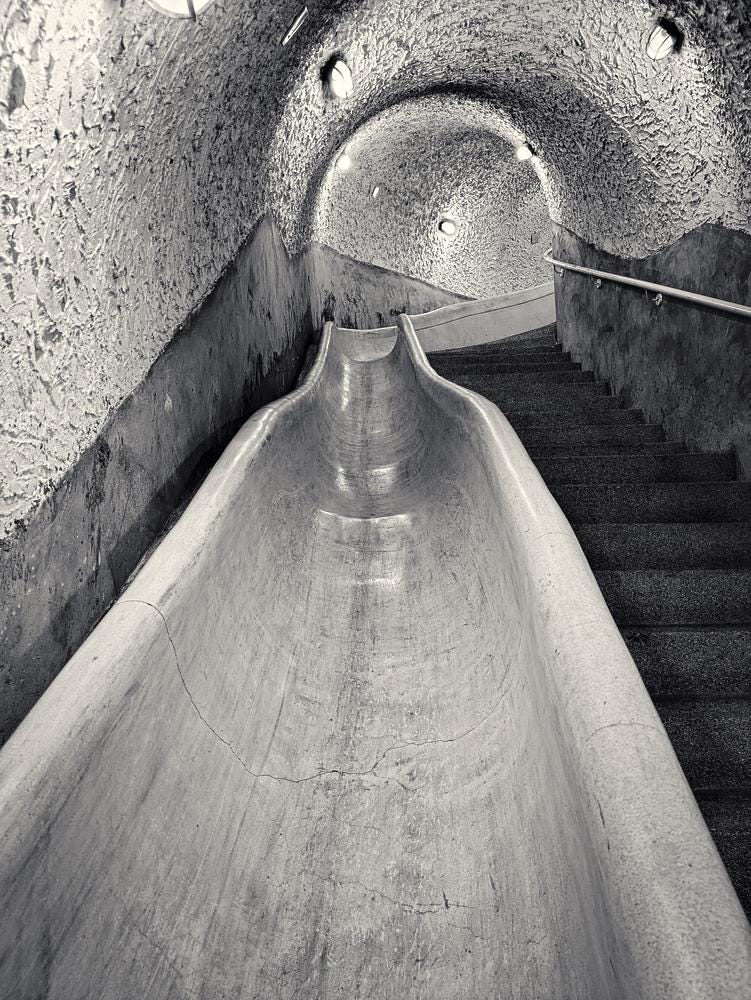
In an emergency, the presidential bodyguard would hustle Chiang Kai-shek to the tunnel entrance. One of the soldiers would then lay down on the smooth trough. The president was placed on top of the soldier, as snug as a child atop a sled. Released, the pair would zoom down the escape slide like an Olympic bobsled team. A second team of soldiers waited at the bottom of the chute to catch their president.
The leader was then hustled the remaining 65 meters to a non-descript steel door, built into a concrete wall. Having outfoxed potential assassins, Chiang Kai-shek would be led to the river and a waiting escape boat.
Although there were some tense moments during Chiang’s rule, emergency contingency plan “Sliding Tunnel Rat” was never implemented. For decades after his death the tunnel remained a closely guarded secret. Finally, in 2019, the government confirmed its existence and opened it for tours.
It certainly makes one wonder how many other rat runs and badger burrows run beneath the placid surface of this city. One never quite knows what other surprises remain concealed behind innocuous doors.
The prolongation of mosquito season is another drawback of a summer that refuses to release its sticky fingers. We have a special breed here in Taipei—the 2:00 am Night Marauder—which, as its name suggests, specializes in concealing itself in secret spots until midnight is just a memory. At that point, when the human prey are adrift in their dreams, the hellspawn emerge from their hidden lairs to suckle like miniature vampire bats.
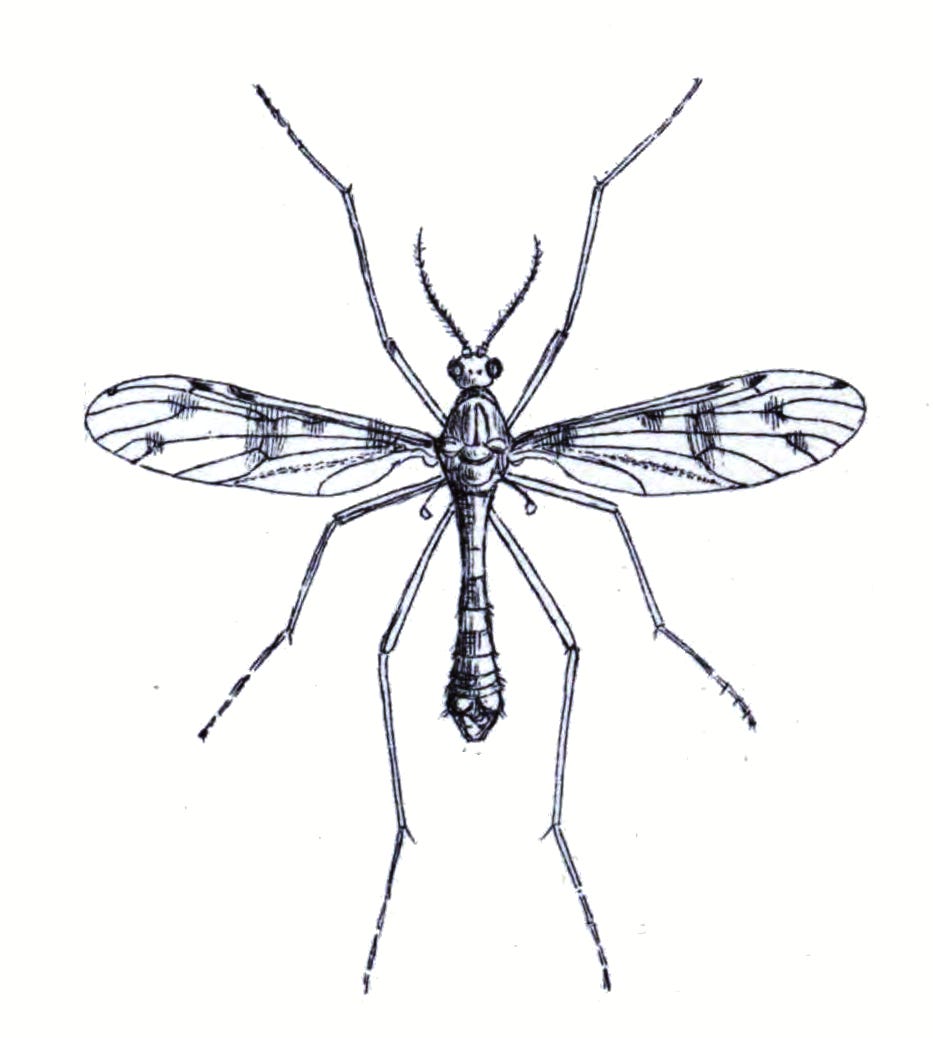
Although I retain faith in the overall arc of evolutionary theory, the mosquito whining in my ear, waking me with the sound of a high speed drill burrowing through a tough molar, makes me wonder if Satan hasn’t thrown a demonic wrench into the evolutionary pathways.
If, as Mr. Darwin argued, evolution favors genetic mutations that confer an advantage over non-mutated examples, then how does the theory account for the mosquito? It seems patently obvious that an insect heralded by an irritating whine labors under a significant genetic disadvantage. Surely, over the millions of years that these critters have annoyed the earth, there must have been some mutations that produced silent flight. How is it possible that shrill, unevolved mosquitoes still exist?
Commonsense suggests that, handicapped by their noisy approach, the baleful creatures would have been replaced by silent predators, the sort that might suck your blood without waking you up. And yet, here in Taipei’s eternal summer, they thrive. They are the Hydra of the insect world: smash one and two more spring forth.
We’ve tried everything: mosquito gassers that spread toxic fumes in the air; a bug zapper designed to lure them to an electric death; weeping and gnashing of teeth—but still they come. In theory, once the weather grows cold, they will stop breeding and give us a respite.
Oh for chilly days that will bring relief on so many fronts.
Only female mosquitoes bite humans. Male mosquitoes lack the needle sharp proboscis required to lance the flesh. The mosquito that attacks you is a female.
Blood is not a regular part of the insect’s diet. Both genders normally feed on plant nectar. However, when the time comes to continue the species, the female turns carnivorous. She needs blood’s protein to produce eggs. At this point in the cycle she hunts a supply of warm-blooded mammals.
Or cold. Mosquitoes also torment frogs and lizards. Of course, since these critters enjoy snapping up a mosquito treat, this is undoubtedly a perilous option.
And finally, the easiest time to kill a mosquito is after she has tanked up on your blood. Sated on the red stuff, she grows turgid and slow to take flight. Watch your background, however, as the swat-ee will leave a nasty scarlet smear.
Eager to escape the heat, we are returning to Japan for our three week winter (ha!) break. I am expecting cooler temperatures and fascinating new vistas. Look for that report next month.
Until then, be safe, be sensible.

Know someone interested in history, travel, or photography? Hit the share button and send them a copy of the Peripatetic Historian.
Thoughts? Comments? I have a button for that as well:
No posts
Comments
Nothing yet. Say the first thing.
Sign in to join the conversation.