
The first time I was asked to build a GTM plan from scratch, I sat in front of a blank Google Doc for many days wondering where to start.
I felt like I was carrying the weight of a whole company’s growth expectations on my shoulders and it for an ADHD brain like mine, it was incredibly overwhelming.
Something that nobody tells you when you join a startup as a solo PMM is that building a GTM plan in an established company with an established audience and positioning, plus a full team, is a completely different animal compared to doing it alone, with limited budget, zero playbook, and a founder asking when the leads will start coming in.
So whether you just joined a startup as the first marketing hire or you’re trying to relaunch a product that hasn’t gotten traction, this one is for you.
I ask this because some PMMs confuse a GTM plan with a marketing plan. They are not the same thing.
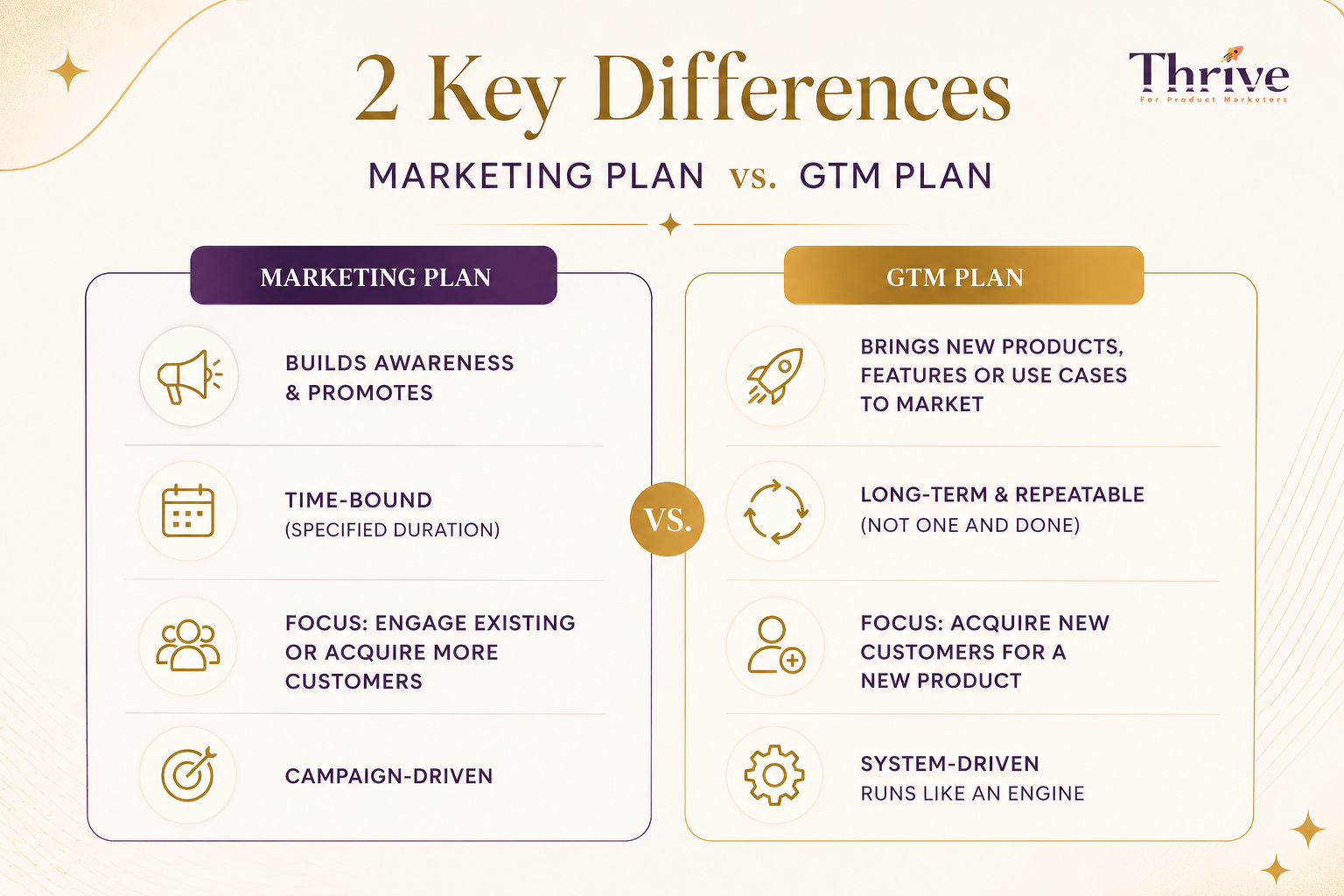
A marketing plan is about how you build awareness around a product and promote it over a specified duration of time. It includes campaigns, channels, content, PR and a bunch of other things that a GTM plan must also have but its specific focus is not to launch something new. It can be to engage customers again or increase acquisition of new customers.
A GTM plan is A SYSTEM used to bring a NEW product (or feature, or new use case) to market. It is not a one and done, it is a repeatable system that is used to acquire new customers for a NEW product over a long period of time. A good GTM runs like an engine, not a campaign. You set it up once, keep maintenance ongoing and it keeps delivering on the key results. If your GTM cannot run like a system, it is just a marketing plan.
A good GTM plan must answer five things:
Who are you going after?
What does it solve?
Why does it matter?
How will you reach customers?
How will you convert customers?
Once you have these answers, the overwhelm shrinks a little. Now, let’s get into the steps.
I know. You want to move fast. The founder wants results. But skipping the research phase is the number one reason GTM plans fail.
Before I write a single word of positioning or pick a single channel, I do the following things:
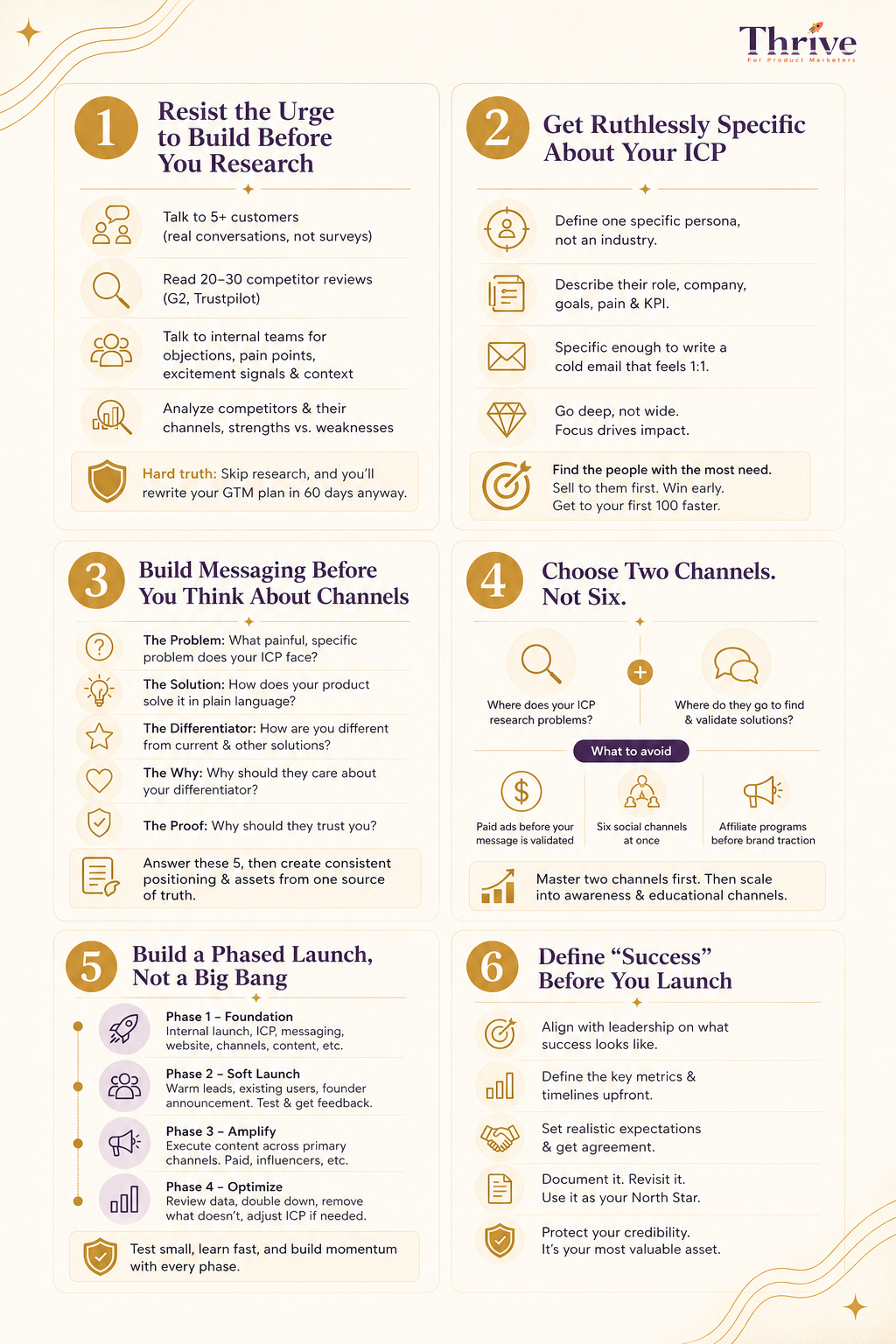
Talk to at least 5 existing or potential customers, actual conversations, not surveys. I want to hear how they describe the problem in their own words.
Read 20-30 competitor reviews on G2 or Trust Pilot with the mindset that every negative review is a positioning opportunity.
Talk to internal teams including sales, product, management or customer success teams. They are sitting on a goldmine of context about the audience and their problems and may not even know it. Look for objections they get from prospects, excitement signals, points of pain that motivates a customer to buy, and recurring questions. This is your shortcut to market intelligence.
I look at existing competitors and their key channels to see how they show up, what their strengths vs weaknesses are and how people interact with them on these channels.
Hard truth: If you skip research and build on assumptions, you’ll be rewriting your GTM plan in 60 days anyway, but with less credibility and more pressure.
Every PMM knows what an ICP is. But most GTM plans I’ve seen define it way too broadly.
“Our ICP is B2B SaaS companies with 50-500 employees.”
That is not an ICP. That is an industry.
Your ICP needs to be specific enough that you could write a cold email to exactly that person and have them think you sent that email to just them. Something like:
“Head of Marketing at a Series A UK fintech with 10,000+ users, trying to reduce churn and hit a 70% activation rate KPI but managing customer behaviour tracking in spreadsheets.”
That is an ICP.
Why does this matter so much for a solo PMM? Because you have no bandwidth to go wide. Picking one profile and going deep is what lets you create messaging that lands, pick the right channels, and close deals faster.
I have done this so many times and it honestly works when all else fails. Find the people that have the most need to solve the problem your product solves and sell to them first. You’ll get your first 100 customers faster and your team will see your value early.
The channel is just a distribution vehicle. The message is the actual product.
Here is the framework I use for every GTM plan:
The Problem: What is the painful, specific problem your ICP faces right now that the product can solve very well?
The Solution: How does your product solve it, in plain language, not jargon?
The Differentiator: How are you different from their current solution and other available solutions in the market?
The Why: Why should they care about your differentiator and the unique way the product can solve their problem? E.g: someone says they want to go to Dubai next week, they can either use a plane or travel by ship. Both are means of transportation but if the customer wants to get there faster, the why here is faster and more convenient travel.
The Proof: Can you prove credibility? Why should they trust you?
Once you have answers to these five questions, you can build your postioning and messaging, including other relevant assets like a homepage, cold emails, a sales deck intro, and an onboarding email, all from the same source of truth. That is how you stay consistent without burning out.
I’m serious. Two.
It is infinitely better to do two channels extremely well than to be mediocre on six while also writing positioning docs, supporting sales, and aligning with product, all by yourself.
How do you pick the right two? Ask yourself: where does my ICP to research their problem and where do they go to find solutions?
In one of my own experiments, I discovered our target audience used Google search to research their problems then went to Reddit to compare alternatives (from Google search) and validate those options through honest peer experiences before deciding. Knowing that changed everything for me and allowed me to build a superior content engine on these 2 channels that rivaled competitors.
This meant that when prospects went to search about solutions to their problems on Google search (and LLMs like ChatGPT), we were always showing up.
When they went to compare and validate the product by asking their peers on Reddit, we were also showing up, reinforcing out positioning and what we are extremely good at.
This solid channels with clear and consistent messaging about our key differentiators made it easy to acquire customers that didn’t churn 98% of the time.
What to avoid here:
Paid ads before your message is validated
Six social channels at once (honestly we still had a Linkedin, X account but it was just for the sake of being present)
Affiliate programs before you have brand traction (I tried this, nobody cared because we weren’t famous enough yet)
When you have built a solid system that helps you acquire customers with your 2 main channels, you can start scaling your channels to include awareness and educational channels. At this point you have built enough trust to get the budget to fund your cool awareness campaigns.
If you don’t have any good channels that steadily acquires customers, you’ll loose the confidence to request the budget you need for awareness and other activities required to scale your acquisition efforts.
The biggest mistake I see solo PMMs make is planning one massive launch day and betting everything on it. When it underperforms, it feels like failure, even when the product is genuinely good.
Instead, I always go phased:
Phase 1 - Foundation: Internal launch and alignment on ICP, positioning/messaging, website update, channels, content, etc.
Phase 2 - Soft Launch: Email to warm leads & waitlist, launch to any existing users, founder announcement… the goal here is to test your messaging and get early feedback in a controlled space that allows you to tweak minor imperfections and smooth out any blockers that could impact the user experience and perception of your product.
This soft launch phase is the one most people skip, and it is the most valuable. It’s where you test your messaging quietly before pushing it to a broad audience. Think of it as your safety net.
Phase 3 - Amplify: Execute content across your primary channels using your validated messaging. This is where you can roll out your commercials, influencers, paid ads, etc depending on your promotional strategy.
Phase 4 - Optimize: Review data, double down on what works, remove what doesn’t, adjust ICP if needed and make sure your GTM system works.
This one is as much about protecting yourself as it is about measuring impact.
Before your GTM goes live, align with leadership on what a successful launch looks like and expectation timelines. What metrics are you tracking? Are expectations realistic?
Document it. When expectations are vague, anything short of explosive growth feels like failure to a founder, even when you’re making meaningful progress. When it’s documented and agreed upfront, you have a shared language for evaluating what’s working.
As a solo PMM, your credibility is one of your most important assets. Guard it.
Building a GTM plan as a solo PMM at an early-stage startup will sometimes feel like building a plane while flying it. Some of your bets won’t work. A channel you were excited about might go quiet after some time. Messaging you loved may fall flat with the market.
That is completely normal.
What makes a GTM plan great isn’t getting everything right the first time, it’s building a system that lets you learn fast and keep moving. The most dangerous thing you can do is overthink and overplan in a vacuum that’s why research and soft launching is very important. Ship the first version of your messaging. Talk to the market. Let the data teach you and tweak from there.
You will be surprised how much clarity comes from just starting.
P.S. I’d love to know: are you currently building a GTM plan from scratch? What’s the hardest part right now, messaging, channels, internal alignment, or something else?
Also, if you liked this, like it (lol) so that I know and bring you some more in-depth letters.
Comments
Nothing yet. Say the first thing.
Sign in to join the conversation.