
A founding PMM is usually the first marketing hire. Or one of the first.
There is no playbook waiting for you.
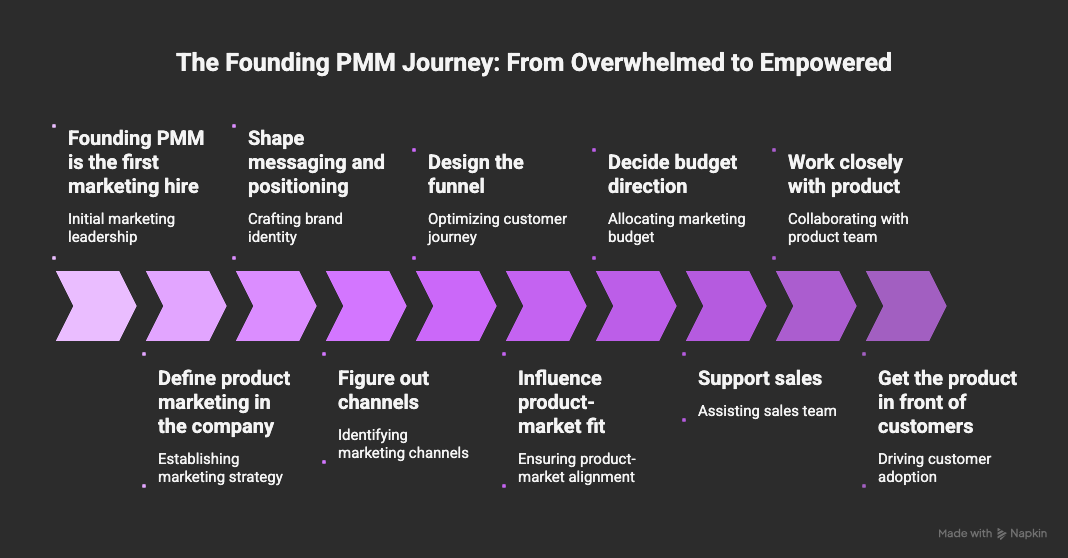
You are expected to:
• Define what product marketing even means in this company
• Shape messaging and positioning
• Figure out channels
• Design the funnel
• Influence product-market fit
• Decide budget direction
• Support sales
• Work closely with product
• And somehow get the product in front of customers.
All at the same time.
And you often have very little budget. Very little structure. And very high expectations.
You also have to constantly explain that you are not the ad manager. Not the social media manager. Not the performance marketer.
It is not an easy job and everyone looks at you like you’re the messiah coming to save them.
When I started as founding PMM at Rayda, I remember feeling overwhelmed. Everyone expected magic. Growth. Leads. Clarity.
Meanwhile, I was thinking, “Okay… but where do I even start?”
After multiple sessions with my mentors, long planning sessions with myself, and a lot of trial and errors, this is how I eventually made it work.
I wrote a clear document outlining:
What product marketing owns
What product marketing influences
What product marketing does not own
Then I shared it with the team.
It wasn’t about drawing hard lines. It was about clarity.
Over time, people stopped expecting me to run ads or chase partnerships. They understood I could support messaging, positioning, strategic direction and experimentation, but not execute every marketing task under the sun.
If you do nothing else as a founding PMM, do this.
Knowledge is your power.
Talk to real customers. Not just once. Repeatedly.
Listen carefully to:
How they describe their problem
How they describe alternatives
How they describe value
Where competitors are winning
Where competitors are failing
Read competitor reviews. Study objections. Study lost deals.
When you know more about the customer, the problem, and the market than anyone else in the room, people naturally start coming to you.
But here’s the hard part.
You must use that knowledge to make decisions.
If you hide behind leadership or wait for consensus every time, no one will see your strategic strength. You build trust by making calls.
In Rayda, the decision that I championed was cutting off all the other products that didn’t win for us at the time and focusing on one product, with one messaging and one GTM strategy.
Doing this dramatically increased the effectiveness of our positioning and value proposition, making it easy for potential customers to find us.
This was a win
That win built trust, and trust gave me influence over roadmap decisions, experiments, and GTM strategy.
After you earn trust, most people become paranoid about losing it. Making a decision becomes paralyzing because you want to maintain your winning streak.
But this does not help you.
What helped me was going back to the source. Customer insight.
If the data and conversations supported the idea, I moved forward.
Some experiments failed. Many worked.
We unlocked new channels. Strengthened our GTM. Built steady inbound.
However, the tip for doing this is to listen to the feedback within your own team.
Sometimes it is annoying to get feedback from everyone who thinks they know how to do marketing but sometimes, there are gems hidden in those half baked ideas.
Most of us can relate to the startup scenario where the founder has a great idea or they see something another company is doing and want to try them.
But you know it does not make sense for your product context, business model and GTM approach.
Sometimes you’re tempted to do it anyway so that you don’t appear difficult but this approach can compromise your credibility.
My recommendation is to advice against it and state why. But don’t just state it, document it.
If you are asked to do it anyway (because let’s be honest, this happens), then always build a tracker that documents expected outcomes, actual outcome and notable concerns.
This protects your credibility.
And it turns failure into learning instead of blame.
If expectations vs notable concerns are well documented, it becomes impossible to blame you.
However, still keep an open mind to executing that idea to the best of your ability. Sometimes, you get surprised with a win.
This might be the most underrated skill of a founding PMM.
A good relationship with product means they will loop you into new features and product roadmap updates.
A good relationship with sales and customer support means they will tell you about objections, concerns, new competitors being mentioned, perceived market shifts, etc. before you have to ask.
A good relationship with your leadership team means they will talk to you openly about thier concerns, expectations, prorities and update you on changes early on.
The list goes on and on.
This topic probably deserves a post of it’s own becaue its very robust and requires logic + emotional intelligence to do well.
My rule of thumb is this:
Treat your colleagues like friends (don’t overshare):
Protect what they share with you, give them credit for even the 0.5% of contributions they make, publicly and privately, do not compete unnecessarily, and put their best interests over the company’s.
I tell my team all the time, nothing is so urgent that you must destroy yourself for it. Except when we are at risk of losing customers or damaging reputation.
Treat leadership like your bosses
The company is usually a huge part of their lives, especially when dealing with founders and co-founders, so I always remember not to overshare or do anything to contradict that idea that I have their best interests at heart and I not just think about acquiring customers, but maximizing them for revenue.
They need to feel like you understand them from a business angle and you can handle money decisions. Ie: increasing revenue, while spending as little as possible.
However, remember to treat them like humans too but never overshare here.
Being a founding PMM is not glamorous.
It is messy, strategic, political and lonely at times.
But it is also one of the most powerful seats in the company if you handle it well.
You are shaping how the market understands the product, and how the company understands the customer. If you do it right, you are not just launching campaigns, you are building the foundation of how the company grows.
If you are in this role right now and feel overwhelmed, that is normal.
Clarity, focus, courage, and relationships will carry you further than trying to look impressive.
And sometimes, the real win is not in launching things but in building repeatable systems that makes sense and leads the business closer to their big goal.
Comments
Nothing yet. Say the first thing.
Sign in to join the conversation.