
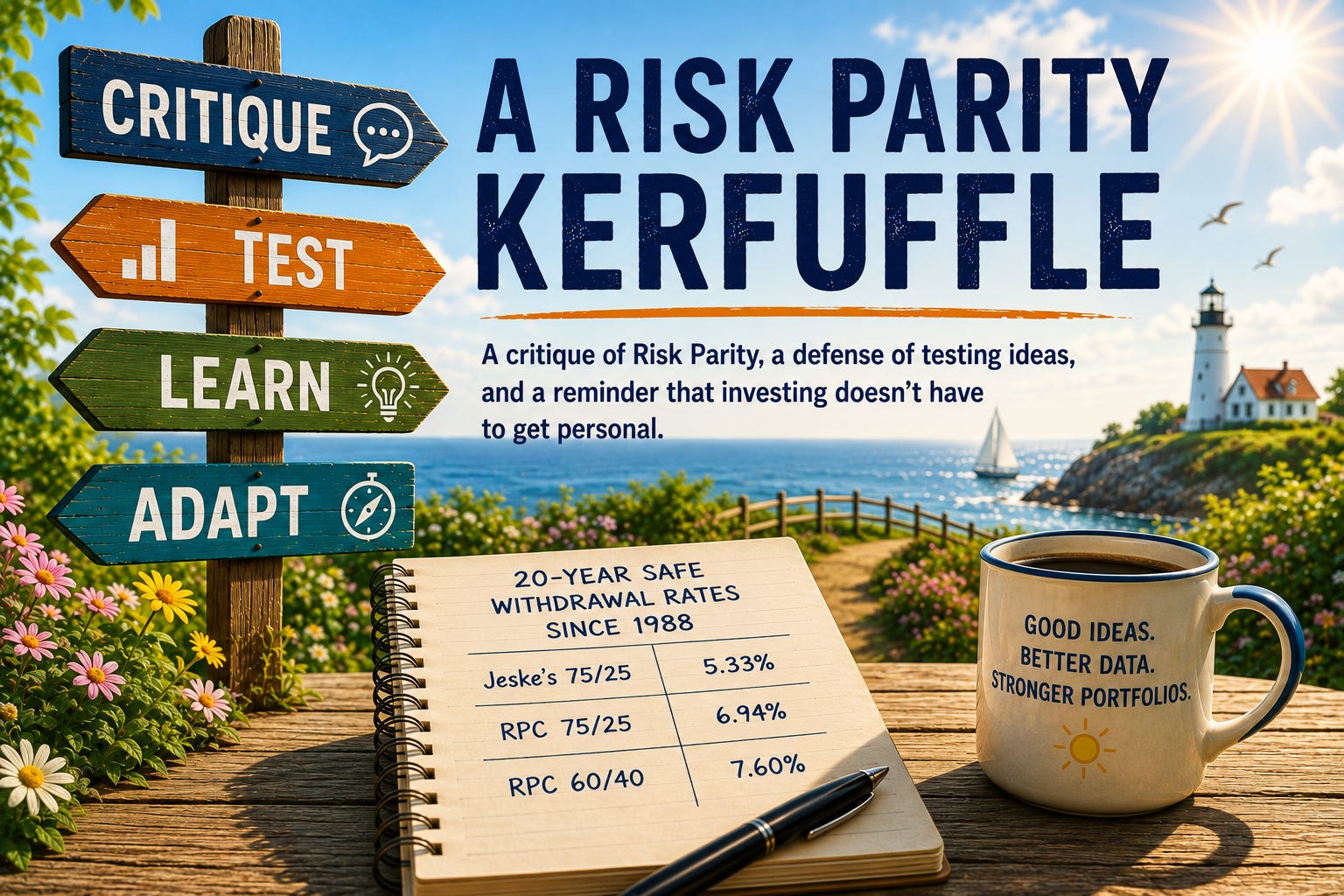
This morning’s big task was to sit down with a recent critique of Risk Parity by Karsten Jeske of the blog Early Retirement Now, really drink it in, and then type up a response for what was sure to be a banger.
I believe in good-faith back-and-forth about investing ideas, and I don’t shy away from critiques of Risk Parity. In fact, I welcome them. Criticism can push my own thinking and help me learn.
Yes, this is Risk Parity Chronicles, but the point was never to build a castle out of Risk Parity and then defend it at all costs. The goal is to push the idea this way and that, test it at the margins, and see what happens when you try to implement it in the real world.
So I started reading the piece with some anticipation—but, admittedly, a little trepidation as well. The series it belongs to is called “How to ‘Lie’ with Personal Finance,” which sets a certain tone.
Oh well for my morning plans. You know what they said about the best laid plans of mice and men.
Jeske’s Risk Parity critique seems much more driven by personal animus toward Frank Vasquez, host of Risk Parity Radio, than by a good-faith examination of Risk Parity. There are numerous asides that feel like pointless extra digs. Not that I need to defend Frank—as a former trial attorney, he can certainly do that himself!—but the tone was discomforting from the outside.
The piece doesn’t give much indication of why the tone is so personal. In the comments, though, there is mention of a soon to be released BiggerPockets Money podcast featuring Jeske and Vasquez. It is due to come out in a few days on Tuesday, the 11th. One can only assume there were some fireworks between the two, leading to Jeske’s volley ahead of the episode.
I guess we’ll have to wait for the podcast to find out.
Honestly, though, I find all of this a little unseemly. It could very well be that Vasquez was the conversational aggressor—I wasn’t in the room, and didn’t listen to an advance copy, so I don’t know. But if an investing debate has become this personal, it feels like we’ve jumped the shark somewhere along the way.
As for the substance of the piece, I think it takes things that may be true of a particular version of Risk Parity and stretches them until they define Risk Parity itself.
There is a recurring “If you believe in Risk Parity, you must believe X” argument, followed by an assertion that I, for one, don’t believe.
Presumably the next step would be: “If you were a true believer in Risk Parity, then you would believe X.”
That’s essentially the No True Scotsman fallacy, and Jeske does this with inverse-volatility weighting, commodities, rebalancing schedules, and more.
I started my rough draft by going point-by-point through these arguments. After about 30 minutes, I abandoned that approach. It was getting tedious to write, and I assume to read, and I realized I was missing the bigger point.
Jeske creates a particular version of Risk Parity, attacks it, then moves on to the next version. It’s a long piece, and by the end I was getting a little dizzy.
But then I got to the conclusion—and found something interesting.
After all the slings and arrows, Jeske ends up advocating 100% equities during accumulation and a 75/25 stocks/bonds portfolio during decumulation.
Wait a minute.
That’s not that far from what I’m advocating, so why all the drama on the way to roughly the same place?
My recommendations are:
During decumulation, a sliding scale where 75/25 stocks/diversifiers probably produces the best returns, while 60/40 provides a somewhat higher withdrawal rate. I laid this out in The Two Triangles, suggesting that individuals might make different trade-offs.
True, my equities and my diversifying assets are different from Jeske’s. For equities, Jeske favors all S&P 500, whereas my mix is split between US Large-Cap Growth, US Small-Cap Value, and total International. For non-equities, I favor a mix of extended-duration bonds, gold, and trend-following managed futures instead of just intermediate-term bonds. Check the links for more info about why, and the Two Triangles piece explains more on how I balance between equities and diversifiers.
As an aside - you’re not going to believe this, but one reason I include gold is because of Jeske’s own research! In Part 34 of his series, he found that gold was an effective diversifier that improved his portfolios, but then didn’t/doesn’t advocate for it. I wonder what the story is there…
Of course, Jeske proposing one thing and me proposing another begs a test, so, just for giggles, I put his 75/25 portfolio against two versions of what I’ve advocated.
The first was:
75% equities, split between growth, small-cap value, and international stocks
8⅓% each in extended-duration bonds, gold, and managed futures
The second was:
60% equities, using the same equity allocation
13⅓% each in extended-duration bonds, gold, and managed futures
The data comes from Testfolio, to which Jeske gives his stamp of approval later in the piece as a reasonable backtesting tool.
The backtest begins in 1988. That’s not as long as I’d ideally like—I especially like getting back to 1970 to capture the crazy 1970s—but it’s long enough to be interesting.
If you want to play around with the test yourself, you can find it here. Anyway, here are the important stats:
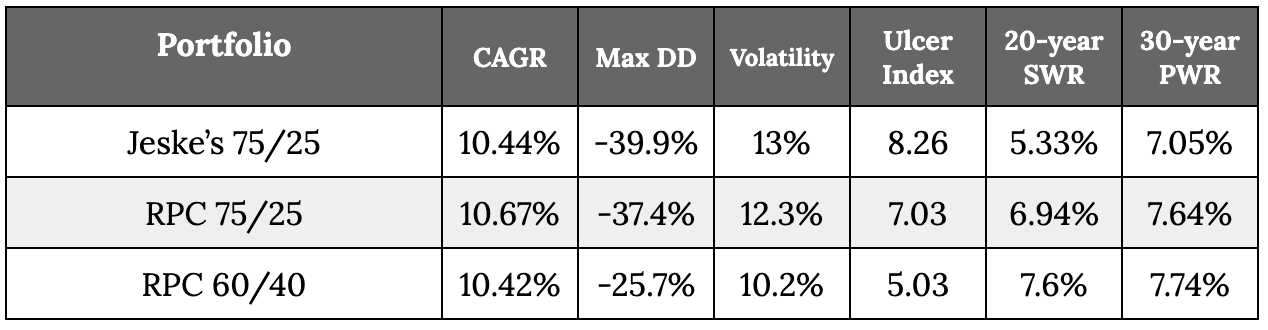
So, score one for Risk Parity—or at least Risk-Parity-influenced investing, since I’m not sure whether Jeske would consider my approach “true” Risk Parity. Also, the reason for the RPC out-performance may be due to the choice of equities, not the choice on non-equities (but in that case, why didn’t Jeske advocate for better equities?).
But there’s no denying the results. Keeping the equity allocation the same at 75% while providing the mix of diversifying assets produced slightly higher CAGR, along with better volatility, drawdown, and Ulcer Index numbers.
In my recent piece on a one-size-fits-most portfolio for retirement, I settled on a split of 60/40 between stocks/diversifiers. That portfolio slightly underperforms Jeske’s version—by just two basis points of CAGR—but has notably better volatility, maximum drawdown, and Ulcer Index.
And then there’s the really interesting part:
Look at those withdrawal rates!
To be clear, this is an exceptionally good period for the markets. I’m absolutely not saying that adopting the RPC 60/40 portfolio means you can blindly withdraw 7.74% for the next 30 years.
I am saying that, directionally speaking, adding more diversifying assets produces a more resilient portfolio that suggests a higher withdrawal rate, or at least more confidence in the withdrawal rate you settle on.
My intention when I started Risk Parity Chronicles was never to build a Risk Parity castle and then sling arrows and hot tar at anyone who attacked it. Risk Parity is an idea—it has merits and drawbacks, times when it applies and times when it doesn’t. Just like any idea.
Instead, I started the blog to see how Risk Parity could withstand storms, tides, wind gusts, and searing heat—otherwise known as general market conditions. If I test Risk Parity and it fails, well, then I’m glad it was just a test!
That’s why the experiments I track through my test portfolios are the core of this blog. They’re mostly how I try to answer questions like this one.
And so far, so good for Risk Parity—or at least Risk Parity–influenced investing, however loosely defined.
My live portfolio experiments show some interesting patterns:
Over the past two years, the capital-efficient portfolios with high effective equity allocations and meaningful positions in diversifiers have performed best.
In 2023 and 2024, when equities were routinely beating everything else, the 100% equity portfolios did the best. Portfolios with significant bond allocations struggled, and Risk Parity–influenced portfolios generally lacked enough equity exposure to keep pace.
In 2022, the Risk Parity portfolios were strongest—but mainly because they went down the least. It was a difficult year for almost everything, and because bonds fell roughly alongside equities, diversification beyond bonds was particularly valuable.
There is an obvious drawback to my experiment: I haven’t been running it for very long. I’ve got about five years of data in total—three years from my old blog, which you can see here, and two years here, with current standings here. That’s not enough time to declare victory—or even close to it.
So I use backtests where appropriate to get a sense of how these approaches might behave over longer periods. The same broad patterns generally hold, although I freely acknowledge that backtests are imperfect. We can never make definitive predictions about the future from historical data, anyway.
But we can test ideas.
And that’s what I’m going to keep doing—without getting personal along the way.
Thanks for reading Risk Parity Chronicles! This post is public so feel free to share it.
No posts
Comments
Nothing yet. Say the first thing.
Sign in to join the conversation.