
Going back to my roots a bit...
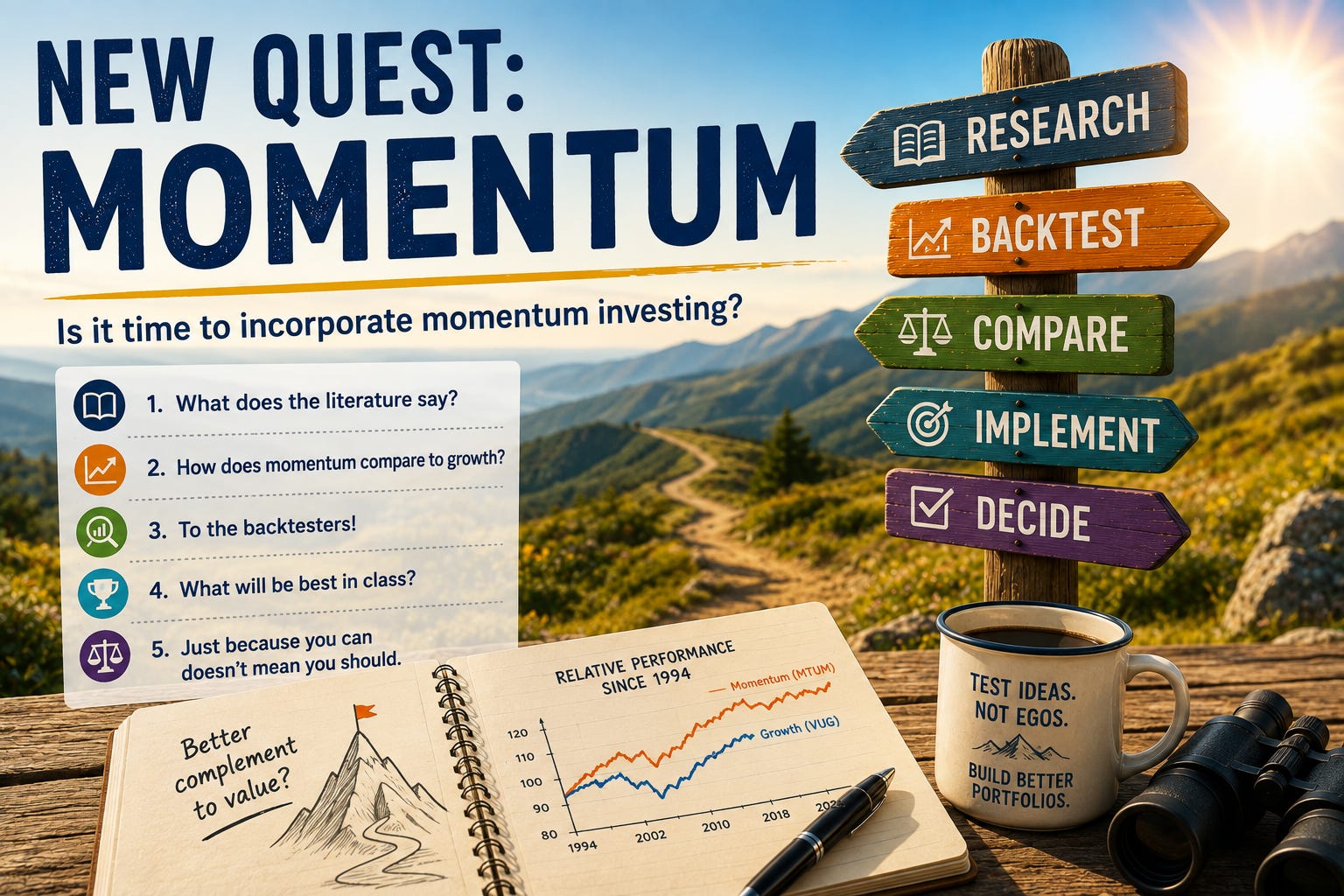
In the early days, I would go on multi-post quests to answer a burning investing question, for example, one on the pros and cons of TIPS and another on whether REITs are truly a distinct asset class that deserves a place in a portfolio. These quests usually involved six or seven consecutive posts attacking a question from different angles: what the literature says, what the backtests show, how to implement the findings, and ultimately, what a DIY investor should actually do.
I’m going to try that again with a topic I’ve been circling around for years:
Is it time to incorporate momentum investing?
As definitions go, defining momentum as an investing strategy is pretty straightforward:
Momentum investing is a trading strategy where investors seek to profit by buying stocks that are already rising in price and selling them at their peak. The idea is that well-performing investments may continue to thrive. Investors track price trends, buy strong performers, and sell when the trend starts to slow. (Investopedia)
Here is a great video explainer from Alpha Architect:
So, basically: buy stuff that is going up, and sell it when it stops going up.
QED.
That definition describes long-only momentum investing, but momentum can also be used on the downside, by shorting assets with negative momentum. Since the options available to DIY investors are predominantly long-only, though, we’ll stick to that.
The whole approach almost sounds too obvious to work. I’ll admit that its simplicity probably pushed me away from momentum early on. I fancy myself, at times, as smarter than the average bear when it comes to choosing investing strategies (yes, that’s been disproven!), so a strategy that essentially amounts to looking at what’s going up seems almost too simple.
But momentum is simple to describe and considerably trickier to implement.
What exactly counts as an upward trend? Over what time period? How do you distinguish genuine momentum from a temporary move? And how do you know when the trend has peaked? Luckily, the Golden Age of ETFs is upon us. We can access sophisticated momentum strategies implemented by experts for very low fees.
Here’s the roadmap.
Next week—or the week after, depending on how things go now that school is starting—I’ll add an entry to the Risk Parity Library.
I’ll dig into the seminal papers on momentum investing, either with a deep dive into one particularly important paper, or a somewhat broader look at several of them.
I’ll also put together some additional resources for readers who want to explore the topic themselves. Momentum investing is increasingly popular, so I’ll try to separate the wheat from the chaff and identify the materials that are actually useful for DIY investors.
This is where things get particularly interesting.
My working hypothesis is that momentum might be a better complement to value than growth is.
I’ll need to test that, though. For decades, growth has been treated as the natural counterpart to value. Maybe momentum is a better complement, or maybe it remains growth, even if momentum has outperformed growth on its own.
We’ll look at correlations, historical performance, and how the different strategies behave alongside one another.
My research may take me somewhere completely different. That’s the point of the quest.
Once I understand the rationale behind momentum investing, I’ll put it through some more rigorous backtesting.
I’ll try to get the longest history possible and then look at how momentum performed during some particularly important periods:
The Lost Decade of the 2000s
The Global Financial Crisis
The Corona Crash
Whatever the hell 2022 was
Just to whet your appetite, I did a quick preliminary test.
I currently use IWY, a large-cap growth fund, in my Equity Triangle. What happens if I replace it with MTUM, one of the oldest and largest U.S. momentum ETFs?
Using simulated funds for MTUM and for the other components, as well, I was able to get a backtest going back to 1994. The results are intriguing:
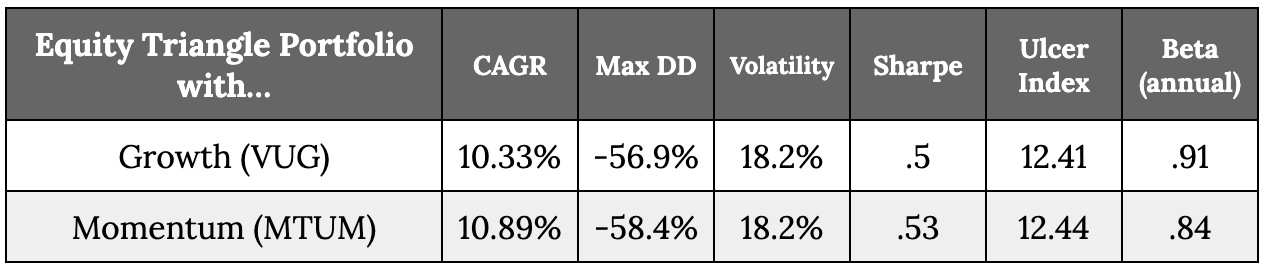
Replacing growth with momentum produced 56 basis points of additional annualized performance. That’s enough to make me curious.
For the backtests, I’ll probably continue using iShares MTUM, which is generally regarded as the flagship low-cost momentum ETF. It’s the oldest of the major U.S. momentum ETFs and remains the largest by assets.
But there are plenty of alternatives worth investigating.
SPMO from Invesco has attracted a lot of attention in recent years because of its strong returns. JPMorgan’s JMOM and Vanguard’s VFMO also deserve a look.
Then there’s Alpha Architect’s QMOM, which takes a very different approach: far fewer holdings, equal weighting, and faster rebalancing.
I’ll put them all through the tests and see what rises to the top.
Finally, I’ll need to answer the practical question: Even if momentum looks better, is it worth changing anything?
If the research leads me to conclude that momentum is a better approach than growth, I’ll still need to decide whether the evidence is strong enough to justify the hassle of switching—not to mention the very real possibility that the conclusion turns out to be wrong.
I’m particularly wary of changing my test portfolios too much.
It’s not the work involved (it’s not really work when you’re as geeky as me!). The bigger problem is that changing holdings midstream contaminates the experiment. These portfolios are supposed to test enduring Risk Parity principles, so constantly changing them would kind of defeat the purpose. On the other hand, maybe I’m the only person who cares about the purity of the experiment to this degree.
When you learn something new, you should change what you do, right?
The question is whether I’m actually learning something—or simply chasing whatever strategy happens to be on a heater.
That’s an important distinction.
I don’t want to add momentum to my portfolios simply because momentum has done well recently. I want to understand why it works, whether the evidence is strong, how it complements value, and whether the case is strong enough to justify making a change.
So that’s the quest. The posts may not be all consecutive, as I have a portfolio review in the mix for sure, and if I fall behind in a week, I may re-print something from the old blog. We’ll see.
Stay tuned. There’s some good learning about momentum ahead!
P.S. Just to follow up on last week’s post about the Big ERN critique of Risk Parity: the drama seems to have centered around a podcast episode that was supposed to air a few days ago. A reader told me that, for whatever reason, the episode of BiggerPockets Money apparently isn’t going to air. Just as well. I’m ready to move on.
No posts
Comments
Nothing yet. Say the first thing.
Sign in to join the conversation.