
2026/07 Portfolio Tracker
In case you need it, here is the explainer for the portfolios I’m testing, and the rules for the portfolios.
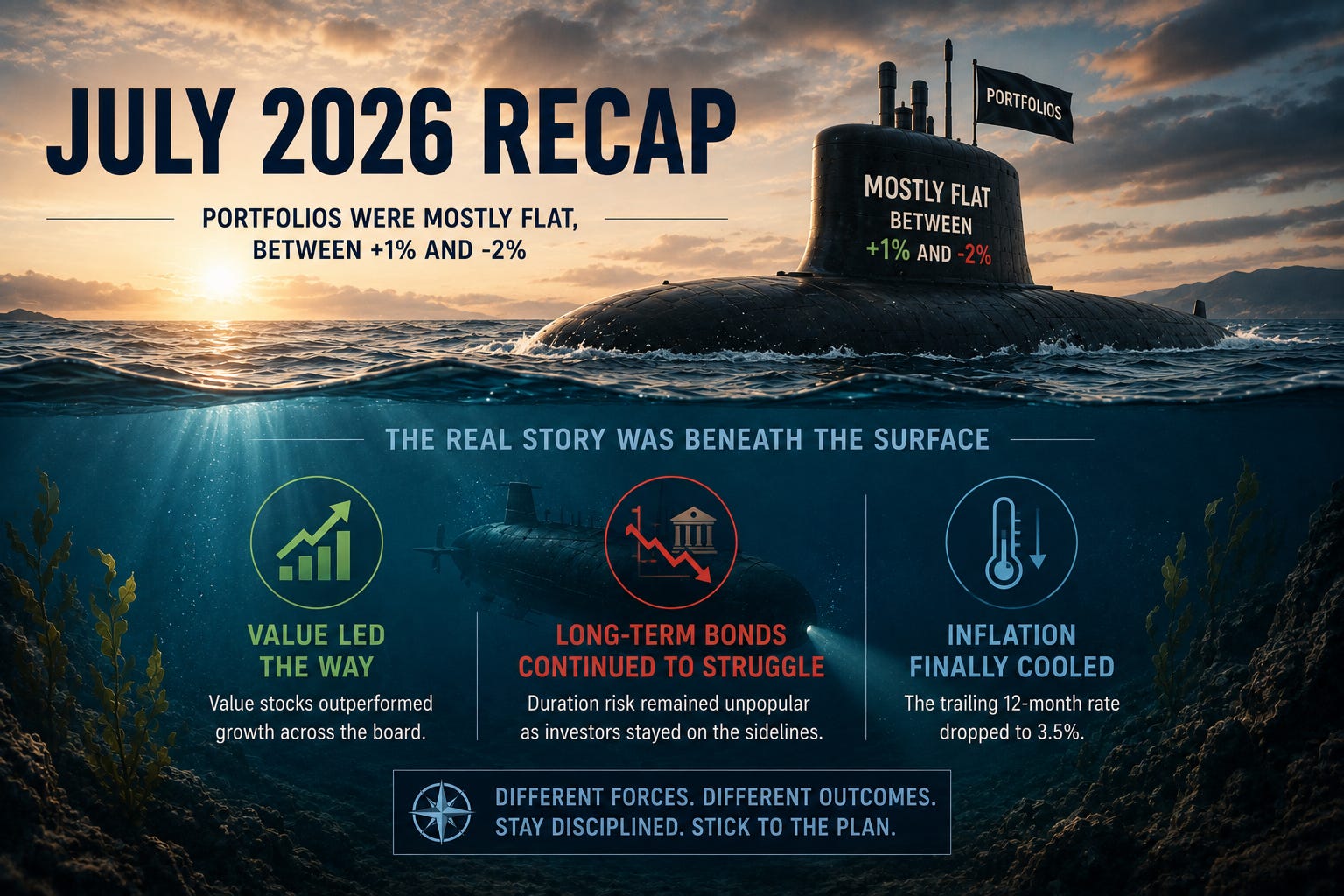
July was another slightly negative month, but there wasn’t much to worry about. The Hare was the only portfolio to finish in positive territory (+1%), while most of the rest lost between half a percent and two percent. It was a reminder that not every down month needs to be dramatic.
The Hare: +1.00%
Triangle and 22: -0.04%
The Unstacked: -0.52%
Golden Butterfly: -2.14%
Shannon’s 50/50 held onto first place for the third straight month. Despite a modest decline in July, it remains up 34.7% since the portfolios launched in July 2025.
At the other end, the Tortoise remains in last place at +14%, alongside the Golden Butterfly. That’s exactly what I’d expect. These are the portfolios designed to sacrifice some upside in exchange for stability and dependable withdrawals when markets eventually turn ugly.
Last month I wrote that value strategy ETFs were carrying the portfolios. July reinforced that story.
The Hare took first place largely because of its value holdings. QVAL gained 5.3%, IVAL added 4.9%, and ACWV— a global minimum-volatility fund—shares many characteristics with value investing and rose 3.2%.
Growth stocks, meanwhile, stumbled. IWY fell 4.3%, dragging down several portfolios and helping push the Golden Butterfly to the bottom of the rankings.
It’s only two months, so I wouldn’t declare a regime change. But it’s interesting to see the rotation. We’ll see if it lasts.
Long-duration Treasuries had another rough month.
GOVZ fell an eye-popping 7%, with much of the damage coming after last week’s FOMC meeting. Investors continue to flee duration risk as fears of persistent inflation and higher interest rates refuse to go away.
Ben Carlson and Michael Batnick had an interesting discussion about this last week. Ben pointed out an irony: six years ago investors avoided long-term bonds because yields were too low. Today they’re avoiding them because yields are too high.
The psychology is understandable.
A move from 0% to 5% feels catastrophic because bond prices fall so much along the way.
But a move from 10% to 5% feels euphoric, finally delivering some relief.
It’s not so much about the numbers but about the mindset, and this is one place where following a Risk Parity approach keeps me disciplined. Rather than trying to predict where rates are headed next, I simply rebalance back to target allocations. When long-duration Treasuries become cheaper, I buy more.
One pleasant surprise this month was inflation.
The trailing twelve-month inflation rate dropped from 4.2% to 3.5%, an unusually large one-month decline. Normally these figures move two or three tenths of a percentage point at a time, not seven.
The drop is especially interesting given the constant headlines surrounding inflation and continued geopolitical tensions in the Middle East. Sometimes the economic data and the news cycle tell very different stories.
The Triangle and 22 quietly continues to impress. It finished second for the month and now sits second overall. My hope was that modest use of leveraged ETFs could improve on the Equity Triangle without dramatically increasing risk, and so far that’s exactly what’s happened.
I’m also pleased that the portfolios are behaving largely as intended. The aggressive portfolios—the Hare, Tall Stack, Equity Triangle, and Triangle and 22—continue to lead the pack, delivering strong growth while still supporting the simulated 4% withdrawals.
Meanwhile, the defensive portfolios—the Tortoise, Golden Butterfly, and Unstacked—remain toward the bottom of the standings, but they’re still accomplishing exactly what they were designed to do: growing modestly while absorbing withdrawals with far less drama.
The Golden Butterfly experienced a rebalancing after AVUV’s remarkable run. Several other portfolios are getting close but haven’t quite reached their thresholds yet.
July was another mild down month—hardly enjoyable, but hardly alarming.
The market continues to send mixed signals. Value is showing signs of life. Bonds remain deeply unpopular. Inflation has unexpectedly cooled. Depending on which headline you read, we’re either on the verge of another Global Financial Crisis or setting up for the next leg higher.
As always, I have no idea which story will prove correct. Fortunately, these portfolios don’t require me to know.
P.S. for those still reading: This Risk Parity critique popped into my inbox the other day. It's from Carsten Jeske (Big Ern), a writer I generally like, even if we occasionally part ways. He didn't exactly bury the lede—the URL literally calls it "Risk Parity Lies" - but the mission at RPC is to explore the topic, not create a moat around it, and that means embracing dissenting views. I haven't read it yet, but I probably will this week, and chances are it'll be next Sunday's post if I have something worth saying about it.
No posts
Comments
Nothing yet. Say the first thing.
Sign in to join the conversation.