

The first exhibit falls from a sandwich. It lands on the steel table, and it won’t be eaten. I seal it in a clear bag and write BREAD across the label. The crumb smells faintly of yeast. Its broken edge shows the tiny rooms where gas expanded inside the dough. Nothing about it suggests a crime scene.
That is why it belongs in the file.
Because oil is like the special dye in a crime lab: swipe it across everyday life, and suddenly the hidden lines of the last hundred years begin to glow.
Claim: Remove industrial nitrogen and a table for eight loses roughly four plates.
Wheat needs nitrogen.
The air above every field is full of it, but the atoms cling together so tightly that most crops cannot use them. For thousands of years, farmers relied on manure, legumes, and whatever fertility the soil had stored.
Then chemists learned to break the pair.
Factories now combine nitrogen from the air with hydrogen usually stripped from natural gas to make ammonia. Around 70 percent becomes fertilizer. The gas supplies much of the hydrogen and the heat that forces the reaction. A loaf can enter the oven carrying a debt to a gas field it will never smell. Industrial ammonia links the nitrogen above us to the food below.
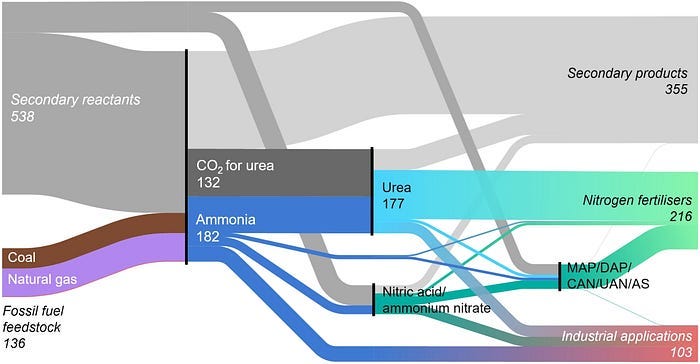
Put eight people around a table and remove factory-made nitrogen. Four plates begin to fade without synthetic ammonia. Wealth and politics would decide which four. Nearly half of us would go hungry without a process few even know about.
Diesel powers the tractor that works the field, the trucks that haul grain to the mill, and the vans that deliver flour to the bakery. Then refrigeration and packaging take over, keeping the loaf fresh long enough to survive the trip and your schedule.
The first clue has entered the body.
Claim: Oil discovered a second life as stuff.
The next exhibit comes from a dryer filter. It once belonged to a fleece jacket.
A refinery is basically a giant sorting machine: it heats crude oil and separates it into different “slices” based on what boils off first. Then chemical plants take some of those slices, crack the molecules apart, and snap them back together into long chains, the building blocks of plastics, foam, paint, or polyester. So the same stuff you picture at a gas pump can end up as a soft jacket that sits on your skin for years, with none of the gasoline smell to give away where it came from.
The International Energy Agency says the biggest jump in oil demand this year will come from making things. By 2030, plastics and synthetic fibers alone could use about 18.4 million barrels of oil a day. So more than one barrel out of every six the world uses will come out as materials, maybe the packaging you toss after lunch or the clear tube carrying medicine into a vein.
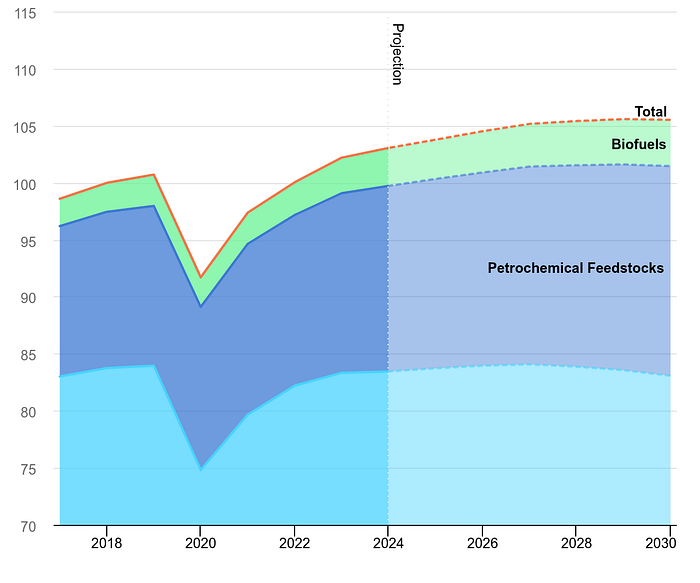
That’s why this part of our oil habit is so stubborn. You can swap a gas car for an electric one, but it’s much harder to “electrify” a disposable wrapper or a sterile medical line, even when there’s a whole spoon’s worth of plastic in our brains, poisoning our most precious organ.

The Nonzero Newsletter@NonzeroNews
The average human brain now contains enough microplastics to make a standard plastic spoon. (Data via Nature Medicine)

12:30 AM · Feb 8, 2025 · 9.84K Views
4 Replies · 14 Reposts · 34 Likes
Now we need to understand why we became so addicted to burning it.
Claim: Oil turned stored energy into luggage.
A red safety can sits beside the evidence table.
Inside it is one US gallon, about 3.8 liters, of gasoline. That amount contains roughly 30,000 food calories. A person eating 2,000 a day would need about fifteen days to take in the same raw energy. One gallon carries it in a container you can lift with one hand.
Your body cannot drink gasoline, thankfully, and an engine wastes much of the energy as heat. Still, fifteen days of food energy can enter a tank in seconds and just sit there, waiting for a spark to go to work.
Wood had to be cut, dried, carried, and fed into fire. Coal packed more energy into each kilogram but remained a rock somebody had to shovel. Liquid fuel flowed through pipes, crossed oceans inside hulls, and entered engines through a hose. Oil let energy travel as luggage.
That portability enlarged the human day. Food could move farther than the climate that grew it. A person could wake beside the Andes and fall asleep on another continent, annoyed that the seat did not recline another four centimeters.
We got used to all this so quickly that we stopped noticing what was really powering it. In one national study, people could guess which things at home use more energy, but they wildly misjudged how much more. Flipping off a light feels like you’re saving energy because you can see yourself doing it. But the diesel that moved your food, your package, or your new shirt is hidden inside the price tag. Modern life is full of these invisible energy costs, and our brains aren’t great at sensing them.
A substance this powerful and obedient was always going to become political.
Claim: A dry river gave away the largest conventional oil field on Earth.
The evidence is an old survey map from eastern Saudi Arabia.
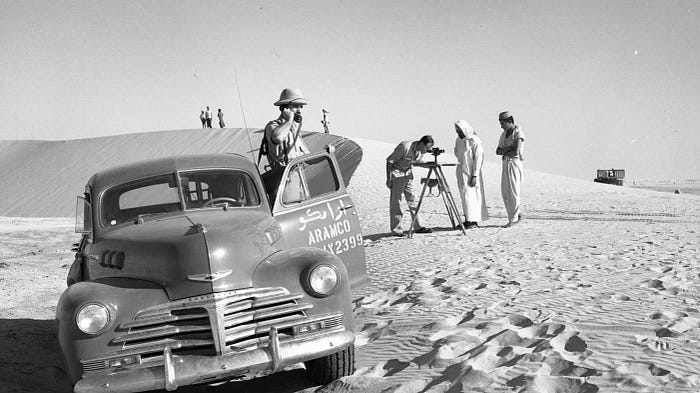
Near Haradh, a dry riverbed moves east across the desert, turns south without an obvious obstacle, then bends east again. Nearby flat-topped hills lean away from an invisible center. In 1940, geologist Ernie Berg suspected those small “wrong turns” traced a fold in the rock below.
Oil rarely stays where it forms. Ancient marine life settles into mud, heat changes the buried organic matter, and hydrocarbons move through stone. If they reach porous rock beneath a sealed cap, they collect like liquid inside a soaked sponge locked under a lid.
Berg read the bend as the edge of that lid. The structure proved to be the southern reach of Ghawar, a field so long that early drilling teams took years to realize distant wells were tapping the same giant reservoir. The bent wadi was the surface hint of a massive hidden vault.
Ain Dar №1 began producing there in 1951. Water did not appear in the well for 49 years, and it eventually yielded 160.2 million barrels. That single well worked across entire careers and several governments.
Ghawar helped turn Saudi Arabia into the central bank of spare barrels. Central banks calm money markets by releasing liquidity. Saudi Arabia can calm oil markets by opening valves, provided it has production ready. Spare capacity is emergency confidence for a civilization that burns fuel continuously.
What happens when that “just in case” cushion is forced through a single bottleneck?
Claim: Once energy became portable, geography entered every household budget.
Before sunrise on September 14, 2019, attacks struck Saudi Arabia’s Abqaiq and Khurais facilities. Fire rose above the equipment. Aramco suspended 5.7 million barrels per day of production. And this was just the preview.
On February 28, 2026, the United States and Israel launched coordinated large-scale airstrikes against military, nuclear, and leadership targets in Iran. 15 million barrels went missing instantly.

International Energy Agency@IEA
Oil exports bypassing the Strait of Hormuz have risen by 1.5 mb/d to nearly 8 mb/d, led by Saudi Arabia & the UAE. Despite this, flows remain far below pre-war levels. At the same time, Iran's exports via the Strait have been curtailed by a US blockade: iea.li/4nuGRWm

9:45 AM · May 26, 2026 · 26.1K Views
4 Replies · 27 Reposts · 51 Likes
The Strait of Hormuz between Iran and the Arabian Peninsula has always been the most concentrated energy corridor on Earth. Roughly a fifth of global oil trade and a significant share of liquefied natural gas passes through it on tankers that have no alternative route.
When tensions escalated into open conflict, that corridor became the front line.
A handful of attacks on shipping and coastal infrastructure were enough to make passage economically impossible even before it became physically dangerous. The strait did not need to be permanently destroyed; it only needed to become uncertain. And when it closed, the effect was immediate and global.
A chokepoint that few could locate on a map had become the dominant variable in the price of diesel, jet fuel, and heating oil. And so, a driver in Argentina, a factory in Germany, and a minister in Japan met inside the same volatile commodity price, revealing its dependency structure with unusual clarity, not just on oil itself, but on the uninterrupted flow through a few critical bottlenecks where geology, history, and politics collide.
Claim: Fracking picked the lock instead of finding the keyhole.
Most drilling used to be a scavenger hunt.
Companies looked for places where oil and gas had already gathered into big underground “pockets.” Shale was different. It held fuel too, but trapped inside rock so tight and crumbly that the oil and gas couldn’t really flow. A straight-down well touched too little of that rock to be worth the cost.
So engineers changed the approach: instead of drilling only down, they drilled down and then turned sideways.
In 1991, Mitchell Energy drilled the C. W. Slay №1 horizontally through the Barnett Shale. The bend kept the well inside the hydrocarbon-bearing layer. Operators later paired that contact with hydraulic fracturing, pumping water in at high pressure to crack the rock, while sand held those tiny cracks open so the gas could seep toward the well. The sideways well let producers target the source rock itself, rather than waiting to find a perfect underground pocket.
Conventional drilling looked for the keyhole. Fracking picked the lock.
By 2025, the US was producing a record 13.6 million barrels of crude oil each day, enough to fill an Olympic pool roughly every hundred seconds. It was pumping about 40% more than either Russia or Saudi Arabia. Suddenly, the old story that “the geology sets the limit” started to look more like: if you have the right tools (and enough drilling rigs), you can push the limit.
But these wells are like fireworks: they roar at the start and then fade quickly. In 2024, production from older wells in the Lower 48 fell by 4.3 million barrels per day, so companies had to keep drilling just to stay even. They brought more than 15,000 new wells online, about 41 every day, to replace the decline and add a little on top.
Energy independence turned into a relentless schedule of ‘drill, baby, drill’ with side effects: parts of the fracking water cycle can affect drinking-water resources and induce earthquakes through wastewater disposal. Today, my home country, Argentina, is betting our future on the illusion of prosperity from foreign fracking.
So where is the crime if the loot feeds people, makes medicine possible, and lets families cross continents?
Claim: Burning one barrel leaves around 430 kilograms of carbon dioxide.
The last exhibit is an empty steel drum.
After refining and burning, the products from one 42-gallon barrel release roughly 430 kilograms of carbon dioxide. That is more than the combined body weight of five 80-kilogram adults.
When you burn oil, combustion pulls oxygen from the air and turns it into carbon dioxide. That’s why the exhaust can actually weigh more than the fuel you started with, because part of what comes out of the tailpipe came in through the engine as air. And unlike the bread crumb or the jacket fiber, you can’t bag this evidence. The CO₂ spreads out into the atmosphere and mixes with everything that’s already there.
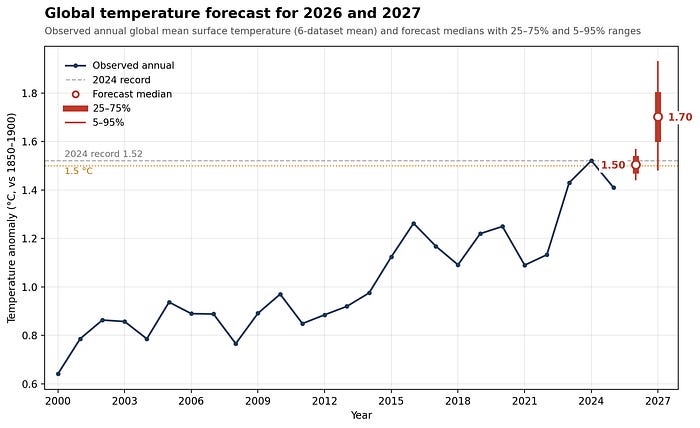
The climate responds to the total buildup. The point is very simple and indisputable: to stop warming from getting worse, we have to stop adding to that running total. Every barrel burned adds another invisible layer to a “crime scene” with no walls and no borders.
Oil had an extraordinary alibi.
It helped us eat. Fertilizer made crops grow, so dinner stayed on the table.
It helped us move. Engines powered ambulances, trucks, and planes, and made long trips something ordinary families could afford.
It helped us heal. Oil-based plastics and chemicals became the reliable materials doctors trust against an open wound.
The harm, though, didn’t show up in one obvious place. The pollution spread through the air, over decades, across borders. The benefits were immediate and personal. The costs were distant and shared.
Oil built the perfect crime: it made life easier enough to justify itself, and over time that ease turned into a dependence we can’t simply walk away from.
There’s no easy way around this. Oil helps sustain lives while its carbon alters the conditions those lives depend on. That’s why oil is the defining story of our times, the engine behind the exponential growth in everything over the last century and the reason why the stability that made that growth possible is cracking.

In a way, we hit the jackpot: we inherited a one-time stash of ancient energy underground and started spending it like it would last forever. That spending became our idea of “progress,” and we called it productivity.
Now the job is harder than simply “stop using oil.” We have to keep the parts of modern life we actually need (food, heat, mobility, healthcare) without dragging along every wasteful habit that cheap fuel made easy. Cars may leave oil first. Aircraft, ships, chemical plants, and the machinery behind food will be harder. Replacing them requires new technology and an argument over how much disposable convenience and speed we intend to keep.
We need to learn when “enough” is actually enough.
The recipe for happiness is hiding right behind it.
Outside, a delivery truck reverses toward a supermarket loading bay. The diesel engine rattles under the fluorescent lights. By opening time, the bread will be stacked in neat rows, soft, cheap, and far from the gas plant that made the fertilizer that fed the wheat.
The truck keeps beeping. And I can’t help but ask myself:
What would breakfast cost if we paid the full price?
Comments
Nothing yet. Say the first thing.
Sign in to join the conversation.