
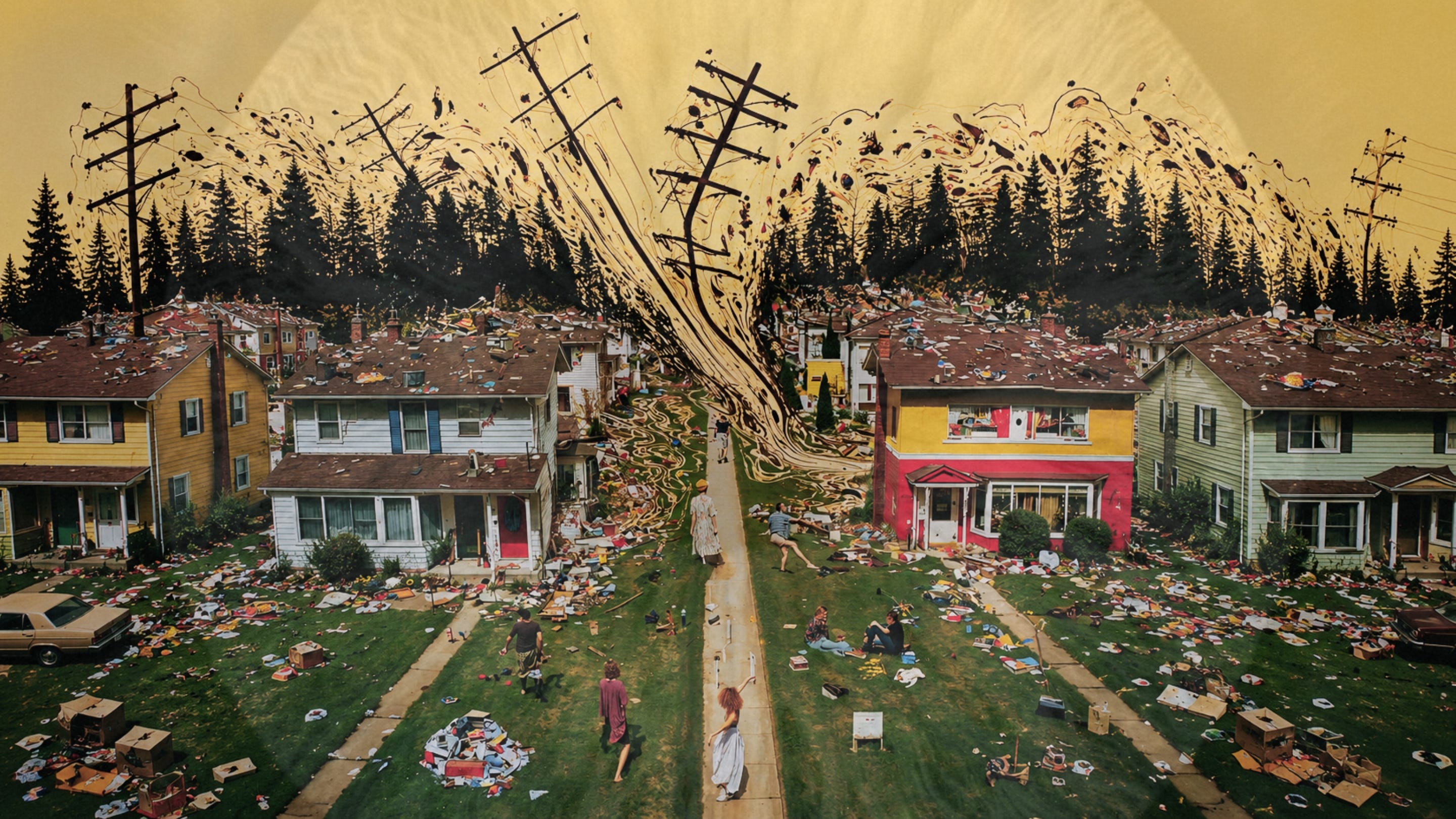
The fire near Saumos is building its own thunderstorm.
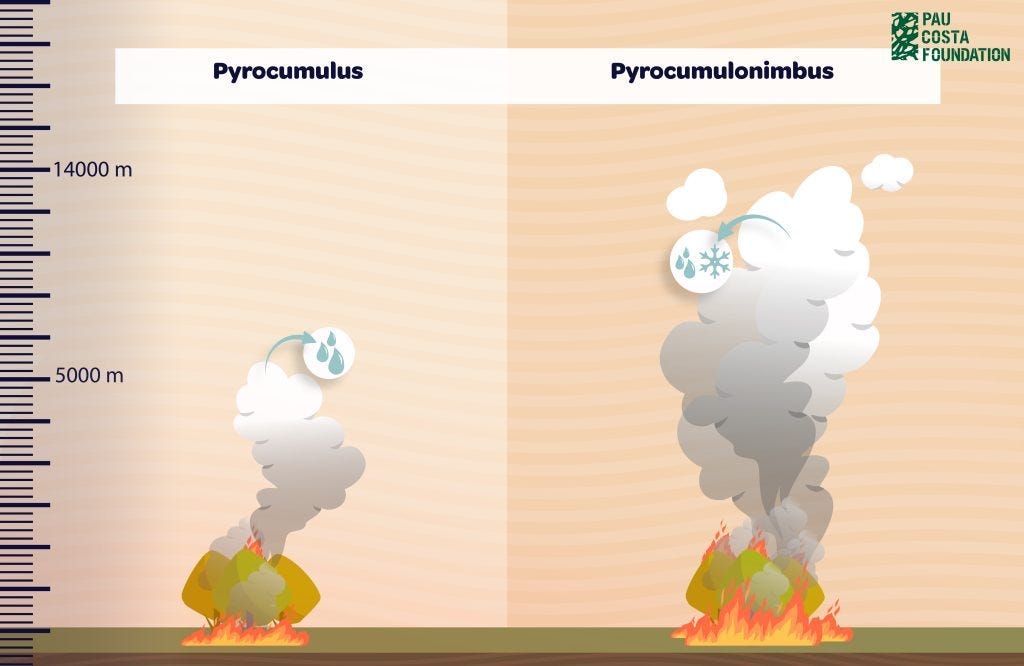
Smoke climbs off the pines in a column, punches through the cool air above, and starts to spin water and ash into a cloud the height of a jetliner’s cruise. Inside it, ice crystals collide and charge. The cloud begins throwing lightning back down at the forest that made it. The spokesman for France’s national firefighters federation tells reporters his country has never recorded one of these pyrocumulonimbus before. Until late July 2026, they belonged to Australia and Canada.
A fire that obeys the weather can be predicted. A fire that manufactures its own weather no longer follows the wind. It sends downdrafts in every direction, lights spot fires kilometers past the line, and turns every training manual the crews learned from into a description of a different planet.

TV5MONDE Info@TV5MONDEINFO
L'incendie en Gironde a formé un pyrocumulonimbus, un phénomène inédit en France pouvant produire des orages de feu avec des éclairs et des braises, et qui permet au brasier de s'auto-alimenter.
4:15 PM · Jul 26, 2026 · 11.2K Views
20 Reposts · 40 Likes
Down the coast in Gironde, another front is generating its own winds and lurching toward Bordeaux, seven Manhattans of forest already gone, soldiers called in because the crews are past what rest can fix. In Spain’s Castellón province, firefighters work a hillside where the heat keeps detonating buried shells from a defensive line built in 1938. One war left its ammunition in the ground and a different kind of war is setting it off.
The season of extremes repeats itself in other alphabets. Canada opened July with less than half its usual burned area, and ten days and three hundred new fires later stood above the ten-year average. In India’s Assam state, the Brahmaputra River flooded and swallowed whole villages. Around 100 people died, and about 300,000 ended up in relief camps. And in one small place called Nepali Khuti, it went from roughly a hundred houses before the water to just a handful after. The dairy farmers there are trying to start over on a thick layer of river silt, but their cattle are gone.
These events all get covered like separate stories, each with its own map and its own reporter in a windbreaker. But they’re the same problem showing up in different places, one after another. And the people who feel and pay for it first aren’t the ones talking about it on TV: they are the ones out in the flames and the floodwater.
Firefighters have a simple rule: you don’t “beat” a wildfire by spraying every flame. You beat it by taking away what it can burn. Fire needs heat, oxygen and fuel. And the only one people can really control is the fuel. So crews scrape a wide strip of ground down to bare dirt (a firebreak) and let the fire reach that line, where there’s nothing left for it to eat. Every wildland crew on Earth works some version of this way. Nobody stands in front of a crown fire with a hose.

Massimo@Rainmaker1973
The farmer from Weld County, Colorado who mowed a firebreak to stop a wildfire that broke out in his hayfield.
2:35 PM · Apr 8, 2026 · 60.9K Views
9 Replies · 30 Reposts · 388 Likes
Global warming runs on the same triangle, and the fuel line has a name.
Carbon dioxide accumulates. The molecule you emit doesn’t just “go away” at the end of the year; a lot of what we release sticks around in the atmosphere for hundreds of years, which means the sky keeps a running total. Right now humanity adds roughly thirty-seven billion tonnes of it annually from fossil fuels, which sounds like nothing because billions always do. Break it down, and it’s about 1,200 tonnes a second, the weight of three fully loaded 747 jumbo jets, thrown upward every second, nonstop, this second included.
The temperature follows that total like it’s on a leash. Which leads to the one indisputable climate fact: the planet stops heating up when we stop adding more CO₂. Not “sometime later,” not “once nature catches up.” When our net emissions hit zero (meaning we aren’t increasing the total anymore), temperatures mostly flatten out pretty quickly. The models say it settles within about a tenth of a degree either way.
Jim Skea, chair of the world’s top climate authority, the Intergovernmental Panel on Climate Change, put it plainly:
“If you want to stop global warming, you must get to net zero carbon emissions. If you don’t get to net zero, the world will continue warming, and all the things we’re seeing at the moment will get more intense and more challenging. That’s basically the choice.”
That’s the whole machine.
Net zero was never meant to be a lifestyle brand or a political team jersey. It’s just the practical line where the warming stops, like a firebreak, where a wildfire hits ground with nothing left to burn. But every year we push that line back, we dump another 37 billion tonnes of CO₂ into the air, and the eventual peak temperature (the one our kids and grandkids will live with) keeps creeping higher.
Adaptation matters enormously, and none of this argues against it. Better warning systems, cooler cities, stronger levees: those are better hoses, and the crews need every one. The problem is: if all we do is keep buying bigger hoses, we never solve the thing that’s feeding the fire. The fire doesn’t get tired. Our budgets do.
So the physics turns out to be the easy, almost insultingly simple part. Everything difficult about this problem lives somewhere else: in the part of the story where cutting the fuel became the argument.
You’ve definitely heard the mocking. Net zero is a “religious” obsession of “eco-zealots.” “Net stupid zero.” And so, the idea that would actually stop the planet from heating up and going full chaos mode gets treated like the extreme position while the idea of just keeping to fuel the fire is presented as the sensible middle.
But let’s take criticism seriously for a minute, take its strongest claims one at a time and see whether they really hold up under pressure or whether they fall apart.
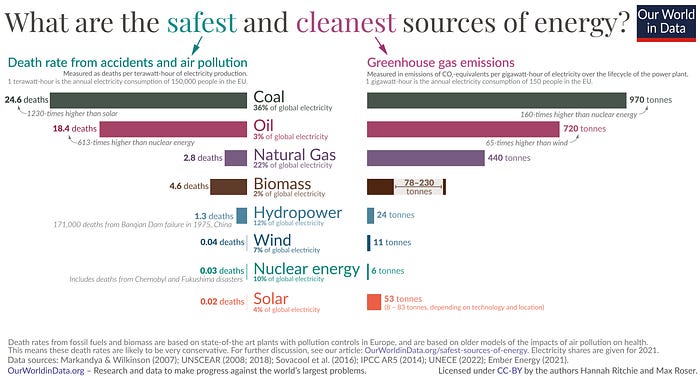
The strongest claim is always about money: “decarbonizing will make regular people poorer.” Except the underlying price signal points the other way. Solar became the cheapest electricity in history years ago. And when economists price out the damage from each extra ton of carbon (around $1,056), the harm is way more expensive than the fixes. A fuller accounting reaches the same verdict from the other side: spending 1 to 2% of output on the transition avoids damages worth 11 to 27% of cumulative GDP this century. So it’s like refusing to pay for a smoke alarm because it costs money… while your house is already on fire.
Then there’s the other classic fear: “okay, but the lights will go out.” But countries have already done this at scale. The UK used to run on coal, then shut its last coal plant in 2024 after 142 years and people didn’t end up living by candlelight. The grid kept working. And globally, renewables have now passed coal in the electricity mix, with so little fuss you probably missed it, because grids that work don’t trend.
And then you hear the “we’re only a few percent of global emissions, so why bother?” argument made in dozens of countries at once. But that’s like a firefighter refusing to do their part of the firebreak because they “only” cover a small stretch of the line. Firebreaks are made of sections. Everyone has a section. That’s the whole point.
So once you pull those arguments apart, one by one, a different question pops up: if they don’t really hold up, why are they getting louder?
Part of it is pretty simple: money and influence. If you dig through public filings in the UK (Companies House, foundation disclosures, etc.), you find that one of the biggest anti–net-zero groups has taken funding through Koch-linked funds and from a foundation invested in oil while also refusing to name its donors. Copy-paste this everywhere.
And part of it is how the story gets told. One study looked at 73,000 news articles and found that in 2018, about 90% of UK articles that mentioned “net zero” also mentioned climate change. By 2024, that number was down to 42%. The policy got surgically separated from its reason. And when you cut the “why” out of the story, the “what” starts to sound like some weird obsession.
Now look at who gets the airtime to argue and who actually gets burned.
A lot of the loud pushback comes from politicians, corporations, tech-bros, and think-tank panels — comfortable air-conditioned places, far from the fireline and very close to the obscene profiting of mayhem. Meanwhile, the people dealing with the consequences up close have stopped arguing entirely. Wildland firefighters show PTSD rates up to four times typical baselines. Three of them died in June on the Colorado–Utah line. Their unions ask for more crews, more aircraft, more water. What they don’t ask for is a debate about combustion.
Believing a thermometer doesn’t take faith. But spending years arguing , over and over, against the crews, the physics, and even the insurance industry? That takes devotion.
The “zealots” were never the ones holding the hoses.
The same machine that sold delay, then denial, then doubt, has one product left on the shelf, and it’s cleverly aimed at people who do accept the science: despair. It’s the one “product” that works on people who believe the data and it asks for nothing except your “Well, nothing can change” resignation. And if you buy that, it pays out the same as denial does: in decades of business as usual.
And resignation can feel like being realistic, like you’re just seeing the world clearly. But it’s a forecast, and usually a bad one, because societies don’t move the way despair assumes.

A society is a complex system, and complex systems don’t do gradual: they hold two states, impossible and inevitable, with almost nothing in between. Votes for women were impossible until they were inevitable. Ireland was run by its bishops for most of a century, until scandal, migration and a stubborn minority flipped the whole arrangement inside a couple of decades, and marriage equality passed by referendum in the country where divorce had been unconstitutional.
That’s the defining property of tipping points: invisible in advance, obvious in retrospect.
And the fellowship doesn’t need to be huge: the tipping point for societal change lies in the commitment of just 25% of the population. Once this critical mass is reached, a dramatic shift occurs as the majority of society quickly aligns with the new direction. As the paper reporting this research notes, “The power of small groups comes not from their authority or wealth but from their commitment to the cause”.
Climate scientists went looking for the places where a relatively small nudge can set off a big chain reaction in society and they found a bunch of pressure points across the whole energy system: money, cities, schools, subsidies, and social norms.
Several of those dominoes are visibly leaning. Clean energy investment is running at nearly double fossil investment this year, two dollars against one. The cheapest way to make a watt is now the one that doesn’t warm anything (though we shouldn’t call it clean either).
Look at how hard the anti–net-zero crowd is going at this right now: the shouting, the rebrandings, the way the media coverage gets stripped of the basic “why.” That’s not what you do when you’re swatting a harmless fringe. You don’t pour this much money and energy into fighting an idea that’s going nowhere. That kind of noise is what a system makes when it can feel the ground shifting under it.
Which is why despair, the one response that feels personal and kind of innocent (like, “I’m just being realistic”), works as a political outcome, manufactured like the other stages (delay, denial, doubt). When enough people believe change is impossible, society acts like it: people disengage, leaders stall, and the status quo that promises continuity and interventions designed to preserve this self-destructive shape of the world wins by default. The schemes are already on the table. Desperate geoengineering proposals. Borders hardening. Walls rising. Exit visas quietly discussed while those already displaced are framed as threats instead of symptoms.

Peter Dynes@PGDynes
This s**t is getting crazy. You can hardly see the sky over #Athens. How does that meme go again? - "This is fine. I'm okay with the events unfolding in #Greece. Everyone stay in the pool and enjoy the view. Ignore that giant #climate fire over just over the hill." #athensfire
11:06 AM · Aug 13, 2024 · 337K Views
406 Replies · 1.46K Reposts · 3.19K Likes
But when people start to feel like change is actually possible, things can speed up fast. And this month I watched one of those dominoes wobble from inside my own country.
Argentina’s Senate finally sat down to vote on a bill they’d already postponed four times for lack of votes, a record even for that building. The government called it the “inviolability of private property,” but buried in it were two changes that really stood out. One would’ve weakened the rural land law that limits how much land foreign investors can buy, pretty sensitive in places like Patagonia, where there’s always money circling around lakes and water sources. The other would’ve changed the fire law that stops burned land from being quickly turned into something profitable, basically the one rule that stands between “wildfire” and “real estate opportunity.”
For weeks, a campaign ran through feeds and group chats. And on the day of the vote the streets around Congress (and in every municipality in the country) filled: unions, territorial organizations, neighbors and 820 officers and eleven arrests’ worth of refusal, while inside, senators watched the votes fail to appear. Before the chamber could vote, the government cut both chapters out of its own bill to save the rest.

Víctor Hugo Morales@VHMok
✊ EL PUEBLO EN LA CALLE, EL GOBIERNO REPRIME 🏛️ Mientras la Cámara de Senadores debate el proyecto que el Gobierno denominó "Inviolabilidad de la Propiedad Privada", afuera del Congreso miles de personas se movilizaron para rechazar la iniciativa. 📢 El capítulo que modificaba
12:25 AM · Aug 7, 2026 · 15.4K Views
188 Reposts · 374 Likes
The land cap stayed. Burned forests stayed protected. Nobody would call it a revolution. It was just a few weeks of committed people refusing despair, which is what the 25% looks like from the inside: showing up, pushing, not giving in to that “nothing ever changes” feeling, until something that seemed impossible suddenly wasn’t.
So how do we stop the end of the world?
The manual was always one line long: get the firebreak from impossible to inevitable before the fire decides for us.
Firefighters have been doing that part every summer.
Now it’s time to do ours.
Comments
Nothing yet. Say the first thing.
Sign in to join the conversation.