
Life in the USA is not normal. It feels pointless and trivial to be talking about small looks at the fascinating natural world when the country is being dismantled. But these posts will continue, as a statement of resistance. I hope you continue to enjoy and learn from them. Stand Up For Science!
Chrysocolla is a common mineral, but a strange one. It’s possibly crystalline (orthorhombic) but never (or almost never) forms crystals. Its listed chemistry is quite specific, Cu2-xAlx(H2-xSi2O5)(OH)4 · nH2O, where x < 1, but the X’s and the “n” suggest that the “specific” composition is actually somewhat variable.
Chrysocolla has been considered to be amorphous, but in the 1966 17th edition of Dana’s Manual of Mineralogy that I used in college, its formula was given as “near” CuSiO6 · nH2O. Although the International Mineralogical Association (IMA) gives the crystallography and chemistry as above, I don’t think it’s a settled question. Some recent work suggests that it is actually a mixture of the mineral spertiniite, Cu(OH)2, with water and amorphous silica (Brown and others, 2006, Chrysocolla redefined as spertiniite: Contributed to 13th International Conference on X-ray Absorption Fine Structure (XAFS13), Stanford, California, 9-14 Jul 2006: slac-pub-12232; also Frost and others, 2013, Is chrysocolla (Cu,Al)2H2Si2O5(OH)4·nH2O related to spertiniite Cu(OH)2?—A vibrational spectroscopic study: Vibrational Spectroscopy 64:33-38).
Another study found that chrysocolla consists of nanoscale copper particles in an amorphous silica matrix (Kahou, 2025, Nanoscale characterization of chrysocolla, black chrysocolla, and pseudomalachite from supergene copper deposits of Atacama Desert in northern Chile: American Mineralogist 110:8, 1329-1339).
Whether it is a well-crystallized mineral or amorphous or a mixture, it probably solidified from a colloidal gel, although it may also form through traditional hydrothermal and other alteration processes.
Whatever – it has enough copper in it to occasionally serve as an ore, and it’s pretty enough for collectors and sometimes jewelry makers to value it.
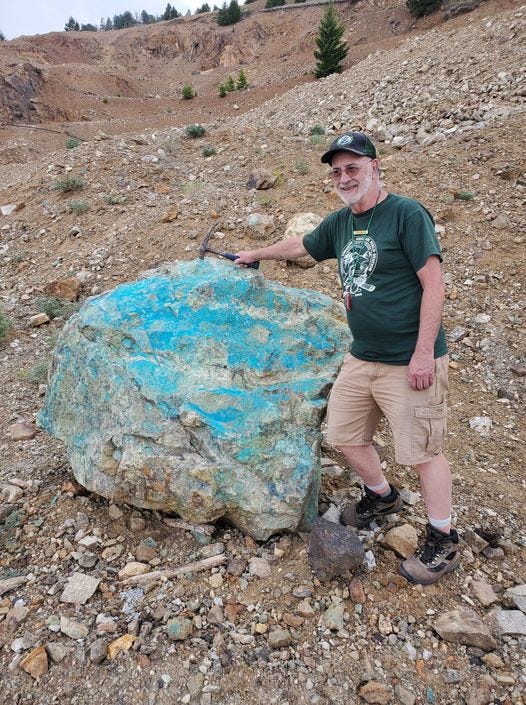
At the Empire Mine near Mackay, Idaho, chrysocolla is abundant in skarns of contact metamorphosed and metasomatized (chemically altered) limestone of Mississippian age (about 320 million years ago) affected by Eocene intrusive rocks (about 50 million years ago). Chrysocolla is one of the primary ores there (Moran, 2021, Geology and historic and present activity of the Empire Mine Project, Custer County, Idaho: Road Log: Northwest Geology 50:63-67, Tobacco Root Geological Society 46th Annual Field Conference).
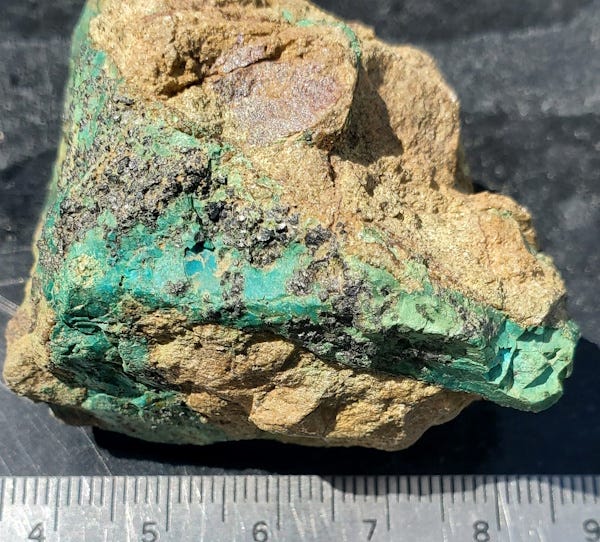
Some of the chrysocolla at Empire is unusual in being associated with magnetite, and some of the magnetite in turn is unusual pseudomorphs after garnet, discussed in this previous post.
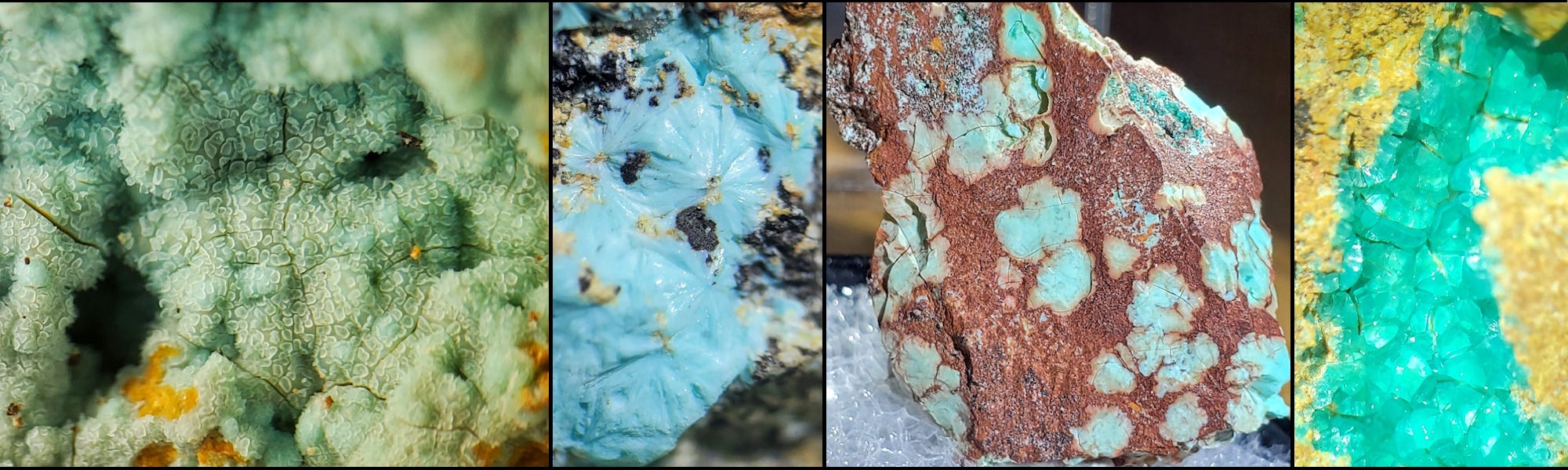
Chrysocolla often forms botryoidal crusts, and sometimes when it dehydrates it fractures and peels, making a distinctive “crackeleur” texture. And it also often replaces other minerals, making it seem to occur in crystals when it’s really a pseudomorph after the other material.
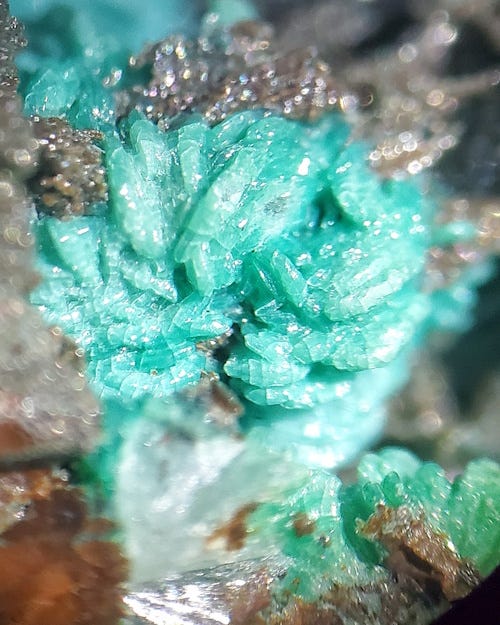
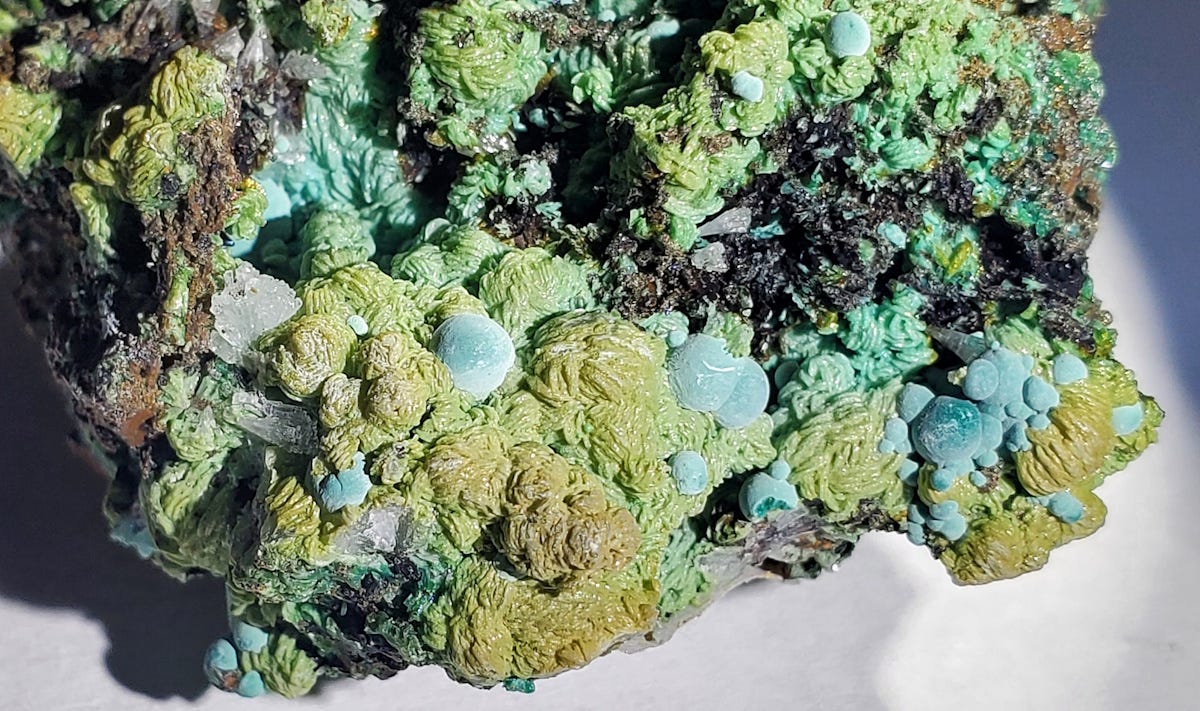
The example in the top photo, labeled as from Payson, Arizona, is chrysocolla in various colors delicately encrusting hemimorphite crystals. The smooth light blue-green spheres are also chrysocolla, but with a very thin coating of malachite. Based on the appearance of a few broken spheres, the malachite is fibrous and less than a tenth of a millimeter thick. The close-up immediately above, of chrysocolla mimicking the underlying hemimorphite crystals, is about 3 mm wide. Note: Hemimorphite is not reported from any mine in the Payson District. This specimen is rather like a few from the 79 Mine, which is probably a more likely locality; chrysocolla pseudomorphs and encrustations after hemimorphite are well known from there. The two districts are in the same county, but nearly 100 miles (160 km) apart.
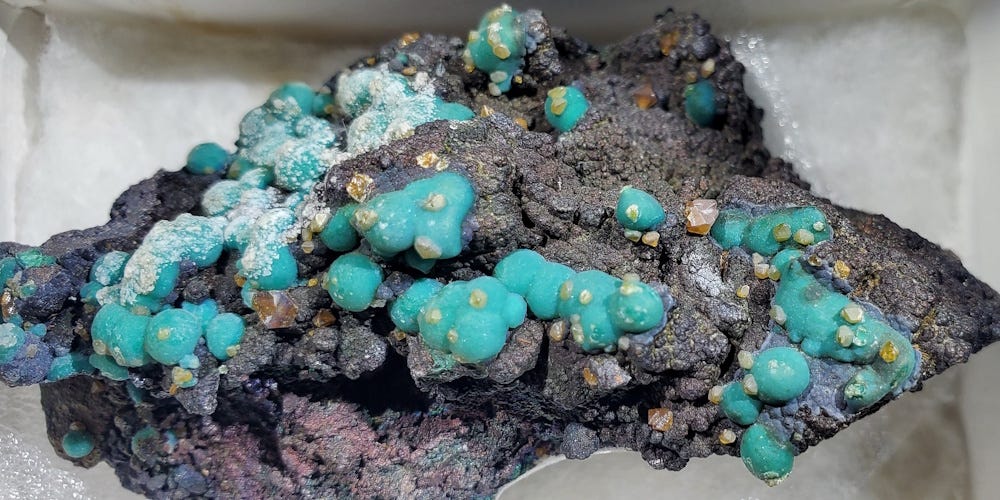
Whim Creek, Western Australia, is famous for many minerals, but my specimen contains botryoidal chrysocolla (coating and partly replacing spherical malachite), with scattered orange wulfenite crystals on the chrysocolla.
So what about that “golden glue”? The name was first used by Theophrastus in his Treatise on Stones in 315 B.C. The word comes from Greek khrusos, “gold,” and kolla, “glue,” for material used as a flux to solder gold in jewelry. Depending on which interpretation of ancient sources you use, gold solder was made using chrysocolla, gold, and asèm, which was a mixture of tin, mercury, and soil (Berthelot, 1889, Introduction à l’étude de la chimie des anciens et du moyen age [Introduction to the study of the chemistry of the ancients and of the middle ages], Paris). André-Jean-François-Marie Brochant de Villiers revived the name chrysocolla in 1808.
Comments
Nothing yet. Say the first thing.
Sign in to join the conversation.