
Life in the USA is not normal. It feels pointless and trivial to be talking about small looks at the fascinating natural world when the country is being dismantled. But these posts will continue, as a statement of resistance. I hope you continue to enjoy and learn from them. Stand Up For Science!
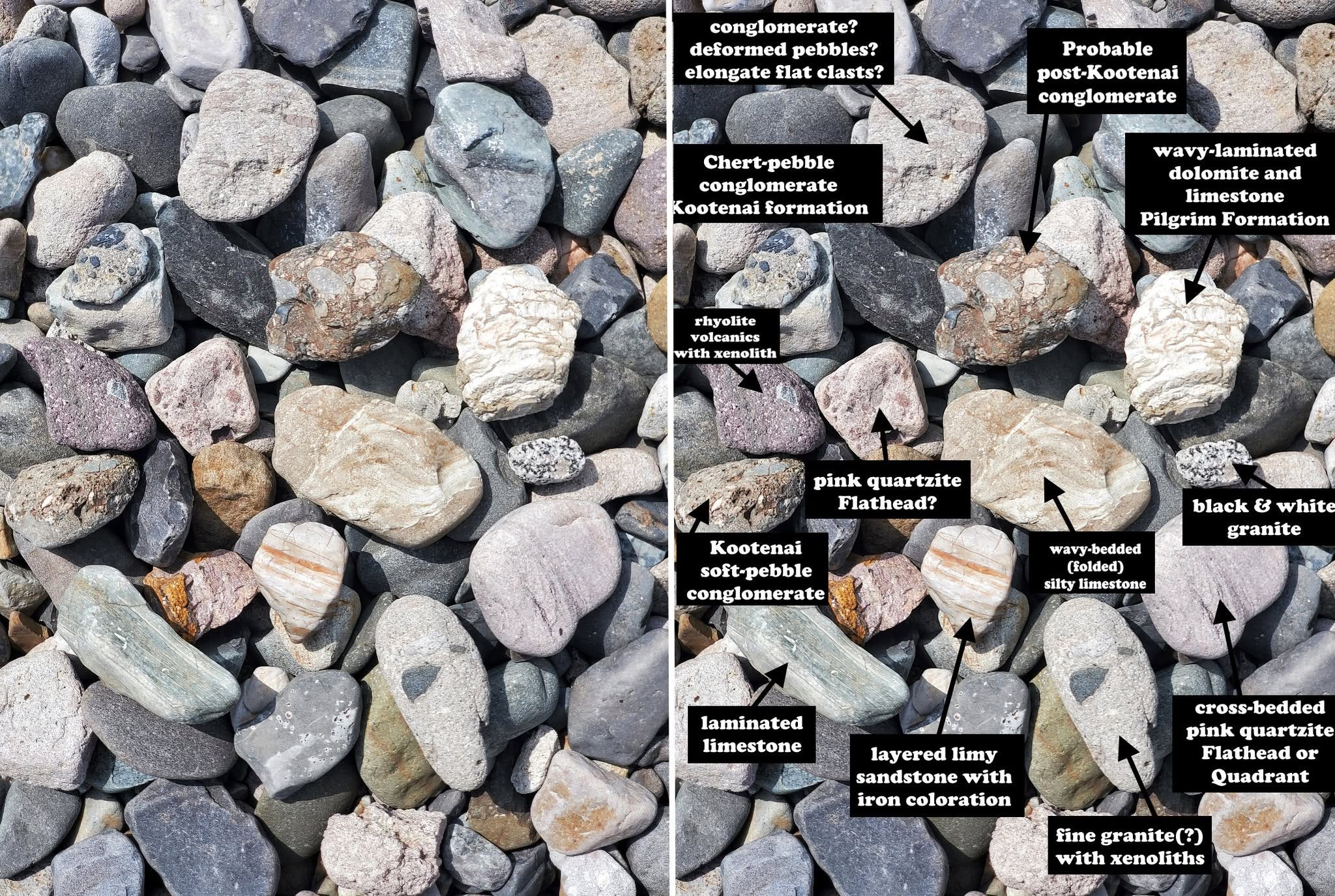
Yes, I’m even curious about cobbles brought in to make the bed for the trail I ride my bike on. It would be a lot more interesting if I knew where they got these river-rounded stones, but they’re still interesting!
These rocks are from along Silver Bow Creek in Rocker, just south of Rocker Station on the Greenway Trail, near Butte here in Montana USA. The only thing I can say confidently about them is that Silver Bow Creek did NOT deposit them there – they were brought in.
We can tell that because most (maybe all) of the cobbles are rocks that are not present upstream on Silver Bow Creek or any of its tributaries. Some of the rocks are confidently identifiable as to the formation from which they came, and others are not, but even the black and white granite, which MIGHT have come from the Boulder Batholith, doesn’t really look much like the granite from the Silver Bow Creek watershed around Butte.
I labeled one conglomerate “Post-Kootenai Conglomerate” because the large gray clast right in the middle looks for all the world like a piece of the Gastropod Limestone, a thin unit that’s made up in places almost entirely of gastropod (snail) fossils that probably lived in a large, persistent lake. That rock marks the top, the last-deposited part of the Kootenai formation about 115 million years ago, so for it to be broken into a pebble and then incorporated into another rock (the conglomerate in the photo), this rock has to be later than the Kootenai. There are conglomerates in the post-Kootenai Cretaceous Blackleaf Formation, some of which form boulders along German Gulch and Silver Bow Creek west of here, and which crops out in many places in western Montana.
The main thing missing from this pile of rocks is crystalline Precambrian metamorphic rocks, like gneiss or schist. That makes me think this material was mined from some river gravel in the western part of the state where the Precambrian metamorphics did not erode into the streams, so that leaves out rivers like the Jefferson, Madison, Gallatin, and Yellowstone, all of which should have abundant Precambrian metamorphic rocks in them.
Adjacent to these rocks in Rocker are many big angular broken pieces of Butte granite that probably are part of the ballast holding up the old railroad bed. The cobbles in my photo are most likely part of the restoration, brought in to underpin the Greenway trail in this location.
And yes, I know that technically some of these rocks are not cobbles. The “official” size designation for a cobble is larger than a pebble, smaller than a boulder, or between 64 and 256 millimeters. There are some pebbles and boulders here as well, but I think it’s mostly cobbles (I didn’t do a statistical analysis of measurements of the size distribution).
Comments
Nothing yet. Say the first thing.
Sign in to join the conversation.