
Life in the USA is not normal. It feels pointless and trivial to be talking about small looks at the fascinating natural world when the country is being dismantled. But these posts will continue, as a statement of resistance. I hope you continue to enjoy and learn from them. Stand Up For Science!
As a follow-up to faden quartz, today we take a look at fenster quartz, or at least some examples approaching it.
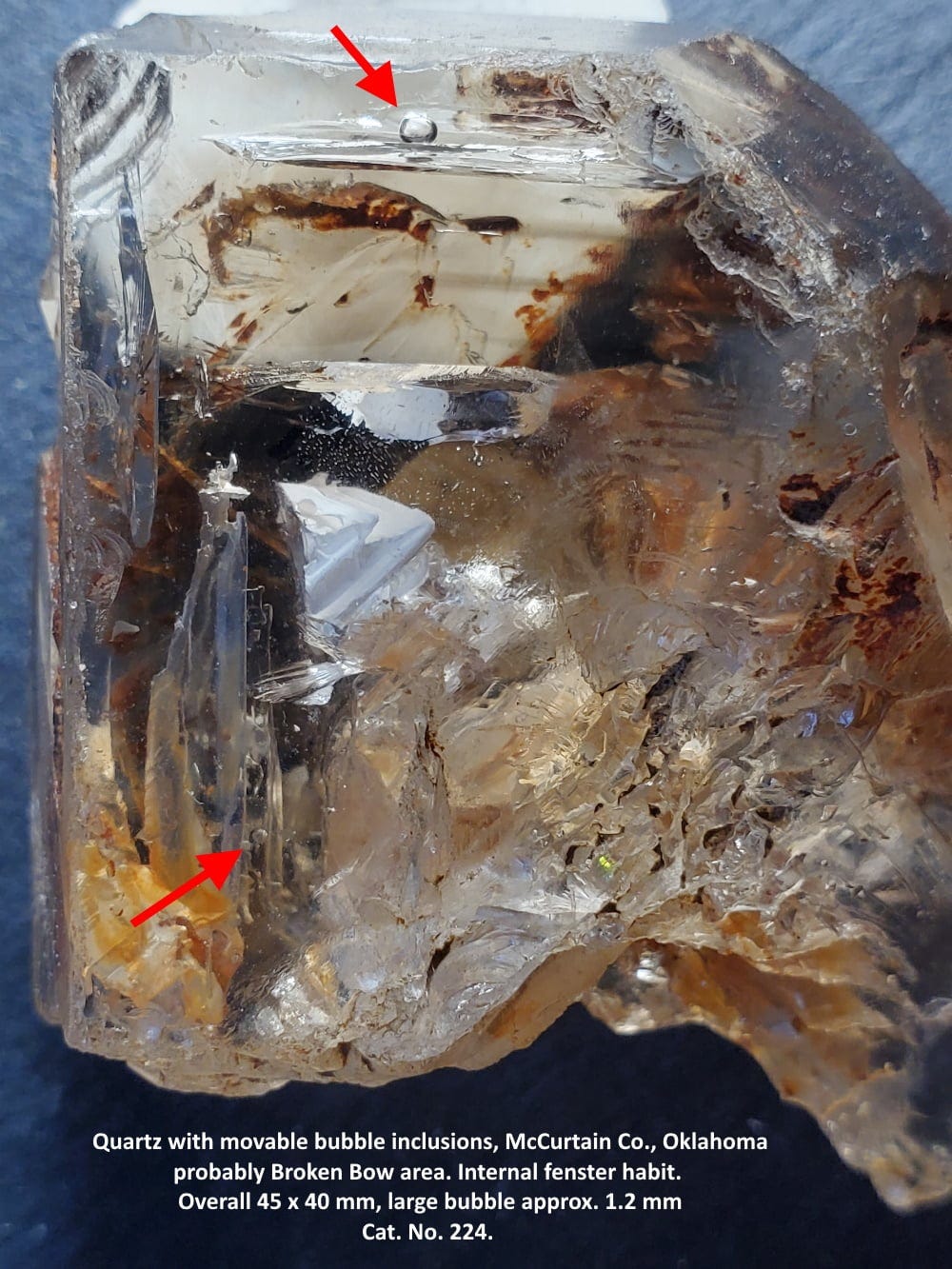
This rather ugly chunk of quartz is interesting for multiple reasons. Many minerals contain fluid or gas inclusions, but movable bubbles of the size of those in this piece are unusual. The void spaces that must contain liquid are not exactly cracks in the quartz but are the consequence of differential growth that left uncrystallized fluid (probably essentially salt water) and the gas bubbles behind.
This quartz definitely has numerous crystal faces, but not the standard hexagonal prisms and pyramids quartz usually has. This tabular form, with phantoms of earlier quartz crystallization and inclusions of a probable white clay mineral, is well known from the Broken Bow Uplift in McCurtain County, far southeastern Oklahoma. The quartz veins there are mostly hydrothermal (“water, hot”) in origin and are related to the last stages of magmatism and mineralization from the Ouachita Orogeny (coeval with the Appalachian Orogeny) during Permian time, about 280 to 245 million years ago when South America and some small associated blocks were colliding with what was then the southern margin of North America in Texas, Oklahoma, and Arkansas.
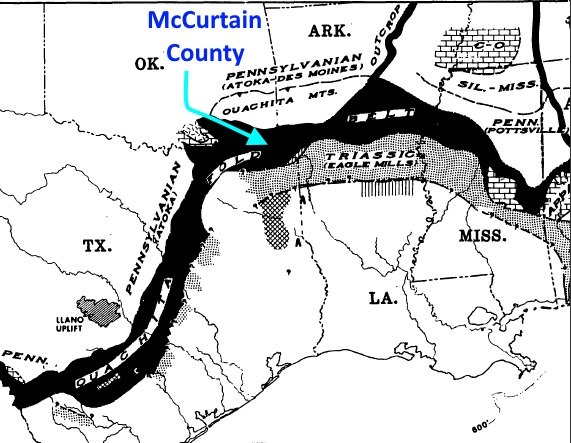
The quartz veins in McCurtain County are mostly in the Crystal Mountain Sandstone, an Ordovician formation laid down on a relatively passive margin of North America about 480 million years ago. When the Ouachita collision culminated 200 million years later, the last mineralized solutions found their way into cracks in the older rocks where they deposited the quartz veins.
The Broken Bow Uplift that contains the Crystal Mountain Sandstone and its quartz veins is a late-stage uplift of the Ouachita Orogeny, forming a broad anticline that brings the old Ordovician rocks to the surface. The arching anticline might have helped crack the Crystal Mountain Sandstone to allow the silica-rich hot waters to percolate through and deposit the quartz veins.
Quartz with depressions in crystal faces is sometimes called skeletal or fenster quartz (fenster means window in German). It develops when the edges of a crystal grow faster than the flat centers of crystal faces and may help explain the unusual tabular nature of these crystals as well as the inclusions of clay, liquid, and gas. My specimen doesn’t really have those inset windows, but the clay zones, at least, probably inhibited quartz crystal growth to some extent, although they don’t reach the surface like traditional fensters do. Nice pyramidal-prismatic quartz crystals with fenster faces are also known from McCurtain County.
We’ve looked at negative crystals within this McCurtain County quartz specimen previously.
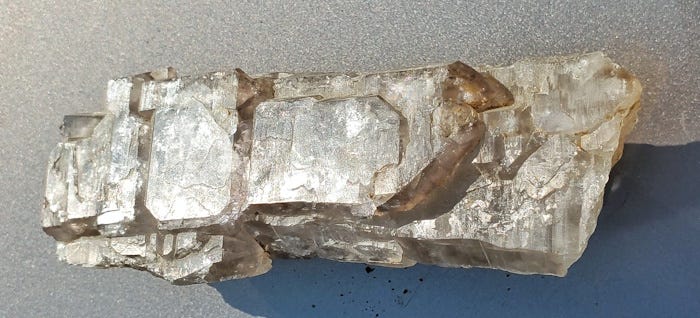
The second example, above, is from the Boulder Batholith in Montana USA. It seems more like a reverse window, where rectangular zones on quartz prism faces stand out in relief, suggesting differential growth speeds in various positions along the prism, and if you want to call this a complex version of parallel crystal growth rather than some kind of fenster, I won’t argue about it. This one also hints at the start of scepter growth, with some portions wider than others.
Quartz like this is also sometimes called skeletal quartz. My examples are not that exemplary for fenster quartz; really they are just strange growth forms in quartz. So if you are interested in better examples please visit The Quartz Page, probably the best resource about quartz anywhere around.
Comments
Nothing yet. Say the first thing.
Sign in to join the conversation.