
Life in the USA is not normal. It feels pointless and trivial to be talking about small looks at the fascinating natural world when the country is being dismantled. But these posts will continue, as a statement of resistance. I hope you continue to enjoy and learn from them. Stand Up For Science!
Sanidine K(AlSi3O8)
Dickite Al2(Si2O5)(OH)4
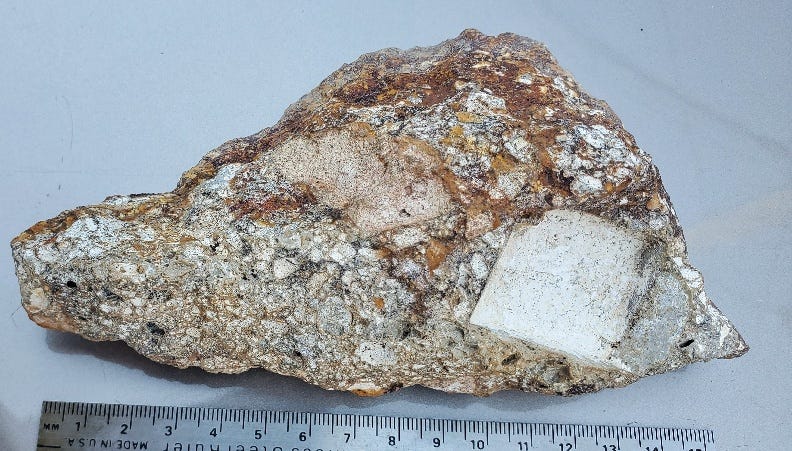
Although I have said repeatedly that I’m basically an eclectic mineral collector with no real specialty, there is no doubt that I have a soft spot for unusual things like pseudomorphs and twins. Consequently I was happy to find this pseudomorph of clay after feldspar on a field trip with the Tobacco Root Geological Society in the Hog Heaven Volcanic Field in July 2026.
A pseudomorph, you probably recall, is a mineral that has replaced, encrusted or otherwise follows the crystal form of a different mineral – the word means false form. In this case, the original material was feldspar, probably sanidine, K(AlSi3O8), in a porphyritic lava erupted about 35 to 34 million years ago (Gammons & Scarberry, 2026, An overview of mineralization in the Paleogene Hog Heaven Volcanic Field, Northwestern Montana: Northwest Geology, 55:71-76, Tobacco Root Geological Society 51st Annual Field Conference, Plains, Montana). The inference of sanidine rather than orthoclase or microcline is from less-altered material elsewhere in the Hog Heaven Volcanics.
Later volcanic activity, part of the same system, at about 33 to 30 million years ago, and its associated hydrothermal fluids, altered the feldspar and completely replaced it in much of the volcanic field (Coppage, 2022, Geology and geochronology of the East Dome Complex within the Hog Heaven Volcanic Field, Flathead County, Montana: M.S. Thesis, Montana Technological University).
A quick portable x-ray diffraction analysis in the field by Chris Gammons of a similar piece showed dickite as the white clay, but many other clay minerals are possible. Dickite, Al2(Si2O5)(OH)4, is polymorphous (“many forms,” i.e., the same chemical composition but different crystallography) with halloysite, kaolinite, and nacrite, and there are other clays that might also be present in this rock. At Hog Heaven, many feldspar crystals are replaced by pinkish alunite, KAl3(SO4)2(OH)6, (Kallio, 2020, Mineralogy, fluid inclusion, and stable isotope studies of the Hog Heaven Mining District, Flathead County, Montana: M.S. Thesis, Montana Technological University), but I don’t see anything like that in my specimen.
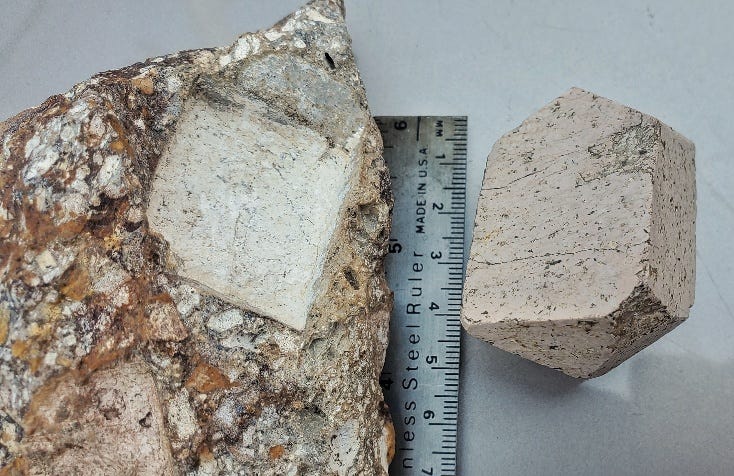
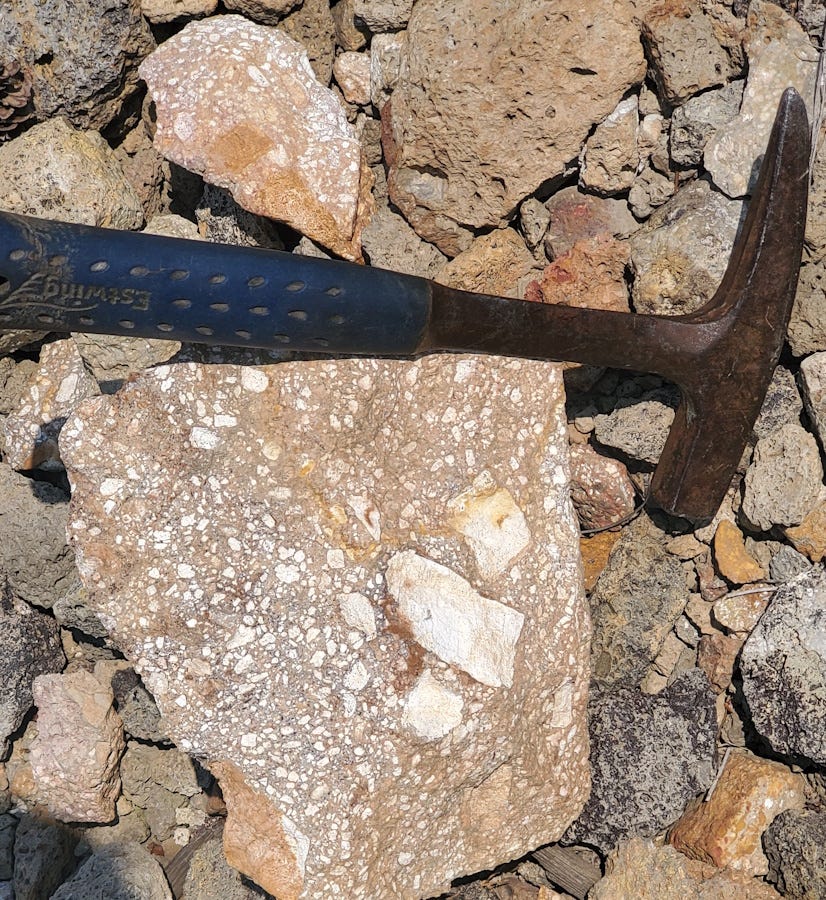
The first photo above compares my 35x27-mm crystal (the squarish white hole) with a similar sized sharp orthoclase crystal from New Mexico, probably the Orogrande District. Some of the crystals at Hog Heaven get really big – the largest one in the second photo above is about 55 mm long.
The end of the space where my crystal used to be has had some of the dickite eroded out leaving the mold of the original crystal. It shows two faces with an angle between them, pointing toward the original crystal. That makes a re-entrant angle, which suggests strongly that my original sanidine crystal was a twin.
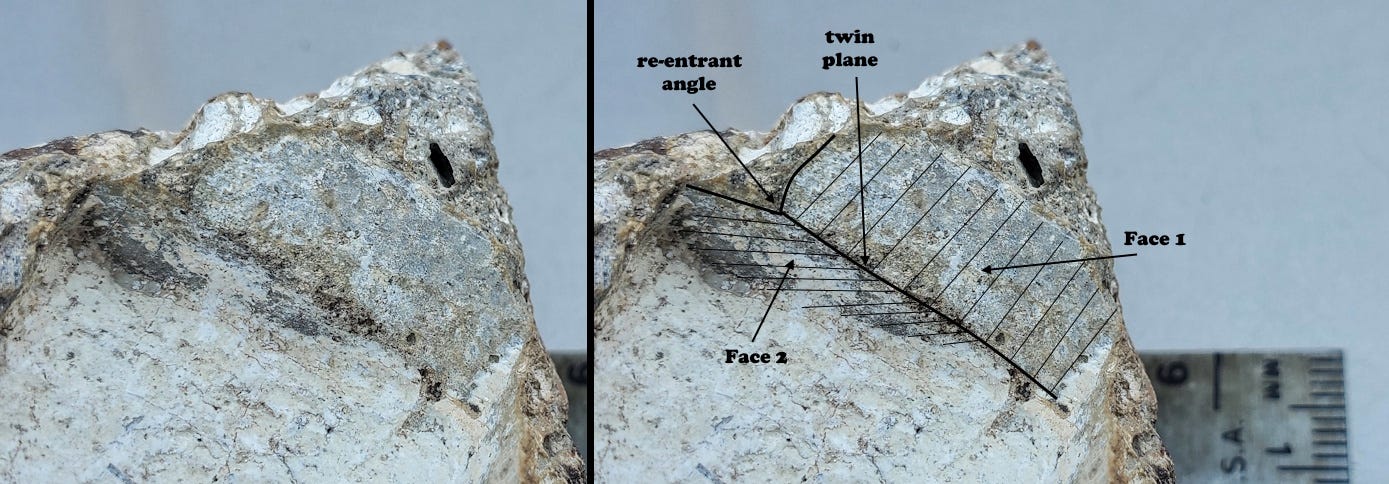
With only two faces it’s difficult to be certain, but I feel that the original twin was a Manebach twin, in which two feldspar crystals grow together on a common basal pinacoid face. Manebach twins are less common than Carlsbad or Baveno twins, and not common at all in sanidine (they are much more prevalent in orthoclase), though they do occur. Because I can’t see the shapes of the whole former crystal I can’t be 100% positive, but I do think this was a Manebach twin in the sanidine crystal. It’s pretty evident when you have the specimen in your hands, but it’s difficult to photograph. I’ve tried to illustrate it in the annotated photo above (the line labeled “twin plane” is coming toward you, toward the former inside of the sanidine crystal), with a drawing of a Manebach twin below to try to help visualize it. Another quite similar possibility is a Carlsbad contact twin, not the same as the well-known Carlsbad penetration twins, and quite rare.
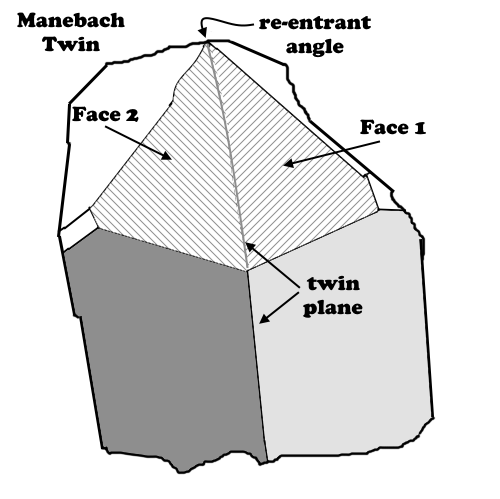
The name Manebach is from the location in Thuringia, Germany, where this type of twinning was first described in 1863. Contrary to popular belief, dickite was not named for me, but rather for Allan B. Dick (1833-1926), the Scottish chemist who described it as a mineral.
Hydrothermal alteration is so common that I suspect most geologists recognize and accept it as a standard process. But in some ways it’s quite amazing: feldspar isn’t some wimpy mineral like chlorite that you can flake apart with your fingers, or halite, so soluble you can taste it — feldspars are strong framework silicates making solid, blocky crystals. But water is a powerful force, especially when it’s hot, especially when it’s acidic, and when it contains corrosive elements. After that, as James Hutton said, “What more can we require? Nothing but time.” Time and hot water changed these feldspar crystals to clay.
Comments
Nothing yet. Say the first thing.
Sign in to join the conversation.