

This is an example of Cognitive dissonance.
We can literally SEE our world getting worse each year now. Yet the stock market is at record highs.
The three leading U.S. indexes closed at record highs on Thursday — CNBC 10/02/25
“The S&P 500 inched up 0.06% to close at 6,715.35. It was up 0.3% at the day’s peak, reaching a fresh all-time intraday high. The Dow Jones Industrial Average climbed 78.62 points, or 0.17%, to finish the day at 46,519.72, while the Nasdaq Composite rose 0.39% to finish at 22,844.05. The tech heavy index also hit a new intraday record as well, supported by a gain in Nvidia shares, which also reached an all-time high, as investors continued to pile into the artificial intelligence giant.”
Don’t they get that +3°C of warming by 2050 is like “Mad Max Apocalypse” BAD?

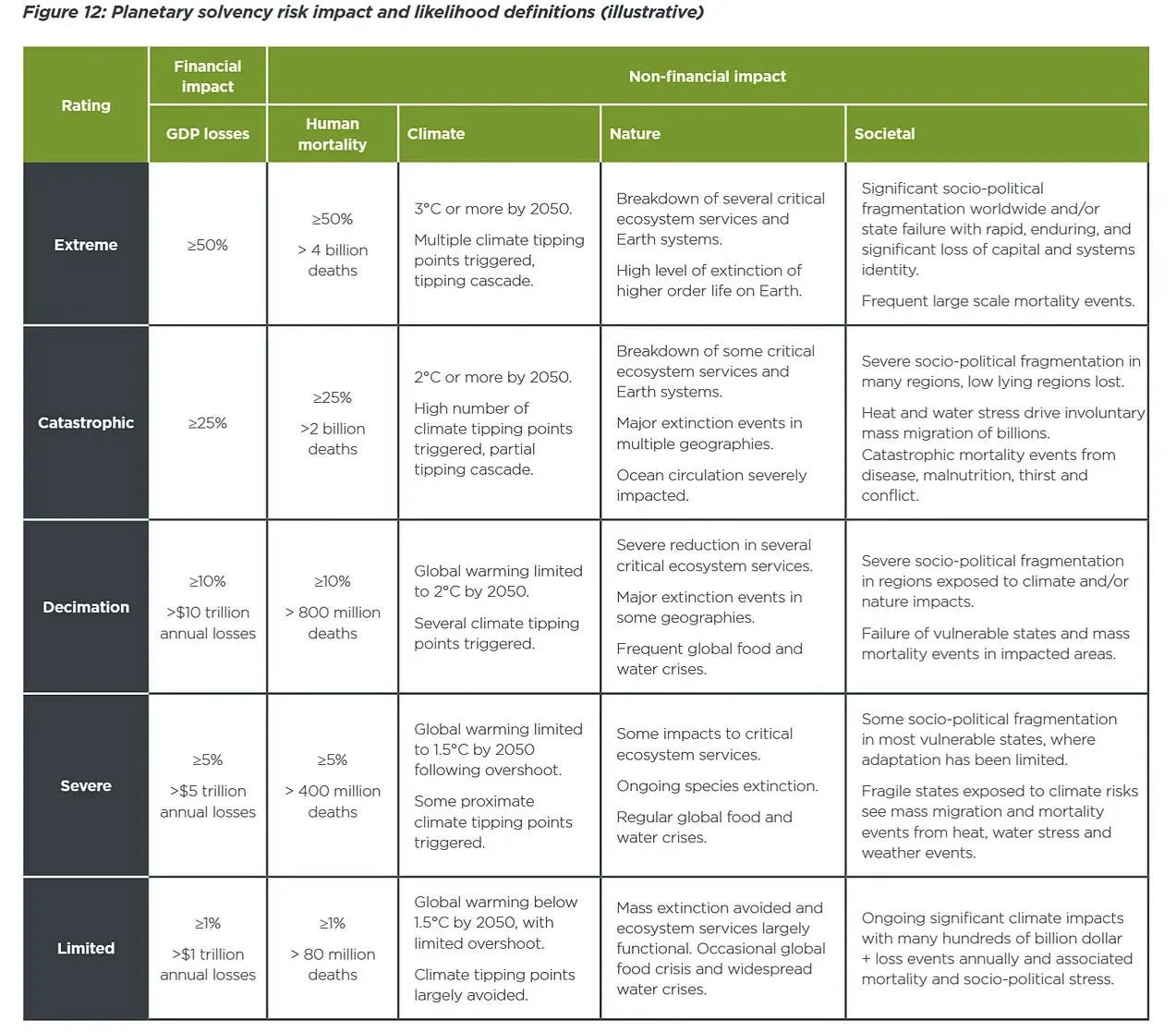
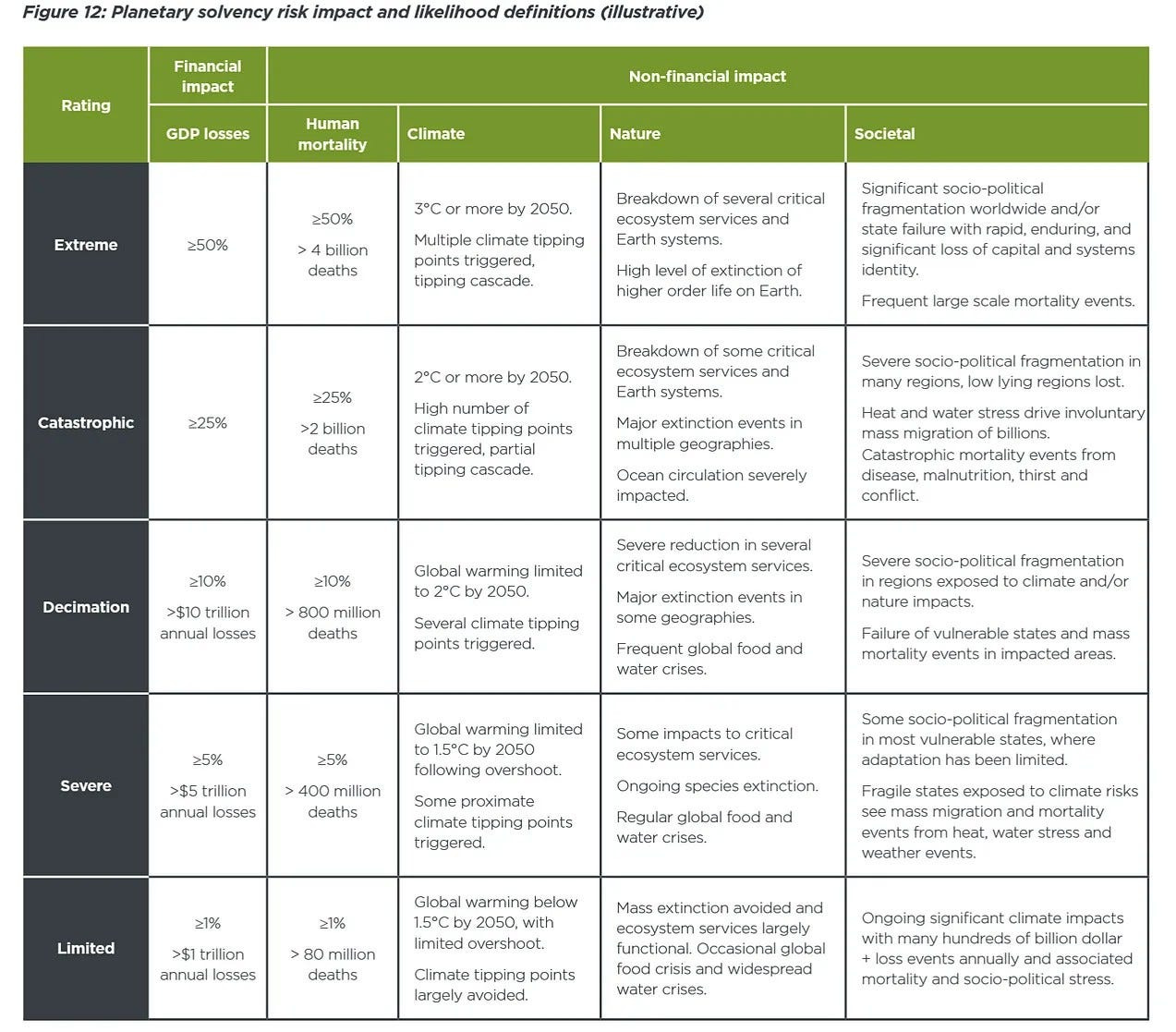
This past January the Actuaries Institute in Exeter found that their models indicate AT LEAST a 50% reduction in the global population if there was +3°C of warming by 2050. Their estimate was for GREATER THAN FOUR BILLION deaths as a result of that warming.
They also warn of:
A breakdown of critical ecosystem services and Earth systems.
A HIGH level of extinction of higher order life on Earth.
Significant socio-political fragmentation worldwide and/or STATE FAILURE with rapid, enduring, and significant loss of capital and systems identity.
FREQUENT catastrophic LARGE SCALE mortality events due to disease, starvation, thirst, infrastructure failure, the migration of billions, and wars.
That’s what the EXPERTS in RISK Prediction and Management think will happen if we get to +3°C of warming by 2050.
JUST 25 YEARS IN THE FUTURE .
Even if you are as old as 50, you can reasonably hope to live to see 2050. If the Global Mean Surface Temperature (GMST) increases another +1.5°C over the next 25 years (a Rate of Warming of about +0.6°C/decade) there’s AT LEAST a 50% chance that you won’t.
You would think news that a highly respected German science organization is stating “the 3°C limit could be exceeded by 2050” would “put a damper” on stock markets globally but it hasn’t.
Globale Erwärmung beschleunigt sich - Ein Aufruf zu entschlossendem Handeln
Es ist nicht mehr zu leugnen: Der Klimawandel schreitet ungebremst voran und beschleunigt sich. In den Jahren 2023 und…www.dpg-physik.de
This might have something to do with it.
Americans’ record stock holdings hit 45% of assets.
From the article.
Americans have more money in stocks than ever before, and economists warn that’s a “bright red flag.” Direct and indirect stock holdings — including mutual funds and retirement plans — accounted for an all-time high of 45% of households’ financial assets in the second quarter, according to Federal Reserve data.
The record-high stock ownership raises concerns about whether a market downturn could significantly impact Americans’ finances, particularly in an economy facing a fragile labor market and persistent inflation.
Stock ownership has now surpassed the levels of the late 1990s, just before the dot-com bubble burst, noted John Higgins, chief markets economist at Capital Economics. “That should ring alarm bells, even if the buoyant stock market keeps rising for a while amid enthusiasm for AI,” Higgins said.
He added: “Indeed, our forecast is that the S&P 500 will make further gains this year and next. But the current very high share of equities is a red flag to watch closely.”
SO, despite the growing alarm bells that this is yet ANOTHER BUBBLE, John Higgins (chief markets economist at Capital Economics) still thinks the S&P will CONTINUE to go UP. At least for the rest of this year and in 26’.
What great wave of economic growth and development is driving this “frenzy” in the market you might ask? Big tech companies like Nvidia have surged, lifting major indexes.
The so-called “Magnificent Seven” — Alphabet, Amazon, Apple, Meta, Microsoft, Nvidia, and Tesla — have accounted for roughly 41% of the S&P 500’s gains in 2025. This group of JUST SEVEN COMPANIES also makes up 34% of the S&P 500’s total market value, leaving investors heavily exposed to just a handful of enormous companies.
The AI bubble is the only thing keeping the US economy together, Deutsche Bank warns — Techspot 09/25/25
When the bubble bursts, reality will hit far harder than anyone expects.
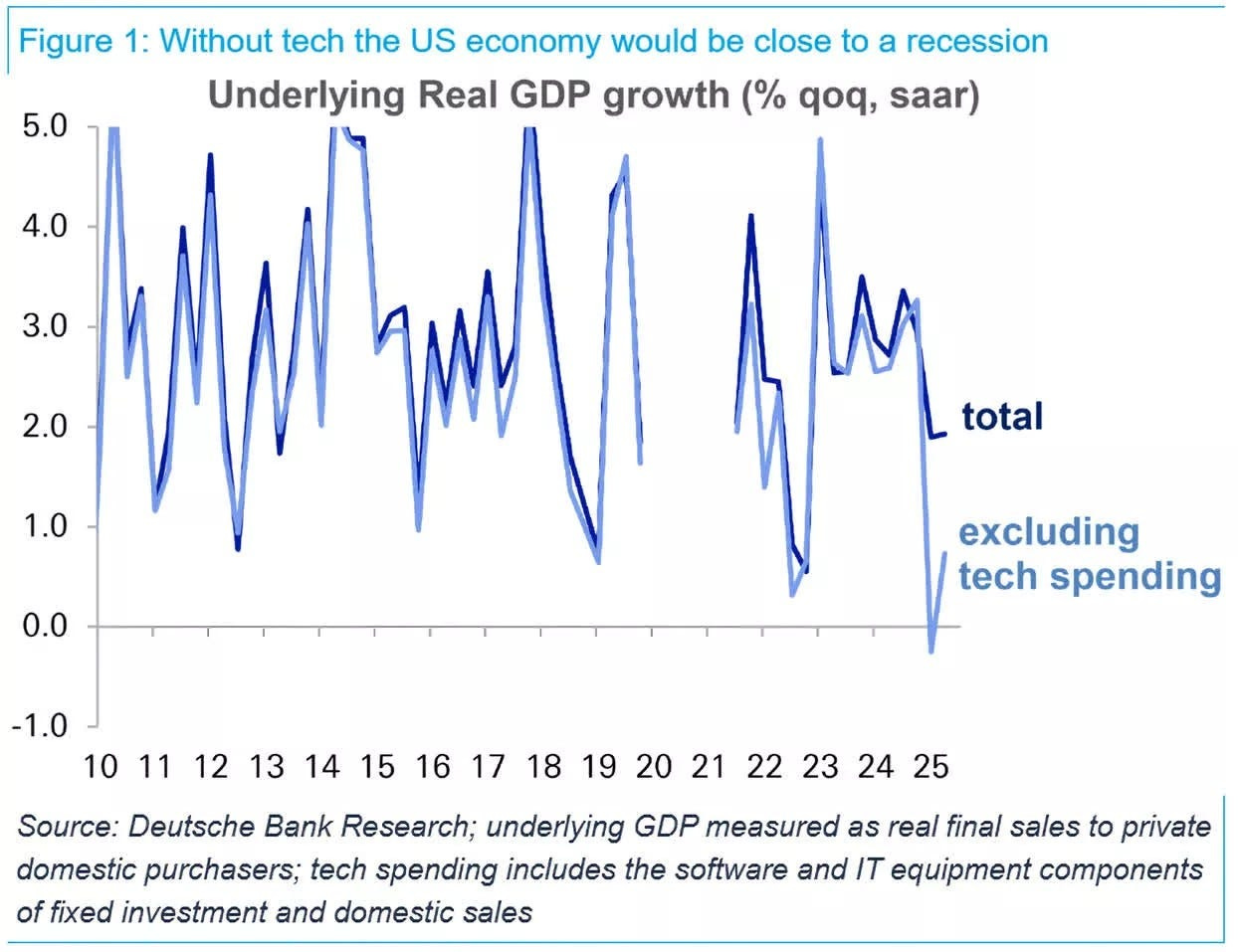
According to a research note recently sent to clients by Deutsche Bank, the AI boom is ALL that is keeping the US economy out of being in a recession but, it cannot continue indefinitely. George Saravelos, Global Head of FX Research at Deutsche Bank, said the US would be close to a recession this year if Big Tech were not spending so heavily on building new AI data centers.
“The “AI machines” are literally saving the US economy right now, but this kind of growth cannot be sustained unless tech company spending remains on an ever-growing course. The bad news is, that in order for the tech cycle to continue contributing to GDP growth, capital investment needs to remain parabolic. This is highly unlikely.”
When you look at it that way, the two things — the AI Bubble and Climate Change Denial aren’t that different.
The AI Bubble and Climate Change Denial aren’t that different. Each of them involves a “willful” denial of actual reality in order to preserve the imaginary reality that is preferred.
With that in mind, let’s look at what the German Physical Society (German: Deutsche Physikalische Gesellschaft, DPG), the oldest organization of “physicists” globally with a worldwide membership of 50,668, stated recently in their climate analysis.
Warning, these are in German and there are no English versions. My German is pretty good but, if yours isn’t, Google Translate works great.
Here is the “Executive Summary”.
Global warming is accelerating — A call for decisive action — Sept 2025
There is no denying that climate change is progressing unchecked and accelerating. In 2023 and 2024, global average temperatures were +1.5°C above pre-industrial levels for the first time. It is even possible that the 1.5-degree limit of global warming adopted in Paris may already be permanently exceeded.
Meanwhile, even the commitment to keep global warming well below 2 degrees is only achievable with considerably increased efforts by the international community and there is a growing risk of this target being missed.
Global warming has entered a period of acceleration.
Already around 2050, warming could reach even +3°C compared to the pre-industrial period, with the rise in temperature in Germany being significantly higher than the global average.
Results from climate models suggest that warming to +5°C is likely by the end of the century.
The Executive Summary is very short. Half of it is graphics like this.
Here is the full 14pg report.
Global warming is accelerating — a call for decisive action : Joint call of the DMG and the DPG….Sept 2025
It opens with this introduction.
The impact of man-made climate change is now obvious and its scale threatens to exceed our adaptability. In addition, there are increasing signs that global warming is progressing faster than previously expected.
Therefore, urgent action is needed.
Extreme weather events in Germany, Europe and worldwide are increasing both in their strength and frequency and are increasingly occurring in regions where they have previously been unknown.
The combination of heat and drought causes forests to die off and severely affects agriculture.
The local water balance is also greatly negatively affected by the consequences of global warming (melting of the alpine glaciers, absence of snow melt, etc.). This applies to both the agricultural and drinking water supply.
Extreme weather events, including large floods and large-scale wildfires, are causing a variety of fatalities and causing damage to private and public infrastructure of many billions of euros every year.
In many regions of the world, temperatures are reaching record levels. Such heat waves, also occurring in Germany, are a major health burden. They endanger, in particular, elderly and health-impaired people.
Rising temperatures also reduce the working capacity of the general population and causes enormous economic damage (in lost productivity).
At the same time, experts around the world are witnessing a drastic loss of biodiversity, which continues to intensify as a result of climate change and which impairs the resilience of our ecosystems.
Worldwide, the risk of impoverishment, hunger, refugee movements and social and global political instability continues to increase.
Despite these obvious developments, the global community and Germany have so far reacted insufficiently to the dangers associated with global warming.
Other than the opening statement about “global warming progressing faster than expected”. The rest of this sounds like standard IPCC warnings. Climate Change is getting worse “blah, blah, blah”. So what makes this report significant?
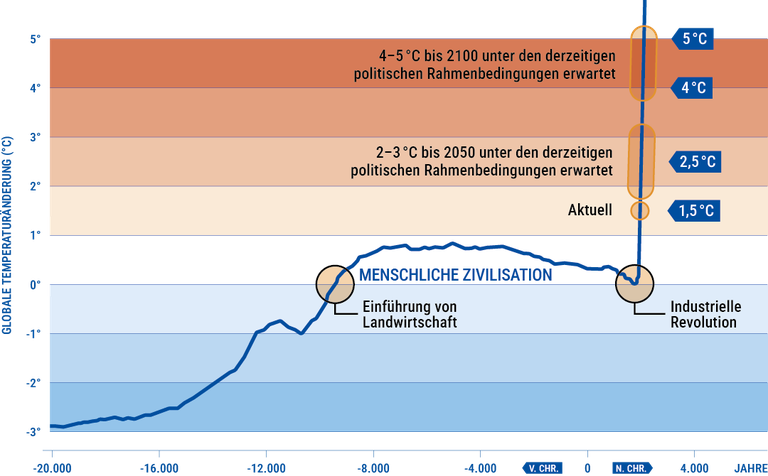
Although greenhouse gas emissions in Germany have been reduced since 1990, the current measures are not enough to achieve the goals of the German Climate Protection Act by 2030 or greenhouse gas neutrality by 2045 at the latest.
In Germany and internationally, the guaranteed climate protection targets are significantly too small (ambition gap) and the currently implemented and envisaged measures are not sufficient to achieve even these too low-measured targets (implementation gap).
This has far-reaching consequences:
The ambition gap by 2100 is likely to lead to a warming of +2 to +5 degrees compared to the pre-industrial temperatures, the implementation gap to a further warming of a few degrees.[ 1.2, VI] Already by 2050 there is a risk of warming by +3 degrees.
+3°C of warming over the 1850 baseline is Climate Apocalypse BAD. It’s +1.5°C more warming in just the next 25 years. That implies that the DPG thinks that the Rate of Warming could now be as high as +0.6°C/decade.
+3°C of warming by 2050 is catastrophically bad.
SO.
In the last 12 months there has been.
An account from last November’s Davos gathering about how many of the wealthy already think a climate disaster is unfolding.
“Wealthy ‘know the world is doomed, so may as well go out with a bang’” — Daily Mail 01/22/25
“The elephant in the room is climate change. Everyone knows it can’t be prevented any more.”
The ‘super rich’ could generally be split into two groups on the topic.
“One group thinks it only affects the poor, the “not-white races”, while the others fear that it could get worse but there’s no sense in trying to do anything about it so they just enjoy themselves.”
The prevailing mood was “after us, the deluge”.
The Institute and Faculty of Actuaries (Exeter) insurance industry report in January.
Global economy could face 50% loss in GDP between 2070 and 2090 from climate shocks, say actuaries - Exclusive: Report by risk experts says previous assessments ignored severe effects of climate crisis….www.theguardian.com
They think the world will DEFINITELY hit +3°C between 2070 and 2090. They also think there is a “chance” it could happen as early as 2050.
A February report by the Institute of International Finance.
FYI — The institute represents about 400 members from more than 60 countries, including JPMorgan and Morgan Stanley. Hardly a “woke” institution.
In which industry officials argue that the financial sector needs a coordinated messaging campaign to regulators, investors and the public that the Paris targets are no longer within reach and banks should not be expected to pursue them.
“The world is not on track to limit temperature rise below +2°C — and limiting warming [to] +1.5°C is almost certainly unachievable. Current policies are projected to result in temperature increases between +1.9°C and +3.7°C, with a median estimate of +2.7°C above pre-industrial levels by the end of the century.”
The March report from Morgan Stanley.
Big banks predict catastrophic warming, with profit potential
Morgan Stanley, JPMorgan and an international banking group have quietly concluded that climate change will likely…www.eenews.net
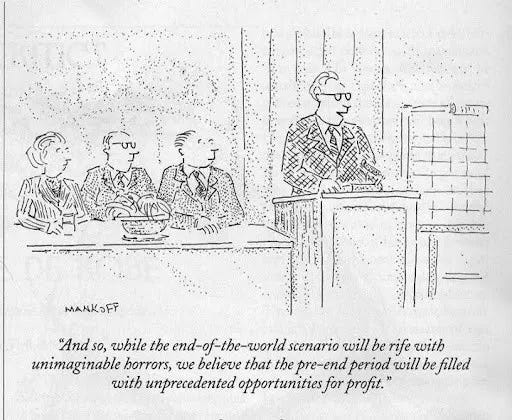
“We now expect a +3°C world,” Morgan Stanley analysts wrote earlier this month, citing “recent setbacks to global decarbonization efforts.”
The stunning conclusion indicates that the bank believes the planet is hurtling toward a future in which severe droughts and harvest failures become widespread, sea-level rise is measured in feet rather than inches and tropical regions experience episodes of extreme heat and humidity for weeks at a time that would bring deadly risks to people who work outdoors.
Morgan Stanley’s climate forecast was tucked into a mundane research report on the future of air conditioning stocks, which it provided to clients on March 17. A +3°C warming scenario, the analysts determined, could more than double the growth rate of the $235 billion cooling market every year, from 3% to 7% until 2030.
June’s announcement by JP Morgan that they are hiring the former chief scientist of NOAA. For the booming new business of “private climate change risk consulting”.
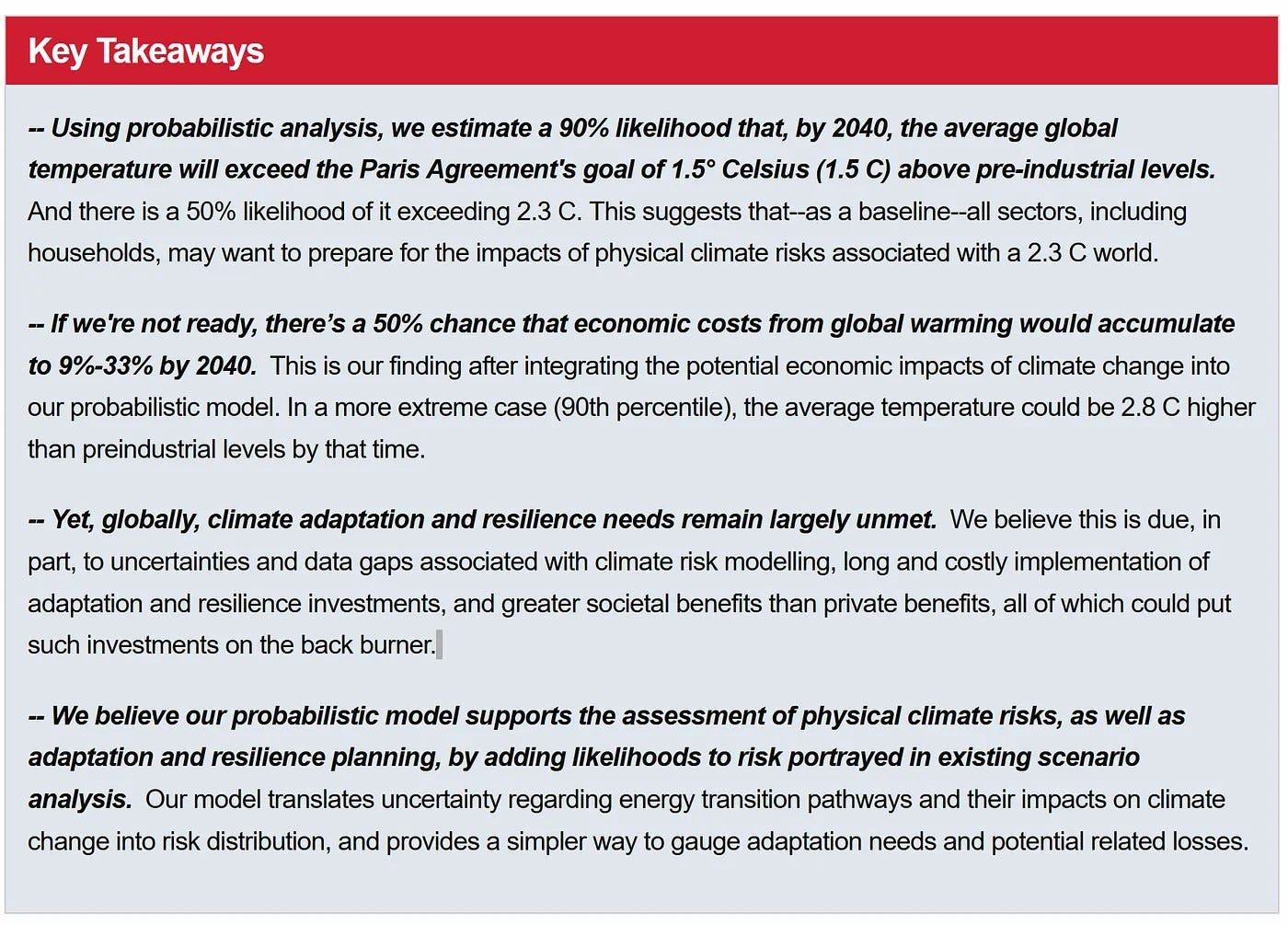
The S&P Global report on Sept 15th advising clients of the 50% risk of +2.3°C by 2040.
By 2040 there is a a 90% chance of the world exceeding the +1.5°C limit set by the Paris agreement AND a 50% chance of the globe warming to +2.3°C over the 1850 baseline.
Sustainability Insights: Why Planning For A 2.3°C Warmer World Is Critical This Decade And Next — S&P Global 09/15/25
What this +2.3°C estimate implies in terms of the Rate of Warming value in their model is a RoW value of about +0.52°C PER DECADE and reaching +3°C by no later than 2055, possibly by 2050.
AND NOW.
Global warming is accelerating — a call for decisive action : Joint call of the DMG and the DPG….Sept 2025
A German report saying warming by 2050 COULD exceed +3°C.
JUST SO WE ARE CLEAR.

That’s collapse of ocean fisheries.
Permanent (on a human timescale) loss of about 40% of existing farmland in the midlatitudes.
Droughts globally.
Massive destruction of infrastructure (roads, rail lines, bridges, sewage treatment, power plants, harbors, communications, food processing/distribution) from weather disasters happening everywhere AND the loss of ability to REPAIR that infrastructure. IE we are rapidly approaching the point where whatever “breaks” will NEVER be repaired or replaced.
70% population reduction in Sub-Saharan Africa (around 700 million dead).
Famines globally and starvation even in places like the US and Europe.
Mass migration of billions of people seeking safety and food.
The collapse of global manufacturing and supply chains.
Over the next 25 years.
RIGHT NOW, that’s currently the “worst case” scenario.
There’s still a 50% chance that the RoW could be less than +0.5°C/decade. Although, that just buys us an extra 10–20 years before we hit +3°C. Unless we DO SOMETHING with that time it just delays the crash.
We WILL KNOW what it’s going to be, in about 2–3 years. The next El Nino will be the indicator of just HOW BAD things really are.
If you cannot see the “writing on the wall” at this point. Then you just don’t want to see it.
This is my analysis.
This is what I see.
This is my “Crisis Report”.
rc 10/04/2025
ADDENDUM
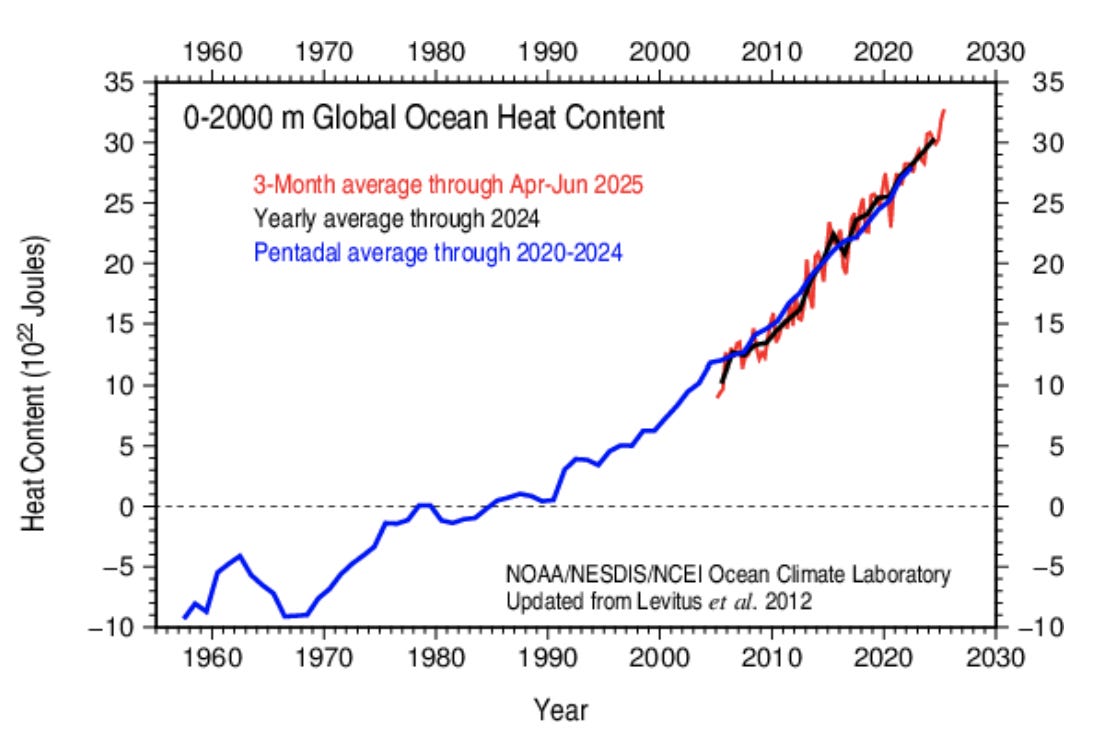
Record High Temperatures in the Ocean in 2024 - Advances in Atmospheric Sciences
Heating in the ocean has continued in 2024 in response to increased greenhouse gas concentrations in the atmosphere…link.springer.com
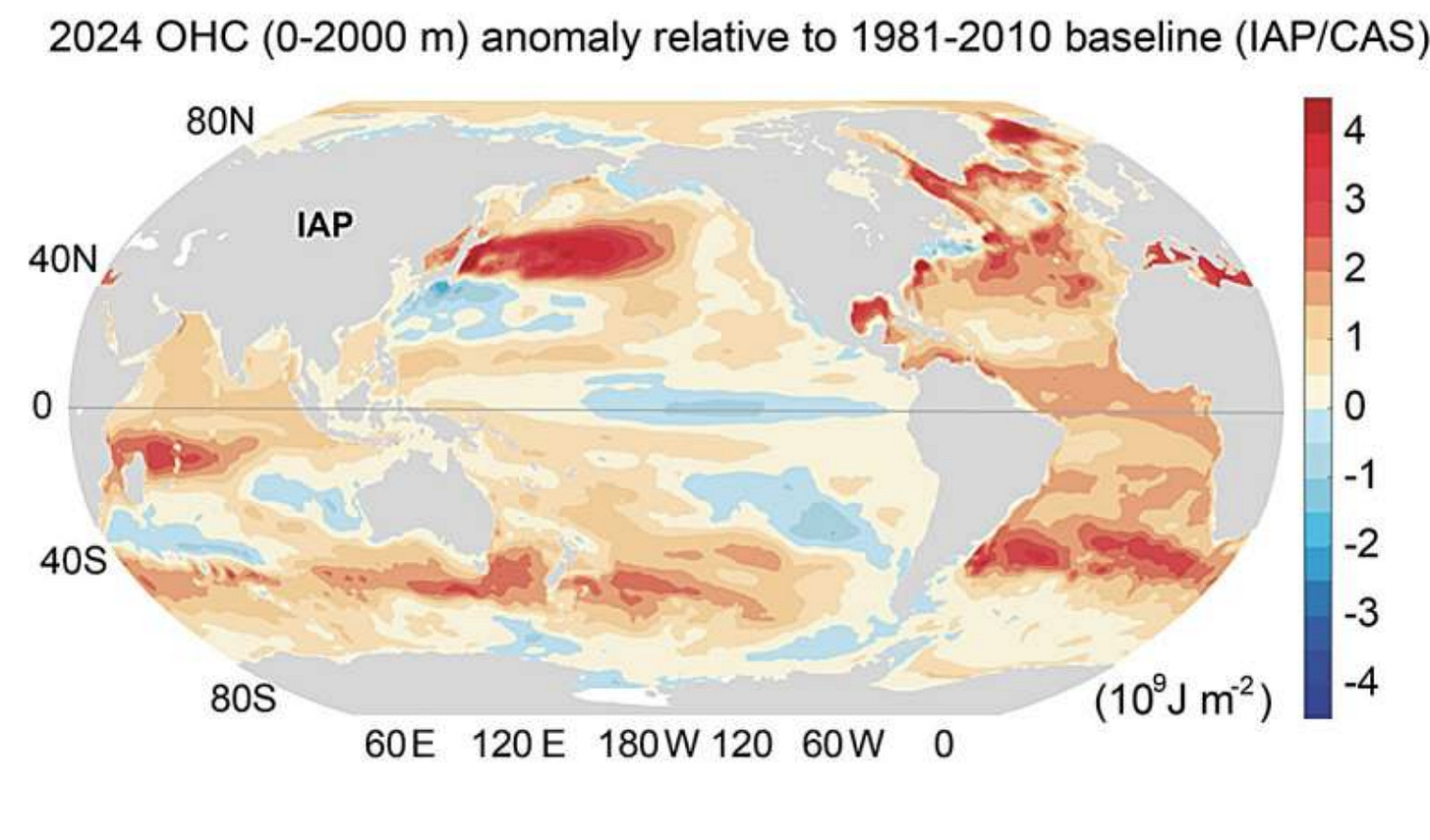
Results from three international teams were consistent — the ocean is warming, and 2024 was a record.
From 2023 to 2024, the global upper 2000m ocean heat content increased by 16 zettajoules ~140 times the world’s total electricity generation in 2023.
No posts
Comments
Nothing yet. Say the first thing.
Sign in to join the conversation.