
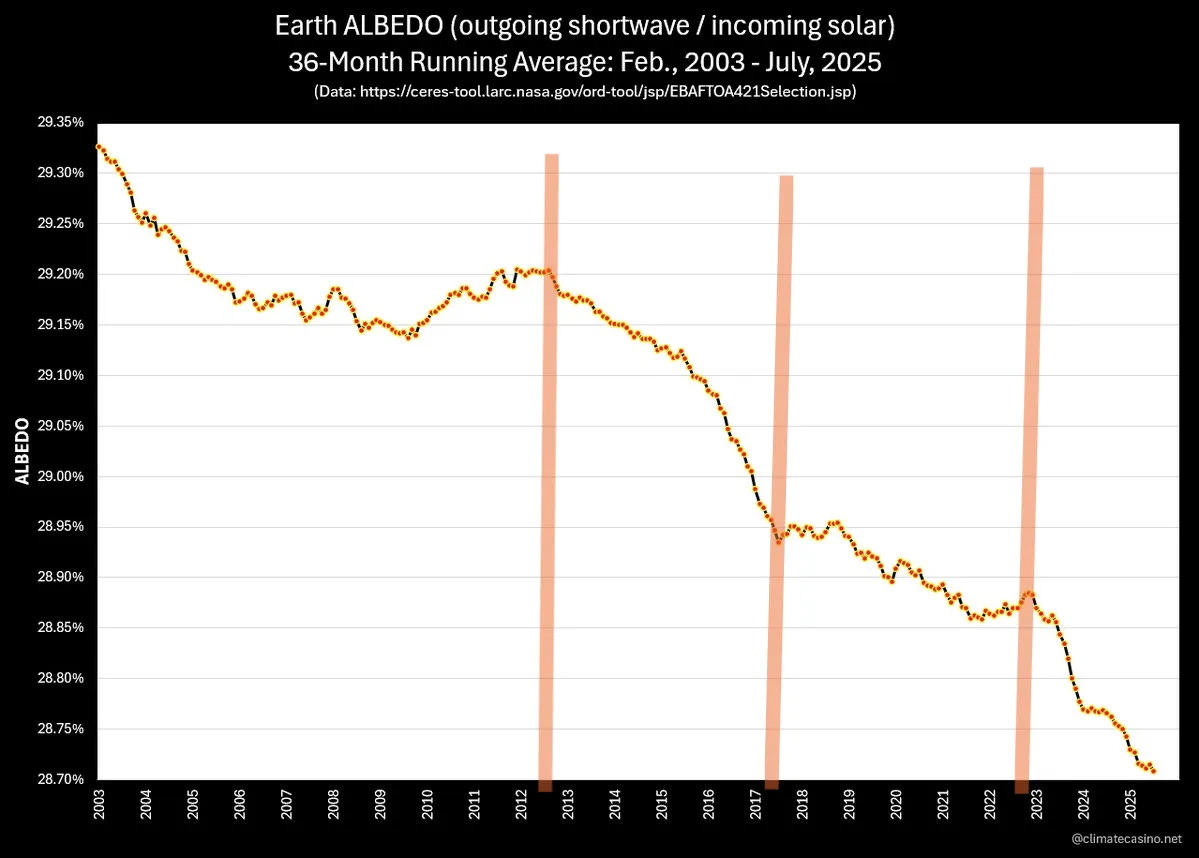
SO, Trump spoke on Tuesday at the UN. At a summit on Climate Change, before the ENTIRE World, the President of the United States stated.
“It’s the greatest con job ever perpetrated on the world, in my opinion. “ — DJT on “Climate Change”
The summit, which took place last week at UN Headquarters in New York, is designed as a launchpad for COP30 later this year. Unlike the sprawling negotiations of a COP climate conference, this is a targeted high-level event where Heads of State, Government leaders, businesses, and civil society are expected to present concrete pledges and new national climate plans.
The MAGAt White House PR team had billed Mr. Trump’s address to the 80th session of the United Nations General Assembly as a chance for the president to lay out his “New Vision” for how America “should be”, and “would be” wielding its power abroad. So, many nations were closely monitoring what Trump said on Tuesday.
Trump made it clear that the US official position is now utter contempt for global institutions.
As a “counterpoint” to Trump’s speech, Colombian President Gustavo Petro also spoke at the UN that day. Although few noticed, his language was extraordinarily direct. In stressing the need for climate action, Petro said of Trump:
“The most powerful man in the world does not believe in science. That is irrationality. As Germany, the country of great philosophers, of Kant, Feuerbach, and others, became prey to irrationalism in 1933. Today it’s this (US) country that is becoming irrational.”
“The old societies of Europe are collapsing, and the United States is applauding its new Hitler.”
“It’s not listening to its own young people, or its older people who died in the battlefields of Europe, fighting against Hitler and against his criminal ideology. Today, the same thing is being done (in the US) as Hitler did, building concentration camps for migrants, and stating that migrants are of an inferior race, and blaming them for crime and degeneration just like Hitler blamed the Jews.”
FYI — The US Department of State announced in a social media post on Friday that it had stripped Petro of his US visa. By international law and tradition this is illegal. Petro stated on learning this, “International law grants me immunity to go to the UN and that there should be no reprisals for my free opinion.”
So, Trump spoke on Tuesday.
THEN
On Wednesday in New York, countries lined up to say they would accelerate their efforts to cut greenhouse-gas emissions. — NYT 09/24/25
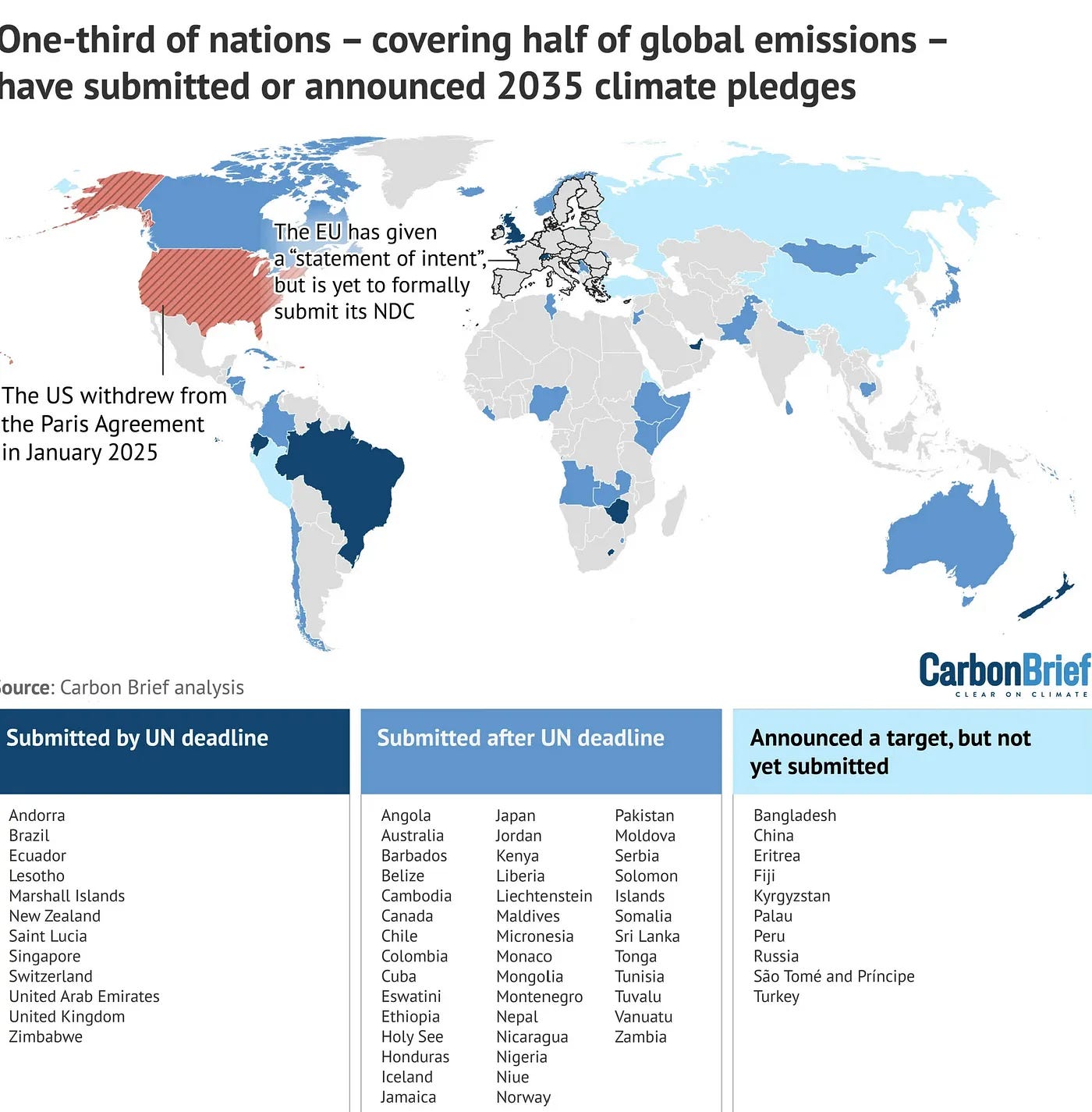
At a climate summit at the United Nations on Wednesday, the vast majority of the world’s nations gathered to make their newest pledges to reduce planet-warming greenhouse gas emissions over the next decade.
EVERYONE WAS THERE
Geopolitical heavyweights including China, Russia, Japan and Germany were there. Dozens of small island states were there. The world’s poorest countries, including Chad and the Central African Republic, were there. Venezuela, Syria, Iran — there, too.
Perhaps because the United States is the world’s biggest producer of both oil and natural gas.
Think about that.
At Wednesday’s climate summit, countries delivered pledges towards reining in global emissions for the sake of trying to slow catastrophic global warming, but the US refused to join them.
When it comes to Climate Change policy, the US stands alone in isolation. NO ONE else, in the World, agrees with Trump and the MAGAts who put him in office.
On Wednesday the “adults” got down to business.
The most important announcement on Wednesday came from Beijing.
China for First Time Promises to Reduce Its Greenhouse Gas Emissions — NYT 09/25/25
From the article:
For the first time, China has announced a detailed target for reducing the greenhouse gas emissions from its immense economy, saying on Wednesday that it would cut carbon dioxide and other pollution by at least 7 to 10 percent by 2035.
In the past, China had pledged only that its greenhouse gas emissions would continue rising until they peaked around 2030. Now, however, studies suggest that China’s emissions have already reached a plateau, five years earlier than expected.
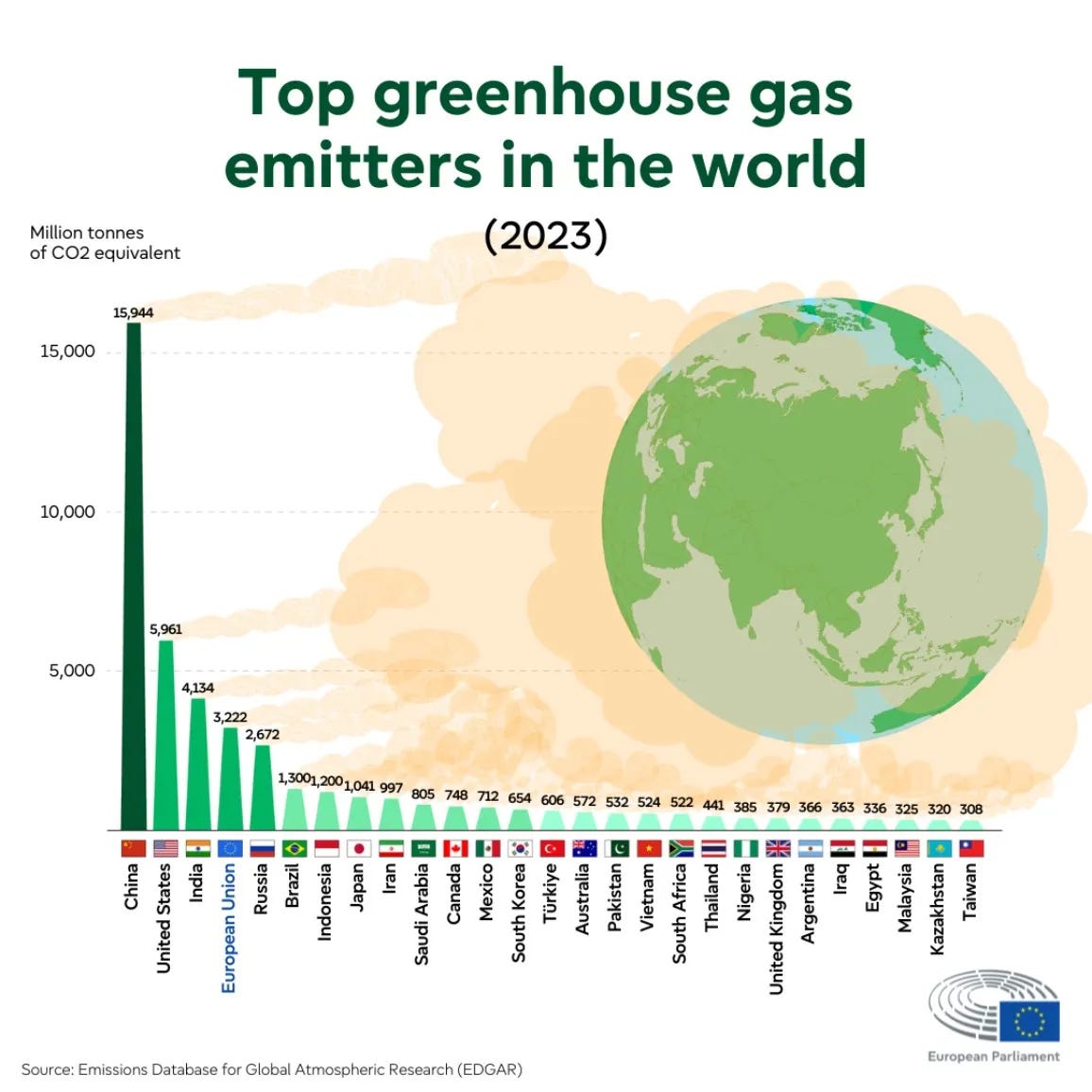
China’s latest climate targets matter for several reasons. First, China currently is the world’s biggest polluter, which means that without a significant turnaround, there is little hope of slowing down global warming.
Let’s examine this statement CLOSELY. One of the common “whataboutism” arguments from the MAGAt’s, is that “China is responsible for climate change.” That it’s “stupid” for the US to try and reduce emissions “at great cost” when “China is the real problem”.
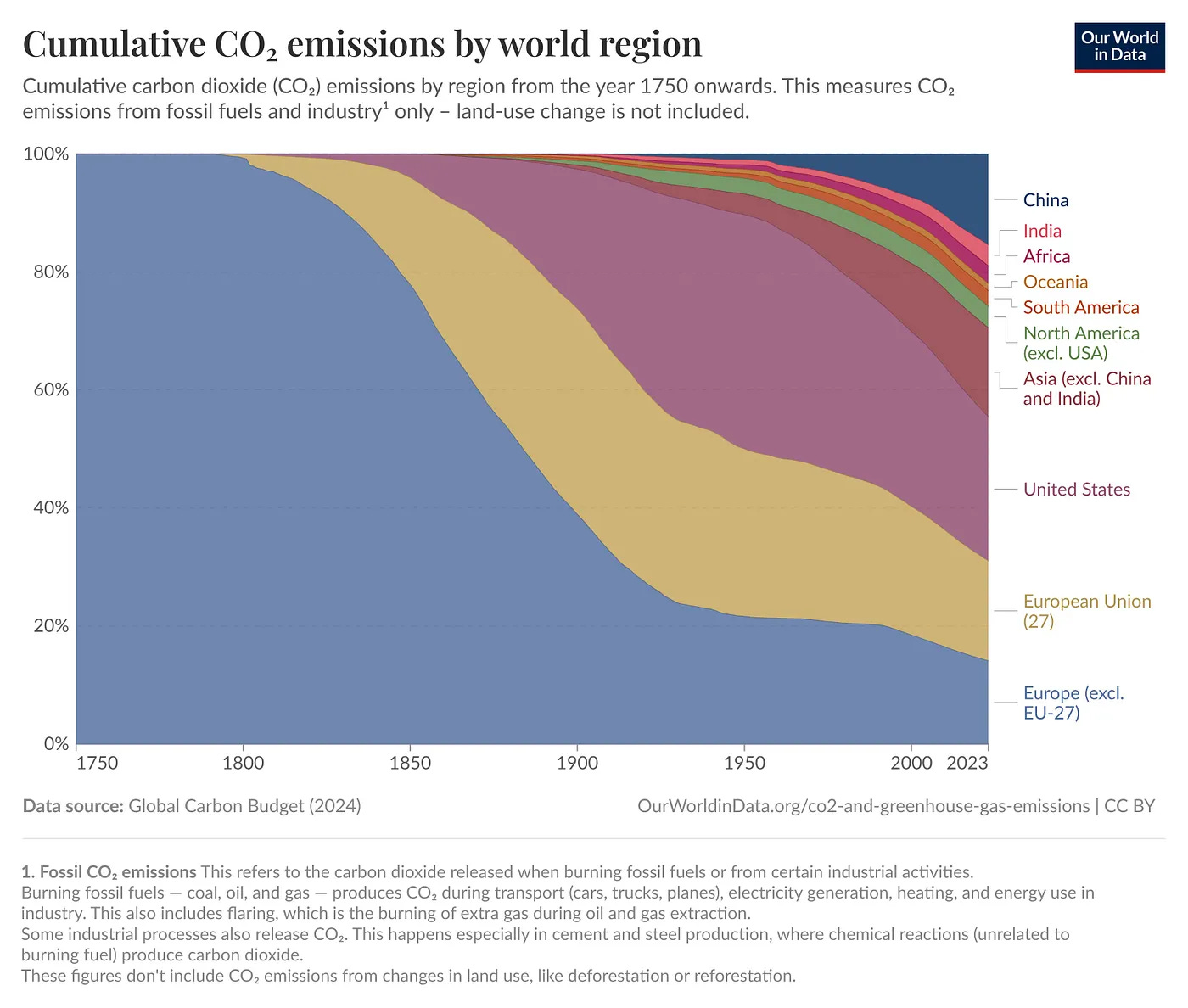
Yes, China is currently the world’s largest CO2 emitter but, the US is responsible for the largest share of CO2 in the atmosphere.
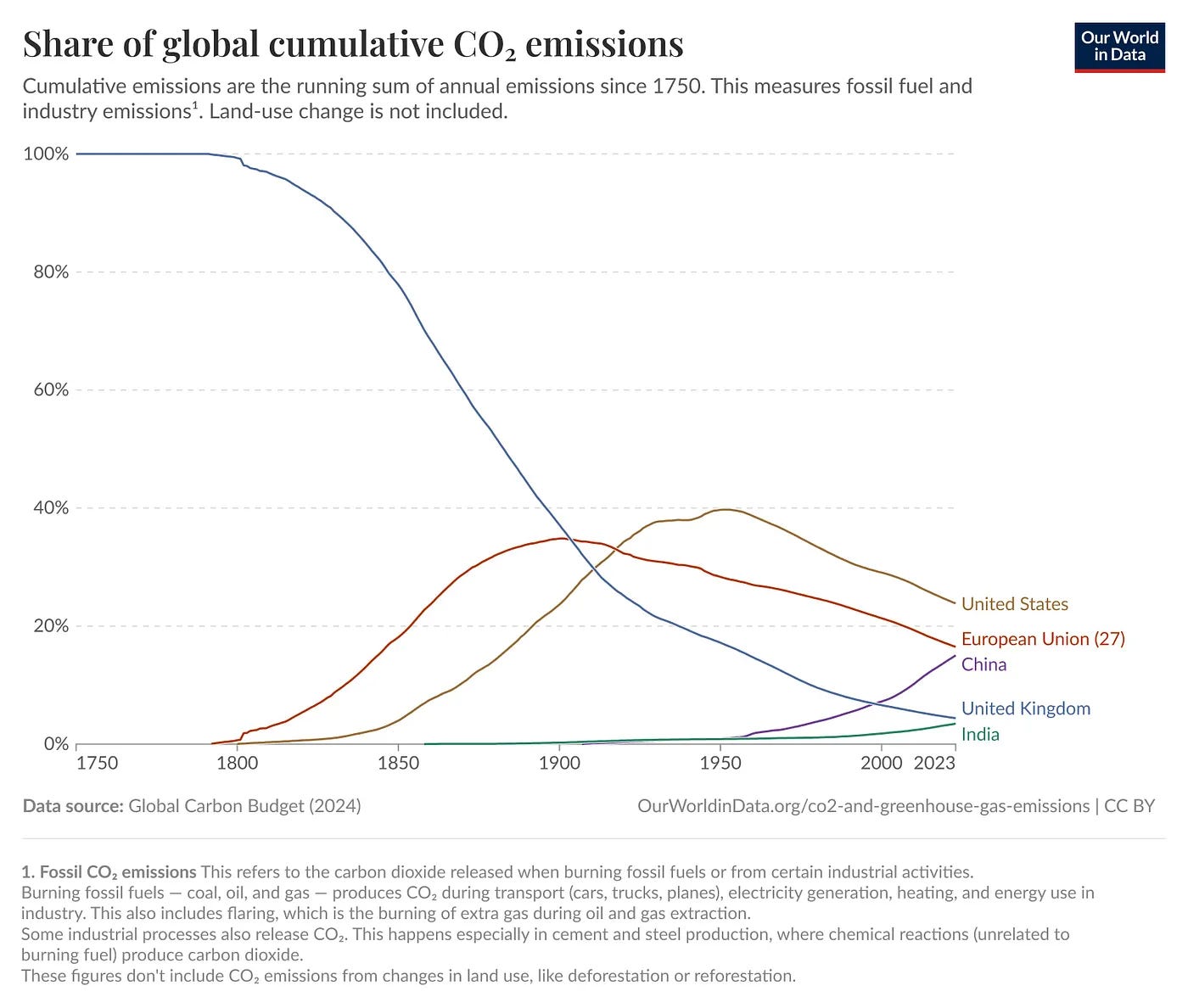
From the NYT article.
China’s new climate target is also a sharp contrast to the posture of the United States, which has contributed the largest share of emissions since the start of the industrial era and which has repudiated climate action under the Trump administration.
“It’s the greatest con job ever perpetrated on the world, in my opinion. “ — DJT on “Climate Change”
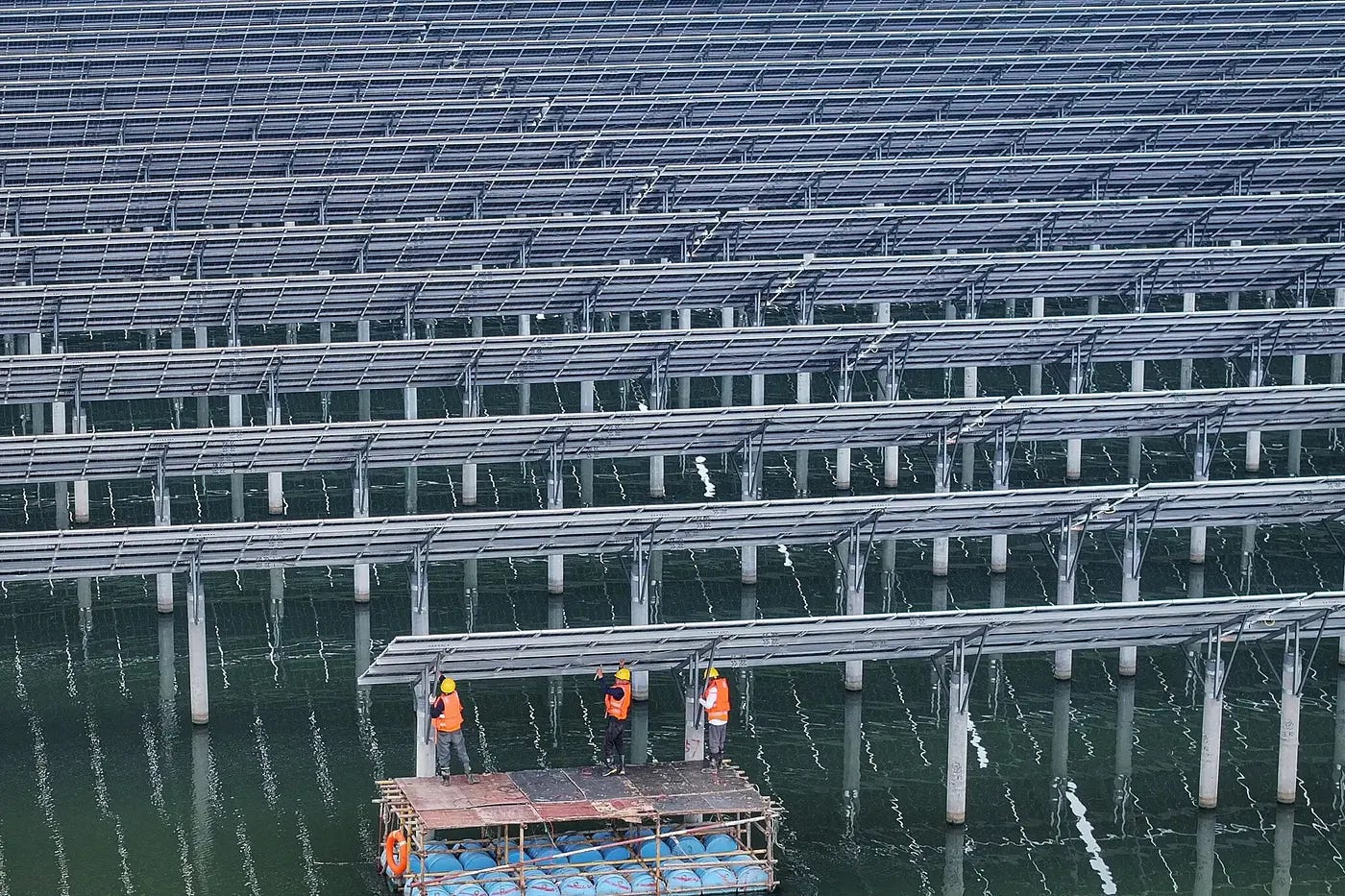
China is adding renewable energy to its grid at astonishing scale and speed. In JUST 2023 alone, China added more solar power capacity than the United States has built in total.
In contrast, China is announcing record amounts of solar and wind production.
China is SO far ahead of the rest of the world in solar panel production that they’re exporting it to most of the rest of the world. Just as the US is an Oil & Gas superpower, China is also becoming an ENERGY superpower. A SOLAR energy superpower.
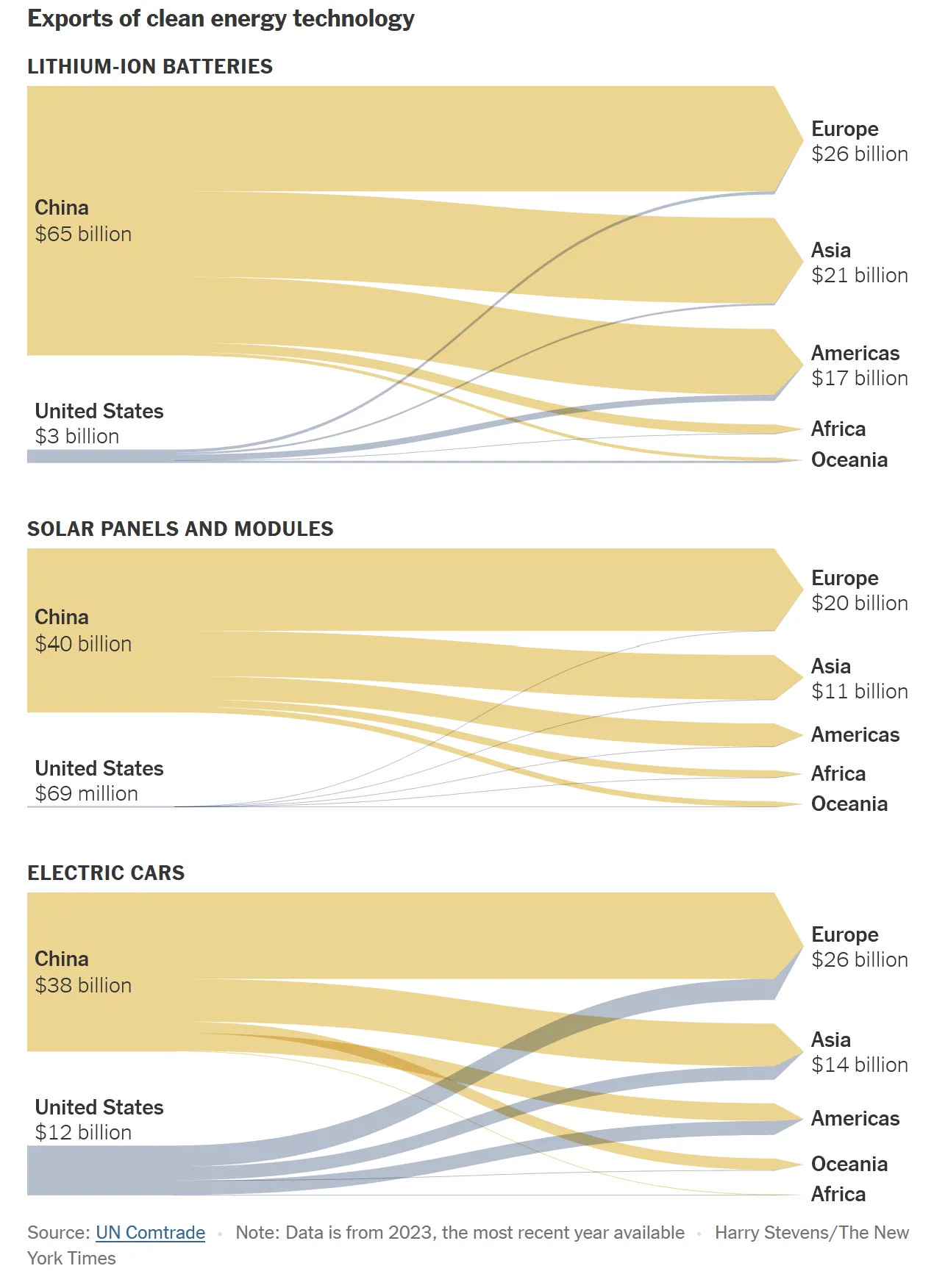
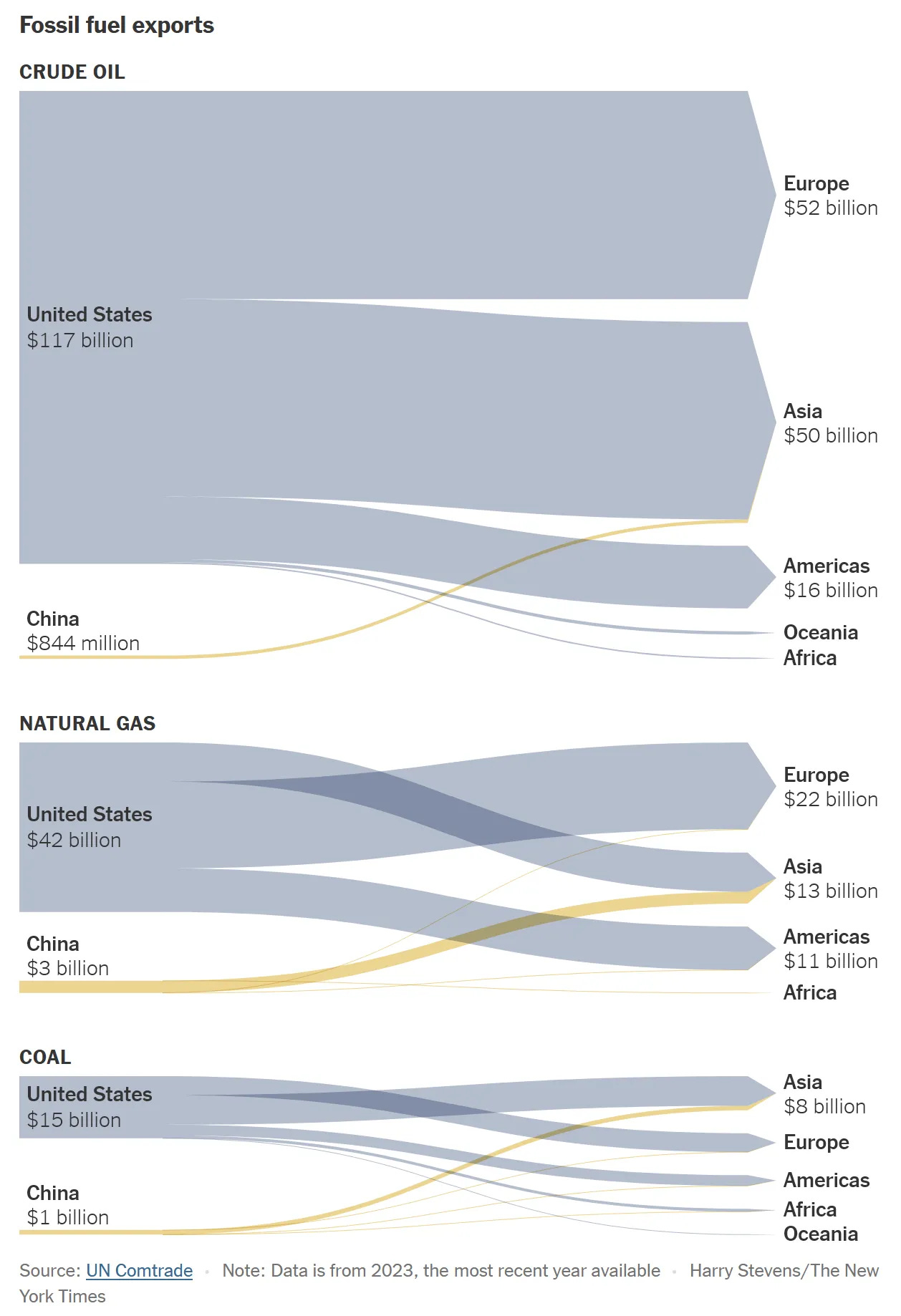
While many countries have problems with Chinese authoritarianism, the Chinese are at least offering something that is stable and based in reality. Two things the United States is telling the world that we’re not interested in.
After the Chinese, came the Europeans.
Despite Trump, the World Isn’t Slowing on Climate, E.U. Official Says — NYT 09/24/25
EU President Ursula Van der Leyen told the summit the EU was on track to reach its 2030 target of slashing emissions 55% by 2030, and the bloc’s 2035 reduction goal would range between 66% and 72%.
Australia, which plans to host a 2026 UN climate summit, announced a pledge that by 2035, it would slash greenhouse gas to between 62% and 70% below 2005 levels.
Brazilian President Luis Inacio Lula da Silva warned that countries’ commitments made ahead of the U.N. climate summit in November would show the world “whether or not we believe in what the science is showing us.” Brazil has committed to reducing emissions by 59%-67% by 2035 and to stepping up efforts to combat deforestation.
It all looked and sounded GREAT.
Secretary-General António Guterres, assured everyone listening that the world was making progress in the energy transition, even if it was slow.
“The Paris Agreement has made a difference, actions taken under the 2015 treaty have lowered the projected rise in the average global temperature by 2100 from +4°C (+7.2°F) to +2.6°C (+3.6°F).” — UN Sec.General Guterres
This might come as a surprise to some of you but the UN/IPCC currently EXPECTS +2.6°C of warming by 2100. IF we continue on with “business as usual” and don’t get to “Net-Zero” that’s how BAD they think things will get by 2100.
If that seems out of touch with the reality that the GMST averaged +1.6°C over baseline for 2024 and was over +1.5°C in 2023 then you don’t understand how Climate Science calculates the temperature for a given year. Climate Science uses a 20 year rolling average in order to “smooth out” the swings of natural variation.
Using a 20 year average from 2004 to 2024, 2024 was only +1.3°C above the preindustrial average. It will take another ten years of temperatures being above +1.5°C before we “officially” get there.
OR IT MIGHT HAPPEN A LOT SOONER.
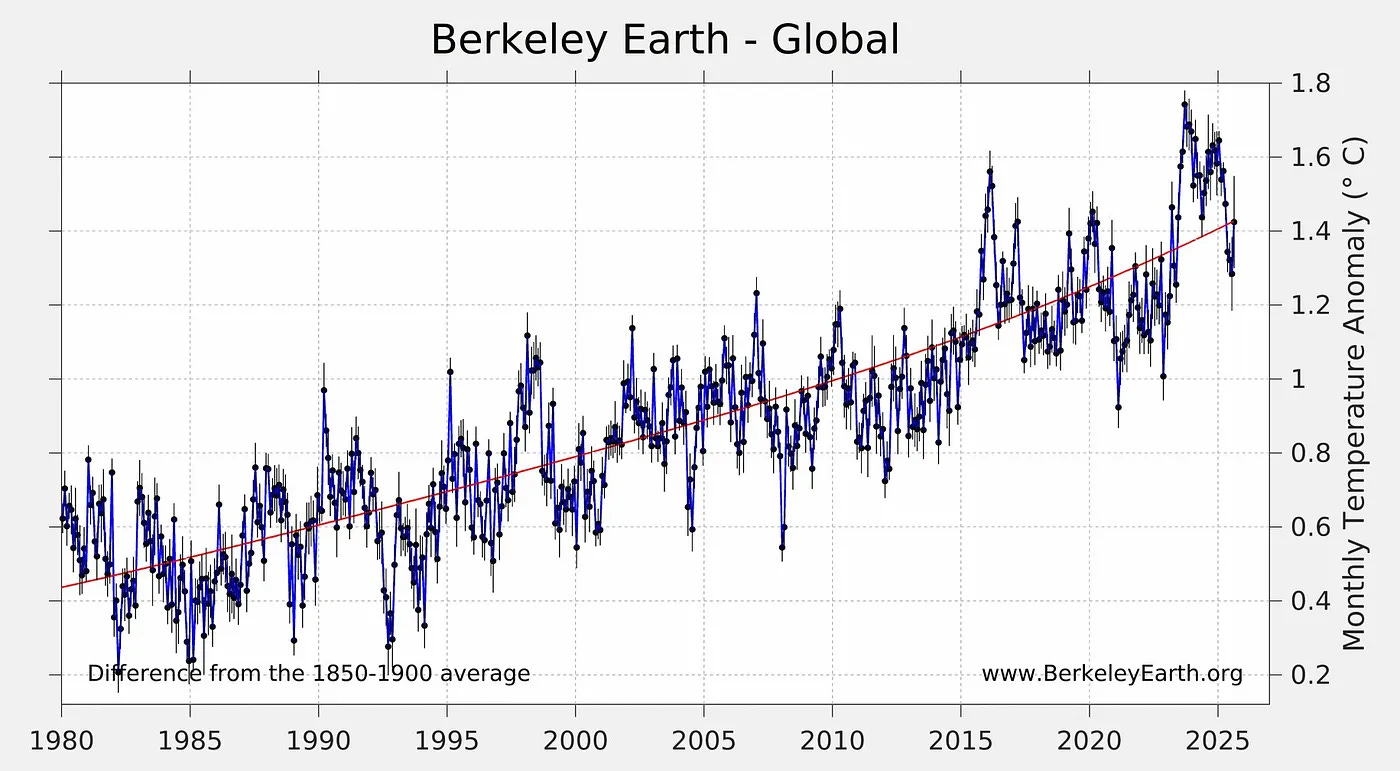
Notice something about this graph, it shows warming of +1°C between 1980 and 2025. A Rate of Warming (RoW) of about +1°C over 45 years, roughly 20 times faster than any warming observed in the ice core record over the last 800,000 years.
Now, project that RoW out to 2100 and you get about +2.6°C of warming by 2100. Which makes it clear that the UN/IPCC models are ASSUMING that warming will not significantly accelerate during this time.
The UN/IPCC models, using mainstream climate science, assume that CO2 emissions are “peaking” right now. Their “worst case” is that CO2 emissions continue at the present level for the rest of the century. They expect CO2 emissions will decline rapidly over the next few decades and that Net-Zero will be reached between now and 2065. Once that happens they expect planetary warming to essentially cease.
Sustainability Insights: Why Planning For A 2.3°C Warmer World Is Critical This Decade And Next — S&P Global 09/15/25
S&P (Standard and Poors) Global is an American financial services company that owns a number of the most well-known players in the global financial system. Including the credit rating agency S&P Ratings and the S&P Dow Jones Indices (which administers the famous S&P 500 stock market index).
These are VERY reputable analysts that are responsible for billions of dollars of wealth and who operate at the highest levels of the global economy.
These are not “crazy doomers” or “woke” environmentalists.
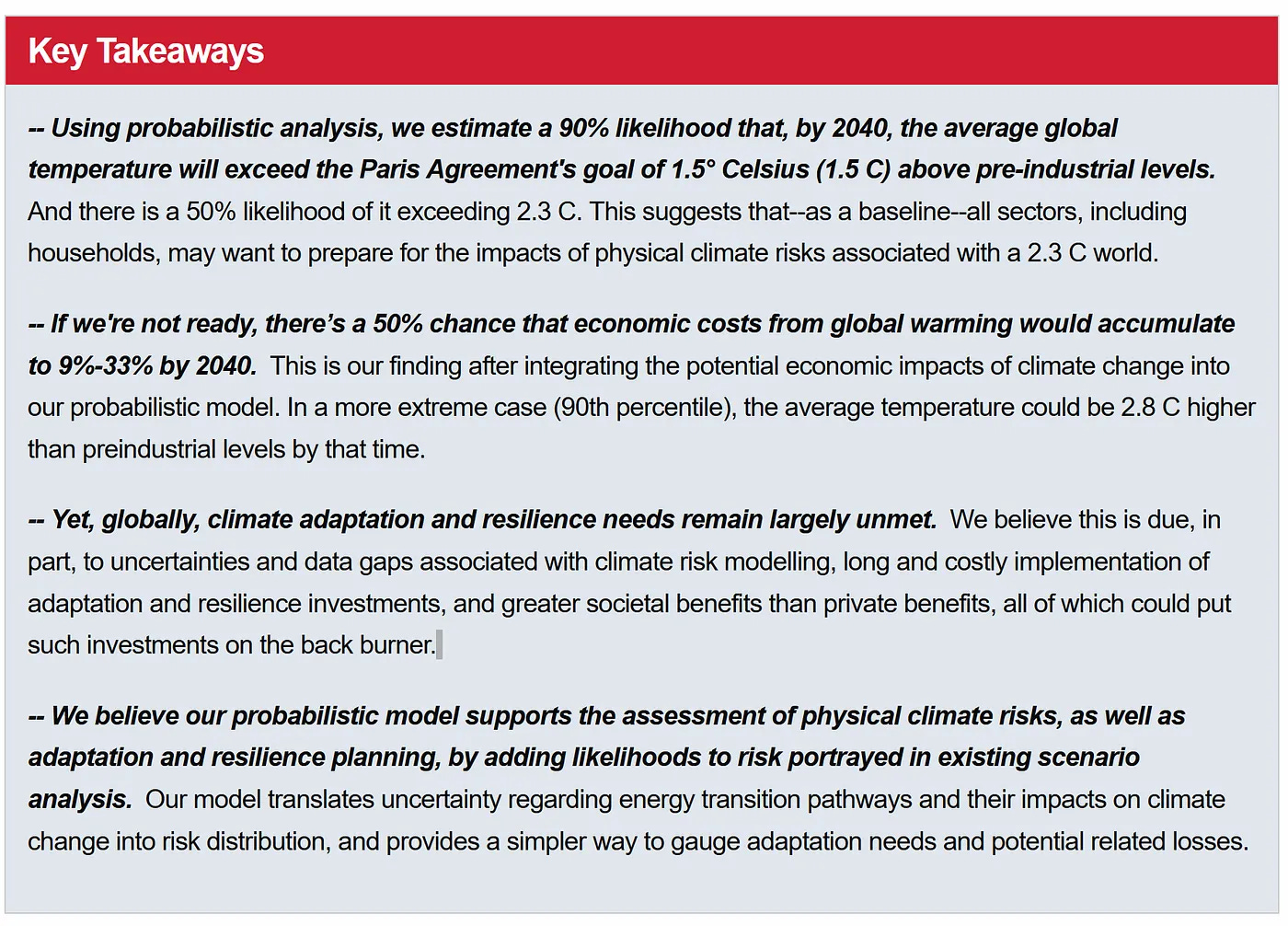
Their analysis uses probabilistic models typical of the financial industry and finds that.
By 2040 there is a a 90% chance of the world exceeding the +1.5°C limit set by the Paris agreement AND a 50% chance of the globe warming to +2.3°C over the 1850 baseline.
This makes my prediction of +2°C by 2035 pretty much “spot on” in what appears to be the “new models” being used.
What this +2.3°C estimate implies in terms of the Rate of Warming value in their model.
IF — you assume that we are now at +1.5°C over baseline.
THEN — that implies a RoW of about +0.52°C PER DECADE.
Which means that these guys think the Mainstream +0.27°C/decade and the Alarmist +036°C/decade estimates are crap.
I stated recently that I thought the RoW could be as high as +0.5°C/decade. These guys seem to think there is a 50% chance that’s correct.
The implications of that are FUCKING DIRE.
That’s
+2.0°C by 2035–20% die off of human population predicted by IFoA
+2.5°C by 2045
+3.0°C by 2055–50% die off of human population predicted by IFoA
+3.5°C by 2065
+4.0°C by 2075
+4.5°C by 2085
+5.0°C by 2095
This suggests that — as a baseline — all sectors, including households, may want to prepare for the impacts of physical climate risks associated with a +2.3°C world.
— If we’re not ready, there’s a 50% chance that economic costs from global warming would accumulate to 9%-33% of GDP by 2040.
— Yet, globally, climate adaptation and resilience needs remain largely unmet.
We believe this is due, in part, to uncertainties and data gaps associated with climate risk modelling, long and costly implementation of adaptation and resilience investments, and greater societal benefits than private benefits, all of which could put such investments on the back burner.
— In a more extreme case (90th percentile), the average temperature could be +2.8 C higher than preindustrial levels by 2040.
This is our finding after integrating the potential economic impacts of climate change into our probabilistic model.
— — — — —
If you remember, the Institute and Faculty of Actuaries (Exeter) issued a scathing report in January where they stated that mainstream Climate Science was “precisely wrong, rather than roughly correct”. They stated that +2°C of warming by 2050 would be “catastrophic” and probably result in global depopulation on the order of -25% (2 billion deaths).
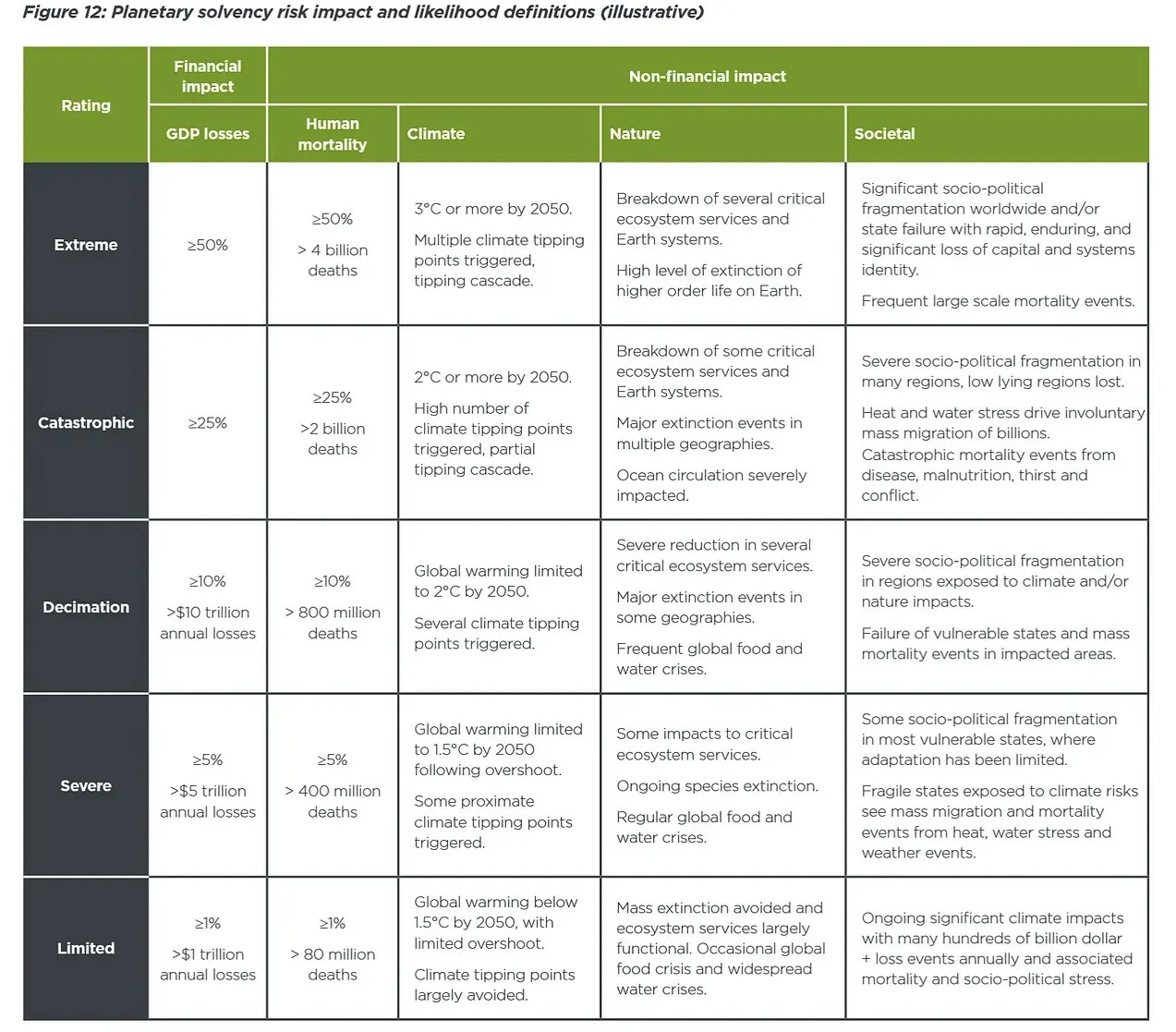
Based on what they are seeing IRL, the insurance industry and now the financial industry are both saying that mainstream climate science MASSIVELY underestimated the speed of warming and the risks associated with it.
Potential economic losses associated with climate hazards will likely be significant in the next 15 years.
Based on a less severe and more severe GDP impact function — that is, the economic impact associated with temperatures rising — we find a 50% probability that temperature increases since preindustrial times would have accumulated to 9%-33% of world GDP per capita by the 2040’s.
The cumulative economic loss associated with temperature increases is set to rise and, with a probability of 50%, will be at least 9% in the 2040s using a conservative impact model, and at least 33% in the 2040s using a more pessimistic impact model, absent further adaptation and resilience measures. (Our GDP impact function is based on a panel modelling approach with fixed effects that links GDP per capita to changes in temperature.)
“Historically, scenario analysis has been the main means of estimating climate risk, using narratives to outline possible global warming trends and associated losses. This approach is complex, relying on projections of future greenhouse gas emissions and their effects on weather patterns.”
“Energy transition and climate scenarios are available in the market, but without probabilities of occurrence, and they are not interconnected. This limits their usefulness in climate adaptation and resilience planning, in our view, even though they remain essential for transition risk management.”
“Scenario results are ‘sensitive to the assumptions embedded in narratives and model parameters’”.
-This is an exquisitely polite way of saying “the mainstream models are full of ASSUMPTIONS” that may not be true.
“For example, scenarios that target net-zero emissions by 2050 are useful from a transition risk perspective but may not be realistic.”
-LOL, “may not be realistic”.
“Meanwhile, predicting policies, technological change, and societal preferences beyond a few years into the future is difficult. Research by Dietz et al 2018 shows that uncertainty regarding productivity growth (such as, how AI may boost economic activity) and climate sensitivity (including how emissions translate into higher temperatures) significantly affects the estimated benefits of climate mitigation, and by corollary, adaptation.”
-It comes down to “climate sensitivity”. If you think that we won’t get to +3°C by 2100 then you value “climate mitigation” a lot less than if you think it’s going to be +3°C by 2055.
“Meanwhile, tipping points or compounding events cannot be extrapolated from past data and remain largely overlooked in current models”.
-Tipping points and feedbacks “remain largely overlooked in current models”. Oh swell, that means you can TRUST them to be “TOO LOW” in their predictions.
The “Money People” are now saying OUTRIGHT that they believe mainstream climate science is WRONG.
Here’s what they say about their methodology in the report.
Methodology Overview: Embedding Energy Transition And Climate Sensitivity Uncertainties
“Our methodology quantifies the size and likelihood of physical climate risk losses across time and across thousands of possible scenarios.”
“Using this large number of emissions pathways, coupled with information on climate sensitivities. We provide a probability distribution for climate change outcomes through the global mean surface temperature (GMST) indicator. This probability distribution enables us to quantify risks robustly across all outcomes, weighted by their likelihoods.”
-This was not a “trivial” effort. They put a lot of time and money into this. They ran “thousands of possible scenarios” using differing values for climate sensitivity and differing CO2 values.
They state CLEARLY that they are using a RANGE of values for “climate sensitivity” or 2XCO2. This strongly implies that they DO NOT accept the mainstream value range for 2XCO2.
To say there is a 50% chance of +2.3°C by 2040, implies that you think there is at least a 50% chance that Hansen is right.
Large Cloud Feedback Confirms High Climate Sensitivity — May 2025
“Our approach allows us to answer questions, including but not limited to:”
- What is the probability that the GMST in 2050 will exceed 3.5 C?
- What is the probability that it will be below 2 C?
“The answers to the above questions allow us to estimate the probability of GDP losses, answering questions like:”
- What is the probability that GMST impacts on GDP will exceed 20% in 2050?
- What is the probability that they will be below 5%?
- What is the probability that the sea-level rises above a certain threshold?
“The answers to these questions enable robust risk assessment that is quantitatively informed of potential higher and lower risks, thereby aiding understanding of adaptation benefits in terms of avoided losses.”
“Transforming the probability distribution of GMST into the distribution of local conditions can support adaptation and resilience planning. For example, it can help governments seeking to avoid construction in areas at risk of sea-level rise or to design building codes for a given specification.”
-They are trying to put together a “practical” climate model that can actually indicate risk for planners and individuals on a fairly fine grained scale.
“Our probabilistic model indicates that a +2.3°C world is very likely to materialize in the next 15 to 25 years.”
By 2040, it’s very unlikely (2.5% probability) that the global average temperature rise will stay below 1.5 C compared to the preindustrial average.
It is very unlikely that physical climate risks will not increase in severity and frequency globally (less than 2.5% chance), implying more climate-change-related losses absent an increase in adaptation and resilience investments.
And yes, that’s an estimate that’s “pants shitting” BAD.
That’s an estimate which indicates 30% of the global population could be dead from starvation, migration, warfare, and infrastructure breakdown.
The CONTRAST between what was said at the UN and what “the money” is saying/thinking could not be more stark.
SO, who’re gonna believe?
This is my analysis.
This is what I see.
This is my “Crisis Report”.
rc 09/29/2025
ADDENDUM
In case the thought of billions of people starving to death wasn’t enough, the S&P report makes it clear that.
They are predicting the ECONOMY is going to SUCK.
“Potential economic losses associated with climate hazards will likely be significant in the next 15 years.”
“Based on a less severe and more severe GDP impact function — that is, the economic impact associated with temperatures rising — we find a 50% probability that temperature increases since preindustrial times would have accumulated to 9%-33% of world GDP per capita by the 2040s.”
“The cumulative economic loss associated with temperature increases is set to rise and, with a probability of 50%, will be at least 9% in the 2040s using a conservative impact model, and at least 33% in the 2040s using a more pessimistic impact model, absent further adaptation and resilience measures.”
So, at least a 10% decline in global GDP by 2040, and possibly a HUGE -33% decline. That’s like a worldwide “Great Depression” decline in GDP over the next 15 years.
There is also a geopolitical SURPRISE buried in the analysis.
“GDP loss estimates by country highlight that temperature-related damage (and the related adaptation and resilience needs) are location specific”.
“As a result of greater physical climate risk exposure, adaptation needs and potential avoided losses are much higher in terms of GDP in China than in the U.S.”
That’s REALLY interesting. They think warming will be WORSE for China than the US. I wonder how navigating this will play out geopolitically.
No posts
Comments
Nothing yet. Say the first thing.
Sign in to join the conversation.